July 16, 2026
The Geology That Changes Everything: Peru's Hard-Rock Lithium and Uranium Convergence
Most conversations about Latin America's lithium future begin and end with brines. The vast salt flats of Chile's Atacama Desert and Argentina's network of high-altitude salars have dominated the global lithium narrative for decades, drawing billions in investment capital and shaping the entire EV supply chain architecture. But a fundamentally different type of lithium deposit has been quietly maturing on a volcanic plateau in southern Peru, and its co-location with Latin America's largest undeveloped uranium resource gives it a dual-commodity profile that no brine field can replicate.
Understanding why the Peru lithium and uranium boom matters to the global energy transition requires starting not with policy announcements or investment figures, but with the geology itself. The Macusani Plateau in the Puno region sits atop an ancient volcanic system that has simultaneously concentrated lithium within hard-rock formations and uranium within sedimentary layers. This is not a coincidence of geography but a consequence of the same igneous processes that drove mineralisation across both commodity classes. The result is a single geological corridor hosting two of the most strategically significant minerals of the 21st century.
When big ASX news breaks, our subscribers know first
Why Hard-Rock Lithium Is Structurally Different From Brine
The distinction between hard-rock and brine-hosted lithium is more commercially significant than most generalist investors appreciate. Lithium brine extraction operates by drawing subsurface saltwater through evaporation ponds, a process that is low-cost but slow, water-intensive, and highly sensitive to climatic conditions. Hard-rock lithium, by contrast, is mined from spodumene or other lithium-bearing minerals in solid rock formations, processed through flotation and chemical conversion, and can reach battery-grade specification through a more controlled industrial process.
Several lesser-known dynamics differentiate the two systems:
- Hard-rock lithium hydroxide can be produced more directly than brine-derived lithium carbonate, making it preferable for certain cathode chemistries used in high-energy-density EV batteries
- Brine operations typically require 12 to 24 months of solar evaporation before lithium can be extracted, creating significant working capital demands and production lag
- Hard-rock operations can be scaled with greater precision and are less exposed to rainfall variability, which has historically disrupted brine yields in the Atacama
- The volcanic-hosted lithium at Macusani is geologically distinct from spodumene lithium extraction methods found in Australia, representing a third category of hard-rock deposit that remains underresearched in public literature
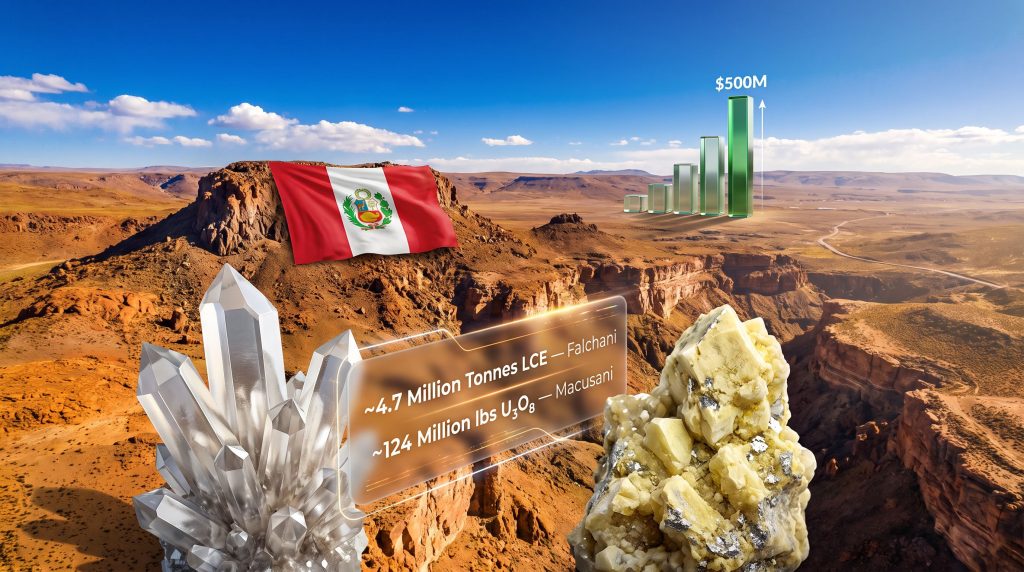
This structural differentiation is central to evaluating the Falchani lithium project, which sits within the Macusani Plateau system and has been estimated to host approximately 4.7 million tonnes of lithium carbonate equivalent (LCE).
Falchani and Macusani: The Scale of Peru's Critical Minerals Endowment
Falchani Lithium Project: Key Metrics
| Metric | Falchani (Peru) | Global Context |
|---|---|---|
| Estimated Lithium Carbonate Equivalent | ~4.7 million tonnes LCE | Top-tier hard-rock discovery globally |
| Projected Annual Export Value | ~US$500 million at production | Comparable to mid-tier copper export contributors |
| Planned Capital Investment | ~US$847 million | Includes on-site refinery infrastructure |
| Targeted Construction Start | 2027 | Subject to regulatory and financing milestones |
| Battery-Grade Production Timeline | Post-2028 | Aligned with accelerating EV demand cycle |
Macusani Uranium Project: Key Metrics
| Metric | Macusani (Peru) |
|---|---|
| Estimated Uranium Resource | ~124 million pounds U₃O₈ |
| Estimated Net Present Value | ~US$600 million |
| Regional Ranking | Largest undeveloped uranium project in Latin America |
| Prior Production History | None, greenfield development required |
If Falchani's resource estimates are eventually converted into bankable reserves through feasibility-stage drilling and economic modelling, Peru could enter the ranks of the world's top six or seven lithium holders. That would place it alongside Australia, Chile, Argentina, China, and the United States in a geopolitical category that carries significant weight in resource diplomacy and supply chain negotiations.
It is critical to distinguish between a resource estimate and proven reserves. Resource estimates reflect geological probability; reserves require demonstrated economic extractability under defined conditions. The 4.7 million tonne LCE figure for Falchani is a resource estimate and should not be treated as equivalent to a confirmed reserve for investment modelling purposes.
The Regulatory Decade: From Legal Void to Strategic Framework
Seven Years Without a Uranium Framework
Between 2018 and 2025, Peru effectively had no functional legal architecture to govern uranium extraction. This was not merely a bureaucratic inconvenience. The absence of uranium-specific legislation created a situation where concession holders could not progress toward any operational pathway, because doing so would have placed them outside the bounds of existing law. The regulatory gap compounded an already difficult operating environment, as concurrent litigation over mining concession titles created title uncertainty that discouraged institutional engagement.
For a deposit the scale of Macusani, title uncertainty is existential. No major mining financier or offtake partner will commit capital to a project where the fundamental question of who legally owns the extraction rights remains unresolved.
The 2025 Supreme Court Ruling: Resolving a Decade of Litigation
Peru's supreme court issued a ruling in late 2025 confirming title to 32 mining concessions associated with the Macusani project area. This decision did more than resolve a single legal dispute. It established a precedent for how Peru's judicial system would treat contested mining concessions in the critical minerals sector, and it cleared the prerequisite condition for institutional investment conversations to begin in earnest.
Legal title confirmation functions as the first gate in the project financing sequence. Without it, debt markets remain closed regardless of deposit quality. With it, the conversation can move to feasibility studies, environmental impact assessments, and offtake term sheets.
June 2026: The Supreme Decree That Opened the Uranium Era
On June 2, 2026, the Peruvian government issued a Supreme Decree formally classifying both lithium and uranium as minerals of national strategic importance. For lithium, this reinforced an existing policy direction. For uranium, it was genuinely transformative: the first time uranium had been formally embedded within Peru's national energy framework.
The practical commercial implications of this classification include:
- Uranium extraction can now be pursued within a defined legal context rather than a regulatory vacuum
- Permitting pathways for strategic mineral projects can be structured with greater predictability
- The classification signals to international investors and offtake partners that Peru treats these commodities with sovereign-level seriousness
- It opens the door to formal engagement with international bodies such as the International Atomic Energy Agency (IAEA) on safeguards and export frameworks
What the decree does not do is replace the detailed legislative instruments still required for uranium transport, processing, and export. Peru is building its uranium regulatory architecture from a zero base, and that construction will take time regardless of strategic intent.
The US$847 Million Investment Plan: Beyond Raw Material Export
What the Falchani Capital Plan Actually Funds
The US$847 million capital investment plan for Falchani is notable not just for its scale but for its strategic composition. A meaningful portion of that capital is allocated to on-site refinery infrastructure, which would allow Peru to produce battery-grade lithium carbonate or lithium hydroxide domestically rather than exporting unprocessed ore or concentrate.
This is a significant departure from Peru's historical resource extraction model, which has largely been characterised by exporting raw materials and capturing a limited share of the value chain. The copper sector offers the clearest cautionary parallel: Peru is the world's second-largest copper producer by volume, yet the country captures a fraction of the value generated by downstream copper products manufactured in Asia and Europe.
Battery-Grade Lithium: Why Product Specification Commands a Premium
Not all lithium is equal in the eyes of battery manufacturers. Furthermore, the specifications matter enormously:
- Battery-grade lithium carbonate must achieve purity levels above 99.5%, with strict limits on impurities including calcium, magnesium, sulphate, and chloride
- Battery-grade lithium hydroxide is increasingly preferred by manufacturers of nickel-rich NMC and NCA cathode materials used in high-performance EV batteries
- Lower-specification lithium compounds trade at significant discounts to battery-grade material, making product specification a direct driver of project economics
- The premium for battery-grade product has historically ranged from 15% to 40% above technical-grade alternatives, though this spread fluctuates with market conditions
Falchani's planned refinery is designed to target battery-grade output, positioning its product for Asian battery manufacturers, European EV supply chains, and North American buyers seeking to qualify materials under the sourcing requirements of the US Inflation Reduction Act. In addition, direct lithium extraction technologies may offer further processing advantages as the sector matures.
Development Timeline
| Phase | Milestone | Target Date |
|---|---|---|
| Regulatory Classification | Supreme Decree issued | June 2026 |
| Project Financing | Debt and equity raise for US$847M capex | 2026 to 2027 |
| Construction Commencement | Site mobilisation | 2027 |
| First Production | Battery-grade lithium output | Post-2028 |
| Full Ramp-Up | Nameplate capacity achieved | 2029 to 2030 (estimated) |
The Resource Curse Trap: Can Peru Escape Its Own History?
Peru's relationship with mineral extraction is long and complicated. The country has been a significant copper and gold producer for generations, yet communities in major mining regions have persistently experienced limited economic development relative to the resource wealth extracted from their land. This pattern, widely described in development economics as the resource curse, reflects a structural failure to convert raw material revenues into lasting domestic prosperity.
The planned Falchani refinery represents a conscious policy signal that the government and project developers are aware of this historical pattern and intend to pursue a different model. Whether that intention translates into execution depends on factors that go beyond investment decisions alone.
The Puno Region: Social Licence as a Critical Variable
The Macusani Plateau sits within the Puno region, home to significant indigenous Aymara and Quechua communities with deep historical connections to the land. Large-scale mining projects in this region have previously encountered sustained community opposition, environmental disputes, and protests that have materially delayed or halted development timelines.
Key social licence considerations for the Falchani and Macusani projects include:
- Free, Prior, and Informed Consent (FPIC) obligations under ILO Convention 169, to which Peru is a signatory
- Water resource management concerns in a high-altitude plateau ecosystem where communities depend on the same hydrological systems that mining operations would affect
- Historical distrust of Lima-based institutional promises in Puno, where previous resource development commitments have not consistently delivered community-level benefits
- ESG-aligned institutional investors increasingly treating social licence failures as disqualifying due diligence concerns
No Supreme Decree issued from Lima automatically translates into community acceptance on the Macusani Plateau. Investors treating the June 2026 regulatory milestone as a complete de-risking event should examine the social licence dimension with equal rigour.
However, Peru's broader ambitions across both commodity classes signal a government increasingly committed to navigating these complexities rather than avoiding them.
The next major ASX story will hit our subscribers first
Peru's Uranium Opportunity Within the Global Nuclear Renaissance
Uranium demand forecasting has shifted dramatically since 2022. The combination of European energy security concerns following geopolitical disruptions, a reassessment of nuclear power's role in decarbonisation strategies, and an aggressive reactor construction pipeline across Asia has fundamentally altered the supply-demand calculus for uranium.
The World Nuclear Association has projected that uranium demand could increase by more than 40% by 2040 relative to 2023 levels, driven primarily by new reactor construction in China, India, South Korea, and the Middle East. Consequently, the uranium market dynamics globally remain constrained by years of underinvestment following the post-Fukushima price collapse of the 2010s. Understanding uranium market dynamics is therefore essential context for evaluating Peru's position.
Macusani in Global Context
| Project | Country | Estimated Resource | Development Status |
|---|---|---|---|
| Macusani | Peru | ~124 million lbs U₃O₈ | Pre-development, regulatory cleared 2026 |
| Athabasca Basin projects | Canada | Varies by deposit | Active production |
| Kazakh ISR operations | Kazakhstan | World's largest producer | Operational |
| Namibian operations | Namibia | Major producer | Operational |
At approximately 124 million pounds of U₃O₈, Macusani represents a genuinely significant undeveloped resource at a moment when the global uranium supply industry is actively searching for new production sources. Furthermore, uranium supply challenges at the macro level make Peru's greenfield potential all the more strategically relevant. Peru has no operational uranium production history, which means the country must simultaneously develop the technical workforce, regulatory oversight capacity, and IAEA safeguards compliance framework required to bring Macusani to market.
Peru vs. the Lithium Triangle: A Structural Comparison
| Dimension | Chile | Argentina | Peru |
|---|---|---|---|
| Primary Deposit Type | Brine (Atacama salar) | Brine (multiple salars) | Hard-rock (volcanic-hosted) |
| Production Status | Active, established producer | Expanding production base | Pre-production |
| Lithium Policy Maturity | Established via CORFO framework | Evolving, provincial variation | Nascent, 2026 Supreme Decree |
| Uranium Endowment | Minimal | Limited | Significant (Macusani) |
| Downstream Processing | Limited | Developing | Planned at Falchani |
Peru's structural disadvantages relative to Chile and Argentina are real: zero prior lithium or uranium production, a uranium legal framework that needs to be built from scratch, and more acute social licence challenges in Puno compared to the sparsely inhabited Atacama or Argentine Puna. However, its structural advantages deserve equal weight. The hard-rock deposit configuration produces a chemically distinct product, the dual-commodity asset base is unique in the region, and the earlier-stage regulatory environment offers asymmetric entry conditions for investors willing to accept development-stage risk.
For instance, detailed analysis of Peru's lithium export framework highlights how the country's trade positioning differs meaningfully from its brine-producing neighbours.
Three Scenarios for Peru's Critical Minerals Decade
Scenario 1: Accelerated Development (Optimistic)
Both Falchani and Macusani reach construction by 2027 to 2028. Peru captures approximately US$500 million annually in lithium export revenues by the early 2030s. The on-site refinery generates downstream employment and positions Peru as a battery-material exporter rather than ore shipper. Peru enters the global top-ten lithium holder rankings.
Scenario 2: Delayed Development (Moderate)
Community engagement challenges or financing gaps push construction commencement to 2029. The uranium legislative framework takes three to four years to fully operationalise. Peru participates in the lithium boom but at reduced scale and later timing, with export revenues materialising without the domestic value-add component initially envisaged.
Scenario 3: Structural Stall (Downside)
Sustained community conflict or environmental litigation halts permitting. A global lithium price correction reduces Falchani's project economics below investment-grade thresholds. The uranium regulatory framework remains incomplete, delaying Macusani indefinitely. Peru cedes first-mover advantage to established Latin American producers.
The 2027 to 2030 window is the decisive interval. Projects that achieve construction commencement within this period will benefit from alignment with peak EV supply chain demand growth. Those that slip beyond it face a more uncertain market environment as additional lithium supply comes online globally.
Frequently Asked Questions: Peru Lithium and Uranium Boom
What is the Falchani lithium project?
Falchani is a hard-rock lithium project located on the Macusani Plateau in Peru's Puno region, with an estimated resource of approximately 4.7 million tonnes of lithium carbonate equivalent. It is considered one of the largest hard-rock lithium discoveries globally and is being developed with a planned capital investment of approximately US$847 million, including on-site refinery infrastructure targeting battery-grade lithium production.
What is the Macusani uranium project?
Macusani is the largest undeveloped uranium project in Latin America, with an estimated resource of approximately 124 million pounds of U₃O₈ and an estimated net present value of around US$600 million. It has no prior production history and requires full greenfield development alongside the construction of Peru's uranium regulatory framework.
Why did Peru issue a Supreme Decree for lithium and uranium in 2026?
The June 2, 2026 Supreme Decree formalised the classification of both lithium and uranium as minerals of national strategic importance. For uranium specifically, it was the first time the mineral had been incorporated into Peru's national energy framework, closing a regulatory gap that had persisted since 2018 and creating the legal foundation needed for commercial development to proceed.
How much could Peru's lithium exports be worth?
At full production, Falchani is projected to generate approximately US$500 million per year in lithium export revenues. This projection is contingent on achieving production timelines, battery-grade product specifications, and lithium market pricing at or above current levels.
What are the main risks to Peru's critical minerals development?
The principal risk categories facing the Peru lithium and uranium boom are:
- Community opposition and social licence challenges in the Puno region
- Incomplete uranium legislative framework requiring construction from a zero base
- Project financing requirements for a US$847 million capital programme
- Global lithium price volatility affecting project economics
- Conversion of resource estimates into bankable reserves through additional drilling and feasibility work
This article is informational in nature and does not constitute financial, investment, or legal advice. All projections, resource estimates, and timeline references involve inherent uncertainty and should not be relied upon as guarantees of future outcomes. Readers should conduct independent due diligence before making any investment decisions.
Want to Stay Ahead of the Next Major Critical Minerals Discovery?
Discovery Alert's proprietary Discovery IQ model delivers real-time alerts on significant ASX mineral discoveries across lithium, uranium, and 30+ other commodities, instantly translating complex geological data into actionable investment insights — explore historic discoveries and their returns to understand the potential, then begin your 14-day free trial at Discovery Alert to position yourself ahead of the broader market.