August 6, 2026
When Capital Moves Faster Than Governance: The Risk Architecture of Africa's Lithium Rush
Resource booms have a tendency to compress timelines in ways that stress-test institutional capacity. When billions of dollars flow into a sector faster than regulatory frameworks can mature, the result is not simply administrative lag — it creates structural voids that opportunistic actors can exploit. Africa's lithium sector in the early 2020s followed this exact trajectory, with Chinese capital flooding into Zimbabwe's spodumene fields at a pace that outstripped local oversight infrastructure by a considerable margin.
The San Ding Lithium shutdown in Zimbabwe is the latest chapter in this story. However, framing it purely as a corporate fraud case misses the deeper architecture of risk that the incident exposes. Understanding why this happened, and why it took so long to surface, requires examining the geology, the capital flows, the governance gaps, and the power dynamics that define Chinese investment in African extractive industries today.
When big ASX news breaks, our subscribers know first
Zimbabwe's Lithium Position: Why the Stakes Are Exceptionally High
Zimbabwe's geological endowment in lithium is not marginal. The country sits atop some of the world's most significant hard-rock lithium deposits, concentrated largely in the Masvingo and Midlands provinces, where pegmatite-hosted spodumene mineralisation reaches grades that are commercially compelling by global standards.
Spodumene, the primary lithium-bearing mineral in Zimbabwe's deposits, typically carries lithium oxide (Li₂O) content ranging from 1.2% to 1.8% in the concentrate form that Zimbabwe has been exporting. This places Zimbabwean material in a competitive bracket with Australian spodumene from the Pilbara region, which dominates the current global supply chain. Understanding how lithium mining works in this context is essential, as the critical difference lies in cost structure: Zimbabwe's lower labour costs and relatively shallow ore bodies at several active mines have historically offered attractive extraction economics for operators willing to manage the country's political risk premium.
Against this backdrop, the scale of Chinese commitment becomes more legible:
- Zimbabwe exported approximately 1.13 million tonnes of lithium-bearing spodumene concentrate to China in 2025 alone
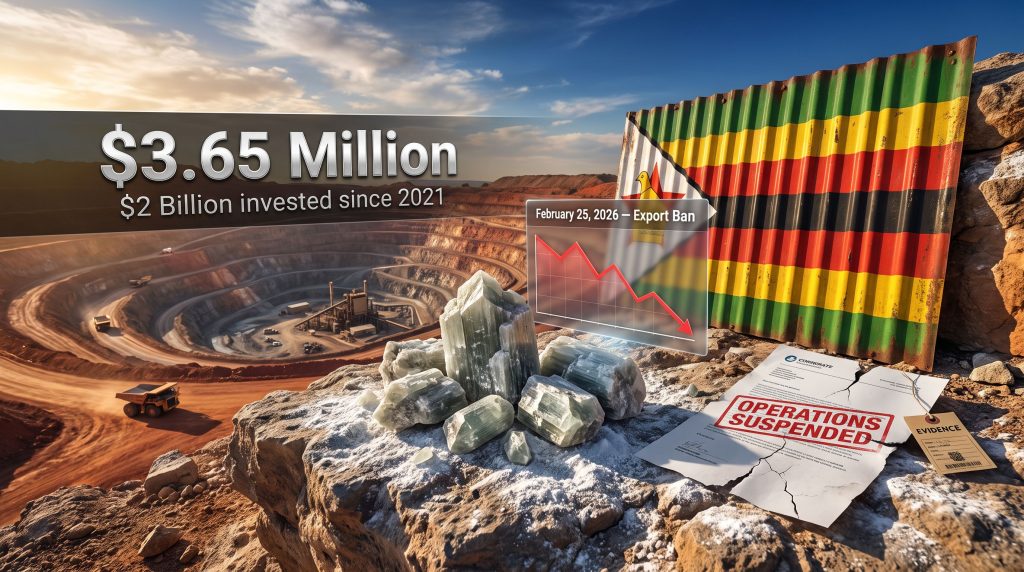
- Chinese companies have deployed more than $2 billion into Zimbabwe's lithium sector since 2021
- Active major investors include Zhejiang Huayou Cobalt, Sinomine Resource Group, Chengxin Lithium Group, Yahua Group, and Tsingshan Holding Group
- Zimbabwe holds the continent's largest lithium reserves, positioning it as Africa's dominant supplier to the global battery supply chain
This volume of capital deployment creates its own governance problem. When investment moves at this velocity into a jurisdiction with limited corporate regulatory infrastructure, the conditions for financial misconduct become structurally embedded rather than incidental.
The San Ding Lithium Shutdown: What the Evidence Suggests
The mechanics of the alleged San Ding Lithium fraud follow a pattern that forensic accountants and mining sector investigators will recognise immediately: concentrated authority, fabricated documentation, and a delayed detection window exploited through obstruction.
Li Shigang, a 58-year-old Chinese national, joined San Ding Lithium in 2022 as both Chief Finance Officer and Commercial Manager. His initial capital contribution of $630,000, recorded on October 12, 2022, established his position within the company before he gained administrative control over its financial systems. The dual role he occupied is where the governance failure begins.
Combining financial oversight with commercial authority in a single executive eliminated the most basic internal control mechanism: segregation of duties. In a properly structured entity, the person approving payments should not simultaneously control invoice generation or commercial settlements. At San Ding, prosecutors allege that Li held authority across all of these functions simultaneously.
The alleged scheme, as outlined by prosecutors, operated through the fabrication of receipts and invoices to disguise fund diversions:
| Alleged Misconduct | Detail |
|---|---|
| Total funds diverted | ~$3.65 million via false receipts and invoices |
| Accused's initial investment | $630,000 (October 12, 2022) |
| Date of resignation | January 2024 |
| Missing documentation | Financial records, accounting books, reconciliation reports |
| Asset misappropriation | Two Toyota Hilux double-cab vehicles sold; proceeds retained |
| Funds recovered | Zero |
Li appeared before Harare Magistrate Jesse Kufa on July 13, 2026, two days after his arrest on July 11. He faces a primary charge of theft of trust property under Zimbabwe's Criminal Law Code, with an alternative charge under the Money Laundering and Proceeds of Crime Act. A second individual, Zhu Guozhonga, is named as an alleged accomplice.
Legal Disclaimer: Li Shigang has not entered a plea and remains in custody pending a bail determination. All allegations are untested before a court. He is presumed innocent until proven guilty.
The Two-Year Detection Gap: A Governance Failure With Structural Roots
One of the most analytically significant aspects of the San Ding Lithium shutdown is not the alleged fraud itself, but the extended period between the accused parties' departure and the eventual prosecution.
Li and Zhu allegedly resigned from San Ding Lithium in January 2024 without completing any formal handover. They allegedly failed to surrender financial records, accounting books, or reconciliation documentation. Company director Chen Dehua and employee Chen Xingmei reportedly intercepted Li while he was allegedly attempting to remove company financial records from the premises, yet the obstruction continued for nearly two years before legal proceedings were initiated.
This gap reflects a challenge that is endemic to cross-border corporate disputes in African mining jurisdictions:
- Foreign national mobility reduces enforcement leverage once individuals exit the country or signal intent to do so
- Document-based fraud is exceptionally difficult to prosecute without the original records, creating a deliberate obstruction incentive for accused parties
- Internal recovery attempts through negotiation or informal pressure are common but often delay formal prosecution, extending the window during which concealment compounds
- Jurisdictional complexity in joint venture structures with Chinese parent entities creates ambiguity about which legal frameworks govern financial misconduct
The inability to recover financial records for over two years before prosecution highlights a recurring structural gap in how foreign-controlled corporate entities in the extractive sector are monitored at the operational level.
Spodumene, Concentrate Quality, and Why Processing Matters So Much
To understand why Zimbabwe's government has responded to cases like the San Ding shutdown with increasingly assertive policy interventions, it is necessary to understand the economics of lithium in its various processed forms. Furthermore, spodumene extraction methods directly influence how much value is retained at each stage of production.
Raw spodumene concentrate, typically graded at 5% to 6% Li₂O, is the lowest value-add form of lithium that enters the supply chain. Chemical-grade lithium carbonate (Li₂CO₃) and battery-grade lithium hydroxide (LiOH·H₂O), which are derived from further processing, command substantially higher market prices and generate more industrial employment per tonne of ore extracted.
Zimbabwe has historically exported concentrate rather than processed product, meaning the value-add processing margin has been captured almost entirely by Chinese refineries, predominantly in Sichuan and Jiangxi provinces. The Zimbabwean economy has received royalties and corporate taxes on raw material exports, but has not captured the industrial transformation premium.
This economic reality is directly behind Zimbabwe's decision to impose a nationwide ban on raw lithium concentrate exports from February 25, 2026. The policy framework targets all operators equally, including the largest Chinese-backed entities, and requires companies to demonstrate domestic processing capacity as a prerequisite for resuming export privileges. It is a resource nationalism measure rooted in economic logic, not simply political posturing.
When a company like San Ding Lithium allegedly has $3.65 million stripped from its operational funds through internal fraud before any lithium even reaches the processing stage, it illustrates precisely the kind of value leakage Zimbabwe's broader minerals policy is designed to address, even if the export ban itself targets a different mechanism. In addition, direct lithium extraction technologies are increasingly being cited as part of the solution to improve domestic processing efficiency.
Mapping the Pattern: San Ding Is Not an Isolated Data Point
The San Ding Lithium shutdown sits within a broader sequence of governance incidents involving Chinese-backed mining operations in Zimbabwe. Consequently, Zimbabwe scrutinising Chinese lithium mining has attracted significant international attention as these incidents accumulate.
| Incident | Company | Year | Nature of Issue |
|---|---|---|---|
| Operational disruption | Bikita Minerals (Sinomine) | May 2023 | Labour malpractice, illegal immigration, and smuggling allegations |
| Nationwide export suspension | All lithium operators | February 2026 | Government-mandated ban on raw mineral exports to force local processing |
| Financial fraud prosecution | San Ding Lithium | July 2026 | Alleged $3.65M diversion, missing records, asset misappropriation |
This pattern is not unique to Zimbabwe. Similar dynamics involving financial misconduct and governance friction in foreign-controlled mining entities have been documented across Ghana, the Democratic Republic of Congo, and Zambia. The common structural feature across all these cases is rapid foreign capital deployment into resource-rich environments where regulatory oversight capacity has not developed at a comparable pace.
What distinguishes Zimbabwe's situation is the sheer concentration of Chinese investment in a single commodity. When more than $2 billion flows into one mineral sector from a relatively homogeneous group of investors operating with broadly similar corporate structures, governance vulnerabilities compound rather than diversify.
The next major ASX story will hit our subscribers first
The Regulatory Reform Imperative: What Zimbabwe's Framework Is Missing
The San Ding case has illuminated specific gaps in Zimbabwe's regulatory architecture for foreign-controlled mining entities. Policy analysts and governance observers have identified several priority areas:
- Mandatory dual-signatory controls for all financial transactions above a defined threshold within foreign-backed or joint venture mining operations
- Independent third-party auditing requirements specifically designed for Chinese joint venture structures, where internal corporate oversight may be exercised through parent entities without local visibility
- Formal government-witnessed handover protocols when licensed mining entity executives resign or transfer, preventing the document obstruction scenario alleged in the San Ding case
- Escrow or bonding mechanisms to secure operational funds against potential diversion, particularly in the early operational phase when financial systems are being established
- Enhanced beneficial ownership disclosure requirements for all entities receiving mining licences, ensuring accountability chains are traceable regardless of corporate structure
Policy Gap: Zimbabwe currently lacks a mandatory, independently verified financial reporting framework specifically designed for foreign-controlled joint venture mining entities. The San Ding Lithium shutdown has placed this gap under significant scrutiny.
Sinomine Resource Group, which operates the Bikita Minerals mine and represents one of the largest single Chinese investments in Zimbabwe's lithium sector, is reported to be in ongoing negotiations with the Zimbabwean government regarding the conditions for resuming concentrate exports under the new policy framework. How these negotiations resolve will be closely watched as a signal of how Zimbabwe balances continued Chinese investment attraction against the enforcement of domestic value-add requirements.
What the San Ding Shutdown Reveals About Chinese Investment Risk in Africa
For investors and analysts tracking the critical minerals supply chain, the San Ding Lithium shutdown offers three distinct risk categories that deserve separate analytical treatment:
1. Governance Risk
Centralising financial and commercial authority within a single foreign-national executive, without independent local oversight, creates a structural single point of failure. This is not unique to San Ding but reflects a broader pattern in how Chinese-backed mining ventures are structured in African jurisdictions where local governance capacity is limited.
2. Documentation and Audit Risk
The alleged use of forged invoices and fabricated receipts points to the absence of real-time independent financial auditing. In jurisdictions with strong audit frameworks, this kind of manipulation is typically detected within a single reporting cycle. The fact that it allegedly persisted long enough to cause $3.65 million in losses before detection suggests audit controls were either absent or non-functional.
3. Jurisdictional Enforcement Risk
When key accused individuals are foreign nationals who have resigned and potentially have the ability to exit the jurisdiction, the host nation's enforcement capacity is structurally constrained. Zimbabwe's prosecutors face this challenge directly in the San Ding case, where recovering financial records, let alone funds, has proven exceptionally difficult.
Frequently Asked Questions: San Ding Lithium Shutdown in Zimbabwe
What is San Ding Lithium and what does it produce?
San Ding Lithium Private Limited is a Zimbabwean-registered lithium mining and processing company backed predominantly by Chinese investment. It extracts and processes lithium ore into concentrate form for use in electric vehicle batteries and consumer electronics.
Why did the San Ding Lithium shutdown occur?
Prosecutors allege that a former Chief Finance Officer and an accomplice diverted approximately $3.65 million in operational funds through fabricated invoices and receipts. The resulting financial losses allegedly rendered continued operations impossible.
Is the San Ding case connected to Zimbabwe's export ban?
These are separate but related developments. The nationwide ban on raw lithium concentrate exports from February 25, 2026 applies across all operators and reflects Zimbabwe's domestic processing policy agenda. The San Ding prosecution is a distinct criminal matter involving alleged internal financial fraud at a single company. However, analysis of Zimbabwe's lithium export restrictions and their broader economic impact suggests these pressures are reshaping how all operators manage their obligations.
What charges does Li Shigang face?
Li faces a primary charge of theft of trust property under Zimbabwe's Criminal Law Code and an alternative charge under the Money Laundering and Proceeds of Crime Act. He has not entered a plea and is presumed innocent until proven guilty.
How much has China invested in Zimbabwe's lithium sector?
Chinese companies have invested more than $2 billion in Zimbabwe's lithium sector since 2021. Major investors include Zhejiang Huayou Cobalt, Sinomine Resource Group, Chengxin Lithium Group, Yahua Group, and Tsingshan Holding Group.
What does spodumene concentrate mean, and why does Zimbabwe want to process it locally?
Spodumene concentrate is a partially refined lithium-bearing mineral product, typically graded at 5% to 6% Li₂O, that forms the feedstock for downstream lithium chemical production. Zimbabwe's export ban is designed to compel companies to perform higher-value processing domestically rather than shipping raw concentrate to Chinese refineries, retaining more of the economic value within the country.
Key Takeaways: Governance Maturity as the Missing Variable in Africa's Critical Minerals Story
The San Ding Lithium shutdown is analytically significant well beyond its headline figures. It functions as a live case study in the gap between investment volume and governance maturity that characterises much of Africa's current role in the global battery supply chain.
- The $3.65 million allegedly diverted is modest relative to the sector's multi-billion dollar scale, but the structural conditions that enabled it are not
- Zimbabwe's dual challenge of attracting Chinese capital while enforcing accountability and capturing domestic industrial value will define the country's lithium sector through the remainder of this decade
- The February 2026 export ban and the San Ding prosecution are not isolated events but reinforcing signals of a host nation asserting greater control over its resource endowment
- For investors monitoring African critical mineral exposure, governance risk is no longer a background variable but a front-line consideration that can directly impair operational continuity
The global lithium market has already registered price sensitivity in response to Zimbabwe's export restrictions, reflecting the country's weight as Africa's largest lithium producer. Furthermore, the broader landscape of critical minerals trade is being reshaped as host nations across the continent assert more control over their extractive industries. How Zimbabwe resolves the tension between sustaining Chinese investment flows and enforcing the institutional standards that protect its own interests will carry implications for African resource governance far beyond its borders.
This article is intended for informational purposes only and does not constitute financial, legal, or investment advice. All allegations referenced are subject to the legal process and presumption of innocence. Readers should conduct independent research before making investment or business decisions related to the mining sector or Zimbabwe's lithium industry.
Want to Track the Next Major ASX Mineral Discovery Before the Market Moves?
Discovery Alert's proprietary Discovery IQ model scans ASX announcements in real time, instantly converting complex mineral data across more than 30 commodities into clear, actionable insights — giving both short-term traders and long-term investors a critical market edge. Explore how historic mineral discoveries have generated substantial returns on Discovery Alert's dedicated discoveries page, and begin your 14-day free trial today to position yourself ahead of the broader market.