July 15, 2026
When Capital Meets Impunity: The Governance Crisis Threatening Africa's Lithium Future
Across the global battery supply chain, lithium has become the mineral that separates industrial ambition from geopolitical reality. The scramble to secure reliable, long-term supply of battery-grade lithium has redirected billions of dollars toward a handful of countries whose geological endowments position them as indispensable to the energy transition. Zimbabwe sits near the top of that list. Yet the country's trajectory from raw mineral exporter to value-adding processing hub now faces a threat that has nothing to do with geology and everything to do with governance.
The collapse of San Ding Lithium Private Limited is not simply a criminal case. It is a diagnostic event, one that exposes the fault lines running beneath Zimbabwe's lithium sector and raises urgent questions about whether the institutional architecture governing foreign-owned extractive ventures is remotely equipped for the scale of capital now flowing through it.
When big ASX news breaks, our subscribers know first
Zimbabwe's Lithium Endowment: Scale, Geology, and Strategic Significance
Zimbabwe holds the largest lithium reserves on the African continent, with deposits concentrated primarily in the Arcaean-age pegmatite belts of Mashonaland West and Midlands provinces. Pegmatite-hosted spodumene, the dominant lithium-bearing mineral in Zimbabwe's deposits, is geologically significant because it can yield battery-grade lithium carbonate equivalent (LCE) at competitive extraction costs relative to brine-hosted deposits in South America's Lithium Triangle.
Spodumene extraction grading between 5% and 6% Li₂O is the benchmark product from hard-rock lithium operations, and Zimbabwe's major deposits have demonstrated the capacity to consistently achieve this threshold. What makes Zimbabwe's geology particularly compelling to Chinese processors is the relative proximity of its spodumene to established maritime export routes, combined with a mineralogy that lends itself to downstream conversion into lithium hydroxide monohydrate, the preferred cathode precursor for high-nickel NMC and NCA battery chemistries used in premium electric vehicles.
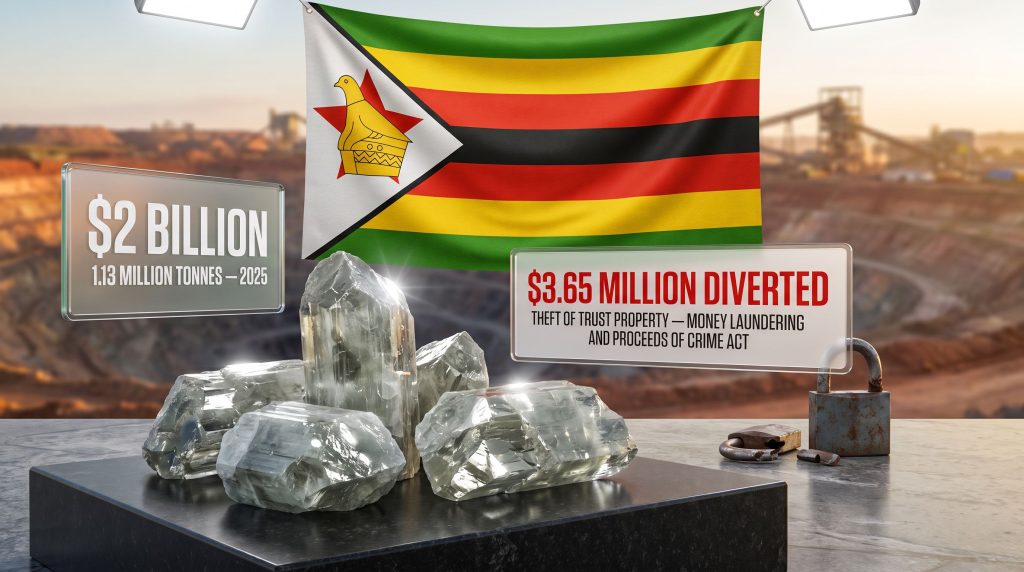
Against this backdrop, Chinese companies deployed more than $2 billion into Zimbabwe's lithium sector between 2021 and 2025, making it one of the most capital-intensive foreign investment corridors in sub-Saharan Africa. In 2025 alone, Zimbabwe exported approximately 1.13 million tonnes of lithium-bearing spodumene concentrate, with China as the overwhelmingly dominant destination.
The major Chinese entities operating in the sector include:
| Investor | Sector Focus |
|---|---|
| Zhejiang Huayou Cobalt | Lithium processing and battery materials |
| Sinomine Resource Group | Hard rock lithium mining (Bikita Minerals) |
| Chengxin Lithium Group | Lithium chemical production |
| Yahua Group | Lithium hydroxide processing |
| Tsingshan Holding Group | Integrated minerals and metals |
A Sector Already Under Regulatory Fire Before the Fraud Emerged
Understanding the San Ding Lithium shutdown requires situating it within a sector that was already under significant regulatory pressure before any criminal charges were filed. In February 2026, Zimbabwe's government enacted an immediate and indefinite ban on all raw mineral and lithium concentrate exports, accelerating a domestic processing mandate that had originally been set for 2027.
The policy decision was driven by documented evidence of widespread mineral smuggling, systemic underreporting of export volumes, and chronic failures across multiple operations to comply with royalty and revenue-sharing obligations. The government's core objective was straightforward: retain industrial value domestically by requiring lithium ore to be processed into higher-value products before it crosses the border.
Critical Context: Zimbabwe's export ban is not a response to any single company's misconduct. It reflects a pattern of value leakage that regulators had been documenting for years across multiple operators, creating a sector-wide accountability reckoning that the San Ding case now amplifies.
This context matters because the Zimbabwe lithium company shut down after $3.65 million diversion allegations emerged is not an isolated anomaly. It is, furthermore, the most visible manifestation of governance failures that run deeper and wider than a single fraudulent executive.
The Mechanics of the Alleged Fraud at San Ding Lithium
San Ding Lithium Private Limited is a Zimbabwe-registered entity that extracts and processes lithium ore for use in electric vehicle batteries and consumer electronics, backed predominantly by Chinese capital. The company's operational collapse traces directly to a set of internal control failures that, in retrospect, were structurally predictable.
Li Shigang, a 58-year-old Chinese national, joined the company in 2022 holding a dual appointment as chief finance officer and commercial manager. Prosecutors allege that this combined role granted him sweeping authority over virtually every critical financial function within the business, including the collection and disbursement of funds, commercial settlements, payment approvals, and financial supervision. Crucially, this structure meant that no independent counterparty within the organisation was positioned to detect or challenge financial irregularities in real time.
Before gaining full access to the company's financial systems, Li invested $630,000 in San Ding Lithium on October 12, 2022. From a fraud typology perspective, this kind of initial personal investment is a recognised pattern in cases involving long-horizon financial misconduct, where early capital commitment serves to build institutional trust and accelerate the granting of operational authority.
The alleged fraud unfolded as follows:
| Alleged Action | Detail |
|---|---|
| Funds diverted | Approximately $3.65 million intended for company operations |
| Method | Fabricated receipts and forged invoices used to mask transactions |
| Co-accused | Zhu Guozhonga |
| Asset misappropriation | Two Toyota Hilux double-cab vehicles sold, proceeds retained |
| Financial records | Books, reconciliation reports, and accounting documentation unrecovered |
| Funds recovered | None as of July 2026 |
Both Li and Zhu allegedly resigned in January 2024 without completing any formal financial handover. Company director Chen Dehua is reported to have physically intercepted Li in the act of removing financial documentation from company premises. Over the following two years, repeated attempts to recover the records and trace the missing capital were met with sustained non-cooperation from the accused.
Li Shigang appeared before Harare magistrate Jesse Kufa on July 13, 2026, following his arrest on July 11. He faces a primary charge of theft of trust property under Zimbabwe's Criminal Law Code and an alternative charge under the Money Laundering and Proceeds of Crime Act. He had not entered a plea as of the time of reporting, remains in custody pending bail determination, and is presumed innocent until proven guilty.
Why $3.65 Million Was Enough to Shut Down an Entire Operation
The scale of the alleged diversion relative to the company's size reveals an important and often underappreciated vulnerability in mid-tier mining ventures operating in emerging markets. Unlike large conglomerates with diversified capital reserves and multi-year liquidity buffers, smaller lithium processors in Zimbabwe typically operate on lean working capital cycles that leave them acutely exposed to large-scale internal fund diversion.
In hard-rock lithium processing, working capital requirements are substantial. Crushing, dense media separation, flotation, and drying circuits require continuous consumable inputs, energy procurement contracts, and skilled labour payroll cycles that cannot be deferred without triggering immediate operational degradation. When the financial pipeline sustaining these cycles is severed, the path from operational distress to complete shutdown can be measured in weeks rather than months.
Industry Insight: In spodumene processing, the conversion from run-of-mine ore to a saleable 6% Li₂O concentrate requires continuous circuit operation. Unlike some commodities where production can be throttled incrementally, hard-rock lithium processing plants are typically designed for sustained throughput, making abrupt operational halts disproportionately damaging to both equipment and commercial relationships.
This operational fragility is precisely why the alleged diversion of $3.65 million was sufficient to bring San Ding Lithium's entire operation to a halt, illustrating that the financial resilience of smaller lithium processors is far thinner than the headline investment figures flowing into Zimbabwe's sector might suggest.
Structural Governance Weaknesses Exposed by the Case
The San Ding Lithium collapse functions as an audit of Zimbabwe's corporate governance framework for foreign-owned extractive entities, and the results are concerning on multiple dimensions.
Key structural vulnerabilities identified:
-
Absence of mandatory separation of duties: Zimbabwe currently lacks enforceable minimum governance standards specifically applicable to foreign-owned mining entities above defined capital thresholds. A single executive controlling both CFO functions and commercial management creates an internal control void that standard governance frameworks are specifically designed to prevent.
-
Physical record management: The alleged physical removal of financial documentation from company premises would be largely irrelevant in jurisdictions that mandate real-time digital record-keeping with government-accessible audit trails. Zimbabwe's current framework does not appear to impose such requirements on mining operators.
-
Dual-nationality enforcement complexity: Prosecuting foreign nationals for financial crimes introduces cross-border asset recovery challenges that bilateral legal frameworks between Zimbabwe and China are not currently structured to resolve efficiently.
-
Absence of independent audit mandates: The case raises substantive questions about whether San Ding Lithium was subject to independent external auditing, a standard requirement in most developed mining jurisdictions that would typically surface significant fund irregularities long before they reached the scale alleged here.
What Red Flags Preceded the Collapse?
- Single executive holding dual financial oversight and commercial management authority
- Personal investment by CFO used to establish trust and accelerate system access
- No independent audit trail for large-scale fund disbursements
- Physical rather than digital financial record management
- Absence of enforceable handover protocols upon executive resignation
- No real-time financial reporting obligations to external regulatory bodies
Investors should consequently be aware that these management red flags are not unique to San Ding Lithium and may exist within other mid-tier operations across the sector.
The next major ASX story will hit our subscribers first
The Bigger Picture: Chinese Investment and Governance Sovereignty
Zimbabwe faces a structural paradox that the San Ding case has thrust into sharp relief. Chinese entities represent the dominant and, for now, largely irreplaceable source of foreign direct investment in the country's lithium sector. No alternative investor bloc is currently deploying capital in Zimbabwe's lithium industry at comparable scale or speed.
This creates an asymmetric negotiating dynamic. Aggressive enforcement of governance standards risks signalling investment hostility to the capital partners Zimbabwe depends on, while inadequate oversight enables precisely the value leakage the government is trying to eliminate through its export beneficiation policy. The February 2026 export ban was partly an attempt to navigate this tension by asserting sovereign control over mineral value chains without directly confronting the bilateral investment relationship.
The San Ding case differs from earlier governance incidents in Zimbabwe's lithium sector. Zimbabwe mining development challenges have been well documented, and Bikita Minerals, the major operation owned by Sinomine Resource Group, faced temporary suspension in 2023 following separate allegations involving smuggling and asset management failures. That case centred on export-related regulatory violations. The San Ding situation, however, involves alleged internal executive fraud, a distinct category of risk that points to a different layer of institutional vulnerability.
Analytical Note: The governance failures exposed by both cases are systemic rather than company-specific. The same internal control gaps that allegedly enabled the San Ding fraud could exist within larger operations that simply have not yet experienced a triggering event.
Policy Reforms That Could Prevent the Next Shutdown
The San Ding case provides a concrete basis for targeted regulatory reform. The following measures address the specific control gaps the case has exposed:
-
Mandatory separation of duties for CFO and commercial management roles in all foreign-owned mining entities above a defined capital threshold.
-
Real-time financial reporting obligations to Zimbabwe's Minerals Marketing Corporation (MMCZ) for all licensed operators, replacing periodic manual submissions with digitally integrated reporting systems.
-
Escrow-based operational fund structures that prevent single-point executive access to large capital pools, requiring dual authorisation for disbursements above defined thresholds.
-
Digital financial record requirements with government-accessible audit trails, eliminating the possibility of physical document removal as a mechanism for concealing fraud.
-
Bilateral asset recovery agreements with major investor nations, providing enforceable legal pathways for cross-border fund tracing in mineral sector fraud cases.
What This Means for Africa's Broader Critical Minerals Governance Landscape
Zimbabwe's experience is not unique. Across Africa, the pace of critical minerals trade in lithium, cobalt, graphite, and manganese has consistently outrun the development of governance frameworks capable of protecting national interests and ensuring that mineral wealth translates into sustained domestic economic benefit.
The Democratic Republic of Congo's cobalt sector and Zambia's copper industry have both demonstrated how rapid foreign capital inflows can expose pre-existing institutional weaknesses, creating conditions where value extraction outpaces value retention at the national level.
For investors and institutions operating in African extractive sectors, the San Ding case reinforces a fundamental due diligence principle: governance architecture is not a secondary consideration. It is a primary risk variable that sits alongside geological and financial metrics in determining whether an investment will generate the returns projected.
The use of forged documentation to conceal fund flows is a well-documented fraud typology in emerging market resource ventures. It is also one that competent financial controls, if properly implemented, are designed to detect early. The absence of those controls at San Ding Lithium did not happen by accident; it happened within a regulatory environment that had not yet made them mandatory.
From Mineral Wealth to Realised Value: The Governance Gap Zimbabwe Must Close
Zimbabwe possesses the geological foundations to become a globally significant supplier of battery-grade lithium materials. The country's spodumene deposits are large, accessible, and mineralogically suited to producing the lithium hydroxide that battery manufacturers increasingly require for next-generation cathode chemistries. The investment interest is real, the demand trajectory is clear, and the strategic positioning is compelling within the broader global lithium market.
However, converting geological endowment into sustained economic development requires something that cannot be extracted from a pegmatite belt: institutional integrity. The Zimbabwe lithium company shut down after $3.65 million diversion is a signal that the governance infrastructure underpinning Zimbabwe's mineral sector has not kept pace with the investment volumes flowing through it.
Closing that gap requires action across three dimensions:
-
Institutional capacity building within the Zimbabwe Revenue Authority and MMCZ to conduct real-time financial surveillance of licensed mining entities.
-
Legislative reform to introduce mandatory corporate governance standards for foreign-owned extractive operators, including minimum audit independence and digital record-keeping requirements.
-
Diplomatic engagement with major investor nations to establish enforceable bilateral frameworks for cross-border asset recovery in mineral sector fraud cases.
The Zimbabwe lithium company shut down after $3.65 million diversion is a headline that describes a single event. The story behind it, furthermore, describes a systemic challenge that will determine whether Zimbabwe's mineral wealth ever fully translates into the industrial and economic transformation the country is working toward.
This article is intended for informational purposes only and does not constitute financial or legal advice. All criminal allegations referenced are untested in court. Li Shigang is presumed innocent until proven guilty. Readers should conduct independent research before making any investment decisions related to the mining sector or Zimbabwe's critical minerals industry.
Want to Stay Ahead of Major ASX Mineral Discoveries as They Happen?
Discovery Alert's proprietary Discovery IQ model delivers real-time alerts on significant ASX mineral discoveries — cutting through complex data across 30+ commodities to surface actionable opportunities the moment they are announced. Explore Discovery Alert's discoveries page to understand why major mineral finds have historically delivered substantial returns, and begin your 14-day free trial to position yourself ahead of the broader market.