July 15, 2026
The Open-Pit Era Is Ending for Australia's Most Strategic Lithium Mines
The global battery supply chain is undergoing a quiet but consequential transformation beneath the surface of Western Australia's goldfields region. As the most accessible lithium-bearing rock near the surface becomes increasingly depleted at major hard-rock operations, mining companies are making calculated bets on subsurface orebodies that open-pit methods simply cannot reach. Understanding how lithium mining works helps contextualise why this shift from surface to underground extraction is not merely a technical evolution. It represents a fundamental rethinking of how long-established lithium operations extend their productive lives, expand their resource bases, and position themselves within an increasingly competitive global supply chain.
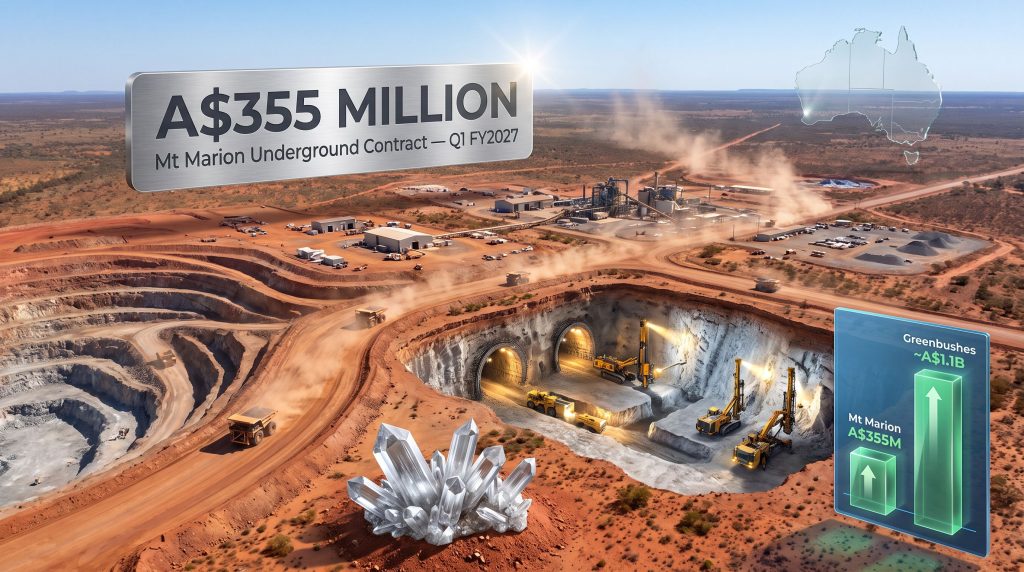
Nowhere is this transition more visible right now than at Mt Marion, where a A$355 million (~USD $247 million) contract awarded to Macmahon Underground Pty Ltd marks one of the most significant operational pivots in the project's decade-long history.
When big ASX news breaks, our subscribers know first
What the Macmahon Mt Marion Lithium Contract Actually Involves
The Macmahon Mt Marion lithium contract covers comprehensive underground development and production mining activities at the Mt Marion operation, located approximately 70 kilometres south of Kalgoorlie in Western Australia's Eastern Goldfields. The site sits roughly 590 kilometres east of Perth, placing it squarely within one of the world's most lithium-rich geological corridors.
The contract structure is a three-year agreement with an option to extend by one additional year, providing meaningful revenue visibility for the contractor while preserving operational flexibility for the joint venture partners.
Key Contract Parameters at a Glance
| Parameter | Detail |
|---|---|
| Contract Value | A$355 million (~USD $247 million) |
| Contract Duration | 3 years + 1-year extension option |
| Scope | Underground development and production mining |
| Contractor | Macmahon Underground Pty Ltd |
| Mine Location | 70km south of Kalgoorlie, Western Australia |
| Joint Venture Partners | Mineral Resources (MinRes) and Jiangxi Ganfeng Lithium |
| Underground Development Start | Q1 FY2027 |
| Combined Operations Target | FY2028 |
The contract was executed in July 2026, following Mineral Resources' confirmation of a Final Investment Decision (FID) in May 2026 to expand Mt Marion's operational footprint through the addition of both underground mining and a new flotation processing plant.
Mt Marion's Ownership Structure and Why It Matters Strategically
Mt Marion operates under a 50-50 joint venture between Mineral Resources (MinRes) and Jiangxi Ganfeng Lithium, one of China's largest and most vertically integrated lithium companies. This structure is more than a corporate arrangement. It creates a direct pipeline between Australian hard-rock lithium production and Chinese downstream processing and battery manufacturing capacity.
Ganfeng's involvement is particularly significant from a supply chain perspective. The company processes lithium compounds at scale in China and supplies battery-grade lithium to major electric vehicle manufacturers. Its stake in Mt Marion effectively ties Australian spodumene output to Chinese battery cell production in a way that few other joint ventures replicate so directly.
The MinRes Life-of-Mine Operating Agreement
Mineral Resources does not simply hold equity in Mt Marion. The company operates the site under a life-of-mine, build-own-operate agreement, meaning it retains responsibility for capital deployment, operational management, and mine services procurement. This structure gave MinRes the authority to make the FID and appoint Macmahon as the underground contractor without requiring separate consent processes from the Ganfeng side on day-to-day contracting decisions, though both parties remain aligned on the expansion's strategic direction.
Mt Marion first entered production through open-pit mining in 2016, making the 2026 underground transition its most consequential operational shift since inception.
What the May 2026 FID Unlocked and Why Timing Is Critical
The Final Investment Decision confirmed by Mineral Resources in May 2026 was the formal trigger that allowed the Macmahon contract to proceed. An FID in mining represents the point at which a project moves from technical feasibility into committed capital expenditure. Before that decision, underground development at Mt Marion existed as a plan on paper. After it, contractors could be formally engaged and schedules could be set.
The expansion has two parallel components:
- Underground mining development to access spodumene mineralisation below the existing open pits
- A new flotation plant to complement the existing Dense Media Separation (DMS) concentrator and improve overall lithium recovery rates from the ore stream
These two elements are interdependent. Underground orebodies at hard-rock lithium mines often carry different mineralogical characteristics compared to near-surface material. Finer-grained spodumene, mixed mineral textures, and varying gangue mineral content can reduce the efficiency of DMS processing alone. A flotation circuit is specifically designed to recover lithium minerals that DMS cannot effectively separate, meaning the processing upgrade is not merely additive — it is architecturally necessary for underground ore types.
The addition of flotation to an existing DMS circuit is a well-established approach in hard-rock lithium processing. It reflects an understanding that ore mined at depth behaves differently from surface material, and that recovery rates matter enormously when lithium prices are under pressure.
The Preparatory Work That Preceded the Macmahon Appointment
The Macmahon contract did not emerge from a standing start. In December 2023, a separate A$46 million contract was awarded to Develop Global for underground exploration decline development and infrastructure installation at Mt Marion. That 18-month scope was specifically designed to prove up the underground orebody, establish access infrastructure, and derisk the larger production phase. Macmahon's appointment to the full-scale underground production contract is, in part, a direct consequence of the technical groundwork laid through that prior engagement.
How the Mt Marion Underground Contract Compares to Macmahon's Other Lithium Work
Macmahon is not new to lithium mining services in Western Australia. The company was appointed to a ~A$1.1 billion contract at the Greenbushes lithium mine in 2023, which is considered the world's largest and highest-grade hard-rock lithium mine. That contract involved open-cut load-and-haul operations for Talison Lithium, the joint venture between Albemarle and Tianqi Lithium.
The Mt Marion contract is structurally different in several important ways:
| Feature | Mt Marion (2026) | Greenbushes (2023) |
|---|---|---|
| Mining Method | Underground | Open-cut |
| Contract Value | A$355 million | ~A$1.1 billion |
| Owner | MinRes / Ganfeng JV | Talison Lithium |
| Commencement | Q1 FY2027 | July 2023 |
| Scope | Development and production | Load-and-haul operations |
The underground scope at Mt Marion is technically more demanding than surface load-and-haul work. Underground development requires specialised drilling and blasting expertise, decline construction, ground support installation, ventilation system management, and the coordination of simultaneous development and production faces. These competencies are distinct from open-cut mining and represent a higher barrier to entry, which is precisely why Macmahon's underground credentials were central to its appointment.
Infrastructure Already in Place and What Still Needs to Be Built
Mt Marion enters the underground transition with a well-established surface infrastructure platform, which meaningfully reduces the capital intensity of the expansion compared to a greenfield underground project.
Existing Infrastructure
- Multiple active open-pit mining areas
- Dense Media Separation concentrator processing plant
- Run-of-mine pad and ore handling facilities
- Waste rock dumps
- Tailings storage facilities
Infrastructure Required for Underground Operations
- Underground decline access development (partially completed via the Develop Global contract)
- Ventilation raises and underground air management systems
- Underground water management and dewatering infrastructure
- Ore handling and hoisting systems to surface
- The planned flotation plant to complement existing DMS processing
The flotation plant addition is particularly important for maximising spodumene recovery from underground ore. In the spodumene flotation process, ore is ground to liberate lithium-bearing minerals from gangue material, then selectively floated using reagents that preferentially attach to spodumene surfaces. The resulting concentrate can achieve lithium oxide (Li₂O) grades sufficient for downstream conversion to battery-grade lithium carbonate or hydroxide.
The next major ASX story will hit our subscribers first
What This Contract Signals for Australia's Lithium Supply Chain
Western Australia accounts for the vast majority of global spodumene concentrate production, with operations including Greenbushes, Pilgangoora, Wodgina, and Mt Marion collectively representing a dominant share of world supply. The transition of established open-pit operations toward combined underground models is a structural industry development with long-term supply implications. Furthermore, innovations such as direct lithium extraction are also reshaping how the broader industry approaches resource recovery at various stages of the supply chain.
Hard-rock lithium deposits in Western Australia are typically hosted within pegmatite intrusions, which are geologically complex bodies that do not always follow predictable flat-lying geometries. At many operations, the richest mineralisation plunges at depth, meaning that open-pit mining eventually reaches economic limits before the orebody is exhausted. Underground mining, while more capital-intensive per tonne, allows operators to follow high-grade mineralisation to depths that pit walls cannot economically reach.
As EV adoption accelerates globally, the transition of established open-pit lithium operations to combined underground models represents a structural shift in how the industry pursues resource depth and longevity, prioritising recoverable reserve quality over surface-level volume.
The Broader Supply Chain Lens
The expansion of Mt Marion's underground capacity contributes to Australia's long-term position as a reliable supplier of battery raw materials. Spodumene concentrate from Mt Marion feeds into Ganfeng's Chinese processing facilities, where it is converted into lithium hydroxide or lithium carbonate for battery cathode manufacture. This positions Mt Marion's output at the upstream end of a supply chain that ultimately serves EV manufacturers across Asia and beyond.
For contractors like Macmahon, alignment with this supply chain through long-duration contracts provides earnings certainty, reduces reliance on spot-price exposed revenue, and builds technical credibility in a commodity sector that is expected to remain structurally important through the energy transition cycle. In addition, Australia's first underground lithium mine milestones have paved the way for projects like Mt Marion to pursue similar transitions with greater confidence. The continued growth of underground lithium mining across the state reflects a maturing industry increasingly comfortable with the technical and financial demands of subsurface extraction.
Frequently Asked Questions: Macmahon Mt Marion Lithium Contract
What is the value of the Macmahon Mt Marion contract?
The contract is valued at A$355 million, equivalent to approximately USD $247 million, covering a three-year term with a one-year extension option.
Who owns the Mt Marion lithium mine?
Mt Marion is jointly owned on a 50-50 basis by Mineral Resources (MinRes) and Jiangxi Ganfeng Lithium. Mineral Resources manages operations under a life-of-mine, build-own-operate agreement.
When will underground mining begin at Mt Marion?
Underground development is scheduled to commence in Q1 FY2027, with combined open-pit and underground operations targeted to be running simultaneously by FY2028.
What triggered the underground expansion at Mt Marion?
Mineral Resources confirmed a Final Investment Decision in May 2026 to expand the operation, which included both underground mining development and the addition of a flotation processing plant.
What infrastructure currently exists at Mt Marion?
The site operates multiple open-pit mines, a DMS concentrator, run-of-mine pad, waste dumps, and tailings storage facilities. These provide a strong foundation for the underground expansion without requiring a full greenfield infrastructure build.
Key Takeaways
- The A$355 million Macmahon Mt Marion lithium contract marks the most significant operational transition at the mine since open-pit production began in 2016
- Underground development will access spodumene mineralisation at depth, extending the mine's productive life beyond what surface mining alone could deliver
- The MinRes-Ganfeng 50-50 joint venture connects Australian operational capability directly to Chinese downstream battery supply chains
- A planned flotation plant will complement the existing DMS circuit, improving lithium recovery from underground ore with different mineralogical characteristics
- Preparatory underground work by Develop Global between 2023 and 2025 derisked the technical case for the larger Macmahon production contract
- For Macmahon, the contract deepens its presence across two of Western Australia's most strategically significant lithium operations
This article contains forward-looking information regarding project timelines, operational targets, and contract commencement dates. Actual outcomes may differ from those described due to operational, market, regulatory, or technical factors. This content is informational only and does not constitute financial advice.
Want to Track the Next Major ASX Lithium Discovery Before the Market Does?
Discovery Alert's proprietary Discovery IQ model scans ASX announcements in real time, instantly identifying significant mineral discoveries across lithium and more than 30 other commodities — turning complex data into actionable insights for investors at every level. Explore how major mineral discoveries have historically generated substantial returns on Discovery Alert's dedicated discoveries page, and begin your 14-day free trial today to position yourself ahead of the broader market.