August 14, 2026
The Hidden Architecture of Global Cobalt: Why Where It's Refined Matters More Than Where It's Mined
Most discussions about critical mineral supply chains focus on where resources are extracted from the ground. Yet for cobalt, one of the most strategically significant metals of the 21st century, the more consequential question has never been about mining geography. It has always been about who controls the refineries.
This distinction sits at the heart of a structural vulnerability that Washington has spent years acknowledging and is now, with increasing urgency, attempting to correct. The DRC cobalt supply chain to the US is being rebuilt from the ground up, and understanding why requires looking past the mine and into the processing infrastructure that has, for decades, acted as the true chokepoint of global cobalt availability.
When big ASX news breaks, our subscribers know first
Cobalt's Unique Position in the Battery and Defense Industrial Complex
Cobalt is not simply another industrial input. Its electrochemical properties make it exceptionally difficult to substitute in lithium-ion battery cathode chemistries at commercial scale, particularly in the NMC (nickel manganese cobalt) formulations that dominate EV battery production. Unlike many raw materials where substitution is a gradual engineering problem, removing cobalt from high-performance battery cathodes typically requires accepting measurable tradeoffs in energy density, thermal stability, or cycle life.
Beyond batteries, cobalt's high-temperature strength makes it indispensable in superalloy manufacturing for jet engines and gas turbines, and its use in hard metals and cutting tools is deeply embedded in defence manufacturing supply chains. The compounding demand pressure emerging from EV adoption curves, defence modernisation programmes, and utility-scale grid storage expansion creates a scenario where cobalt demand trajectories are not merely growing but accelerating across multiple sectors simultaneously.
The supply side tells a starkly different story. According to the U.S. Geological Survey, only 300 tonnes of cobalt were mined domestically in the United States in 2025. To frame that figure appropriately: it represents a fraction of a percent of what the country requires across its industrial and defence sectors. No realistic domestic production expansion timeline can close that gap, which means import architecture is not a secondary policy consideration but a primary national security concern.
Who Has Actually Been Supplying the U.S., and What That Reveals
Understanding the existing U.S. cobalt import structure requires separating two concepts that are frequently conflated: mining origin and processing origin. In both 2024 and 2025, USGS data identified Norway, Finland, Canada, and Japan as the source of approximately 70% of U.S. cobalt imports. On the surface, this appears to describe a geographically diversified supply base. In practice, it describes something more concentrated.
Norway, Finland, and Japan function primarily as refining and processing intermediaries. They are not significant cobalt mining nations. Their appearance in U.S. import data reflects the fact that they transform raw or intermediate cobalt material, sourced largely from elsewhere, into refined products that enter U.S. manufacturing supply chains. Canada is the meaningful exception, operating as a genuine primary producer with its own mining output alongside refining capacity.
The cobalt products moving through these import channels span the value chain:
| Import Category | Description | Primary Supplier Type |
|---|---|---|
| Refined cobalt metal | Highest-purity end product | Refining hubs (Norway, Finland) |
| Cobalt oxides | Intermediate battery material | Mixed refining and mining nations |
| Cobalt sulfate | Precursor for cathode manufacturing | Refining hubs (Japan, Finland) |
| Cobalt hydroxide | Raw feedstock for downstream processing | Primary producers (DRC, Canada) |
This structure reveals something critical: the U.S. has been purchasing cobalt as a processed product, not as a raw material with transparent mining origins. The question of where the underlying ore came from has, in many cases, been answered by Chinese refineries long before the material ever entered a U.S. import manifest.
The DRC's Paradox: The World's Largest Cobalt Producer Absent From U.S. Import Data
The Democratic Republic of Congo accounted for approximately 73% of global cobalt production in 2024, according to USGS figures. Yet across both 2024 and 2025, the DRC did not appear among named U.S. cobalt import sources. Even in 2023, when USGS data included more granular breakdowns identifying other African suppliers such as Zambia, Morocco, and Madagascar, the DRC remained conspicuously absent.
This is not because Congolese cobalt was unavailable. It is because the overwhelming majority of raw and intermediate cobalt exports leaving the DRC flowed directly to Chinese refining facilities. China operates the world's largest cobalt refining industry, and through years of upstream investment in Congolese mining assets, it built a supply architecture that effectively captured DRC output before it could reach Western buyers. Furthermore, local elite control over Congolese mining assets has historically shaped how these export relationships developed.
The result was a paradox: the U.S. was almost certainly consuming Congolese cobalt indirectly, embedded within Chinese-refined intermediary products purchased from European hubs, while having no direct commercial relationship with the world's dominant cobalt-producing nation.
This arrangement gave China structural leverage over cobalt pricing, availability, and downstream access that Western industrial policy is now explicitly trying to dismantle. The US-China cobalt rivalry has consequently become one of the defining resource geopolitics stories of the decade.
The 2025 Embargo and Its Role as a Strategic Catalyst
One event accelerated Washington's engagement with Kinshasa more than any policy paper: the DRC cobalt export ban of early 2025. The Congolese government used the embargo as a sovereign instrument to assert greater pricing control and compel international buyers to engage directly with Congolese terms rather than continuing to purchase processed material from Chinese intermediaries.
The effect was immediate and measurable. According to Congolese mining statistics, the United States alone imported 1,103 tonnes of cobalt in February 2025, during the concentrated export window that preceded the embargo taking full effect. This single data point demonstrated both U.S. appetite for direct Congolese supply and the vulnerability of a system in which DRC export policy decisions could cause instant supply disruptions for American manufacturers.
The cobalt export suspension was subsequently replaced by a quota-based export system, and by December 2025, the two nations had formalised a bilateral mining partnership establishing a framework for direct mineral cooperation. It is under this framework that the most significant current supply initiatives are being developed. The broader cobalt price impacts of these policy shifts reverberated across global markets throughout 2025.
EGC and EVelution Energy: Building the First Direct Cobalt Pipeline
On 13 May 2026, Entreprise Générale du Cobalt announced it was in active negotiations with U.S.-based EVelution Energy to establish a direct cobalt supply relationship. EGC is a state-owned DRC entity created in 2019 with a legal monopoly over the purchase, processing, and export of cobalt sourced from the country's artisanal and small-scale mining sector.
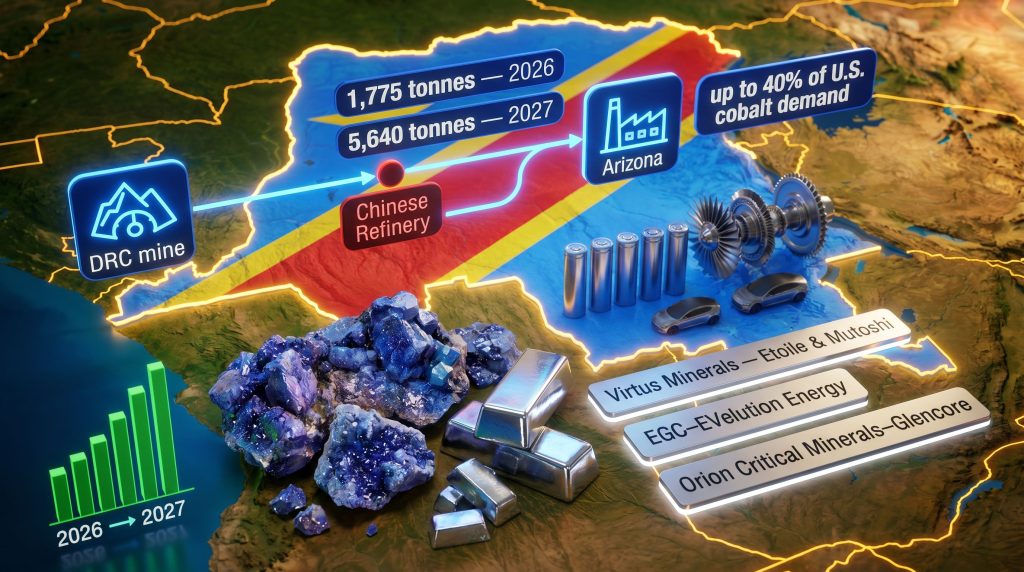
The proposed arrangement would see EGC supply cobalt hydroxide feedstock to a processing facility EVelution Energy is currently constructing in Arizona. The ambition behind the partnership is substantial: the initiative is designed to meet up to 40% of total U.S. cobalt demand.
EGC's allocated export quotas under the post-embargo quota system provide a concrete sense of near-term supply ceiling:
- 1,775 tonnes allocated for 2026
- 5,640 tonnes allocated for 2027
- These figures represent the maximum volume EGC could direct toward the U.S. partnership under current quota constraints
- Actual contracted volumes have not yet been publicly specified
The artisanal mining dimension adds a layer of complexity that is often underappreciated. EGC's mandate specifically covers cobalt sourced from artisanal and small-scale mining operations, a sector historically associated with serious human rights concerns. Without verifiable traceability infrastructure, artisanal Congolese cobalt cannot enter U.S. battery supply chains under existing due diligence requirements regardless of sovereign-level agreements.
To address this, a U.S.-backed pilot programme launched in January 2025 in Lualaba Province is working to formalise artisanal mining operations and implement chain-of-custody traceability tools. The initiative involves collaboration with the Fair Cobalt Alliance and the Responsible Minerals Initiative, with funding channelled through the U.S. Department of Labor. Scaling this infrastructure across the DRC's artisanal sector, which involves hundreds of thousands of individual miners operating across fragmented and often informal networks, represents a multi-year institutional undertaking. Indeed, responsible sourcing standards provide an essential framework for ensuring these supply relationships meet international expectations.
Formalising artisanal cobalt supply is not purely an ethical objective. It is a commercial prerequisite. Without chain-of-custody verification, the cobalt simply cannot legally enter U.S. battery manufacturing regardless of how favourable the bilateral agreements appear on paper.
The next major ASX story will hit our subscribers first
Private Sector Mobilisation: Virtus Minerals and Orion Critical Minerals
U.S. interest in Congolese cobalt extends well beyond the EGC partnership framework. Two significant private-sector initiatives are simultaneously advancing, each targeting different segments of the DRC cobalt asset base.
Virtus Minerals and the Chemaf Acquisition
In April 2026, U.S.-based Virtus Minerals completed its acquisition of Chemaf SA, the operating company behind the Etoile and Mutoshi copper-cobalt mines in the DRC. The company has explicitly framed the acquisition as a strategic move aimed at establishing a primary cobalt supply line directed at the U.S. market. At full operational optimisation, the two combined sites could generate approximately 20,000 tonnes of cobalt annually, according to Chemaf's own projections.
The qualification at full optimisation carries significant weight. Restarting and scaling DRC mining operations involves compounding cost pressures across infrastructure deficits, power supply constraints, and the logistical challenges of exporting from a landlocked country with limited corridor options. A budget of approximately $700 million has been referenced for the operational restart and optimisation programme, though as trade publication Bankable has noted, the financing structure underpinning that figure remains publicly unconfirmed.
Orion Critical Minerals and the Glencore Negotiations
Separately, Orion Critical Minerals, a consortium established in 2025, is pursuing a 40% equity stake in Glencore's Mutanda and Kamoto mining operations in the DRC. These are two of the world's highest-output cobalt assets, and a completed transaction would represent one of the most significant Western re-entries into Congolese cobalt production in recent memory. As of mid-2026, negotiations remain ongoing with no binding agreement finalised.
Comparative Overview of U.S. DRC Cobalt Initiatives
| Initiative | Entity Type | Asset or Partner | Target Output | Status (mid-2026) |
|---|---|---|---|---|
| EGC and EVelution Energy | State-to-private | Artisanal cobalt to Arizona plant | Up to 40% of U.S. demand | Negotiations ongoing |
| Virtus Minerals and Chemaf SA | Private acquisition | Etoile and Mutoshi mines | ~20,000 t/year cobalt | Acquisition complete; restart pending |
| Orion Critical Minerals and Glencore | Consortium and major miner | Mutanda and Kamoto mines | Not yet specified | Negotiations ongoing |
Five Barriers That Could Derail the DRC-to-U.S. Cobalt Buildout
The gap between announced intention and operational supply is where critical minerals diplomacy most frequently fails. Across the DRC cobalt landscape, five structural barriers stand between current momentum and a functioning direct supply pipeline.
1. No binding agreements have been finalised. Across all three major initiatives, the transition from negotiation to legally enforceable commercial contract remains incomplete. The history of critical minerals diplomacy includes numerous memoranda of understanding that never progressed to operational supply arrangements.
2. Financing gaps at the project level are material. The Virtus Minerals restart of Chemaf SA operations carries an estimated price tag of $700 million with no confirmed financing structure. This is not a minor administrative detail. It is the difference between a strategic announcement and an operational supply chain.
3. DRC export control architecture creates ongoing uncertainty. The quota system that replaced the embargo demonstrates Kinshasa's willingness and capacity to use mineral exports as a sovereign policy instrument. EGC's allocated quotas represent a ceiling, not a floor, and could be revised based on domestic political or economic conditions.
4. China's refining dominance cannot be overcome by upstream agreements alone. Even if U.S. entities secure cobalt hydroxide feedstock from the DRC, processing that material outside Chinese refining infrastructure requires non-Chinese capacity that barely exists at scale outside Europe. EVelution's Arizona facility would represent one of the very few U.S.-based cobalt processing assets if completed.
5. Artisanal traceability infrastructure is still in early development. The Lualaba pilot is a promising intervention in a sector defined by fragmentation and informality. Scaling chain-of-custody systems across the DRC's artisanal mining population is not a problem that quarterly funding cycles can solve.
Scenario Pathways Through 2030: What the Evidence Actually Supports
Three distinct trajectories are plausible for the DRC cobalt supply chain to the US over the next four years, and they differ substantially in their implications for U.S. cobalt security.
Scenario A: Accelerated Integration. Binding agreements are finalised across multiple initiatives, EVelution's Arizona facility reaches operational capacity, and artisanal traceability infrastructure scales to support compliant volumes. The DRC enters the named U.S. import list by 2027–2028, and direct Congolese cobalt begins displacing Chinese-refined intermediary volumes in U.S. battery manufacturing.
Scenario B: Partial Progress. One or two of the three major initiatives reach operational status, but financing gaps and quota limitations constrain total volumes. The DRC becomes a meaningful but not dominant U.S. cobalt source, supplementing rather than replacing existing European refining-hub imports.
Scenario C: Structural Stall. Financing challenges, DRC sovereign policy shifts, or geopolitical complications delay all three initiatives beyond 2028. The U.S. remains dependent on European refining intermediaries and indirect Chinese-processed cobalt, while the DRC continues to prioritise Chinese buyers offering faster and less conditional commercial terms.
Based on the current evidence, Scenario B appears most probable. Multiple initiatives are in motion, but none have crossed the threshold from negotiation to operational supply. The 2026–2027 period will be the critical test of whether sovereign-level agreements can translate into tonnes in transit.
For the U.S. to achieve meaningful DRC cobalt integration, several conditions must be met concurrently: finalised and bankable commercial agreements, confirmed financing for both the Chemaf restart and the Arizona processing facility, scalable traceability infrastructure across artisanal supply streams, sustained political alignment between Washington and Kinshasa, and the emergence of sufficient non-Chinese refining capacity to process DRC feedstock without routing through Chinese facilities.
The architecture being built is ambitious. Whether it becomes a functioning supply chain or remains a framework of intentions may well determine how exposed U.S. manufacturers remain to the cobalt supply disruptions that the 2025 embargo briefly, and vividly, illustrated.
FAQ: Understanding the DRC Cobalt Supply Chain to the United States
Does the U.S. currently import cobalt directly from the DRC?
As of 2025 USGS data, the DRC does not appear among named U.S. cobalt import sources. Most DRC cobalt is processed in China before reaching global markets, meaning the U.S. has been consuming Congolese cobalt indirectly through Chinese-refined intermediary products purchased via European hubs.
What is EGC and why does it matter?
Entreprise Générale du Cobalt is a DRC state-owned entity established in 2019 with a legal monopoly over the purchase, processing, and export of artisanally mined cobalt. It is the primary institutional vehicle through which the DRC government is engaging with U.S. partners to build a direct bilateral cobalt supply relationship.
How much of U.S. cobalt demand could the DRC realistically meet?
The EGC and EVelution partnership targets up to 40% of U.S. cobalt demand. However, this is an aspirational figure contingent on binding agreements, EGC quota allocations of 1,775 tonnes in 2026 and 5,640 tonnes in 2027, and the processing capacity of the Arizona facility once operational.
Why did the DRC impose a cobalt export embargo in 2025?
The DRC government used the embargo to assert greater pricing control and compel international buyers to engage directly with Congolese commercial terms rather than purchasing processed material from Chinese intermediaries. The embargo was subsequently replaced by a quota system.
What is cobalt hydroxide and why is it the focus of the EGC partnership?
Cobalt hydroxide is an intermediate form of processed cobalt that sits between raw ore and fully refined metal. It can be transported and processed into battery-grade materials at downstream facilities like EVelution's Arizona plant. Sourcing cobalt hydroxide directly from the DRC allows the U.S. to capture more of the value chain domestically rather than importing fully refined material from European or Asian intermediaries.
What responsible sourcing challenges apply to artisanal DRC cobalt?
The artisanal mining sector in the DRC has historically been associated with child labour and unsafe working conditions. Under existing U.S. and international due diligence standards, cobalt without verifiable chain-of-custody documentation cannot be used in U.S. battery manufacturing supply chains. The Lualaba pilot programme launched in January 2025 is working to establish the traceability infrastructure needed to make artisanal Congolese cobalt commercially usable for U.S. manufacturers.
Want To Track The Next Major ASX Mineral Discovery Before The Market Moves?
Discovery Alert's proprietary Discovery IQ model delivers real-time alerts the moment significant ASX mineral discoveries are announced, transforming complex commodity data — including battery metals like cobalt — into actionable investment insights for both short-term traders and long-term investors. Explore historic discoveries and the returns they generated, then begin your 14-day free trial at Discovery Alert to position yourself ahead of the broader market.