August 14, 2026
The Hidden Arithmetic of Sovereignty: Why the DRC's Royalty Restructure Changes Everything for Lithium Investors
Across the history of commodity markets, the most consequential shifts in mining economics have rarely originated from geological discoveries or technological breakthroughs. More often, they have emerged from a single policy document, a council vote, or a regulatory reclassification that rewrites the financial logic of an entire industry overnight. The DRC's decision to redesignate lithium, tantalum, niobium, tungsten, uranium, and rare earth elements as strategic minerals belongs to exactly that category of event.
For investors and mining operators with exposure to DRC lithium mining royalties, the implications extend far beyond a headline rate adjustment. What has changed is the structural relationship between extraction economics, host-nation fiscal expectations, and the broader calculus of where capital flows in a world increasingly organised around battery supply chains. Furthermore, understanding these changes is essential for any investor navigating the global lithium market in the current environment.
When big ASX news breaks, our subscribers know first
Understanding the Fiscal Architecture: How the DRC Mining Code Actually Works
The DRC's 2018 Mining Code established a tiered royalty framework that distinguishes between commodity categories based on strategic relevance. Standard non-ferrous metals attracted a 3.5% royalty on gross revenue, while minerals designated as strategic were subject to a 10% gross revenue levy. Cobalt and coltan were already sitting in the strategic category before 2026, meaning their operators had long been absorbing the higher rate.
What makes the DRC system unusually significant from a financial modelling perspective is the gross revenue basis. Unlike profit-sharing arrangements or net smelter return structures that fluctuate with operating costs and commodity price cycles, a gross revenue royalty is extracted from the top line regardless of whether a project is profitable. This makes the royalty function more like a production tax than a profit participation mechanism.
The practical consequence is that the cost of the royalty increase cannot be absorbed through operational efficiency gains or cost-cutting programmes. It is structurally embedded in every tonne of ore extracted and sold. For context, key changes to the DRC Mining Code have been closely watched by legal and financial analysts alike.
The gross revenue royalty structure means that for every $100 of lithium sold within the DRC, $10 flows directly to the Congolese state under the new framework, irrespective of what it cost to extract that lithium in the first place.
The Six Minerals Now Classified as Strategic
The DRC Council of Ministers formally approved the addition of six mineral categories to the strategic classification:
- Lithium – central to battery cell chemistry for electric vehicles and grid storage
- Tantalum – critical for capacitors in consumer electronics and aerospace applications
- Niobium – used in high-strength steel alloys and superconducting applications
- Tungsten – essential for hardened tooling, aerospace, and defence manufacturing
- Uranium – nuclear fuel cycle applications
- Rare earth elements – permanent magnets, catalysts, and advanced electronics
Each of these minerals shares a common characteristic: they sit at the intersection of the global energy transition, advanced manufacturing, and national security supply chains, making them priority targets for resource sovereignty policy. Consequently, the shift in DRC lithium mining royalties is inseparable from the broader surge in critical minerals demand worldwide.
What a 186% Royalty Increase Actually Costs a Lithium Producer
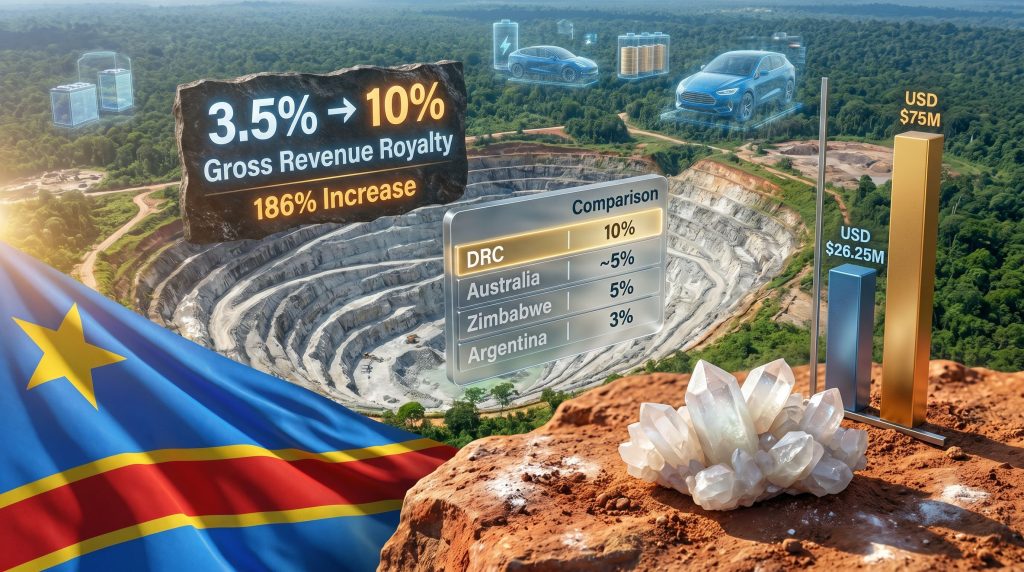
Moving from 3.5% to 10% on gross revenue represents a 186% increase in the royalty burden, but the real-world impact on project economics is best understood through concrete modelling rather than percentage comparisons.
Step-by-Step Project Economics Impact
- Establish gross revenue: Calculate lithium carbonate equivalent (LCE) production multiplied by the prevailing spot price per tonne
- Apply the legacy rate: Deduct 3.5% of gross revenue as the pre-2026 government royalty payment
- Apply the new rate: Deduct 10% of gross revenue under the strategic mineral classification
- Identify the incremental burden: The additional 6.5 percentage points on gross revenue compress project-level margins directly, with no mechanism for offset
- Recalculate breakeven thresholds: Projects with lower ore grades, higher processing costs, or longer transport distances face disproportionate margin pressure at the revised rate
- Reassess capital recovery timelines: Higher royalties extend payback periods on initial capital expenditure, reducing internal rates of return and affecting debt serviceability
Illustrative Scenario: Mid-Scale Lithium Operation
Hypothetical: A lithium project producing 50,000 tonnes of LCE annually at a realised price of USD $15,000 per tonne generates gross revenue of USD $750 million per year.
- Under the old 3.5% rate: royalty payment equals USD $26.25 million per year
- Under the new 10% rate: royalty payment equals USD $75 million per year
- Incremental annual cost increase: USD $48.75 million
Disclaimer: This is a hypothetical illustration for analytical purposes only. Actual project economics will vary based on ore grade, processing method, logistics costs, prevailing lithium prices, and applicable tax treaties. This does not constitute financial advice.
The significance of this figure extends beyond the immediate cash flow impact. Bankability assessments, project financing terms, and equity investor return expectations are all recalibrated when royalty costs shift at this magnitude. Feasibility studies completed under the old 3.5% assumption become materially misleading documents for any project not yet in production.
Benchmarking DRC Royalty Rates Against the Global Lithium Landscape
To contextualise where the DRC now sits within global lithium fiscal regimes, a comparative analysis across major producing and emerging jurisdictions is instructive:
| Jurisdiction | Mineral | Royalty Rate | Basis |
|---|---|---|---|
| DRC (post-2026) | Lithium (strategic) | 10% | Gross revenue |
| DRC (pre-2026) | Lithium (non-ferrous) | 3.5% | Gross revenue |
| Australia | Lithium | ~5% (state-dependent) | Gross revenue / value |
| Zimbabwe | Lithium | 5% | Gross revenue |
| Chile | Lithium | ~40% effective (CODELCO model) | Revenue-based + state equity |
| Argentina | Lithium | 3% federal + provincial levies | Varies |
| Canada | Lithium | ~2-5% (province-dependent) | Varies |
At 10% on gross revenue, the DRC's new lithium royalty rate is among the highest flat-rate structures globally. Only Chile's effective rate exceeds it, and that model incorporates deep state equity ownership rather than a pure royalty mechanism. For investment allocation decisions, this repositioning matters enormously.
Investor Note: Argentina lithium opportunities present a comparatively low federal royalty rate of approximately 3%, combined with provincial flexibility, positioning Argentina as a notably more cost-competitive lithium jurisdiction on royalty terms alone. Capital allocation decisions at the portfolio level are likely to increasingly reflect this differential.
The Geopolitical Logic Behind the Timing
The DRC's royalty restructure did not emerge in isolation. It reflects a convergence of several macro forces that have been building simultaneously across global commodity markets and international diplomacy.
Why Kinshasa Moved Now: Four Structural Drivers
- Supply chain anxiety in Western capitals: The United States and European Union have both accelerated programmes designed to reduce reliance on Chinese-controlled critical mineral processing, elevating the DRC's negotiating leverage with potential partners who genuinely need access to its resource base.
- The cobalt precedent: Having operated the 10% strategic mineral royalty on cobalt for years without triggering mass capital flight, the Congolese government has empirical evidence that the battery metals sector will absorb higher fiscal costs when the underlying resource is sufficiently irreplaceable.
- The China dominance factor: Chinese firms including CMOC Group and Zijin Mining hold significant operational positions across the DRC's battery metals sector. A universal royalty increase extracts additional state revenue through fiscal policy rather than requiring direct diplomatic confrontation.
- The minerals-for-security framework: Kinshasa has been actively exploring partnership structures with Washington that leverage its critical mineral endowment as diplomatic currency, as evidenced by the Congo-US minerals partnership framework announced in early 2025.
The Announcement Channel: A Signal in Itself
The decision was communicated via a video posted on the DRC Ministry of Mines' official social media account rather than through traditional regulatory gazette mechanisms. This choice of communication channel, while not altering the legal force of the Council of Ministers approval, signals an awareness of the international audience for this decision and a deliberate choice to communicate to global mining investors and partner governments in real time. Moreover, lithium miners in Congo facing higher royalties has rapidly become one of the most closely followed regulatory stories in the sector.
Which Companies Face the Most Material Exposure
The royalty reclassification creates differentiated impacts depending on an operator's production stage, ore grade characteristics, and existing cost structure.
| Company | Origin | DRC Exposure | Royalty Impact Category |
|---|---|---|---|
| AVZ Minerals | Australia | Manono lithium project (pre-production) | High: feasibility study reassessment required |
| Zijin Mining | China | Expanding battery metals portfolio | Medium-High: increased operating cost base |
| CMOC Group | China | Copper-cobalt with battery metals exposure | Medium: multiple reclassified categories |
| Glencore | Switzerland | Cobalt-copper operations | Pre-existing strategic exposure on cobalt |
| Ivanhoe Mines | Canada | Major copper assets, by-product revenue streams | Moderate: depends on by-product mix |
The AVZ Congo lithium dispute warrants particular attention. The Manono lithium project in the DRC's Tanganyika Province is one of the largest undeveloped lithium deposits anywhere in the world, and it has already navigated a complex series of ownership disputes and permitting challenges. The royalty increase adds a further layer of financial modelling complexity to a project that has not yet reached production. Any revised feasibility study will need to incorporate the 10% gross revenue assumption from the outset.
The next major ASX story will hit our subscribers first
Africa's Resource Nationalism Spectrum: The DRC in Continental Context
The DRC's approach to resource sovereignty differs meaningfully from the strategies adopted by its African neighbours, even as all pursue broadly similar objectives of capturing greater value from mineral wealth.
| Policy Tool | DRC Approach | Zimbabwe | Namibia | Ghana |
|---|---|---|---|---|
| Royalty rate increase | Applied (3.5% to 10%) | Partial | Limited | Partial |
| Export restrictions | Not applied | Applied (lithium ore ban, 2022) | Applied (critical minerals) | Selective |
| State equity participation | Partial (existing SOE involvement) | Expanding | Developing | Increasing |
| Processing mandates | Under discussion | Implemented | Under development | Selective |
Zimbabwe's ban on unprocessed lithium ore exports, implemented in 2022, prioritises downstream industrialisation over immediate royalty revenue. The DRC's revenue-first approach reflects a different institutional capacity and infrastructure reality. For a government navigating significant domestic fiscal pressures, the sequencing makes rational sense even if it sacrifices longer-term value chain capture.
Supply Chain Consequences: What This Means for the Global Lithium Market
The central tension in analysing the DRC royalty shift is that it simultaneously increases the cost of DRC lithium supply while offering no easy substitute for the scale of the country's resource base. The Manono deposit alone contains lithium resources of a magnitude that cannot simply be replicated by expanding operations in alternative jurisdictions.
For Western supply chain architects seeking to reduce Chinese processing dependency, the DRC remains geographically and geologically unavoidable in long-term planning horizons. The practical implication is that the DRC lithium mining royalties cost increase will likely be partially absorbed by buyers further up the supply chain through higher offtake pricing. However, for early-stage exploration projects and smaller developers without the balance sheet resilience of major operators, the revised fiscal regime may redirect capital toward lower-royalty jurisdictions. Indeed, the DRC royalty hike may be masking a real lithium opportunity elsewhere for nimble investors willing to look beyond headline risk.
Key Takeaway for Investors: The restructure of DRC lithium mining royalties does not eliminate the jurisdiction from critical mineral supply planning, but it does materially alter the return profile for lithium projects at every stage of development. Any discounted cash flow model or NPV calculation built on pre-2026 royalty assumptions should be treated as unreliable until restated under the new framework. This analysis is provided for informational purposes only and does not constitute financial advice.
FAQ: DRC Lithium Mining Royalties Explained
What minerals did the DRC reclassify as strategic in 2026?
The DRC Council of Ministers approved the addition of lithium, tantalum, niobium, tungsten, uranium, and rare earth elements to the strategic minerals list. All of these minerals now attract the 10% gross revenue royalty rate, replacing the standard 3.5% rate that previously applied.
Was lithium always subject to the higher royalty rate?
No. Prior to the 2026 reclassification, lithium was treated as a standard non-ferrous metal under the DRC Mining Code and taxed at 3.5% of gross revenue. Only cobalt and coltan were previously classified as strategic minerals subject to the 10% rate.
Does the royalty apply to profit or gross revenue?
The royalty is applied to gross revenue, meaning it is calculated on the total value of minerals extracted and sold before any deduction for operating costs, capital recovery, or financing expenses. A project does not need to be profitable for the royalty obligation to apply in full.
Why does it matter that the royalty is on gross revenue rather than profit?
A gross revenue royalty is structurally different from a profit-based mechanism because it applies uniformly regardless of a project's financial performance. During periods of low lithium prices or high operating costs, the royalty burden as a proportion of actual margin increases dramatically, potentially rendering otherwise viable projects uneconomic.
How does this affect companies developing lithium projects in the DRC?
All operators extracting strategically reclassified minerals are subject to the revised rate. For companies with projects still in development or feasibility study phases, the change necessitates a comprehensive restatement of project economics, capital requirements, and investor return projections.
Want to Identify the Next Major Mineral Discovery Before the Market Does?
Discovery Alert's proprietary Discovery IQ model scans ASX announcements in real time, instantly transforming complex mineral data into actionable investment insights across more than 30 commodities — ensuring subscribers are positioned ahead of the broader market. Explore historic discoveries and their remarkable returns, then begin your 14-day free trial to secure a genuine market-leading edge.