
May 21, 2026
The Anatomy of a Resource Diplomacy Misstep: What the DRC Mine Security Controversy Reveals
When sovereign governments and foreign partners negotiate access to critical mineral wealth, the distance between political intention and legally binding financial commitment can be vast. That gap became publicly visible on April 28, 2026, when the US Embassy in Kinshasa issued a direct clarification stating that the US denies funding Congo mine security force operations of any kind. The statement, confirmed by Reuters, arrived just days after Congo's General Inspectorate of Mines had publicly attributed the backing of a proposed $100 million mine security force to both the United States and the United Arab Emirates.
The episode offers a rare window into the structural fragilities of resource diplomacy, where host nation regulators, foreign partners, and private capital operate under different timelines, communication protocols, and legal constraints. Understanding what actually happened, and why it matters, requires looking beyond the denial itself.
When big ASX news breaks, our subscribers know first
What the US Embassy Actually Said, and What It Didn't
The US Embassy's statement was deliberately precise in its phrasing. Washington confirmed it is not currently funding mine security units in the DRC, a formulation that denies present financial commitment without closing the door on future cooperation. Critically, the same statement reaffirmed Washington's commitment to economic growth and stability in the DRC through its existing strategic partnership framework.
This linguistic construction is not accidental. It signals a tactical clarification rather than a strategic withdrawal, and that distinction matters considerably for mining companies, institutional investors, and policy analysts tracking the US-Africa minerals relationship.
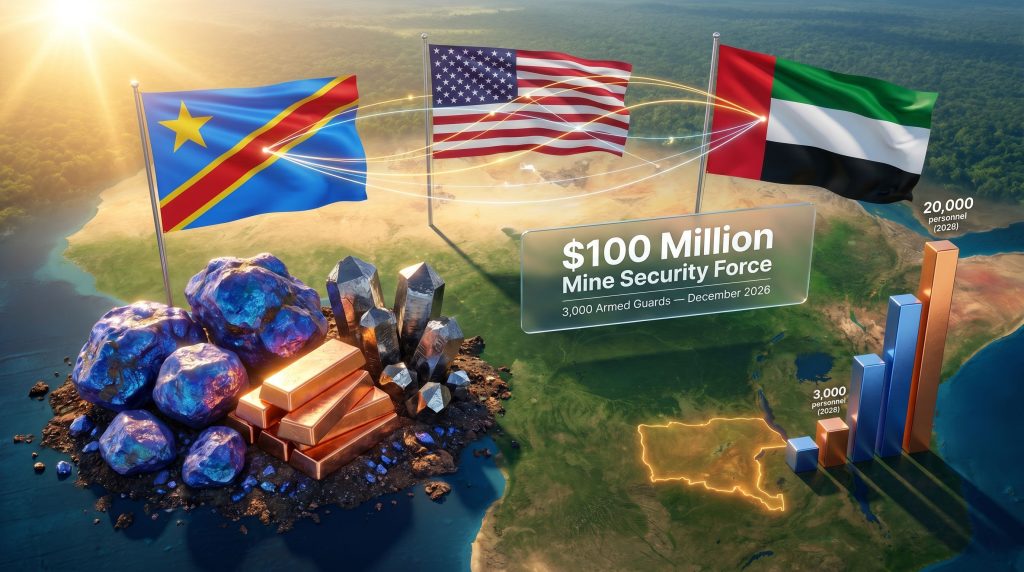
The denial followed an announcement by Congo's General Inspectorate of Mines (IGM), which had described a proposed armed paramilitary unit with the following operational parameters:
- A proposed budget of $100 million
- Initial deployment of up to 3,000 armed mining guards by December 2026
- Expansion to over 20,000 personnel by 2028
- A mandate covering active mineral production zones, traceable mineral transport, and the gradual replacement of informally deployed defence forces
Following the US denial, Congo's mining regulator subsequently repositioned the announcement, clarifying that the initiative is being developed with international partners and would not be funded directly by any single country. That clarification itself tells a story about how the original announcement may have overstated the firmness of foreign commitments.
The Katanga Region: Understanding What Is Actually at Stake
The proposed force's primary deployment zone is the Katanga region, a territory in southeastern DRC that represents one of the most concentrated deposits of strategically critical minerals anywhere on earth. The IGM specifically cited Katanga as the central focus of the initiative. Furthermore, the DRC's mineral wealth extends far beyond cobalt alone, encompassing a range of resources critical to global clean energy transition.
| Mineral | Primary Industrial Application |
|---|---|
| Cobalt | EV batteries, energy storage systems |
| Copper | Electrification infrastructure, power grids |
| Lithium | Clean energy technology inputs |
| Coltan (Tantalum) | Electronics, semiconductors |
| Tin | Soldering, electronics manufacturing |
| Gold | Financial reserves, electronics |
| Zinc | Galvanisation, industrial manufacturing |
The security challenge in this region is not simply a matter of policing. According to the IGM's statement to Bloomberg, military units and presidential guard officers have been deployed across multiple mine sites in ways that contravene the national mining code. The proposed paramilitary force is explicitly designed to consolidate these fragmented, legally inconsistent security arrangements into a single regulated structure operating within the formal legal framework.
"This security gap is not merely a law enforcement problem. It represents a structural investment risk that complicates capital allocation decisions for Western mining firms and creates chain-of-custody vulnerabilities that increasingly matter under emerging supply chain due diligence regulations."
For investors and operators, the distinction between police deployment and military deployment at a mine site has real compliance implications. Traceability of minerals from extraction point to export is increasingly required under frameworks such as the EU Critical Raw Materials Act and sourcing provisions within the US Inflation Reduction Act. A mine site where security is provided by units operating outside the legal framework creates documentation gaps that can compromise compliance across the entire supply chain.
The US-DRC-UAE Strategic Triangle: A Rapidly Evolving Relationship
The mine security episode did not occur in isolation. It is, however, the latest chapter in a series of escalating diplomatic and commercial engagements connecting Washington, Kinshasa, and Gulf capital. The sequence of events provides important context:
- December 4, 2025: US President Donald Trump and DRC President Félix Tshisekedi signed a peace framework at the United States Institute of Peace in Washington DC, establishing the foundational architecture for a bilateral minerals partnership
- February 2026: The DRC announced plans to sell copper to Saudi Arabia and the UAE through a US-backed partnership with Mercuria Energy Group Ltd, widely interpreted as part of Washington's broader strategy to reduce Chinese dominance in critical mineral supply chains
- April 2026: Congo's IGM announced the $100 million mine security force with claimed US and UAE backing, followed within days by Washington's public denial
The progression from peace framework to commodity trading agreements to security infrastructure proposals reflects a recognisable pattern in resource diplomacy: relationships that begin with high-level political agreements gradually extend into operational domains, and the transition from political intent to formal financial commitment is rarely linear.
Consequently, the UAE's role in this architecture remains unresolved following the US clarification. DRC officials have not specified whether any potential funding would originate from government budgets or private sector sources. The UAE's existing commercial presence in Congo's gold supply chain, including a reported supply agreement routed through Dubai, suggests Gulf capital may be more deeply embedded in the DRC minerals financing architecture than publicly confirmed. The broader US-Congo minerals partnership framework, nonetheless, remains a central pillar of Washington's strategy in the region.
Why Washington Moved Quickly to Distance Itself
The swiftness of the US Embassy denial warrants examination. Several structural constraints make direct US government funding of a DRC paramilitary force legally and politically complicated:
- Leahy Law compliance: US law restricts security force assistance to units credibly implicated in human rights abuses. Deploying this framework to a new paramilitary force in a conflict-affected region would require extensive vetting procedures before funding could legally flow
- Congressional scrutiny: Paramilitary funding in African conflict zones carries significant oversight exposure in Washington, particularly where accountability mechanisms are limited
- Reputational risk: If a US-funded unit were later implicated in civilian harm or resource extraction abuses, the political and legal consequences for Washington would be substantial
These constraints explain why Washington's strategic interest in DRC mineral security can remain genuinely intact while direct funding of a mine security force remains off the table in the near term. The denial, therefore, reflects legal and political reality, not necessarily a lack of strategic alignment. In addition, the mining security partnership between the two nations continues to evolve through other formal channels.
The China Dimension: Why This Debate Has Global Stakes
Understanding why the US is engaged in DRC mineral diplomacy at all requires acknowledging China's existing position. Chinese state-backed enterprises hold dominant positions across DRC cobalt and copper mining through long-term offtake agreements and direct investment in extraction and processing infrastructure.
The February 2026 copper sales arrangement with Gulf partners via Mercuria was, as Business Insider Africa reported, widely considered part of Washington's strategy to weaken China's dominance in the global critical minerals supply chain. The ongoing Congolese cobalt rivalry between the US and China sits at the very heart of this geopolitical contest.
A formalised, Western-aligned mine security infrastructure in the DRC would represent something more consequential than improved law enforcement. It would alter who controls the operational conditions under which strategically critical minerals are extracted and exported. This is precisely why the security force proposal attracts international attention that would be disproportionate to its apparent scope as a domestic policing initiative.
"The geopolitical stakes embedded in a mine security proposal for the Katanga region are not about policing. They are about which external powers shape the governance architecture around resources that will determine the competitiveness of clean energy supply chains for decades."
The next major ASX story will hit our subscribers first
What This Means for Supply Chain Investors and Mining Operators
For investors and companies with exposure to DRC-sourced cobalt and copper, the episode has several practical implications:
- Security premium persistence: Until a formalised security structure is operational, mining zones in Katanga will continue carrying elevated operational cost premiums associated with informal and legally inconsistent security arrangements
- Traceability risk: The absence of a unified, regulated security presence complicates mineral provenance documentation, increasing compliance exposure under Western supply chain regulations
- Announcement credibility: The episode highlights the risk of treating premature government announcements about foreign backing as confirmed investment catalysts. Verifying the stage of negotiation before acting on announcements remains essential
- Private sector pathways: Washington's denial does not eliminate private sector-led security financing models, which may prove more politically viable than direct government funding and could emerge as an alternative architecture
Furthermore, the DRC cobalt export risks associated with ongoing governance instability continue to weigh heavily on supply chain planning for manufacturers across North America and Europe. The broader pattern across mineral-rich African jurisdictions suggests that security formalisation is a prerequisite for attracting sustained formal capital investment from Western mining firms and institutional investors.
Key Takeaways at a Glance
| Dimension | Current Status |
|---|---|
| US Funding Commitment | No current financial commitment confirmed; strategic partnership remains active |
| DRC Regulatory Credibility | Premature foreign attribution risks undermining investor confidence |
| UAE Financial Role | Unconfirmed; private capital pathways remain possible |
| Katanga Security Gap | Persists; cobalt and copper traceability remains a compliance challenge |
| China Competition Dynamic | US strategic interest in DRC minerals intact despite the denial |
| Investment Outlook | Formal security infrastructure remains a prerequisite for reducing Western capital risk premium |
Frequently Asked Questions
Why Did the US Deny Funding Congo's Mine Security Force?
The US Embassy in Kinshasa clarified on April 28, 2026, that Washington is not currently providing financial support for any mine patrol or guard units in the DRC. The denial followed a public announcement by Congo's General Inspectorate of Mines describing the proposed $100 million security force as backed by both the US and UAE. Washington moved quickly to correct that characterisation, while simultaneously reaffirming its broader strategic partnership with Kinshasa.
What Is the Proposed DRC Mine Security Force?
It is a proposed paramilitary unit announced by Congo's mining regulator, designed to protect mining sites, ensure traceable mineral transport, and replace informally deployed defence forces operating in mining zones in contravention of the national mining code. The force was projected to deploy 3,000 personnel by December 2026, expanding to more than 20,000 by 2028, with primary operations concentrated in the Katanga region.
Is the UAE Still Involved in the DRC Mine Security Initiative?
The UAE's role has not been formally confirmed or denied. Following the US statement, DRC officials have not clarified whether any potential funding would originate from government or private sources. The UAE's existing commercial engagement in Congo's gold supply chain suggests Gulf capital may play a financing role, however no formal commitment has been announced.
How Does This Affect Cobalt and Copper Supply Chains?
Without a formalised security framework, DRC mining zones remain exposed to mineral smuggling, informal trade, and governance inconsistencies. These factors elevate supply chain risk for Western manufacturers dependent on DRC-sourced cobalt and copper for clean energy technologies, and create compliance vulnerabilities under emerging due diligence regulations in both the EU and the United States.
Disclaimer: This article is intended for informational purposes only and does not constitute financial or investment advice. References to future timelines, security force deployments, and diplomatic outcomes involve uncertainty and should not be treated as confirmed forecasts. Investors should conduct independent due diligence before making decisions based on geopolitical or policy developments.
Want to Stay Ahead of the Next Major Mineral Discovery?
While geopolitical forces reshape critical mineral supply chains across the DRC and beyond, Discovery Alert's proprietary Discovery IQ model scans ASX announcements in real time, instantly identifying significant mineral discoveries and turning complex data into actionable investment insights — explore the historic returns major discoveries have delivered or begin your 14-day free trial today to position yourself ahead of the broader market.