May 22, 2026
The Hidden Cost of Resource Wealth: Why African Nations Are Rethinking Mining Governance
Across the global critical minerals landscape, a recurring paradox has defined resource-rich developing nations for decades: countries sitting atop some of the world's most valuable mineral deposits consistently fail to capture their fair share of the economic value extracted from their own soil. This is not simply a story of corruption or mismanagement. It is a structural problem embedded in the architecture of joint venture agreements, transfer pricing practices, and the asymmetric information that naturally favours large multinational operators over minority sovereign stakeholders.
The Democratic Republic of Congo's decision to launch a sweeping DRC mining joint venture audit in 2026 represents one of the most significant governance interventions in African extractive industry history. However, to understand why this moment matters, it is necessary to look beyond the immediate policy announcement and examine the long-running economic mechanics that made such an intervention inevitable.
When big ASX news breaks, our subscribers know first
Congo's Structural Position in the Global Minerals Economy
Few nations on earth occupy a more strategically critical position in the global energy transition than the DRC. The country is currently the world's largest supplier of cobalt and the second-largest copper producer globally, two minerals that sit at the absolute core of electric vehicle battery manufacturing and renewable energy infrastructure. Understanding the natural resources in the DRC helps contextualise why that combination of resource dominance creates enormous bargaining power on paper — yet in practice, the structure of how those resources are extracted has historically tilted revenue flows away from the Congolese state.
The vast majority of major mining operations in the DRC involve a consistent ownership pattern: large foreign operators hold controlling stakes while the state or state-owned enterprises such as Gécamines hold minority positions. This structure appears in operations run by CMOC Group, Glencore, and Barrick Mining, among others. Minority ownership provides theoretical governance participation but often lacks the information rights, board leverage, or technical capacity to independently verify the financial reporting that determines how much revenue flows to the state.
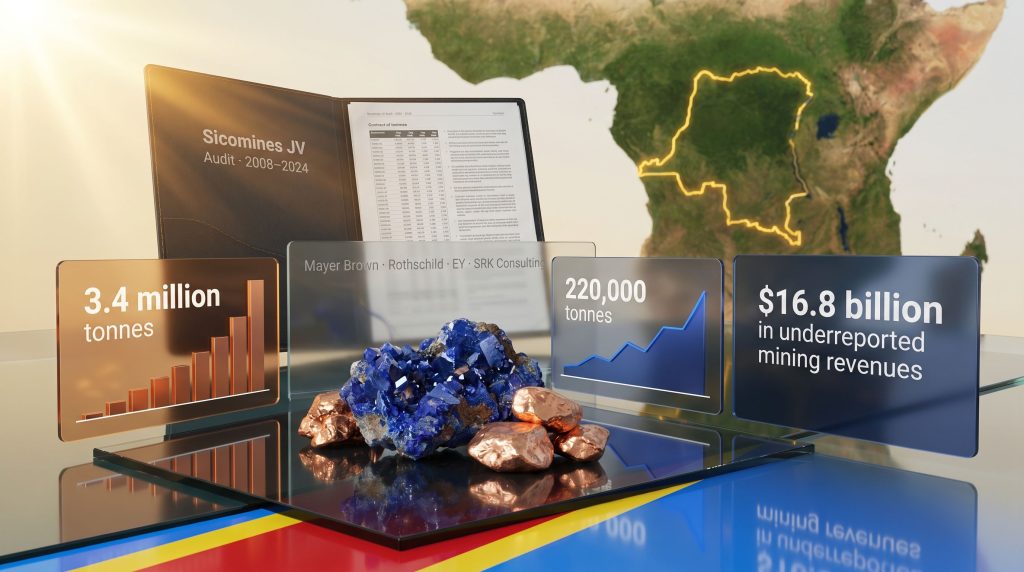
This is where a particularly damaging financial practice enters the picture: capital flight through fraudulent import declarations. In practice, this involves mining operators inflating the declared value of imported equipment, services, or materials, which artificially elevates recoverable costs and depresses taxable profits. Combined with the non-repatriation of export proceeds, these mechanisms represent a sustained and systematic siphoning of national wealth. Prior analysis identified approximately $16.8 billion in underreported mining revenues across the DRC between 2018 and 2023, a figure that contextualises the urgency behind President Felix Tshisekedi's 2026 directive.
"The $16.8 billion underreporting figure represents not an isolated incident but a structural fiscal drain operating across a five-year period, suggesting systemic rather than opportunistic revenue leakage."
Understanding the DRC's Two-Track Audit Framework Launched in 2026
The 2026 initiative is not a single audit. It operates on two distinct but complementary tracks, each targeting a different dimension of the revenue leakage problem.
The Sicomines Joint Venture Audit: Scope and Mandate
The first track is a dedicated, deep-dive review of the Sino-Congolese Mines joint venture, known as Sicomines or SCM. This entity operates under an equity structure where a Chinese consortium holds 68% and Gécamines retains 32%, with mining activities conducted under permits PE 9681 and PE 9682 in Lualaba Province. The formal audit was initiated on March 5, 2026, and covers a 16-year operational window from 2008 to 2024, spanning the original infrastructure-for-minerals agreement through to its 2024 amendment. The DRC's mining project review and appointment of specialist advisors reflects the considerable complexity involved.
The complexity of this audit is reflected in the advisory consortium engaged to conduct it. Four specialist firms bring distinct technical disciplines to the review:
- Mayer Brown (legal compliance and contractual analysis)
- Rothschild & Co (financial valuation and deal structure assessment)
- EY (accounting, financial performance, and tax compliance)
- SRK Consulting (technical and geological assessment)
The audit spans six dimensions: mining operations, financial performance, infrastructure expenditure, debt obligations (with total debt approaching $9 billion), legal compliance, and environmental performance. The infrastructure expenditure component is particularly significant given the original deal architecture, which was structured as an exchange of mining rights for Chinese-funded infrastructure development across the DRC.
The Broader Export Revenue and Joint Venture Governance Audit
The second track, initiated through a presidential directive at the April 24, 2026 cabinet meeting, extends scrutiny across all mining joint ventures in the country. Relevant ministers were given 30 days to formally initiate audit procedures, with preliminary findings required by June 15, 2026.
This track focuses on revenue traceability from the point of mineral export through to foreign exchange repatriation and government collection. Furthermore, the audit requires the integration of four critical data systems that have historically operated in isolation:
- Customs authority export documentation
- Port operations shipment records
- Central bank foreign exchange transaction data
- Commercial banking sector payment flows
The 2025 production benchmarks that provide context for this audit's scope are substantial: the DRC recorded copper output of 3.4 million tonnes and cobalt output of 220,000 tonnes, both representing significant volumes against which revenue traceability is being assessed.
| Audit Track | Launch Date | Coverage Period | Key Advisors | Primary Focus |
|---|---|---|---|---|
| Sicomines JV Audit | March 5, 2026 | 2008–2024 | Mayer Brown, Rothschild, EY, SRK | Infrastructure deal compliance, debt, governance |
| Broad Revenue & JV Audit | April 24, 2026 | Ongoing/current | Government ministries and agencies | Export revenue repatriation, capital flight |
Decoding the DRC Mining Code's Repatriation Requirements
Central to both audit tracks is the DRC Mining Code's repatriation framework, which operates on a sliding scale between 60% and 100% of export earnings. The applicable rate is determined by whether an operator has fully recovered its initial capital investment. Companies still in cost-recovery phase face the lower threshold, while those that have recouped their initial outlay face the highest repatriation obligations.
This two-tier structure creates significant compliance ambiguity, and it is not difficult to see why. The determination of when capital has been "fully recovered" involves complex accounting judgements, cost allocation methodologies, and transfer pricing practices that are notoriously difficult for minority state partners to independently verify. Aggressive cost recovery claims, whether through inflated import valuations or management fee charges, can extend the lower-repatriation phase indefinitely, keeping state revenue collection perpetually suppressed.
"The repatriation framework's sliding scale is theoretically designed to balance investor cost recovery with sovereign revenue rights, but its enforcement has historically depended on accounting transparency that minority state partners have often lacked the capacity to independently audit."
President Tshisekedi's framing of the state's required response as needing to be "firm, realistic, traceable, and technically applicable" is itself instructive. The language acknowledges a prior enforcement gap: the rules existed but the monitoring architecture to enforce them did not. The inter-agency data integration now being mandated is designed to close precisely that gap.
How Joint Venture Governance Creates Accountability Gaps
Gécamines' 32% stake in Sicomines has historically not translated into commensurate information rights or governance leverage. This is a structural pattern rather than an exception. In joint ventures where the majority partner controls operational management, accounting systems, and commodity offtake agreements, a minority state shareholder may technically be entitled to its share of declared profits while having limited visibility into whether those profits are accurately declared in the first place.
Comparative frameworks in nations such as Zambia, Botswana, and Chile have attempted to address this through mandatory production reporting to independent government agencies, third-party assay requirements, and real-time customs data feeds. The DRC's 2026 audit framework, by mandating inter-agency data connectivity, is attempting to build a comparable monitoring architecture, albeit retroactively.
The Macro-Fiscal and Geopolitical Case for Acting Now
The timing of these audits reflects converging fiscal and geopolitical pressures that have created a narrow but significant window for governance reform.
From a fiscal perspective, the relationship between uncollected mining revenues and the DRC's chronic infrastructure deficit is direct and measurable. A nation that cannot fully capture the value of its mineral exports faces compounding costs: lower government revenue, higher reliance on external debt, and reduced capacity to fund the infrastructure that would make future resource development more efficient. The $16.8 billion underreporting figure, spread across five years, represents a fiscal loss of a scale that dwarfs many international aid programmes directed at the DRC.
The geopolitical dimension is equally significant. The Sicomines structure, where a Chinese consortium holds a 68% controlling stake in exchange for infrastructure financing, has become a widely cited example of resource-backed infrastructure financing. The 2024 amendment to the original 2008 agreement triggered renewed scrutiny of the deal's overall architecture. Meanwhile, the Congolese cobalt rivalry between Western and Chinese interests has intensified dramatically as cobalt and copper have become central to electric vehicle battery supply chains.
A US-brokered peace framework involving Rwanda and the DRC, signed in December 2025, provided diplomatic context for renewed discussion of DRC mineral governance. The US-Congo mining partnership represents diplomatic engagement rather than direct project support or strategic designation for any specific mining operation, however.
The October 2024 crackdown on conflict mineral sourcing, which included explicit warnings to technology companies including Apple regarding the acquisition of tin, tantalum, and gold potentially connected to violence in eastern Congo and smuggled through neighbouring Rwanda, served as a direct precursor to the 2026 audit agenda. That intervention demonstrated both the DRC government's willingness to use regulatory mechanisms assertively and the international leverage available through critical mineral supply chain scrutiny.
How the DRC Audit Compares to Similar African Mining Reviews
The DRC's 2026 initiative does not exist in isolation. It forms part of a discernible continent-wide pattern of resource governance reassertion that has accelerated between 2024 and 2026.
Ghana's Comprehensive Gold Sector Audit
In October 2025, Ghana launched what was described as the most thorough review of its mining sector in a decade, with particular emphasis on the gold industry. The audit examined production metrics, mineral distribution channels, tax and royalty compliance, and environmental adherence across operations managed by a roster of globally significant operators:
- Newmont (United States)
- Zijin Mining (China)
- AngloGold Ashanti and Gold Fields (South Africa)
- Perseus Mining (Australia)
- Asante Gold (Canada)
The audit process commenced in November 2025 with Gold Fields' Damang facility and Perseus operations, with completion of Xtra-Gold's Kibi unit scheduled for June 2026, creating a timeline that runs almost parallel to the DRC's preliminary findings deadline.
Senegal's Multi-Sector Extractive Audit
Senegal's audit journey began in April 2024, when newly inaugurated President Bassirou Diomaye Faye, himself a former tax inspector, announced a comprehensive review of the nation's oil, gas, and mining sectors in a nationally televised address. The appointment of a tax professional to the nation's highest office, followed immediately by a multi-sector extractive audit, signals how directly the fiscal dimensions of resource governance shaped Senegal's political transition. Faye simultaneously communicated continued openness to international investment, framing accountability and attractiveness as complementary rather than contradictory policy objectives.
| Country | Audit Launched | Sector Focus | Key Trigger | Timeline Status |
|---|---|---|---|---|
| DRC (Sicomines) | March 2026 | Copper-cobalt JV | Infrastructure deal compliance review | Active |
| DRC (Broad Revenue) | April 2026 | All mining JVs | Capital flight and repatriation enforcement | Findings due June 2026 |
| Ghana | October 2025 | Gold mining | Decade of transparency concerns | Active through June 2026 |
| Senegal | April 2024 | Oil, gas, and mining | New government reform mandate | Ongoing |
The next major ASX story will hit our subscribers first
Operational and Investment Implications for Mining Companies
For multinational mining operators with DRC joint venture exposure, the DRC mining joint venture audit mandate creates a layered set of compliance and disclosure risks that deserve careful analysis.
The most immediate variable is where each operator sits relative to capital recovery status. Companies that have fully recouped their initial investment face 100% repatriation obligations, meaning that any historical period during which full repatriation was not achieved could generate retroactive liability claims. The multi-disciplinary structure of the Sicomines advisory consortium, combining legal, financial, accounting, and geological expertise, significantly increases the probability of identifying previously unquantified liabilities that individual disciplines might miss in isolation.
The June 15, 2026 preliminary findings deadline creates a near-term material disclosure risk for any listed mining company with meaningful DRC joint venture exposure. Investors monitoring affected operators should watch for:
- Guidance updates or earnings revisions ahead of the preliminary findings release
- Disclosure of contingent liabilities in financial statements
- Any formal communications from the DRC government regarding individual operator findings
- Changes to hedging or production guidance that may signal operational uncertainty
Post-audit corrective measures could range across a spectrum of interventions, from renegotiated equity structures and revised profit-sharing ratios to mandatory back-tax payments, royalty adjustments, or the establishment of dedicated inter-agency monitoring infrastructure for ongoing compliance.
Disclaimer: Nothing in this article constitutes financial advice. Investors should conduct their own due diligence and consult licensed financial advisors before making investment decisions related to companies with DRC mining exposure.
Step-by-Step: How the DRC Mining Joint Venture Audit Process Works
- Presidential Directive Issued — Cabinet meeting of April 24, 2026; relevant ministers formally notified of the audit mandate and compliance obligations.
- 30-Day Initiation Window — Ministries must formally launch audit procedures within one month of the directive, targeting a start date no later than May 24, 2026.
- Inter-Agency Data Integration — Customs, port operations, central bank, and commercial banking institutions are required to build a unified revenue traceability architecture capable of tracking export proceeds end-to-end.
- Field and Document Review — Technical, financial, legal, and environmental assessments conducted at the joint venture level, with the Sicomines audit incorporating the specialist advisory consortium.
- Preliminary Findings Submitted — Deadline of June 15, 2026; covers identification of governance shortcomings, estimates of uncollected revenues, and initial findings on repatriation compliance.
- Corrective Measures Proposed — Audit body recommends enforceable remediation actions tailored to identified non-compliance categories.
- Government Response — The presidential council of ministers determines the enforcement pathway, including whether retroactive claims, renegotiations, or structural reforms will be pursued.
Frequently Asked Questions: DRC Mining Joint Venture Audit
What triggered the DRC's 2026 mining joint venture audit?
The audit was initiated in response to longstanding concerns about capital flight, systematic non-repatriation of export proceeds, and opaque joint venture governance structures. Prior analysis identified approximately $16.8 billion in underreported revenues between 2018 and 2023, providing the quantitative foundation for the presidential directive. The 2024 amendment to the Sicomines agreement also appears to have catalysed renewed scrutiny of the broader deal architecture.
Which companies are affected by the DRC mining audit?
The audit covers joint ventures across the DRC mining sector, including large-scale copper and cobalt operations. The Sicomines joint venture, involving a Chinese consortium holding 68% and Gécamines at 32%, faces a dedicated audit covering 2008 to 2024. Broader operations run by major global mining operators, including CMOC Group, Glencore, and Barrick Mining, which carry state or state-owned entity minority stakes, are also within the scope of the broader revenue and governance audit.
What is the repatriation requirement under DRC mining law?
Congolese mining regulations require operators to repatriate between 60% and 100% of export earnings. The applicable rate is determined by whether the operator has fully recovered its initial capital investment, with higher obligations applying once cost recovery is complete.
When will the DRC audit results be published?
Preliminary findings from the broader revenue and joint venture audit are expected by June 15, 2026. The Sicomines-specific audit, covering a 16-year operational period with six distinct assessment dimensions, may follow a longer reporting timeline given its considerable complexity.
How does the DRC audit compare to similar African mining reviews?
Ghana launched a comprehensive gold sector audit in October 2025, targeting June 2026 for completion. Senegal initiated a multi-sector extractive audit in April 2024. The DRC's 2026 initiative forms part of a broader continental governance trend in which resource-rich African nations are moving from passive royalty collection toward active revenue traceability and assertive joint venture oversight. Furthermore, the broader mining geopolitics shaping these decisions extend well beyond the DRC's borders.
African Resource Sovereignty and the Future of Mining Joint Ventures
Redefining the Terms of Extractive Partnerships
The concurrent audit initiatives across the DRC, Ghana, and Senegal are not coincidental. They reflect a structural shift in how African governments conceptualise their relationship with extractive industries. The previous paradigm, in which sovereign nations largely accepted the terms set by better-resourced foreign investors and collected whatever revenues flowed through formal royalty and tax channels, is giving way to a more assertive model built around independent verification, real-time data integration, and retroactive accountability.
The critical minerals supercycle is amplifying the fiscal stakes considerably. As global demand for cobalt and copper accelerates in line with electric vehicle adoption and energy storage deployment, the value of what is being extracted from countries like the DRC increases dramatically. A governance framework that was merely inefficient in a period of moderate commodity prices becomes economically devastating when the same minerals are commanding premium valuations on global markets. In addition, the DRC cobalt export suspension earlier in 2025 demonstrated just how consequential unilateral DRC policy decisions can be for global supply chains.
Implications for the Global Critical Minerals Supply Chain
The DRC's cobalt and copper output is not easily replaceable. The concentration of these resources in a single jurisdiction means that governance-driven disruptions, whether through renegotiated joint venture terms, production interruptions during audit processes, or retroactive financial claims that affect operator investment decisions, carry genuine supply chain consequences for battery manufacturers and energy infrastructure developers worldwide.
Two competing scenarios shape the long-term outlook:
- Scenario A: Improved governance and revenue transparency attract higher-quality foreign investment characterised by greater accountability, more sustainable operating practices, and longer-term capital commitment, ultimately strengthening the DRC's fiscal position without disrupting supply.
- Scenario B: Aggressive retroactive enforcement creates operational uncertainty, deters new capital allocation, and introduces short-to-medium term supply chain volatility, potentially affecting global battery metal availability during a period of peak demand growth.
The degree to which the DRC government balances enforcement credibility with investment climate predictability will likely determine which scenario prevails. Senegal's President Faye demonstrated one model for managing this tension by coupling an audit announcement with explicit reassurances about continued openness to foreign investment — a dual message that the DRC may need to articulate with comparable clarity as preliminary findings approach in June 2026.
What is beyond dispute is that the era of passively accepted opacity in African extractive joint ventures is drawing to a close. The DRC mining joint venture audit of 2026 may ultimately be remembered less as a single policy event and more as a visible marker of a deeper, continent-wide transformation in how resource sovereignty is exercised in practice.
Want to Stay Ahead of the Next Major Mineral Discovery?
Discovery Alert's proprietary Discovery IQ model delivers real-time alerts on significant ASX mineral discoveries — cutting through the complexity of global commodity shifts to surface actionable investment opportunities the moment they are announced. Explore Discovery Alert's discoveries page to see how historic mineral finds have generated substantial returns, and begin your 14-day free trial to position yourself ahead of the broader market.