August 6, 2026
The Hidden Architecture of Global Cobalt Dependency
Beneath every electric vehicle battery, every aerospace turbine blade, and every precision-guided defense system lies a supply chain most consumers never see. Cobalt sits at the intersection of all three, and its geography tells a story that industrial policymakers are only now beginning to fully reckon with. The world does not have a cobalt problem in the conventional sense. It has a cobalt concentration problem, one that is forcing the United States to fundamentally rethink where its critical mineral relationships begin and end.
The DRC U.S. cobalt supply chain relationship is not simply a bilateral trade story. It is a window into the structural vulnerabilities of modern industrial economies, the long-term consequences of two decades of Chinese upstream investment in Africa, and the extraordinary leverage that a single country, the Democratic Republic of Congo, now holds over the global technology sector.
When big ASX news breaks, our subscribers know first
Why Cobalt's Supply Geography Is Unlike Any Other Critical Mineral
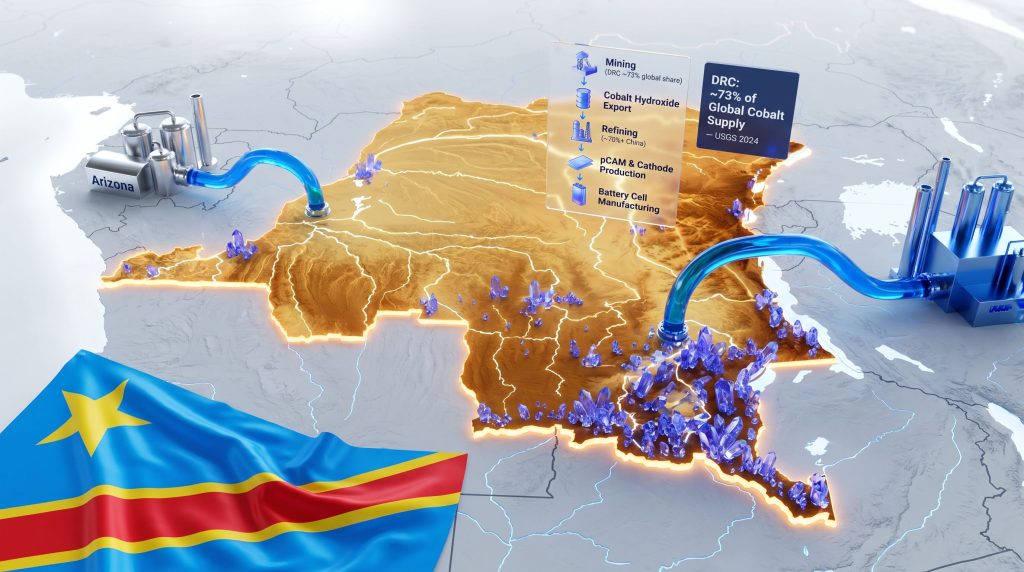
Most critical minerals have concentration risks. Few have them to the degree that cobalt does. According to U.S. Geological Survey data, the DRC accounted for approximately 73% of global cobalt mine production in 2024, a figure that has remained structurally elevated for years. The next-largest producers, including Australia, the Philippines, and Russia, collectively supply a fraction of what a single African country delivers to global markets each year.
This is not a gap that is narrowing meaningfully at current investment trajectories. New cobalt projects in non-DRC jurisdictions face longer permitting timelines, lower-grade deposits, and higher unit costs compared with the Congolese copper-cobalt belt, which hosts some of the richest cobalt-bearing ore bodies on the planet. The Katanga province alone contains geological formations with cobalt grades that dwarf anything available in peer jurisdictions, making the DRC's dominance a function of geology as much as geopolitics. The broader cobalt mining industry continues to reflect this structural imbalance year after year.
The DRC's cobalt advantage is fundamentally geological. The Central African Copperbelt hosts sediment-hosted stratiform copper-cobalt deposits with cobalt grades that can exceed 0.3% Co, orders of magnitude higher than what is typically found in laterite or magmatic sulphide deposits elsewhere in the world. This grade premium makes Congolese cobalt structurally cheaper to produce at scale, which is why competing supply cannot simply be willed into existence through policy alone.
Cobalt's applications compound this concentration risk further. It is irreplaceable in the nickel-cobalt-manganese (NCM) and nickel-cobalt-aluminium (NCA) cathode chemistries that currently dominate high-energy-density battery applications. While lithium iron phosphate (LFP) batteries have reduced cobalt intensity in some market segments, the highest-performance EV batteries, aerospace-grade superalloys requiring cobalt for heat resistance, and defense electronics all maintain hard-to-substitute cobalt dependencies.
Demand curves from EV adoption, grid-scale energy storage, and military modernisation programs are converging simultaneously, creating a structural demand floor that makes supply security a non-negotiable priority. Furthermore, as research from the Cobalt Institute highlights, Western nations have been slow to build the downstream processing infrastructure needed to compete with established Chinese networks.
The Cobalt Value Chain: From DRC Mines to U.S. End Users
Understanding why the DRC barely features in official U.S. cobalt import data requires tracing how cobalt actually moves through the global value chain. The metal does not travel in a straight line from mine to manufacturer.
| Stage | Dominant Geography | Key Players |
|---|---|---|
| Mining (raw ore) | DRC (~73% global share) | Industrial mines + ASM sector |
| Cobalt hydroxide export | DRC | EGC, Glencore, CMOC |
| Refining (cobalt sulfate/metal) | China (~70%+ of global capacity) | Chinese state-linked processors |
| pCAM and cathode production | China, South Korea, Japan | Battery material manufacturers |
| Battery cell manufacturing | China, South Korea | CATL, Samsung SDI, LG Energy |
The DRC exports cobalt primarily as cobalt hydroxide, a semi-processed intermediate product. That hydroxide then flows into Chinese refining networks, where it is converted into battery-grade cobalt sulphate or refined cobalt metal. The refined output is then sold globally, including to processors in Norway, Finland, and Japan, which are among the top identified sources of U.S. cobalt imports.
This explains a counterintuitive reality: the DRC does not appear prominently in U.S. import records despite being the world's dominant producer, because its output reaches American supply chains only after passing through multiple third-country intermediaries. Consequently, the DRC cobalt export ban of 2025 exposed just how fragile these indirect pathways truly are.
According to USGS data, the United States produced only 300 tonnes of cobalt domestically in 2025, a negligible fraction of national consumption. Norway, Finland, Canada, and Japan collectively supplied approximately 70% of U.S. cobalt imports, with Canada being the only one among this group with meaningful primary cobalt mining output. The other three function primarily as refining and processing hubs, not original source nations.
This layered structure obscures origin and concentrates processing leverage in Chinese hands, which is precisely the vulnerability that current U.S. policy is attempting to address.
The Artisanal Mining Layer: Risk, Opportunity, and the EGC Mandate
A dimension of the DRC cobalt story that receives insufficient attention in mainstream analysis is the role of artisanal and small-scale mining, commonly referred to as ASM. ASM accounts for a meaningful portion of total Congolese cobalt output, with estimates varying based on methodology, and it operates through fundamentally different channels than large-scale industrial mining.
Historically, ASM cobalt has carried significant traceability risks. Informal purchasing networks, limited regulatory oversight, and well-documented concerns about labour conditions, including child labour, have created reputational and compliance barriers for downstream buyers subject to due diligence requirements under frameworks like the OECD Guidelines for Multinational Enterprises. The cobalt export suspension impact analysis of 2025 demonstrated how deeply these informal networks are embedded in the broader supply structure.
This is where Entreprise Générale du Cobalt (EGC) becomes strategically significant. Established in 2019 as a Congolese state-owned entity, EGC holds a statutory monopoly over the purchase, processing, and export of cobalt sourced from artisanal miners. The design intent is to create a single, traceable channel that converts informal ASM production into certified, compliant material eligible for international supply chains. In principle, EGC functions as a formal market-maker between thousands of small-scale miners and international buyers who require documented sourcing.
The model's practical effectiveness depends on several factors that remain works in progress:
- EGC's purchasing price competitiveness relative to informal buyers who operate outside regulatory frameworks
- The company's logistical and operational infrastructure in Lualaba and other producing provinces
- Enforcement capacity to ensure ASM cobalt flows through official channels rather than bypassing them
- International buyer confidence in EGC's certification and audit standards
A USAID initiative launched in January 2025, focused on formalising artisanal cobalt mining in Lualaba Province in partnership with the Fair Cobalt Alliance and EGC, directly targets these operational gaps. The program reflects a recognition that traceability infrastructure, not just supply agreements, is the prerequisite for building a credible DRC-to-U.S. cobalt corridor.
Three U.S.-Linked Initiatives Reshaping the DRC Cobalt Landscape
Several distinct but related initiatives are now attempting to operationalise U.S. strategic interest in Congolese cobalt. Each reflects a different entry point into the value chain and carries its own risk profile.
| Initiative | Structure | Scale | Status (Mid-2026) |
|---|---|---|---|
| EGC-EVelution Energy | State-to-private supply agreement | Up to 40% of U.S. demand | Under active negotiation |
| Virtus Minerals / Chemaf SA | Private acquisition of operating mines | ~20,000 t/year potential | Acquisition complete; restart pending |
| Orion Critical Minerals / Glencore | Consortium stake purchase | Mutanda and Kamoto assets | Binding agreement pending |
The EGC-EVelution Energy Supply Corridor
In May 2026, EGC announced active negotiations with U.S.-based EVelution Energy to establish a direct cobalt supply corridor between the DRC and the United States. The proposed structure would see EGC supply cobalt hydroxide as feedstock for EVelution Energy's processing facility currently under construction in Arizona, with the partnership designed to potentially cover up to 40% of U.S. cobalt demand.
EGC's allocated export quotas provide a concrete ceiling for near-term volumes: 1,775 tonnes for 2026, scaling to 5,640 tonnes for 2027 under the quota system introduced following the partial lifting of the DRC cobalt export ban. During the embargo period in early 2025, when Congolese exports were concentrated in January and February before restrictions tightened, the United States alone imported 1,103 tonnes of Congolese cobalt in a single month of February, demonstrating the latent demand that formal supply channels have not yet consistently served at scale.
Virtus Minerals and the Chemaf SA Acquisition
In April 2026, U.S.-based Virtus Minerals finalised its acquisition of Chemaf SA, the operator of the Etoile and Mutoshi copper-cobalt mines in the DRC. The company has described the transaction as a strategic step aimed primarily at supplying the U.S. market directly from Congolese production assets.
The operational potential is substantial. Once fully optimised, the two sites could together produce approximately 20,000 tonnes of cobalt annually according to Chemaf's operational estimates. However, the path from acquisition to optimised production requires resolving a significant financing challenge. A capital requirement of approximately $700 million has been identified for the restart and optimisation program, but as industry publication Bankable has noted, the financing structure for this commitment remains unconfirmed as of mid-2026.
Orion Critical Minerals and the Glencore Stake
Orion Critical Minerals, a Washington-linked consortium established in 2024, is pursuing a 40% stake in Glencore's Mutanda and Kamoto mining operations. These assets rank among the highest-volume cobalt-producing mines globally. The transaction remains subject to final binding agreements and regulatory approvals, meaning it exists at the moment as a strategic intention rather than an operational commitment.
The Chinese Refining Chokepoint: Why Upstream Access Is Not Enough
Securing mining rights or supply agreements in the DRC addresses only one dimension of Western cobalt vulnerability. The more structurally embedded problem is China's dominance over the refining stage that sits between Congolese mines and Western manufacturers. The intensifying US-China cobalt rivalry has made this chokepoint one of the most strategically sensitive nodes in the entire global supply chain.
China controls an estimated 70% or more of global cobalt refining capacity. This means that even when Western companies own DRC mining assets outright, converting cobalt hydroxide into battery-grade materials has historically required either Chinese processing or the construction of alternative refining infrastructure from scratch.
| Refining Scenario | Location | Timeline | Strategic Benefit |
|---|---|---|---|
| Status quo | China | Operational now | None for U.S. or EU |
| Arizona processing (EVelution) | United States | Under construction | Reduces U.S. refining dependency |
| In-country DRC refining | DRC | Long-term and conceptual | Maximum value retention for DRC |
| European refining hub | EU member states | Medium-term | EU supply chain security |
EVelution Energy's Arizona facility is the first serious U.S. attempt to establish domestic cobalt processing specifically designed to receive DRC feedstock. Its operational success would validate the model of pairing upstream African resource access with downstream Western processing investment, a template that could be applied across other critical minerals if proven at scale. The U.S. International Development Finance Corporation has similarly identified this refining gap as a core priority in countering Chinese dominance across critical mineral value chains.
The next major ASX story will hit our subscribers first
Structural Barriers That Could Limit These Ambitions
Strategic intent and operational reality have historically diverged in DRC mining investment. Several compounding risk factors deserve serious investor and policy attention.
Financial execution risk is perhaps the most immediate concern. The $700 million Chemaf SA restart program has no confirmed financing structure. Large-scale mining restarts in the DRC face layered cost pressures including infrastructure deficits, logistics constraints in a landlocked region, currency volatility, and regulatory compliance costs that can materially expand project budgets beyond initial estimates. The history of announced DRC mining investments that were delayed or restructured due to financing gaps is extensive.
Regulatory and commercial complexity adds further uncertainty. Neither the Orion-Glencore transaction nor the EGC-EVelution supply agreement has reached binding execution as of mid-2026. The DRC government's policy environment, including the export quota system and EGC's monopoly structure, introduces variables that require ongoing navigation. China's established commercial relationships with the same Congolese mining counterparties create competitive pressure that Western investors cannot ignore.
Operational sequencing matters enormously for the EGC initiative specifically. EVelution Energy's Arizona processing facility is under construction but not yet operational. The EGC supply channel cannot function at intended scale until receiving infrastructure is in place. Scaling from the 2026 quota allocation of 1,775 tonnes to the 5,640-tonne 2027 target requires parallel progress across mining, logistics, export certification, and processing simultaneously. The Congo cobalt price impacts observed during the 2025 embargo underscore how quickly market disruptions can cascade when operational sequencing breaks down.
What Success Would Actually Mean for the Global Cobalt Balance
If the DRC U.S. cobalt supply chain initiatives described above reach operational maturity, the implications extend well beyond bilateral trade statistics. A functioning direct corridor between Congolese artisanal production, via EGC, and U.S. processing capacity would represent the first significant Western-aligned alternative to the DRC-China processing pipeline that has operated largely without competition for two decades.
For the DRC, the strategic moment is equally significant. Kinshasa has already demonstrated willingness to use cobalt export controls as a policy instrument, evidenced by the 2025 embargo and the subsequent quota system. As competing Western and Chinese demand intensifies, the DRC's leverage in negotiating for better commercial terms, greater in-country value addition, and stronger infrastructure commitments from foreign partners is growing, not diminishing.
The DRC cobalt supply question is ultimately a test of whether industrial policy can translate strategic intent into supply chain reality against a Chinese incumbent that has spent two decades building infrastructure, commercial relationships, and processing capacity across the African critical minerals landscape. The gap between announcement and delivery will define whether this decade belongs to aspiration or execution.
The answer will depend not on whether the United States recognises the strategic importance of Congolese cobalt, a question already settled in the context of the DRC U.S. cobalt supply chain, but on whether the financial, operational, and diplomatic commitments required to build genuinely alternative supply chains can be sustained through the multi-year timelines that resource development invariably demands.
This article contains forward-looking statements and projections based on publicly available information as of mid-2026. Figures relating to project timelines, production targets, financing structures, and negotiation outcomes are subject to change. This content is intended for informational purposes only and does not constitute financial or investment advice. Readers should conduct independent due diligence before making any investment decisions related to companies or projects discussed herein.
Want to Stay Ahead of the Next Major Critical Minerals Discovery?
Discovery Alert's proprietary Discovery IQ model delivers real-time alerts on significant ASX mineral discoveries — including critical minerals like cobalt — transforming complex market data into actionable insights for investors at every level. Explore historic examples of major discoveries and their substantial returns, then begin your 14-day free trial at Discovery Alert to position yourself ahead of the market.