August 20, 2026
When Capital Expenditure and Free Cash Flow Rise Together, the Business Model Is Working
In most capital-intensive mining operations, a year of aggressive infrastructure investment comes at a direct cost to free cash flow. Management teams routinely ask shareholders to accept short-term cash compression in exchange for long-term production growth. This trade-off is so common it has become an accepted norm across the global gold mining sector.
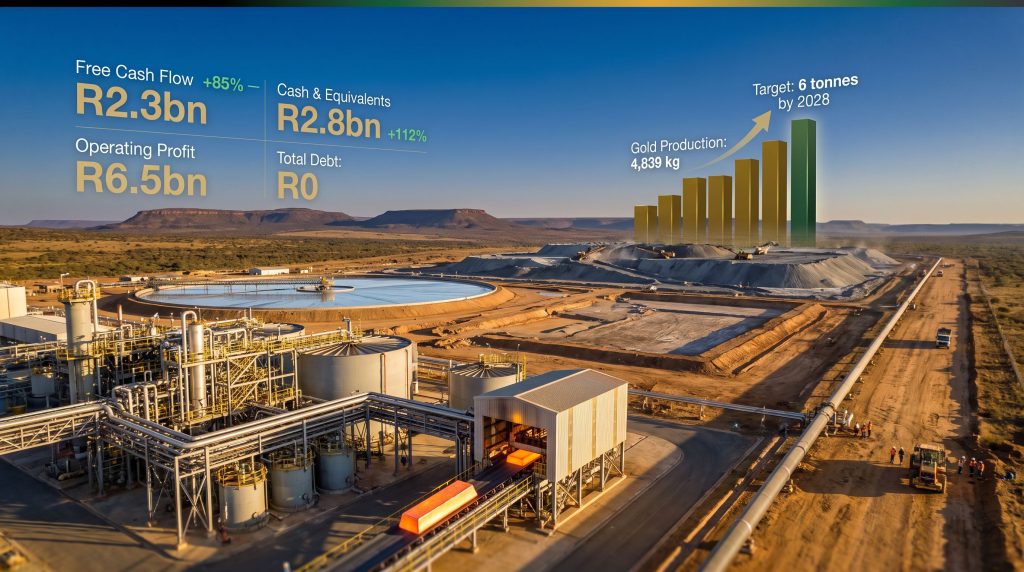
What makes DRDGOLD's FY2026 financial results structurally interesting is that this trade-off appears to have been largely avoided. DRDGOLD free cash flow up 85% to R2.3bn represents one of the more compelling combinations seen in South African gold mining: the company deployed R3.5 billion in capital expenditure — its heaviest single-year investment under the Vision 2028 programme — while simultaneously growing free cash flow. Understanding how that combination was achieved requires looking beyond headline numbers and examining the operational mechanics underneath.
When big ASX news breaks, our subscribers know first
The FY2026 Numbers in Full: What the Data Actually Shows
The scale of DRDGOLD's FY2026 performance becomes clearer when the key metrics are viewed together rather than in isolation. Furthermore, examining how these figures interact reveals a business generating genuine cash leverage rather than simply riding favourable commodity conditions.
| Financial Metric | FY2026 Result | Year-on-Year Change |
|---|---|---|
| Free Cash Flow | R2.3 billion | +85% |
| Operating Profit | R6.5 billion | +83% |
| Headline Earnings | R4.3 billion | +89% |
| Cash and Cash Equivalents | R2.8 billion | +112% |
| Capital Expenditure | R3.5 billion | Peak investment cycle |
| Gold Production | 4,839 kg | Exceeded annual guidance |
| Total Debt | R0 | Debt-free balance sheet |
| Final Cash Dividend | R1.20 per share | Declared |
Several dynamics within this table deserve particular attention:
- The 112% surge in cash equivalents to R2.8 billion occurred during the heaviest capital deployment year in Vision 2028's history, not after it
- Gold production of 4,839 kg exceeded annual guidance, confirming that throughput was not sacrificed to fund construction activity
- The zero-debt position was maintained throughout the entire year, despite over R5 billion in cumulative Vision 2028 investment committed to date
- Headline earnings rising 89% to R4.3 billion reflects the leverage effect of operating profit growth flowing through to the bottom line with limited debt servicing drag
Key Insight: Achieving an 85% rise in free cash flow alongside R3.5 billion in capital expenditure is an uncommon combination in South African gold mining. It signals that the underlying processing operations are generating genuine cash leverage, not simply benefiting passively from gold price movements.
It is worth noting, as DRDGOLD CEO Niël Pretorius acknowledged, that gold price conditions have been supportive during this period. What the company can control, he noted, is operational execution, capital discipline, and how favourable conditions are used to leave the business structurally stronger. The gold price impact on mining equities is well documented, and the FY2026 results suggest DRDGOLD's controllable factors were managed effectively alongside that tailwind.
What Is Vision 2028 and Why Does Its Architecture Matter?
Vision 2028 is DRDGOLD's approximately R10-billion multi-year capital programme designed to reshape the company's production profile through 2028 and beyond. Its three primary objectives are:
- Increasing combined processing throughput across the Ergo and Far West Gold Recoveries (FWGR) operational hubs
- Lifting annual gold production toward six tonnes by 2028
- Materially extending FWGR's life-of-mine
As of FY2026 year-end, more than R5 billion has been committed to the programme, representing over half of the total planned investment. Critically, this capital is now beginning to translate from construction activity into commissioned operating infrastructure.
Vision 2028 Infrastructure Progress at a Glance
| Programme Milestone | Status at FY2026 Year-End |
|---|---|
| Total Investment Committed | R5+ billion of ~R10 billion |
| Daggafontein Tailings Storage Facility | First water June; first tailings July – commissioned |
| DP2 Plant Expansion (FWGR) | Elution circuit and smelt house commissioned; first gold poured |
| Regional Tailings Storage Facility (RTSF) | ~67% complete |
| Libanon Pipeline Network | ~95% complete |
| Libanon Water Use Licence | Approved July 2026 |
| Kloof 2 Dump Transfer (from Sibanye-Stillwater) | Completed December 2025 |
| Withok Tailings Storage Facility (Ergo) | Anticipated completion 2029 (subject to regulatory approvals) |
The transition from capital commitment to operational commissioning is a pivotal inflection point in any major mining infrastructure programme. For investors and analysts tracking DRDGOLD's production trajectory, the shift from construction-phase reporting to first-gold and first-tailings milestones across multiple sites simultaneously is a meaningful change in the programme's narrative.
How the Ergo Operation Is Being Structurally Extended
Ergo is DRDGOLD's flagship tailings reprocessing operation and the operational heart of the company's near-term cash generation. The strategic challenge at Ergo has always been managing deposition capacity as the legacy Brakpan Tailings Storage Facility approaches the end of its operational life.
Daggafontein: The First Major Vision 2028 Completion
The Daggafontein Tailings Storage Facility represents the first fully delivered project under Vision 2028. Key commissioning milestones included:
- First water received in June 2026
- First tailings deposited in July 2026
- Facility now operational and actively reducing Brakpan dependency
With Daggafontein commissioned, Ergo is positioned to sustain throughput of approximately 1.65 million tonnes per month in the absence of unforeseen operational disruptions. This is not a marginal improvement. Maintaining that throughput rate without Daggafontein would have required continued reliance on infrastructure that was already approaching maturity, introducing meaningful operational risk.
The Withok Facility: Long-Horizon Deposition Insurance
The Withok Tailings Storage Facility operates on a different timeline but carries profound long-term significance:
- Expected to add 150,000 tonnes per month of additional deposition capacity to Ergo
- Would bring Ergo's total deposition capacity to approximately 1.8 million tonnes per month
- Provides an additional 310 million tonnes of tailings storage capacity, foundational to the remainder of Ergo's life-of-mine
- Completion anticipated in 2029, contingent on regulatory approvals being granted by end of December 2026
Operational Note: Withok's near-term throughput contribution is modest relative to the overall Ergo production profile. Its real value lies in securing the long-term deposition runway that makes the rest of Ergo's operational life economically viable. In tailings reprocessing, storage capacity and production capacity are inseparable.
A lesser-known dimension of the Withok approval process is the significance of tailings storage facility licensing in South Africa's regulatory environment. Obtaining a new tailings storage facility licence involves multiple government departments, environmental impact assessments, and water use authorisation processes that can run concurrently or sequentially depending on the application pathway. The December 2026 approval deadline is consequently a firm external dependency rather than an internally controlled milestone.
FWGR: The Growth Engine Coming Online
Far West Gold Recoveries is where the most significant production growth upside within Vision 2028 is concentrated. Multiple interconnected infrastructure projects at FWGR are at different stages of completion, but the FY2026 year-end position is materially more advanced than twelve months prior.
DP2 Plant Expansion: Processing Backbone for the Next Phase
The expanded DP2 plant is central to FWGR's throughput growth strategy. Key commissioning achievements during FY2026 included:
- New elution circuit commissioned in July 2026
- New smelt house commissioned simultaneously
- First gold poured on the day of commissioning, a milestone that confirms the circuit moved directly from construction completion to operational status without a meaningful commissioning lag
The elution circuit is a technically critical component in the carbon-in-leach gold processing chain. During the elution process, gold is stripped from activated carbon using a hot caustic solution before the gold-bearing solution is processed through electrowinning cells and ultimately smelted into doré bars. The commissioning of a new elution circuit alongside a new smelt house represents the addition of complete end-to-end gold recovery capacity at the plant, not merely incremental throughput improvement. Full expansion of the DP2 plant is expected to be completed in Q2 FY2027.
The Libanon Reclamation Site: The Final Link in FWGR's Growth Chain
The Libanon reclamation site is planned to become the primary feed source for the expanded FWGR processing infrastructure. Its integration requires the completion of a pipeline network and pump station infrastructure, both of which were in advanced stages at FY2026 year-end:
- Pipeline network linking DP2, the RTSF, and Libanon was ~95% complete
- Water use licence for the Libanon pump station was approved in July 2026, removing the final regulatory barrier to pump station construction
- The RTSF was ~67% complete, with beneficial occupation required before Libanon feed can commence
Once the RTSF receives beneficial occupation and the DP2 expansion is complete, Libanon's planned throughput contribution is:
- Phase 1: 600,000 tonnes per month to FWGR's throughput profile
- Phase 2: Scaled to 1.2 million tonnes per month
To contextualise that scale, a throughput contribution of 1.2 million tonnes per month from a single reclamation site represents a very substantial addition to FWGR's processing capacity, with corresponding implications for gold production volumes moving toward the six-tonne annual target.
Kloof 2 Dump: How Tailings Operators Grow Reserves Without Exploration Drilling
One of the least understood competitive advantages of the tailings reprocessing business model is the mechanism through which reserves are added. In conventional underground or open-pit mining, reserve growth requires exploration drilling, geological interpretation, resource estimation, and ultimately ore reserve declaration. This process is expensive, time-consuming, and carries geological risk.
In the tailings reprocessing model, the equivalent process involves identifying, acquiring, or receiving the transfer of surface tailings dumps that have already been physically characterised. The Kloof 2 dump transfer from Sibanye-Stillwater to FWGR in December 2025 is an instructive example:
- The dump was transferred and subsequently classified as a mineral reserve under industry-standard reserve estimation guidelines
- The classification added 67 million tonnes to DRDGOLD's group mineral reserves
- FWGR's life-of-mine was extended by four years through a single asset transfer
The discovery cost per tonne of reserve added through this mechanism is structurally lower than greenfield exploration, and the geological uncertainty is substantially reduced because the physical material already exists on surface. Investors familiar with gold mining stock types will recognise this as a key differentiator for tailings-focused operators versus conventional producers.
Energy and Environmental Performance: Discipline During a Build Phase
A commonly overlooked dimension of large-scale mining capital programmes is the environmental performance trajectory during construction. Infrastructure build phases often result in temporary increases in energy consumption, water usage, and land disturbance as new facilities are established. DRDGOLD's FY2026 sustainability metrics move in the opposite direction.
Electricity Strategy: Building Toward Grid Independence
At Ergo, net electricity consumption sourced from Eskom and municipalities declined by 14% year-on-year. This was driven by:
- Increased contribution from Ergo's solar plant and battery energy storage system (BESS)
- Active use of electricity wheeling, a mechanism that allows renewable energy generated at one location to be transmitted across the grid and credited against consumption at another
Electricity wheeling is an evolving commercial framework in South Africa that has become more accessible to large industrial users following regulatory reforms. DRDGOLD's early adoption of mining electrification and decarbonisation strategies positions it favourably as energy costs and carbon obligations intensify across the sector.
Water and Safety: Sustained Improvement
- Group potable water consumption declined by 23% during FY2026
- DRDGOLD maintained its zero-fatality record throughout the financial year
- Lost-time injury frequency rate improved by 23%
- Reportable injury frequency rate improved by 67%
Sustainability Signal: A 23% reduction in potable water consumption and a 14% reduction in net grid electricity consumption, achieved simultaneously with the company's largest-ever capital deployment cycle, demonstrates operational discipline that is increasingly difficult to replicate in the broader South African resources sector.
The next major ASX story will hit our subscribers first
The Tailings Reprocessing Model vs Conventional Gold Mining: A Structural Comparison
Understanding why DRDGOLD's financial results look different from those of a conventional South African gold producer requires understanding the structural differences between the two operating models. In addition, the cut-off grade economics are fundamentally different — tailings operators process vast volumes at very low grades rather than targeting high-grade ore bodies, which shapes the entire cost and capital structure. For further context, cut-off grade economics play a pivotal role in how tailings projects assess viability.
| Dimension | Tailings Reprocessing Model | Conventional Underground Mining |
|---|---|---|
| Capital Intensity per Tonne | Lower (surface operations) | Higher (shaft sinking, underground infrastructure) |
| Safety Profile | Lower inherent risk (surface) | Higher risk (underground exposure) |
| Environmental Footprint | Remediation-positive (cleans legacy waste) | Extraction-negative (new surface disturbance) |
| Reserve Extension Mechanism | Asset transfers, dump acquisitions | New exploration and drilling campaigns |
| Energy Dependency | Hybrid (solar, BESS, wheeling, grid) | Predominantly grid-dependent |
| Grade Certainty | Lower average grades, high volume | Higher grades, lower volume |
| Life-of-Mine Extension Driver | Tailings storage capacity and dump acquisitions | Exploration success and ore body continuity |
Tailings deposits typically carry gold grades in the range of 0.2 to 0.5 grams per tonne (g/t), substantially below the average grades of operating underground gold mines. The economics of tailings reprocessing therefore depend fundamentally on processing very large volumes of material at low cost per tonne, rather than on extracting high-grade ore from a smaller physical inventory.
This is why throughput capacity, measured in tonnes per month, is the primary operational metric in DRDGOLD's reporting, and why Vision 2028's infrastructure investments are almost entirely focused on expanding deposition capacity, pipeline connectivity, and processing plant throughput.
Capital Allocation and Balance Sheet: The Debt-Free Discipline
DRDGOLD's decision to maintain a zero-debt balance sheet while simultaneously deploying R3.5 billion in capital expenditure and declaring a shareholder dividend is not simply a financial conservatism preference. It reflects a deliberate capital structure decision with compounding strategic benefits:
- No interest burden means operating cash flow is fully available for reinvestment and distribution
- No refinancing risk eliminates the vulnerability that indebted miners face during gold price downturns
- No debt covenants means operational and investment decisions are not constrained by lender requirements
- A cash position of R2.8 billion provides a substantial liquidity buffer for the commissioning phase ahead
The declaration of a final cash dividend of R1.20 per share during the company's peak investment year communicates a particular signal to income-oriented investors. It suggests management believes the operating cash generation capacity of the business is sufficient to sustain shareholder returns alongside infrastructure investment without requiring leverage. Indeed, DRDGOLD's 18-year dividend streak underscores just how consistently the company has maintained this discipline.
Key Risks and FY2027 Milestones to Monitor
The FY2027 period represents a transition from construction-phase reporting to commissioning-phase execution across multiple FWGR and Ergo sites simultaneously. Execution risk is elevated when multiple interdependent infrastructure components must achieve operational status within a compressed timeframe. Furthermore, the completion of a robust definitive feasibility study process underpins the confidence with which management is progressing each infrastructure milestone.
The critical external dependencies that investors and industry observers should track include:
- Withok regulatory approval by end of December 2026, which determines whether the 2029 completion timeline holds
- RTSF beneficial occupation, which is a prerequisite for Libanon throughput to commence
- DP2 full expansion completion in Q2 FY2027
- Libanon pump station construction commencement following water use licence approval
- Throughput maintenance at Ergo at approximately 1.65 million tonnes per month pending Withok commissioning
Forward-Looking Perspective: FY2027 will likely be assessed less on financial metrics and more on whether the commissioning sequence across FWGR unfolds as planned. The infrastructure foundation laid during FY2026 materially de-risks the production trajectory toward the six-tonne annual target, but the final execution of that ramp-up involves regulatory, engineering, and operational variables that are not fully within DRDGOLD's control.
With DRDGOLD free cash flow up 85% to R2.3bn alongside zero debt, peak capital investment, and a dividend maintained throughout, the FY2026 results present an unusually complete picture of a mining business operating effectively across financial, operational, and sustainability dimensions simultaneously.
Disclaimer: This article is intended for informational purposes only and does not constitute financial advice. Forward-looking statements, production targets, and financial projections referenced herein involve known and unknown risks and uncertainties. Readers should conduct their own independent research and consult a licensed financial adviser before making any investment decisions. Past performance is not indicative of future results. All figures are sourced from DRDGOLD's FY2026 annual results as reported by Mining Weekly.
Want to Identify the Next Major ASX Mining Discovery Before the Market Moves?
Discovery Alert's proprietary Discovery IQ model scans ASX announcements in real time, instantly converting complex mineral data into actionable insights across more than 30 commodities — giving subscribers a decisive edge the moment a significant discovery is announced. Explore historic examples of exceptional discovery returns and begin your 14-day free trial at Discovery Alert to position yourself ahead of the broader market.