July 28, 2026
The Geological Architecture Behind Canada's Gold Drilling Surge
Few investment themes in the natural resources sector generate as much sustained capital allocation as a mature, geologically proven jurisdiction entering a new exploration cycle. Canada's gold exploration landscape in 2026 represents precisely this convergence: a country with Archean bedrock among the oldest and most gold-bearing on Earth, now experiencing a measurable uplift in drilling activity. Keeping pace with gold exploration trends makes it clear that drilling for gold in Canada is attracting serious capital across multiple project stages.
What makes this moment distinctive is not simply that gold prices have remained elevated. It is that the economics of finding gold in Canada have improved structurally. Geophysical survey resolution has increased, predictive targeting has grown more precise, and the cost of mobilising modern drill rigs into previously inaccessible northern corridors has declined relative to historical norms. The result is a broad-based expansion in drilling for gold in Canada that spans everything from 1,500-metre initial drill tests to 30,000-metre infill campaigns.
When big ASX news breaks, our subscribers know first
Canada's Position in the Global Gold Hierarchy
Canada now ranks as the world's fourth-largest gold producer, a position it reached by surpassing the United States after a sustained period of exploration investment that began gaining serious momentum around 2016. This trajectory was not accidental. It reflects a deliberate accumulation of exploration capital directed at some of the world's most productive geological terranes. Understanding global gold production dynamics helps contextualise just how significant Canada's rise has been.
The country's geological endowment spans three primary deposit styles that account for the majority of its production:
- Archean greenstone belts hosting lode gold deposits of Neoarchean age, concentrated in Ontario and Quebec
- Orogenic shear zone systems where fluids migrating along crustal-scale faults deposited gold during periods of metamorphic activity
- Intrusion-related gold systems, particularly relevant in British Columbia and the Yukon, where gold is spatially and genetically linked to granitic intrusions
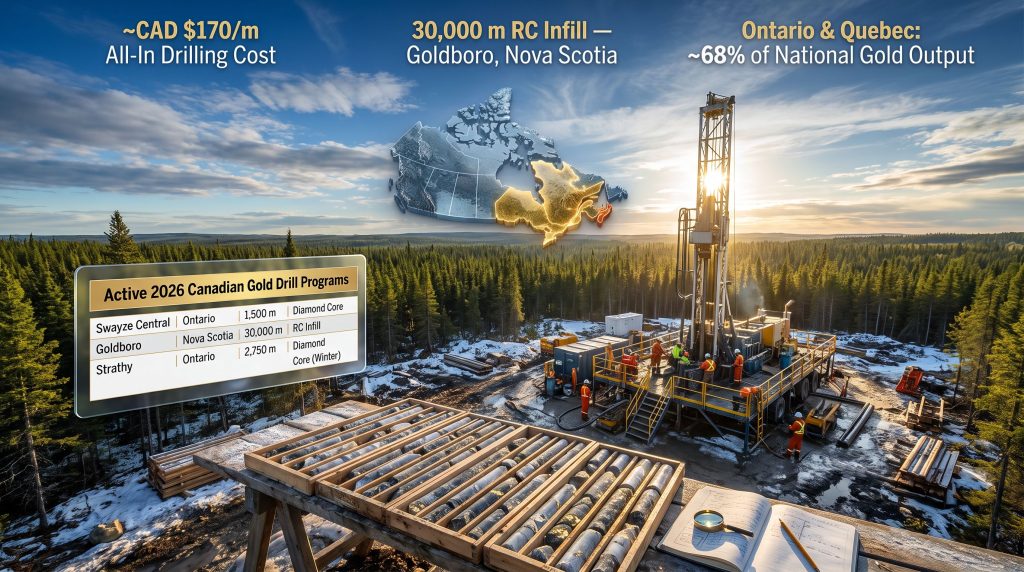
Ontario and Quebec collectively account for approximately 68% of Canada's national gold output as of 2024, a concentration that reflects both geological prospectivity and the infrastructure advantages of Canada's most populous provinces. Nova Scotia, British Columbia, Newfoundland, and New Brunswick represent a growing secondary tier of exploration jurisdictions, each with distinct geological characteristics and evolving regulatory frameworks.
"Canada's gold sector is not simply benefiting from elevated spot prices. It is experiencing a structural expansion in exploration activity, underpinned by geological prospectivity, stable mining jurisdictions, and improving drill program economics."
How Canada's Gold Exploration Landscape Breaks Down by Region
Ontario: The Engine of Canadian Gold Drilling
The Abitibi Greenstone Belt, shared between Ontario and Quebec, is widely regarded as one of the most prolific gold-producing geological formations on the planet. In Ontario, the belt's southwestern extensions into the Swayze and Atikokan corridors have attracted renewed attention in 2026, with multiple companies advancing drill programs at different stages of maturity.
A 1,500-metre diamond drill program at Swayze Central is anticipated to commence in late July 2026, targeting initial resource testing in a corridor that has historically seen less systematic drilling than the core Abitibi camps to the east. Meanwhile, a project near Atikokan has received permit approval for up to 20 drill holes totalling 2,500 metres, representing the early execution phase of a project that has completed its permitting cycle.
Northern Ontario also hosts the Strathy project, where a 2,750-metre winter diamond core program has already been completed, demonstrating that year-round drilling is operationally viable in accessible parts of the province.
Quebec: Tier-One Jurisdiction With Expanding Drill Pipelines
Quebec's appeal to exploration companies rests on three reinforcing advantages: geological continuity with Ontario's Abitibi belt, a regulatory framework that is well-understood by the industry, and a history of government-backed geological mapping that has systematically de-risked early-stage target generation.
The Lac Arsenault project in Quebec represents a 2026 program building on a maiden drill campaign of 58 or more holes, with the current phase designed to expand the resource envelope defined by that initial work. This progression from initial drill testing to systematic resource expansion is a common trajectory for Quebec gold projects and reflects the province's capacity to move projects through the exploration pipeline efficiently.
Nova Scotia, British Columbia, and Atlantic Canada: Emerging Frontiers
Nova Scotia has re-emerged as a credible gold exploration destination, anchored by the Goldboro project's 30,000-metre reverse-circulation infill program, one of the largest active drill programs in Atlantic Canada. The scale of this campaign reflects the project's maturity: infill drilling at this density is designed to tighten drill spacing and upgrade resource classification from inferred to indicated, a prerequisite for advancing toward feasibility studies.
British Columbia's polymetallic gold systems, Newfoundland's Appalachian gold belt, and early-stage activity in New Brunswick collectively represent a broadening of Canada's exploration geography beyond the traditional Ontario-Quebec axis.
What Types of Drilling Are Used in Canadian Gold Exploration?
The selection of drilling methodology is one of the most consequential technical decisions in any exploration program. Each method offers a different trade-off between data quality, cost efficiency, and operational flexibility.
| Drilling Method | Primary Application | Core Recovery | Cost Efficiency | Best Suited For |
|---|---|---|---|---|
| Diamond Core (DDH) | Resource definition, structural geology | High (continuous core) | Moderate to High per metre | Deep targets, complex geology |
| Reverse Circulation (RC) | Infill drilling, grade confirmation | Chip samples only | Lower cost per metre | Shallow to medium depth, bulk sampling |
| Rotary Air Blast (RAB) | Reconnaissance, near-surface screening | Low | Lowest cost | Early-stage target generation |
Why Diamond Drilling Dominates Canadian Gold Programs
Diamond drilling produces continuous core samples that allow geologists to interpret the structural controls governing gold mineralisation. In orogenic systems, where gold is hosted in veins and shear zones with complex geometries, understanding the orientation of mineralisation is fundamental to building an accurate resource model.
Oriented core, retrieved using specially designed core barrels that record the rotational position of the sample, allows geologists to measure vein dip, strike, and plunge direction directly from the drill hole. This data feeds directly into 3D geological modelling that guides subsequent drill hole placement. Without oriented core, resource models in structurally complex settings carry significantly higher uncertainty.
The logging and sampling workflow for diamond core also differs materially between operators. Junior explorers typically rely on contractor geologists and external assay laboratories, while mid-tier operators increasingly deploy automated core scanning technology to accelerate the logging process and reduce human interpretation variability.
The Role of RC Infill Drilling in Resource Upgrade Strategies
Reverse circulation drilling produces chip samples rather than continuous core, which limits its utility for structural interpretation. However, for programs focused on grade confirmation within an already-understood mineralised system, RC offers a compelling cost advantage.
The relationship between drill hole spacing and resource classification is governed by the reporting standards of National Instrument 43-101 in Canada. As drill spacing decreases, the statistical confidence in grade interpolation increases, allowing resources to migrate from:
- Inferred (limited geological evidence, least confidence)
- Indicated (sufficient spacing and sampling quality for reasonable confidence)
- Measured (tight spacing, high data density, highest confidence)
This progression from inferred to indicated is the critical threshold before a feasibility study process can rely on the resource for economic modelling. The Goldboro 30,000-metre RC infill program is explicitly designed to achieve this upgrade, making it a high-priority corporate milestone rather than simply an exploration exercise.
Many experienced operators now run simultaneous DDH and RC programs: diamond holes for structural control and geological interpretation, RC holes for cost-effective grade confirmation across broader areas.
What Does It Actually Cost to Drill for Gold in Canada?
Cost transparency is one of the more practically useful inputs for investors evaluating junior exploration companies. Canadian gold drilling costs are moderate to high relative to global peers, but this is offset by the quality of data produced and the regulatory certainty of the operating environment.
| Cost Component | Approximate Range | Notes |
|---|---|---|
| Drilling only (per metre) | ~CAD $100/m | Varies by depth, terrain, rig type |
| All-in cost (drilling + assays) | ~CAD $170/m | Includes sample prep and lab fees |
| Program mobilisation | Variable | Significantly higher in fly-in/fly-out locations |
| Permitting and environmental compliance | Variable by province | Ontario and Quebec have established, predictable frameworks |
Important disclaimer: The cost figures above are indicative estimates drawn from specific project disclosures and should not be interpreted as national averages. Actual program costs vary materially based on depth, remoteness, ground conditions, and seasonal access logistics.
Factors That Drive Cost Variability
Several operational variables can push per-metre costs significantly above or below indicative benchmarks:
- Terrain and access: Road-accessible projects in southern Ontario carry materially lower mobilisation costs than fly-in-only programs in northern Quebec or the Northwest Territories
- Ground conditions: Broken or highly fractured rock requires casing, mud programs, and slower penetration rates that increase cost per metre
- Contractor market: Regional rig availability fluctuates with exploration cycle intensity; tight rig markets in active periods drive up day rates
- Assay turnaround times: Laboratory bottlenecks during peak exploration seasons can extend program timelines and defer capital deployment decisions
Year-Round Drilling in Canada
One underappreciated operational advantage of Canadian exploration in accessible northern corridors is the viability of year-round drilling. Winter conditions in parts of Ontario and Quebec can actually improve site access: frozen lake surfaces and winter roads open remote areas that are inaccessible during summer months due to soft ground and water body crossings.
The trade-off involves cold-weather equipment protocols, heated drill shelters, and crew logistics that add operational complexity. However, for companies with continuous exploration programs, winter drilling preserves momentum, avoids the seasonal capital deployment gaps common in other jurisdictions, and can accelerate the timeline to resource milestones.
How Do Companies Structure a Canadian Gold Drill Program?
The progression from initial geological concept to drill-ready program follows a systematic workflow that reflects both technical best practice and regulatory requirements.
- Regional geophysical surveys using airborne magnetics, VTEM, and gravity to identify structural corridors prospective for gold mineralisation
- Soil and till geochemistry to delineate pathfinder element anomalies in glaciated terrain, where bedrock is typically obscured by transported overburden
- Trenching and channel sampling to expose bedrock mineralisation at surface and provide initial grade data
- Initial widely spaced drill testing at 200 to 400 metre centres to test conceptual targets and establish the presence and geometry of mineralisation
- Resource delineation drilling at 50 to 100 metre centres to build a resource model with sufficient data density
- Feasibility-stage infill at 25 to 50 metre centres for reserve estimation and mine planning inputs
Permitting and Indigenous Consultation: A Practical Reality
Standard exploration drilling permits in Ontario and Quebec typically require three to six months to obtain, though programs in environmentally sensitive areas or those requiring broader consultation may take longer. Ontario's Class Exploration Permit system and Quebec's exploration licence framework are both well-understood by the industry.
A dimension of Canadian permitting that is often underweighted by outside observers is the legally binding duty to consult with Indigenous communities. Under Section 35 of the Constitution Act, this obligation applies to exploration-stage activities, not only to production decisions. Companies that invest in genuine relationship-building with First Nations and Métis communities early in project development consistently achieve smoother permitting outcomes and stronger social licence to operate.
"The duty to consult is not simply a compliance checkbox in the Canadian context. It is a substantive legal obligation that intersects with project timelines at every stage, and companies that treat it as a strategic priority rather than a procedural hurdle tend to advance more quickly through permitting."
The next major ASX story will hit our subscribers first
Snapshot of Major Canadian Gold Drill Programs in 2026
| Project | Province | Program Size | Method | Strategic Objective |
|---|---|---|---|---|
| Swayze Central | Ontario | 1,500 m | Diamond core | Initial resource testing |
| Strathy | Ontario | 2,750 m | Diamond core (winter) | Resource expansion |
| Goldboro | Nova Scotia | 30,000 m | RC infill | Resource upgrade to indicated |
| Lac Arsenault | Quebec | Ongoing 2026 | Diamond core | Expansion of maiden 58-hole program |
| Central Canada Project (Atikokan) | Ontario | Up to 2,500 m (20 holes) | Diamond core | Exploration permit execution |
The disparity in program scale across this table is itself informative. The 1,500-metre Swayze Central program and the 30,000-metre Goldboro campaign represent fundamentally different stages of the exploration life cycle. Swayze Central is testing whether a mineral system exists; Goldboro is refining the boundaries and grade confidence of one that is already established. Both activities are classified as exploration, but their risk profiles, capital requirements, and potential outcomes differ enormously.
Canada vs. Global Peers: A Drilling Jurisdiction Comparison
| Factor | Canada | Australia | West Africa | Latin America |
|---|---|---|---|---|
| Geological prospectivity | Very High | Very High | High | High |
| Political and regulatory stability | Very High | Very High | Variable | Variable |
| Drilling cost environment | Moderate to High | Moderate | Lower | Lower to Moderate |
| Infrastructure access | Variable (remote) | Generally good | Limited | Variable |
| Indigenous consultation framework | Legally robust | Legally robust | Less formalised | Variable |
| Year-round operability | Seasonal | Largely year-round | Wet season disruption | Altitude-dependent |
Canada's higher cost environment relative to West Africa or parts of Latin America is the most commonly cited structural disadvantage. However, this cost differential is frequently offset by the risk-adjusted return of operating in a jurisdiction with enforceable property rights, transparent royalty and taxation frameworks, and access to deep capital markets.
The TSX and TSX Venture Exchange together host more listed mining companies than any other exchange globally, providing Canadian gold explorers with access to a uniquely specialised investor base that understands exploration-stage risk and is comfortable with the long capital deployment cycles that gold discovery requires.
Flow-through share financing is a mechanism exclusive to Canada that deserves particular attention from investors. Under this structure, exploration companies renounce qualifying exploration expenditures to investors, who can deduct those amounts from their personal taxable income. The practical effect is that the investor bears a lower effective cost of capital, and the company can raise exploration funds at a premium to market price. For junior explorers operating in remote northern Canada, flow-through financing can represent the difference between a program proceeding and being deferred.
Technologies Reshaping Gold Drilling Operations in Canada
Advanced Downhole and Surface Survey Technologies
Modern Canadian gold drill programs increasingly deploy a suite of technologies beyond the drill rig itself:
- Downhole electromagnetic (DHEM) surveys detect off-hole conductors that may represent mineralised structures not intersected by the drill hole, guiding follow-up targeting without additional surface drilling
- Borehole televiewers and acoustic imaging systems provide structural data in situations where oriented core recovery is poor, preserving the interpretive value of a drill hole even in difficult ground conditions
- Automated core scanning and hyperspectral imaging accelerate the logging process by identifying mineral assemblages associated with gold-bearing alteration zones, reducing reliance on manual identification under a hand lens
- Real-time data transmission from remote drill sites enables geologists based in urban technical centres to participate in targeting decisions without being physically present on site
AI and Machine Learning in Canadian Gold Exploration
One of the less widely discussed developments in Canadian gold exploration is the application of machine learning to till geochemistry interpretation. Because much of Canada's prospective gold terrain is covered by glacially transported overburden, the geochemical signal at surface reflects not only the underlying bedrock but also the direction and distance of glacial transport.
Furthermore, predictive models trained on historical drill databases and regional geophysical datasets are increasingly being used to reverse-engineer this transport component and identify bedrock source areas that warrant drilling. Interpreting drill results accurately is consequently becoming as important as the drilling itself, particularly as data volumes grow with each successive campaign.
The integration of 3D geological modelling software such as Leapfrog, Micromine, and Vulcan into drill program design has also become standard practice among mid-tier and well-capitalised junior operators. These platforms allow geologists to update resource models in near real-time as new drill results are received, enabling rapid tactical adjustments to hole placement and reducing the risk of drilling into already-tested ground.
ESG and Environmental Considerations
Modern Canadian drill programs operate under a progressively demanding set of environmental obligations. Key operational practices include:
- Directional drilling from single pads to access multiple subsurface targets while minimising surface disturbance
- Closed-loop mud systems that recycle drilling fluids and prevent contamination of local water bodies
- Reclamation bonding requirements that oblige companies to fund site rehabilitation from the outset of drilling activity
- Progressive rehabilitation protocols that restore disturbed areas during active programs rather than deferring all reclamation to post-program completion
The Investment Outlook for Canadian Gold Drilling
Macro Drivers Sustaining Exploration Budgets
The relationship between gold spot prices and exploration budget allocation is well-established in the literature: sustained price strength above key economic thresholds unlocks programs that were previously marginal on a cost-per-ounce-of-resource basis. Central bank gold purchasing, which has remained elevated in multiple consecutive years as institutional reserve managers diversify away from US dollar assets, provides a demand-side floor that supports longer-term price expectations.
Critically, the global gold industry faces a structural reserve replacement challenge. The average discovery-to-production timeline for a major gold deposit is typically measured in decades, and the volume of new discoveries required to replace depleted reserves in producing mines has not been met by exploration results in recent years. This depletion dynamic creates a structural incentive for major producers to increase exploration expenditure and pursue acquisitions of advanced Canadian exploration assets.
Strategic Scenarios for Canadian Gold Exploration Through 2027
Scenario A: Sustained Price Strength
Gold prices remain above USD $2,500 per ounce, driving broad-based expansion in drill program scale and encouraging mid-tier producers to enter grassroots exploration through farm-in agreements and joint ventures with junior explorers.
Scenario B: Price Consolidation
Gold prices stabilise in the USD $2,000 to $2,400 per ounce range, concentrating available capital in higher-confidence, near-development projects and creating a more competitive funding environment for early-stage programs.
Scenario C: Supply Constraint Shock
A significant reduction in global mined supply, whether through mine closures, geopolitical disruption, or underinvestment in development-stage projects, triggers accelerated merger and acquisition activity, with major producers acquiring advanced Canadian exploration assets ahead of feasibility completion.
Disclaimer: The scenario projections above represent analytical frameworks for considering potential outcomes and do not constitute financial advice. Exploration-stage mining investments carry significant risk, including the possibility of total loss of capital. Investors should conduct their own due diligence and seek independent financial advice before making investment decisions.
Key Takeaways
- Canada has established itself as the world's fourth-largest gold producer, with Ontario and Quebec forming the backbone of national output at approximately 68% of total production
- Diamond drilling and RC infill programs are the dominant methodologies, selected based on project maturity, target depth, and resource classification objectives
- Indicative all-in drilling costs of approximately CAD $170 per metre make Canada a moderate-cost jurisdiction relative to global peers, offset by superior regulatory stability and capital market access
- Active 2026 drill programs range from 1,500-metre initial drill tests to 30,000-metre infill campaigns, reflecting the full spectrum of project maturity across the country
- Year-round drilling is operationally viable in key Ontario and Quebec corridors, providing a competitive advantage over seasonally constrained jurisdictions
- Flow-through share financing, TSX and TSXV market access, and a legally robust Indigenous consultation framework collectively define Canada's unique exploration investment environment
- Emerging technologies including DHEM surveys, automated core scanning, and machine learning-assisted targeting are improving the efficiency and precision of drilling for gold in Canada across all project stages
Further reading on Canadian gold exploration drilling and global drilling industry developments is available through GeoDrilling International at geodrillinginternational.com.
Want to Stay Ahead of the Next Major ASX Gold Discovery?
Discovery Alert's proprietary Discovery IQ model delivers real-time alerts the moment significant mineral discoveries hit the ASX, transforming complex geological data into actionable investment insights for traders and investors at every experience level — start your 14-day free trial today, or explore how major discoveries have historically generated extraordinary returns on Discovery Alert's dedicated discoveries page.