May 21, 2026
The continuous evolution of mineral processing technologies has driven significant transformations in how extractive industries approach resource recovery. As environmental regulations intensify and water scarcity becomes increasingly critical in mining regions worldwide, the industry faces mounting pressure to develop innovative solutions that minimize ecological impact while maintaining economic viability. Among these emerging technologies, dry separation technology in mining represents a paradigm shift from conventional water-dependent processing methods toward sustainable, chemical-free alternatives that preserve material integrity while reducing operational complexity.
Understanding the technical mechanisms behind these waterless processing systems reveals their potential to revolutionize mineral beneficiation across multiple commodity sectors. From preserving crystalline structures in graphite processing to enabling efficient concentration of iron ore without generating tailings slurries, dry separation encompasses diverse technological approaches that leverage fundamental physical properties to achieve effective mineral separation. Furthermore, the integration of these technologies with broader mining industry innovation trends positions dry processing as a cornerstone of sustainable mining practices.
What Is Dry Separation Technology and Why Does It Matter for Modern Mining?
Defining Water-Free Mineral Processing Systems
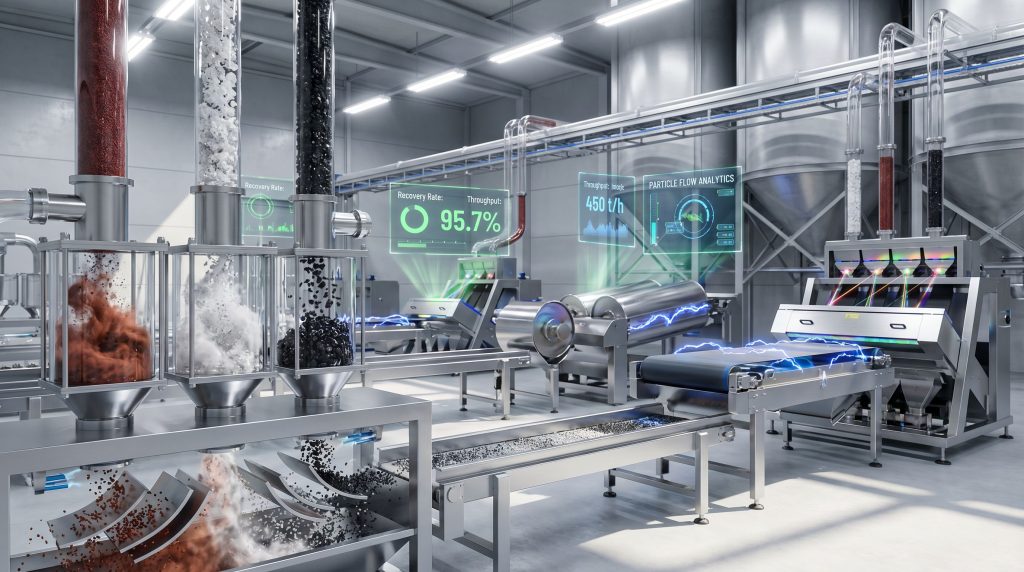
Dry separation technology in mining fundamentally operates through waterless beneficiation processes that utilise physical properties such as density, magnetic susceptibility, electrical conductivity, and optical characteristics to separate valuable minerals from gangue materials. Unlike conventional wet processing methods that rely heavily on flotation chemicals and substantial water consumption, these systems employ air currents, magnetic fields, electrostatic forces, or optical sensors to achieve mineral concentration.
The technical foundation of dry separation rests on exploiting differential physical properties between target minerals and waste rock. Gravity-based systems utilise density variations in air-fluidised environments, while magnetic separation targets paramagnetic and ferromagnetic minerals using high-intensity magnetic fields. However, electrostatic methods leverage differences in electrical conductivity, and optical sorting systems identify materials based on colour, density, or X-ray transmission characteristics.
Key performance indicators for dry separation systems include:
- Recovery rates: Percentage of valuable minerals recovered from feed material
- Grade improvement: Enhancement of concentrate quality compared to feed grade
- Throughput capacity: Processing volume per unit time under optimal conditions
- Separation efficiency: Ratio of correctly separated particles to total processed material
- Energy consumption: Power requirements per tonne of processed material
Environmental and Economic Drivers Behind Adoption
Water scarcity in mining regions has emerged as a critical constraint, particularly in arid climates where major mineral deposits are located. Traditional wet processing operations can consume between 2-4 cubic metres of water per tonne of processed material, creating substantial operational costs and environmental liabilities in water-stressed regions. Moreover, the growing focus on critical minerals energy transition has highlighted the need for sustainable processing technologies.
The economic advantages of dry separation extend beyond water savings. Eliminating flotation chemicals reduces operational costs while simplifying environmental permitting requirements. Additionally, the absence of tailings slurries eliminates the need for tailings storage facilities, reducing both capital expenditure and long-term environmental liabilities.
Table: Dry vs. Wet Processing Comparison
| Factor | Dry Processing | Wet Processing |
|---|---|---|
| Water Usage | Zero consumption | 2-4 m³/tonne |
| Chemical Requirements | Minimal/None | Flotation reagents required |
| Tailings Volume | Reduced solid waste | Slurry ponds required |
| Energy Consumption | Lower (no drying) | Higher (dewatering) |
| Infrastructure Needs | Simplified systems | Complex water management |
Carbon footprint reduction represents another significant driver, as dry separation eliminates energy-intensive dewatering processes typically required in conventional beneficiation. The absence of water heating, chemical preparation, and tailings pond management substantially reduces overall energy consumption per tonne of processed material. Consequently, this aligns with broader mining sustainability transformation initiatives across the industry.
Regulatory pressure on tailings management has intensified following high-profile tailings dam failures. Environmental authorities increasingly favour processing technologies that minimise or eliminate tailings generation, creating regulatory incentives for dry separation adoption across various mining jurisdictions.
How Do Different Dry Separation Technologies Work in Practice?
Air-Based Gravity Separation Systems
Air jigs and pneumatic tables represent the foundational technology for density-based dry separation, utilising controlled air currents to create differential settling velocities between materials of varying densities. These systems effectively process particles ranging from fine fractions to relatively coarse material, with optimal performance typically achieved in the 10 micron to 50 millimetre size range.
The technical principle involves creating an upward air flow that creates a fluidised bed environment where heavier particles settle faster than lighter ones. Vibration frequency and amplitude critically affect separation efficiency, with typical operating frequencies ranging from 200-800 cycles per minute depending on particle size distribution and density differential.
Key operational parameters include:
- Air velocity optimisation based on particle terminal velocity calculations
- Vibration amplitude adjustment for different ore types
- Feed rate control to maintain optimal bed density
- Screen aperture sizing for effective size classification
Two-way separator technology represents an advancement in air-based systems, capable of achieving recovery rates between 85-99% depending on ore characteristics and operational optimisation. For instance, these systems separate feed material into three fractions: light reject, middlings for reprocessing, and heavy concentrate.
Electrostatic and Triboelectric Separation Methods
Belt separator configurations excel in processing ultra-fine particles, effectively handling material sizes from sub-micron to 300 micrometers. The triboelectric effect generates electrical charges through particle collision and friction during material handling, creating differential charging based on material properties.
Friction charging mechanisms exploit inherent differences in work function values between minerals. Materials with different electrical properties acquire opposite charges when brought into contact, enabling separation through electrostatic force application. This principle proves particularly effective for separating calcite from quartz, barite from quartz, and aluminosilicates from carbon.
Multi-stage separation designs optimise purity through sequential processing steps, with each stage targeting specific size fractions or concentration ranges. The technology demonstrates significant economic advantages over flotation in applications where chemical costs, water treatment expenses, and environmental compliance represent substantial operational burdens.
Advanced Magnetic Separation Techniques
Fines Dry Magnetic Separation (FDMS) technology utilises rare-earth permanent magnets to achieve field strengths approaching 20,000 gauss, enabling effective separation of weakly magnetic minerals. High-intensity magnetic systems target paramagnetic minerals that exhibit minimal magnetic response under conventional magnetic separation conditions.
The technology demonstrates particular effectiveness in iron ore concentration, achieving grade improvements from approximately 40% to 68% iron content depending on ore mineralogy and liberation characteristics. Processing capacity specifications typically range around 30 tonnes per hour per processing unit, though multiple units can be configured in parallel for higher throughput applications.
Solid waste management advantages include eliminating tailings slurry generation, significantly reducing environmental footprint compared to conventional wet magnetic separation circuits. The dry magnetic concentrate requires no dewatering, reducing downstream processing complexity and energy consumption.
Sensor-Based and Optical Sorting Technologies
X-ray transmission sorting represents cutting-edge technology for real-time gangue identification and automated rejection. These systems analyse X-ray attenuation characteristics to identify material composition, enabling instantaneous sorting decisions at processing speeds compatible with high-throughput applications. Advanced X-ray sorting benefits include improved precision and throughput capabilities.
Colour-based optical systems demonstrate exceptional performance in limestone processing, with advanced installations capable of handling up to 600 tonnes per hour. These systems utilise high-resolution cameras and sophisticated algorithms to identify colour variations that correlate with mineral composition differences.
Grain size optimisation enables effective processing across an extraordinary range from 1 micrometre to 200 millimetres, though optimal performance typically occurs within narrower size fractions for specific applications. Machine learning algorithms continuously improve separation accuracy through pattern recognition and decision optimisation.
"Technology Selection Considerations: Successful implementation requires careful evaluation of ore characteristics, target minerals, required purity levels, and economic constraints. Particle size distribution often determines the optimal separation method, while mineral liberation characteristics affect achievable recovery rates."
Integration with existing circuits offers flexibility for both retrofit applications in operating facilities and greenfield installations in new processing plants. Modular system designs enable scalable implementation, allowing operations to match processing capacity with production requirements whilst maintaining separation efficiency.
Which Commodities Benefit Most from Dry Separation Applications?
Coal Processing and De-Stoning Operations
Coal beneficiation represents one of the most established applications for dry separation technology in mining, with systems effectively processing material in the -80+0 millimetre size range down to approximately 3 millimetre effective particle size limits. Large-scale implementations in coal-producing regions have demonstrated processing capabilities ranging from 2-9 million tonnes annually per installation.
Quality improvement metrics focus on ash content reduction and calorific value enhancement, critical parameters for coal market competitiveness. Dry separation eliminates the substantial water requirements traditionally associated with coal washing operations, addressing environmental compliance challenges in regions with stringent water discharge regulations.
Operational advantages include:
- Elimination of coal washing water treatment requirements
- Reduced sludge generation and disposal costs
- Improved product handling characteristics through moisture reduction
- Enhanced transportation economics due to reduced water content
Iron Ore Beneficiation Advances
Magnetite and hematite processing through dry separation exploits magnetic susceptibility differences to achieve effective concentration without water consumption. The technology demonstrates particular value in grade enhancement applications, enabling economic processing of previously marginal low-grade iron ore deposits.
Tailings reduction impact represents a significant environmental advantage, eliminating slurry pond requirements that have become increasingly problematic following high-profile tailings dam incidents. Dry processing generates solid waste that can be readily transported and disposed of without long-term environmental monitoring requirements.
Case studies from major iron ore producers indicate successful implementation of FDMS technology following regulatory pressure to reduce tailings generation risks. These installations demonstrate the technology's commercial viability whilst addressing environmental compliance requirements in major iron ore producing regions.
Industrial Minerals and Heavy Mineral Sands
Zircon, rutile, and monazite concentration represents specialised applications requiring custom-designed systems typically operating at 1-5 tonnes per hour processing capacity. These applications demand high-precision separation to meet stringent product specifications for industrial and strategic mineral markets.
Kaolin and limestone purification utilises high-intensity magnetic separation to remove iron-bearing contaminants that affect product brightness and industrial suitability. Dry separation eliminates the extensive washing and dewatering typically required in conventional kaolin processing.
Barite processing for drilling mud applications benefits from electrostatic separation that achieves the high-purity specifications required for oil and gas industry applications. The technology eliminates chemical flotation requirements whilst maintaining product quality standards.
Salt purification through optical sorting enables achievement of food-grade specifications by removing colour-differentiated impurities that conventional wet processing cannot economically eliminate.
Emerging Applications in Critical Minerals
Graphite processing represents a significant opportunity, as demonstrated by recent technological developments. Volt Carbon Technologies has received three patent allowances from the United States Patent and Trademark Office for proprietary dry separation technology specifically targeting graphite beneficiation. The company's approach emphasises preserving graphite's crystalline structure, which conventional wet processing can damage.
Conventional wet processing damages the crystalline structure, lowering yield and increasing downstream processing requirements. Dry separation maintains crystallinity, enabling more efficient conversion into battery materials, expandable graphite, and graphene whilst reducing processing intensity and environmental impact. This technological advancement complements broader industry battery recycling breakthrough developments.
Lithium mineral concentration, particularly spodumene processing, benefits from dry separation technologies that preserve mineral structure whilst achieving effective separation from gangue materials. This application supports the growing demand for battery-grade lithium compounds in energy storage applications.
Rare earth element processing represents an emerging frontier where dry separation can potentially reduce the chemical intensity traditionally required for rare earth beneficiation. The technology offers environmental advantages in processing critical minerals essential for renewable energy and high-technology applications.
Battery material feedstock processing increasingly demands high-purity specifications that dry separation can achieve whilst maintaining the structural integrity required for optimal electrochemical performance in energy storage applications.
What Are the Technical Advantages and Operational Limitations?
Performance Benefits and Efficiency Gains
Recovery rate optimisation represents a primary advantage of modern dry separation systems, with properly configured installations achieving 85-99% efficiency across optimal size ranges. These recovery rates compare favourably with conventional flotation circuits whilst eliminating chemical consumption and water treatment requirements.
Processing flexibility enables handling variable ore grades and compositions without extensive circuit modifications. Unlike flotation systems that require reagent optimisation for different ore types, dry separation systems adapt through mechanical adjustments to vibration frequency, magnetic field strength, or optical sensor calibration.
Operational simplicity reduces complexity compared to flotation circuits, eliminating pH control, chemical dosing systems, and complex water recirculation networks. Maintenance requirements focus on mechanical components rather than chemical handling systems, simplifying operator training and reducing specialised maintenance expertise requirements.
Energy efficiency advantages include eliminating dewatering and drying energy requirements that typically represent 15-25% of total processing energy consumption in conventional wet circuits. The absence of water heating, pumping, and chemical preparation reduces overall energy intensity per tonne of processed material.
Feed Preparation and Size Classification Requirements
Dry feed specifications represent critical operational constraints, as most dry separation technologies require feed material with moisture content below 2-5% depending on the specific technology employed. Achieving these moisture levels may require material drying, adding operational complexity and energy consumption.
Screening protocols for size classification become essential for optimal separation efficiency, as most dry separation technologies perform optimally within specific particle size ranges. Multi-stage screening systems ensure feed material meets size specifications whilst maximising throughput.
Dust management systems address environmental and safety considerations inherent in dry material handling. Effective dust suppression and collection systems represent essential infrastructure components that add to capital and operating costs.
Material handling challenges include specialised conveying systems designed for dry materials, storage systems that prevent moisture absorption, and transfer points that minimise dust generation whilst maintaining material flow continuity.
Economic Considerations and Capital Requirements
Initial investment comparison reveals that dry processing plants typically require 15-25% lower capital expenditure than equivalent wet processing facilities when water treatment infrastructure and tailings storage facilities are considered. However, feed preparation systems may add complexity depending on ore characteristics.
Operating cost analysis demonstrates advantages in elimination of chemical costs, reduced water treatment expenses, and simplified waste management. Labour requirements typically decrease due to reduced system complexity, though specialised maintenance skills may be required for sophisticated separation technologies.
Throughput scalability varies significantly among different dry separation technologies. Whilst some systems readily scale to high-capacity applications, others remain limited to specialised, lower-throughput applications due to fundamental technological constraints.
Table: Operational Parameter Comparison
| Technology Type | Particle Size Range | Throughput Capacity | Key Limitation |
|---|---|---|---|
| Air Gravity | 10 µm – 50 mm | Variable by design | Feed moisture content |
| Triboelectric | <1 µm – 300 µm | High multi-stage | Material conductivity |
| Magnetic (FDMS) | Fine post-crush | 30 t/h per unit | Magnetic susceptibility |
| Optical/X-ray | 1 µm – 200 mm | Up to 600 t/h | Colour/density contrast |
Payback period calculations typically range from 2-5 years depending on water costs, environmental compliance expenses, and commodity prices. Operations in water-scarce regions or those facing stringent environmental regulations often achieve shorter payback periods due to higher conventional processing costs.
How Is Dry Separation Technology Evolving and What's Next?
Recent Technological Advances Since the 1980s
Improved fine particle processing represents the most significant advancement in dry separation technology, with modern systems effectively handling sub-micron materials that were previously impossible to process economically. Enhanced particle handling and improved separation physics enable processing of increasingly complex ore compositions.
Automation integration incorporating artificial intelligence and machine learning algorithms optimises separation parameters in real-time. These systems continuously adjust operational parameters based on feed characteristics, achieving consistent performance despite ore variability that traditionally required manual intervention.
Sensor technology improvements include higher resolution optical sensors, faster processing speeds, and enhanced material identification capabilities. Modern X-ray transmission systems analyse material composition with precision levels that enable separation of minerals with minimal compositional differences.
Magnetic field innovations utilise stronger permanent magnets and optimised field configurations to achieve separation of weakly magnetic materials previously requiring wet processing. Rare-earth magnet developments enable field strengths exceeding 20,000 gauss in compact, energy-efficient configurations.
Multi-technology combinations integrate different separation principles in hybrid systems designed for complex ore processing applications. These systems combine magnetic, electrostatic, and optical separation in sequential stages to achieve purity levels unattainable through single-technology approaches.
Industry Implementation Trends and Case Studies
Large-scale coal applications demonstrate commercial viability with installations processing multiple million tonnes annually. These implementations validate the technology's capability to handle high-throughput applications whilst maintaining economic competitiveness with conventional processing methods.
Mining company adoption patterns indicate increasing interest driven by environmental compliance requirements and water scarcity constraints. Companies operating in water-stressed regions lead adoption, whilst those facing stringent tailings management regulations follow closely.
Regional deployment variations show concentrated implementation in arid mining regions, particularly in Australia, southwestern United States, and parts of South America where water costs and availability constraints create economic incentives for dry processing adoption.
Technology provider landscape includes established equipment manufacturers developing specialised dry separation systems alongside emerging companies focusing on novel separation principles. This competitive environment drives continuous innovation and cost reduction.
Future Development Directions and Market Drivers
Sustainability regulations increasingly pressure mining operations to minimise water consumption and eliminate tailings generation. Government policies in major mining jurisdictions favour technologies that reduce environmental impact, creating regulatory incentives for dry separation adoption.
Critical mineral demand for energy transition materials drives interest in processing technologies that maintain material quality whilst reducing environmental impact. Battery material feedstock processing particularly benefits from crystalline structure preservation achievable through dry separation.
Digitalisation integration incorporates Internet of Things sensors and predictive maintenance systems that optimise equipment performance whilst reducing downtime. Machine learning algorithms continuously improve separation efficiency through pattern recognition and automated parameter adjustment.
Modular system designs enable scalable and transportable processing solutions suitable for remote mining operations or temporary installations. These systems reduce deployment time and capital requirements whilst maintaining processing efficiency.
"Innovation Spotlight: Integration of artificial intelligence with real-time sensor data enables predictive separation optimisation, potentially increasing recovery rates by 5-15% whilst reducing energy consumption through automated parameter adjustment based on feed characteristics."
Investment and Commercial Deployment Outlook
Market size projections indicate substantial growth potential driven by environmental regulations and critical mineral demand. Industry analysts project 15-25% annual growth in dry separation equipment markets through 2030, driven primarily by sustainability requirements and water scarcity constraints.
Technology maturity assessment reveals varying commercial readiness across different applications. Coal processing and iron ore beneficiation demonstrate full commercial maturity, whilst critical mineral applications represent emerging opportunities with significant development potential.
Competitive landscape analysis shows consolidation among equipment manufacturers alongside innovation from specialised technology companies. Strategic partnerships between mining companies and technology developers accelerate commercial deployment whilst sharing development risks.
Integration challenges differ significantly between retrofitting existing operations versus greenfield projects. Retrofit applications require careful integration with existing infrastructure, whilst greenfield projects enable optimised system design from initial planning stages.
Companies like Volt Carbon Technologies exemplify the commercial development trajectory, advancing from patent development through demonstration phases toward commercial deployment. The company develops a scalable demonstration facility designed to validate technology under commercial conditions before full commercialisation, representing typical development pathways for emerging dry separation technologies.
Market penetration forecasts suggest accelerated adoption in water-scarce regions and environmentally sensitive jurisdictions, with broader deployment following as technology costs decrease and performance capabilities expand. Regulatory pressure on tailings management and water consumption will likely drive adoption timelines across diverse geographic regions. For additional insights into comprehensive dry processing techniques, see the Global Weir expert Q&A on dry processing. Additionally, the Engineering & Mining Journal's feature on sustainable dry mineral processing provides valuable industry perspectives on implementation strategies.
Disclaimer: This analysis is for informational purposes only and should not be considered as investment advice. Technology development timelines, market projections, and commercial viability assessments involve inherent uncertainties. Readers should conduct independent research and consult qualified professionals before making investment or operational decisions related to dry separation technologies.
Are You Tracking the Latest Dry Processing Innovations in Australian Mining?
Discovery Alert's proprietary Discovery IQ model provides instant notifications when ASX-listed companies announce breakthroughs in sustainable mining technologies, including waterless processing systems and environmental innovations that could drive significant market movements. With dry separation technology representing a critical shift toward sustainable mining practices, stay informed about which companies are pioneering these transformative technologies by exploring Discovery Alert's discoveries page and begin your 14-day free trial today.