June 4, 2026
The Hidden Complexity Behind Large-Scale Underground Mine Economics
Few investment outcomes in the mining sector are as counterintuitive as watching a company's share price collapse on the same day it publishes a technically positive feasibility study. Yet this phenomenon repeats itself with remarkable consistency across the industry, and it reveals something important about how capital markets process risk information differently from engineering teams. The Duluth Twin Metals project prefeasibility study, released in June 2014, produced precisely this outcome, and dissecting why offers a masterclass in the gap between geological value and investable economics.
Understanding what actually happened, and what it means in the context of today's critical minerals demand landscape, requires looking well beyond the headline numbers.
When big ASX news breaks, our subscribers know first
The Duluth Complex: A Geological Formation Unlike Any Other in North America
The Duluth Complex is a mafic intrusive geological formation stretching across northeastern Minnesota, formed approximately 1.1 billion years ago during the Midcontinent Rift System. This rifting event, which nearly split the North American continent in two, created the conditions for one of the most mineralogically distinctive ore bodies on the planet. The sulphide mineralisation within the Duluth Complex is predominantly disseminated rather than massive, meaning the metals are distributed relatively evenly through large volumes of rock rather than concentrated in narrow, high-grade veins.
This geological characteristic has profound engineering and economic consequences. Disseminated sulphide deposits typically require high-throughput processing to achieve economic returns, which in turn demands large, capital-intensive infrastructure. The ore grades at Twin Metals are not exceptional by global standards, but the sheer continuity and lateral extent of mineralisation across the complex means the total contained metal inventory is enormous.
What Makes the Duluth Complex Mineralogy Unusual
The co-occurrence of copper, nickel, and platinum group metals within the same sulphide assemblage is relatively rare globally. Most PGM deposits are associated with layered mafic intrusions like the Bushveld Complex in South Africa, where mineralisation tends to be stratiform and high-grade. The Duluth Complex represents a different genetic model, where PGMs occur as accessory minerals within a copper-nickel sulphide matrix.
This has two important implications for project economics:
- Revenue diversification is inherently built into the ore body, providing natural hedging across multiple commodity price cycles
- Metallurgical processing must achieve separation of multiple sulphide minerals simultaneously, adding complexity to concentrate production and smelter offtake negotiations
The polymetallic nature of the ore also means that the economic breakeven is harder to model, since it depends on the simultaneous pricing of six different commodities, each with its own supply-demand dynamics. Furthermore, cut-off grade economics become particularly complex when multiple revenue streams must be modelled concurrently.
Decoding the Duluth Twin Metals Project Prefeasibility Study Parameters
The Duluth Twin Metals project prefeasibility study, completed by AMEC E&C Services in 2014 and compliant with NI 43-101 disclosure standards, outlined a fully underground operation targeting the ore body through modified long-hole stoping with cemented hydraulic fill. This mining method was selected for its ability to achieve high extraction ratios in the disseminated sulphide environment while using cemented fill to stabilise the void space, reducing surface subsidence risk.
Stantec contributed engineering work focused specifically on minimising the surface footprint, a deliberate design choice that reflects the project's proximity to the Boundary Waters Canoe Area Wilderness and the associated community sensitivities. The surface infrastructure was designed to consolidate ventilation, heating, and processing functions into integrated facilities, reducing both the visual profile of the operation and its long-term energy consumption.
Core Technical Parameters at a Glance
| Parameter | PFS Specification |
|---|---|
| Mining Method | Modified long-hole stoping with cemented hydraulic fill |
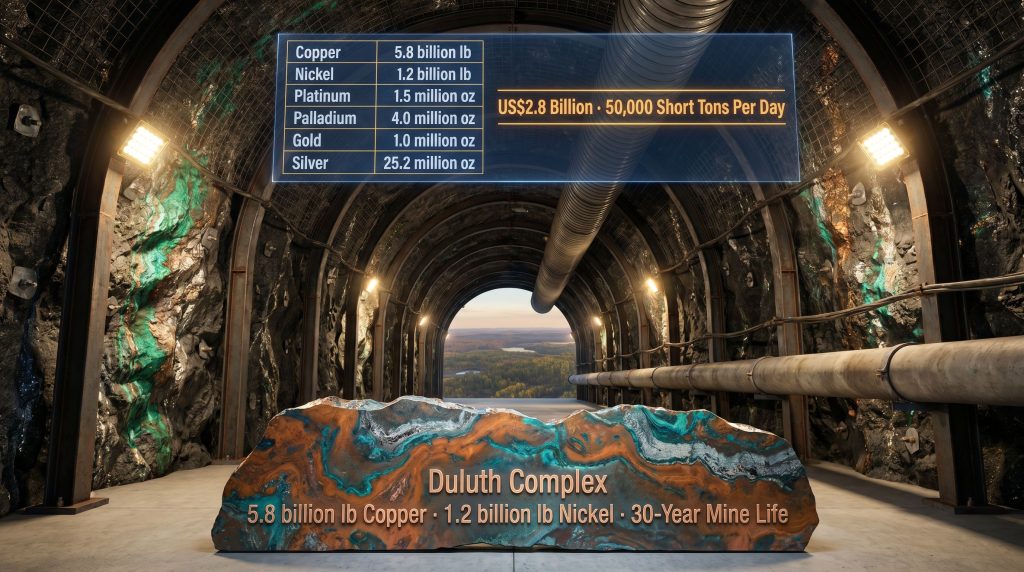
| Daily Processing Throughput | 50,000 short tons per day |
| Annual Throughput | ~18.3 million tons |
| Projected Mine Life | 30 years |
| Capital Payback Period | 6.4 years |
| Total Capital Cost | US$2.8 billion |
Lifetime Metal Production Projections
Over the 30-year operational horizon, the project was estimated to generate the following metal output:
| Metal | Projected Lifetime Production |
|---|---|
| Copper | 5.8 billion lb |
| Nickel | 1.2 billion lb |
| Palladium | 4.0 million oz |
| Silver | 25.2 million oz |
| Platinum | 1.5 million oz |
| Gold | 1.0 million oz |
The palladium output figure deserves particular attention. At 4.0 million ounces over the mine life, Twin Metals would represent a meaningful contribution to North American palladium supply, a commodity for which the United States currently has virtually no domestic production. Global palladium supply remains heavily concentrated in Russia and South Africa, creating a structural import dependency that is rarely discussed in the context of North American resource security.
Capital Cost Anatomy: Why US$2.8 Billion Triggered a Market Sell-Off
Breaking Down the Capital Intensity Calculation
At 18.3 million tonnes per year throughput and a US$2.8 billion construction capital estimate, Twin Metals implied a capital intensity of approximately US$153 per annual tonne of ore processed. For context, large-scale underground copper-nickel projects globally have historically been developed in the US$80 to US$150 per tonne range, placing Twin Metals at the upper boundary of the peer group.
The elevated capital intensity reflects several compounding factors specific to this project:
- The depth of the ore body requires extensive shaft sinking and underground development before any ore extraction can commence
- The cemented hydraulic fill system requires a paste fill plant and associated infrastructure, adding cost but enabling better ground stability management
- Minnesota's environmental requirements demand water treatment and tailings management systems of above-average specification
- The integrated surface design approach, while reducing operational costs over the mine life, front-loads capital expenditure into the construction phase
The 6.4-Year Payback in the Context of Project Finance
A 6.4-year payback period on a US$2.8 billion capital base occupies a challenging position in the project finance landscape. Most senior lenders to mining projects target payback periods below five years to ensure debt service coverage ratios remain comfortable through a full commodity price cycle. A 6.4-year payback at base case commodity prices leaves limited headroom if copper prices soften by even 15 to 20 percent.
Key Risk Consideration: For development-stage companies, a high capital cost combined with a marginally acceptable payback period creates a compounding problem. Equity dilution from capital raises reduces per-share value, while lenders may require covenant structures that limit operational flexibility during the early production years when payback is being achieved.
This was the calculation investors were making in real time on the day the Duluth Twin Metals project prefeasibility study was released, explaining the more than 25% single-session decline in Duluth Metals' share price on the TSX. The market was not rejecting the geology. It was repricing the financing risk.
The Regulatory Labyrinth: What Makes Twin Metals One of the Most Complex Permitting Cases in U.S. Mining History
The Boundary Waters Dimension
Twin Metals' location within the Superior National Forest, adjacent to the Boundary Waters Canoe Area Wilderness, creates a regulatory overlay that has no direct equivalent in most North American mining jurisdictions. The BWCA is a congressionally designated wilderness area protected under the Wilderness Act of 1964, and it attracts approximately 150,000 visitors per year, making it one of the most visited wilderness areas in the United States.
The proximity of the proposed mine to this watershed means that water management and the potential for acid mine drainage represent existential permitting questions rather than routine environmental conditions. Sulphide mining in proximity to sensitive water bodies has historically been one of the most contested regulatory battlegrounds in North American resource development. Indeed, understanding grade vs permitting trade-offs is essential when evaluating projects of this complexity.
Dual Regulatory Framework
Twin Metals operates under a layered permitting structure involving:
- Minnesota Department of Natural Resources (state-level environmental review and mining permit)
- Minnesota Pollution Control Agency (water quality and discharge permits)
- U.S. Forest Service (federal land management, given the project's location within the Superior National Forest)
- U.S. Army Corps of Engineers (wetlands and waterway impacts under the Clean Water Act)
Each of these agencies operates on different legislative timelines and with different risk tolerances. The interaction between state and federal review processes has historically created coordination challenges that extend overall permitting timelines well beyond what any single agency's process would require in isolation.
Following completion of the PFS in mid-2014, the formal next step was the submission of a Mine Plan of Operations to trigger the environmental impact assessment process. This submission initiated what would become a multi-year, politically contentious review sequence that continued to evolve across subsequent federal administrations.
Commodity Price Sensitivity: Reassessing 2014 Economics Through a 2020s Lens
The economic assumptions embedded in the 2014 Duluth Twin Metals project prefeasibility study reflected commodity price conditions that have since undergone substantial structural revision. Copper, which traded in the US$3.00 to US$3.20 per pound range at the time of the PFS, has spent much of the period from 2021 onward above US$4.00 per pound. Monitoring copper market trends reveals that this shift has been driven by electrification demand growth from solar energy deployment, electric vehicle manufacturing, and grid infrastructure investment.
The implications for project economics are material:
| Scenario | Copper Price Assumption | Economic Outcome |
|---|---|---|
| 2014 PFS Base Case | ~US$3.00/lb | Positive but marginal NPV; 6.4-year payback |
| Downside Stress | ~US$2.50/lb | Likely negative NPV; economics deteriorate materially |
| Current Market Environment | ~US$4.00-4.50/lb | Substantially improved NPV; payback compresses |
| Critical Minerals Uplift | Elevated PGM and Ni prices | Revenue diversification benefit amplified significantly |
The palladium and nickel components of the revenue stream add further complexity to this analysis. Palladium prices exceeded US$2,000 per troy ounce for extended periods between 2019 and 2022, driven by tightening autocatalyst demand and supply disruptions from Russia. While prices have since moderated, the structural undersupply of North American palladium production remains a long-term factor that did not feature prominently in 2014 economic discussions.
The next major ASX story will hit our subscribers first
What a Full Feasibility Study Would Need to Resolve
Technical Gaps Requiring Further Investigation
A definitive feasibility study advancing beyond the Duluth Twin Metals project prefeasibility study would need to address several areas of residual technical uncertainty:
- Geotechnical characterisation: Underground conditions at depth require detailed rock mechanics testing to finalise ground support design and manage execution risk during shaft sinking and lateral development
- Metallurgical variability testing: The ore body spans multiple geological domains with potentially varying sulphide mineralogy, and recovery rates across this variability range must be confirmed before offtake contracts can be finalised with smelters
- Tailings management design: Water treatment and tailings storage in a watershed-sensitive environment requires detailed hydrogeological modelling that exceeds the scope of a prefeasibility study
- Paste fill plant design: The cemented hydraulic fill system requires detailed cement consumption modelling tied to actual ore extraction sequences, which can only be completed once the mine plan is finalised at a higher level of engineering definition
Financial Assumptions Requiring Updating
Beyond the technical parameters, any reactivation of a full feasibility study would need to incorporate:
- Post-2020 construction cost inflation, which has materially increased the delivered cost of mining infrastructure globally
- Updated long-term commodity price forecasts reflecting structural demand shifts for copper, nickel, and PGMs
- A revised financing structure assessment reflecting the availability of critical minerals-focused financial instruments that did not exist in their current form in 2014
Analytical Note: Capital cost inflation in the mining sector between 2014 and 2024 has been particularly pronounced for labour, steel fabrication, and electrical equipment, all of which are heavily weighted in underground mine construction budgets. Any updated feasibility study would likely show a materially higher nominal capital cost than the US$2.8 billion established in the 2014 PFS, even if the underlying engineering design remained unchanged.
The Long View: What Twin Metals Represents as a Critical Minerals Asset
Polymetallic Diversification as a Strategic Attribute
One of the less-discussed attributes of the Twin Metals ore body is the degree to which its polymetallic composition naturally hedges against single-commodity price cycles. Unlike a pure copper or pure nickel project, Twin Metals generates revenue across six distinct commodity streams, each responding to different demand drivers:
- Copper is primarily driven by electrification and construction activity
- Nickel demand is increasingly tied to battery cathode chemistry in electric vehicles
- Palladium and platinum are primarily consumed by internal combustion engine catalytic converters, though platinum has emerging hydrogen fuel cell applications
- Gold and silver provide additional revenue stability with their safe-haven price characteristics
This diversification does not eliminate commodity price risk, but it does reduce the probability of all revenue streams declining simultaneously, which is a meaningful risk management attribute for a project requiring 6.4 years to recover its capital.
Generational Asset Characteristics
A 30-year mine life places Twin Metals in a category of assets that few development-stage projects can claim. At this operational horizon, the project's economic value is less dependent on any single commodity price cycle and more a function of the long-term trajectory of industrial metal demand. Infrastructure investments, workforce development, and community relationships all achieve different economics when amortised over three decades rather than the ten to fifteen year mine lives that characterise many smaller polymetallic operations.
The Twin Metals case ultimately illustrates a fundamental tension in resource development: the assets with the greatest long-term strategic value are frequently the ones with the highest capital cost, the longest permitting timelines, and the most complex social and environmental considerations. Resolving that tension, rather than the engineering itself, remains the defining challenge for the project's eventual development pathway.
This article is intended for informational and educational purposes only and does not constitute financial or investment advice. Readers should conduct their own independent research and consult a qualified financial adviser before making investment decisions. Economic projections and commodity price scenarios referenced herein involve forward-looking assumptions that are subject to material uncertainty.
Want to Track the Next Major Mineral Discovery Before the Market Does?
Discovery Alert's proprietary Discovery IQ model delivers real-time alerts on significant ASX mineral discoveries — instantly translating complex, multi-commodity data into actionable investment insights for both short-term traders and long-term investors. Explore historic discoveries and their extraordinary returns, then begin your 14-day free trial at Discovery Alert to position yourself ahead of the broader market.