August 22, 2026
Modern metallurgical processing faces unprecedented challenges as global demand for battery metals surges beyond traditional capacity constraints. The convergence of electrification mandates, renewable energy storage requirements, and circular economy imperatives has created a perfect storm requiring advanced materials solutions that conventional engineering approaches cannot adequately address. Within this context, the hydrometallurgical sector confronts escalating operational pressures where equipment failure represents not merely maintenance costs, but fundamental bottlenecks in critical metal supply chains essential for energy transition success. Furthermore, the implementation of duplex stainless steels in hydrometallurgy offers transformative solutions to these operational challenges through superior corrosion resistance and mechanical properties.
Understanding the Metallurgical Foundation of Duplex Stainless Steels
The fundamental advantage of duplex stainless steels in hydrometallurgy stems from their unique microstructural architecture combining approximately 50% ferrite and 50% austenite phases. This dual-phase composition creates synergistic properties impossible to achieve through single-phase optimisation, with the ferritic phase contributing strength and chloride stress corrosion resistance while the austenitic phase provides corrosion resistance and toughness. Moreover, this microstructural synergy directly addresses the demanding conditions encountered in modern mining industry evolution applications.
The nitrogen alloying strategy represents a critical innovation in modern duplex formulations. Nitrogen additions ranging from 0.10% to 0.30% by weight increase yield strength by 10-15% compared to nitrogen-free alternatives while simultaneously enhancing pitting resistance equivalent (PRE) numbers by 3-5 points per 0.1% nitrogen content. This dual enhancement mechanism proves particularly valuable in acidic hydrometallurgical environments where both mechanical stress and chemical attack occur simultaneously.
Corrosion resistance mechanisms in duplex steels operate through complementary pathways:
• The austenitic phase contributes high chromium and molybdenum content forming stable chromia-rich passive films
• The ferritic phase provides elevated chromium content (21-25% versus 16-18% in austenitic grades) with nitrogen enhancement stabilising passive layers
• Combined phase effects increase pitting potential and resistance to localised corrosion beyond single-phase capabilities
• Galvanic compatibility between phases prevents preferential attack when properly balanced
Traditional austenitic grades like 316L require 8-10% nickel content to achieve corrosion resistance, while lean duplex formulations accomplish similar performance with 1.5-3% nickel through nitrogen substitution. This alloying optimisation strategy reduces exposure to nickel price volatility whilst maintaining technical performance standards required for demanding hydrometallurgical applications.
The economic implications of material selection extend beyond initial procurement costs. Lifecycle cost analysis reveals duplex steels deliver 30-40% total cost advantage over 20-year equipment service life despite 15-30% initial material premiums. These savings derive from eliminated corrosion allowance requirements, reduced maintenance frequencies, extended replacement intervals, and avoided lining system costs.
When big ASX news breaks, our subscribers know first
Performance Specifications Across Duplex Grade Classifications
Lean Duplex Solutions for Economic Optimisation
Lean duplex LDX 2101 represents the most cost-effective duplex option with chemical composition optimised for moderate service conditions. The specification includes 21-22% chromium, 1.4-1.6% nickel, 0.05-0.25% molybdenum, and 0.20-0.30% nitrogen, achieving PRE values of 24-26 suitable for sulfuric acid concentrations below 50 g/L at temperatures under 80°C.
Key performance thresholds for LDX 2101 applications:
• Minimum yield strength of 450 MPa enabling 40% wall thickness reduction versus carbon steel
• Operating temperature limit of 80°C for sustained service life
• Chloride ion tolerance up to 200 ppm without accelerated pitting
• Cost premium of 15-20% above carbon steel versus 25-35% for standard duplex grades
The wall thickness reduction capability translates directly into material cost savings and transportation advantages. For atmospheric leaching reactors, the 450 MPa yield strength allows 3-4 mm wall thickness where carbon steel requires 6-8 mm including corrosion allowance, representing 40-50% weight reduction and corresponding fabrication cost benefits.
Standard Duplex Performance Parameters
Duplex 2205 establishes the industry benchmark for hydrometallurgical equipment with balanced composition providing 22% chromium, 5-6% nickel, 3% molybdenum, and 0.15% nitrogen. This formulation achieves PRE values of 34-36, supporting moderate acid concentrations up to 150 g/L sulfuric acid at temperatures reaching 120°C.
Mechanical strength specifications for 2205 grade:
| Property | Specification | Performance Impact |
|---|---|---|
| Yield Strength | 450-550 MPa | Wall thickness optimisation |
| Tensile Strength | 620-750 MPa | Pressure vessel design capability |
| Elongation | 25% minimum | Fabrication workability |
| Impact Toughness | >100 J at -40°C | Seismic resistance capability |
Fabrication considerations for 2205 require controlled heat treatment to maintain phase balance within 40-60% ferrite range. Welding procedures must follow qualified parameters preventing excessive ferrite formation or sigma phase precipitation, both of which compromise corrosion resistance and mechanical properties.
Temperature and pressure operating limits for 2205 extend to 150°C at atmospheric pressure or 120°C at elevated pressures up to 40 bar. These parameters align with zinc direct leaching operations and moderate pressure autoclave applications whilst maintaining 20-25 year service life expectations.
Super Duplex Applications for Extreme Environments
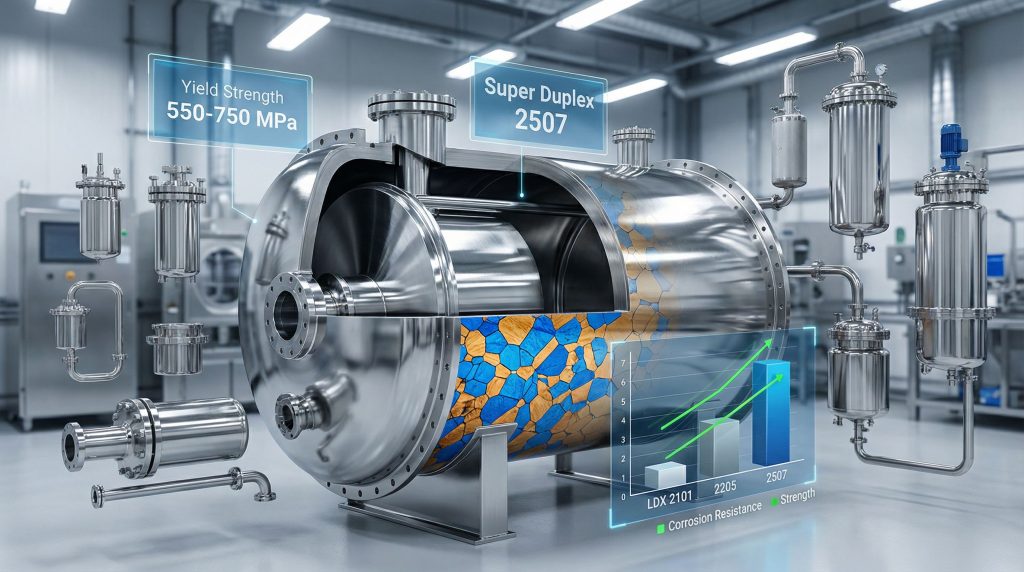
Super duplex 2507 represents the premium solution for demanding hydrometallurgical conditions with composition including 25% chromium, 7% nickel, 4% molybdenum, and 0.25% nitrogen. The resulting PRE value of 41-43 enables operation in concentrated sulfuric acid exceeding 150 g/L at temperatures up to 280°C under pressure. Additionally, these specifications align with emerging lithium refinery developments requiring extreme environmental resistance.
Extreme environment capabilities of 2507 grade:
• Pressure leaching autoclave service up to 280°C and 60 bar
• Concentrated acid resistance including sulfuric acid above 200 g/L
• Yield strength 550-750 MPa enabling maximum wall thickness optimisation
• Service life expectation exceeding 25 years in properly designed applications
The high-pressure autoclave applications represent the most demanding service conditions in hydrometallurgy. Vessel wall thickness calculations for 2507 grade demonstrate significant advantages, with 15-20% thickness reduction possible compared to 2205 whilst maintaining equivalent safety factors. This optimisation simplifies offsite fabrication and transportation logistics for large autoclave installations.
Comparative Analysis Against Alternative Materials
Carbon Steel Limitations and Economic Trade-offs
Carbon steel remains prevalent in hydrometallurgical installations due to low initial cost, but operational limitations create significant lifecycle disadvantages. Corrosion rates in sulfuric acid environments range from 0.5-2.0 mm/year depending on concentration and temperature, necessitating corrosion allowances of 3-6 mm plus protective lining systems. Furthermore, understanding these limitations becomes critical when developing a comprehensive critical minerals strategy.
Typical lining system configurations and failure modes:
• Fibreglass-reinforced plastic linings: 5-8 year replacement cycles, thermal expansion mismatch issues
• Rubber linings: 3-5 year service life, susceptible to mechanical damage
• Lead-backed brick: 8-12 year life, installation complexity and environmental concerns
• Polymer coatings: 2-4 year cycles, application quality dependency
The weight penalty from thick-wall carbon steel construction compounds transportation and foundation costs. A 10-meter tall atmospheric leaching reactor in carbon steel weighs approximately 60-80% more than equivalent duplex construction, requiring upgraded crane capacity, reinforced foundations, and oversized transportation equipment.
Operational downtime for lining replacement typically requires 2-4 weeks including surface preparation, installation, and cure time. At production rates of 50,000 tonnes per year copper equivalent, each maintenance shutdown represents $2-4 million in lost production value, making uptime reliability economically critical.
Fibre-Reinforced Polymer Constraints
FRP systems offer excellent chemical resistance in specific environments but face mechanical limitations restricting application scope. Design stress limitations of 20-40 MPa for FRP compare unfavourably to 450-750 MPa for duplex steels, requiring substantial support structures and increased overall system complexity. According to detailed research on stainless steel applications in hydrometallurgy, these limitations significantly impact design flexibility.
Critical FRP limitations in hydrometallurgical applications:
• Temperature restrictions typically below 80-100°C depending on resin system
• Pressure limitations requiring thick wall sections or external reinforcement
• Seismic vulnerability due to brittle failure modes
• Support structure requirements introducing carbon steel corrosion concerns
• Quality control challenges in field installation affecting long-term reliability
The modular design advantages of metallic construction become apparent in seismic zones where FRP systems require extensive bracing and support structures. Duplex steel construction provides inherent structural integrity with simplified seismic design compared to composite alternatives.
Critical Engineering Design Considerations
Pressure Vessel Optimisation Strategies
Wall thickness calculations for duplex steel pressure vessels leverage the superior strength properties to achieve optimised designs. Using ASME Boiler and Pressure Vessel Code Section VIII calculations, duplex 2507 with 550 MPa yield strength enables 30-40% wall thickness reduction compared to austenitic 316L with 200 MPa yield strength for equivalent pressure ratings. These design advantages support the implementation of duplex stainless steels in hydrometallurgy across various applications.
Design optimisation calculations for typical autoclave specifications:
• Internal pressure: 60 bar (870 psi)
• Operating temperature: 250°C
• Vessel diameter: 3 meters
• Required thickness 316L: 45 mm
• Required thickness 2507: 30 mm
• Weight reduction: approximately 35%
• Material cost offset: 15-20% despite higher unit cost
Stress analysis for autoclave applications must account for thermal stress interactions with pressure loading. The coefficient of thermal expansion for duplex steels (13-14 μm/m°C) falls between carbon steel (11-12 μm/m°C) and austenitic stainless (15-16 μm/m°C), providing favourable thermal stress characteristics in temperature cycling service.
Fatigue resistance becomes critical in cyclic loading conditions typical of batch hydrometallurgical processes. Duplex microstructure provides superior fatigue performance compared to austenitic grades due to higher yield strength and reduced plastic deformation accumulation during stress cycling.
Corrosion Engineering Implementation
Galvanic compatibility requires careful attention in mixed-material systems where duplex components interface with carbon steel supports or piping. The galvanic series positions duplex stainless steels as more noble than carbon steel, potentially accelerating carbon steel corrosion if electrical connection exists in electrolytic environments.
Galvanic protection strategies include:
• Electrical isolation through polymer gaskets and bushings
• Cathodic protection systems for carbon steel components
• Area ratio management minimising small anode/large cathode configurations
• Environmental control reducing electrolyte conductivity where possible
Crevice corrosion prevention focuses on design geometry eliminating stagnant areas where aggressive chemistry can concentrate. Weld design requirements include full penetration joints, smooth profiles, and post-weld surface finishing to minimise initiation sites for localised attack.
Stress corrosion cracking mitigation involves both material selection and stress management. However, duplex steels resist chloride stress corrosion cracking better than austenitic grades, residual stress control through proper heat treatment and mechanical design remains essential for long-term reliability.
Specific Application Case Studies and Performance Validation
Atmospheric Leaching System Implementation
Reactor design for copper and zinc processing represents the largest volume application for duplex stainless steels in hydrometallurgy. Typical atmospheric leaching conditions include 80-120°C operating temperature, 50-150 g/L sulfuric acid concentration, and agitated slurry environments creating both chemical and mechanical attack. Moreover, these applications align with trends in the global lithium market outlook where similar processing conditions apply.
The Impala Base Metals Refinery case study demonstrates quantifiable benefits from duplex implementation. The replacement of brick-lined carbon steel autoclave with duplex 2205 construction eliminated the need for protective linings whilst reducing maintenance downtime from 15-20 days per year to 3-5 days for routine inspection and minor repairs.
Quantified performance improvements from the Impala installation:
• Capital cost reduction: 25% despite higher material cost due to simplified construction
• Maintenance cost savings: 60% annually through eliminated lining replacement
• Production uptime improvement: 95% versus 85% for lined carbon steel system
• Service life extension: projected 25 years versus 12-15 years for lined alternative
Agitation system material selection requires consideration of both chemical resistance and erosion resistance. Duplex steels provide adequate hardness (typically 250-300 HB) for moderate abrasion service whilst maintaining corrosion resistance, though ceramic or hard facing may be required for severe abrasion applications.
Heat exchanger applications in leach circuits benefit from duplex thermal conductivity (15-20 W/m·K) intermediate between carbon steel (45-50 W/m·K) and austenitic stainless (12-16 W/m·K). The thermal performance, combined with superior corrosion resistance, enables optimised heat exchanger design with reduced fouling and extended cleaning intervals.
Pressure Leaching Autoclave Performance
High-temperature, high-pressure vessel construction represents the most technically demanding application for duplex stainless steels in hydrometallurgy. Operating conditions typically include 200-280°C temperature, 40-60 bar pressure, and concentrated acid environments exceeding 150 g/L sulfuric acid concentration.
Super duplex 2507 specifications enable autoclave optimisation through reduced wall thickness whilst maintaining safety factors required by pressure vessel codes. A 5-meter diameter autoclave operating at 60 bar requires approximately 35 mm wall thickness in 2507 versus 50 mm in austenitic 316L, representing significant material and fabrication cost savings.
Internal component material selection proves critical as internal structures experience the most aggressive service conditions. Duplex 2507 maintains mechanical properties and corrosion resistance at autoclave operating temperatures, though specific component design may require higher alloy materials for extreme local conditions.
Autoclave sizing optimisation through duplex implementation:
• Wall thickness reduction: 25-35% versus austenitic alternatives
• Weight reduction: 30-45% for equivalent pressure rating
• Transportation advantages: larger vessels within road transport limits
• Foundation load reduction: 25-35% structural load savings
• Offsite fabrication feasibility: improved dimensional control and quality
Maintenance access and inspection considerations require permanent provisions for internal examination and component replacement. The extended service life potential of duplex construction justifies investment in sophisticated access systems and non-destructive testing capabilities.
Battery Material Recovery System Applications
Battery black mass processing represents a rapidly growing application area for duplex stainless steels as lithium-ion battery recycling capacity expands to meet circular economy objectives. The processing involves concentrated sulfuric acid leaching at elevated temperatures to recover lithium, nickel, cobalt, and manganese from spent battery materials. This aligns with recent advances in battery recycling breakthrough technologies requiring robust material solutions.
OKTOP reactor technology demonstrates the application of duplex materials in specialised processing equipment. These jacketed reactors operate with agitated slurries containing abrasive particles whilst maintaining precise temperature control and chemical resistance to hot sulfuric acid environments.
Lithium hydroxide production equipment specifications:
• Operating temperature: 80-120°C for conversion reactions
• Chemical environment: concentrated lithium sulfate solutions with pH control
• Mechanical requirements: agitation systems with moderate abrasion resistance
• Material selection: lean duplex LDX 2101 for economic optimisation in moderate conditions
Cathode material recovery systems require specialised equipment handling mixed metal solutions with complex chemistry including sulfuric acid, oxidising agents, and various metal salts. The chemical compatibility of duplex steels across this range of environments provides operational flexibility as processing parameters are optimised.
Precious metal extraction vessel specifications often involve higher-grade solutions requiring super duplex 2507 for maximum corrosion resistance. The economic value of recovered materials (platinum group metals, gold, silver) from electronic waste justifies premium material selection for maximum reliability and extended service life.
Operating Condition Analysis and Material Selection Criteria
Environmental Severity Classification Framework
Systematic material selection requires quantitative assessment of environmental severity based on temperature, acid concentration, chloride content, and mechanical stress factors. The following classification framework provides engineering guidance for optimal grade selection:
| Severity Level | Temperature Range | Acid Concentration | Chloride Level | Recommended Grade | Selection Rationale |
|---|---|---|---|---|---|
| Mild | <60°C | <25 g/L H₂SO₄ | <100 ppm | Carbon steel + lining | Economic optimisation |
| Moderate | 60-80°C | 25-75 g/L H₂SO₄ | 100-300 ppm | LDX 2101 | Cost-performance balance |
| Severe | 80-150°C | 75-200 g/L H₂SO₄ | 300-1000 ppm | DX 2205 | Standard duplex capability |
| Extreme | 150-280°C | >200 g/L H₂SO₄ | >1000 ppm | SDX 2507 | Maximum resistance required |
Temperature and pressure interactions significantly influence material selection decisions. The combination of high temperature and high pressure creates synergistic effects where corrosion rates accelerate beyond simple additive relationships. For instance, 150 g/L sulfuric acid at 200°C under 40 bar pressure creates more aggressive conditions than the same concentration at atmospheric pressure and 120°C.
Thermal cycling effects require consideration in equipment operating with batch processes. Temperature swings from ambient to operating conditions create thermal stress accumulation that can initiate fatigue cracking in susceptible materials. Duplex microstructure provides superior resistance to thermal fatigue compared to austenitic alternatives due to higher yield strength and lower thermal expansion coefficient.
Chemical Environment Assessment Protocols
pH range compatibility varies significantly among duplex grades, with optimal performance typically occurring in pH ranges of 1-4 for sulfuric acid systems. Below pH 1, hydrogen evolution and acid reduction reactions can compromise passive film stability, whilst above pH 4, precipitation of metal hydroxides may create crevice corrosion conditions. Understanding these parameters proves essential when considering duplex stainless steel properties for specific applications.
Chloride ion concentration effects require careful evaluation as chloride ions are particularly aggressive toward passive film stability. The critical chloride concentration for pitting initiation decreases with increasing temperature and decreasing pH, making simultaneous consideration of all three factors essential for reliable material selection.
Chloride tolerance guidelines for duplex grades:
• LDX 2101: 200 ppm at 60°C, 100 ppm at 80°C
• DX 2205: 500 ppm at 80°C, 300 ppm at 120°C
• SDX 2507: 1000+ ppm at 150°C, 500+ ppm at 200°C
Oxidising potential significantly influences corrosion behaviour, with strongly oxidising conditions potentially destabilising passive films through trans-passive dissolution. The presence of oxidising agents like hydrogen peroxide or ferric sulfate requires evaluation of specific electrochemical conditions to ensure material compatibility.
Contamination sensitivity analysis must account for trace elements that can accelerate localised corrosion. Elements such as fluoride, bromide, and iodide ions exhibit significantly higher aggressiveness than chloride at equivalent concentrations, requiring upgraded material selection or environmental control measures.
The next major ASX story will hit our subscribers first
Engineering Calculations and Economic Optimisation Models
Mechanical Design Advantage Quantification
Yield strength-based wall thickness reductions provide tangible cost benefits beyond initial material savings. Using standard pressure vessel design calculations, a 10-meter tall atmospheric leaching tank with 2-meter diameter operating at 5 bar internal pressure demonstrates the following thickness requirements:
Comparative wall thickness calculations:
• Carbon steel (A516 Grade 60, 220 MPa yield): 12 mm + 6 mm corrosion allowance = 18 mm total
• Austenitic 316L (200 MPa yield): 15 mm design thickness
• Duplex 2205 (450 MPa yield): 8 mm design thickness
• Weight comparison: 2205 weighs 35% less than 316L, 55% less than carbon steel
Transportation and installation cost benefits extend beyond weight reduction. Large pressure vessels approaching road transport dimensional limits can be fabricated with larger internal dimensions when using duplex materials due to reduced wall thickness requirements. This optimisation often eliminates the need for field assembly of large vessels, improving quality control and reducing installation time.
Foundation load reduction implications prove significant for large installations. A 50-tonne atmospheric leaching reactor in duplex 2205 versus 80-tonne equivalent in carbon steel reduces foundation concrete requirements by approximately 30-40%, with corresponding reductions in excavation, reinforcement, and construction time.
Corrosion Rate Modelling and Service Life Prediction
Uniform corrosion rate predictions require empirical data from standardised testing under relevant environmental conditions. ASTM G31 weight loss testing provides baseline corrosion rates, whilst ASTM G48 pitting resistance testing establishes critical pitting temperature (CPT) values for specific grade and environment combinations. Research into corrosion behaviour of duplex steels provides additional insights into these performance characteristics.
Representative uniform corrosion rates in sulfuric acid environments:
| Material | 100 g/L H₂SO₄, 80°C | 150 g/L H₂SO₄, 120°C | Service Life Projection |
|---|---|---|---|
| Carbon Steel | 1.2-2.0 mm/year | 3.0-5.0 mm/year | 5-8 years with lining |
| LDX 2101 | 0.02-0.05 mm/year | Not recommended | 20+ years |
| DX 2205 | 0.01-0.03 mm/year | 0.05-0.10 mm/year | 25+ years |
| SDX 2507 | <0.01 mm/year | 0.02-0.05 mm/year | 30+ years |
Pitting potential assessments utilise electrochemical testing methods to establish critical conditions for localised corrosion initiation. The pitting resistance equivalent (PRE) calculation provides a useful screening parameter, but actual performance requires validation through ASTM G150 or similar electrochemical testing under specific environmental conditions.
Crevice corrosion risk evaluation proves critical for bolted connections, gasket interfaces, and other design features creating stagnant conditions. ASTM G78 crevice corrosion testing establishes critical crevice temperature (CCT) values that must exceed operating temperature by adequate safety margins, typically 25-50°C depending on design life requirements.
Total Cost of Ownership Analysis Framework
Comprehensive TCO calculations must include initial material cost, fabrication labour adjustments, installation logistics, operating costs, maintenance expenses, and end-of-life considerations over equipment design life typically spanning 20-25 years.
Initial cost comparison for 100 m³ atmospheric leaching reactor:
| Cost Component | Carbon Steel + Lining | Austenitic 316L | Duplex 2205 | Super Duplex 2507 |
|---|---|---|---|---|
| Material cost | $80,000 | $180,000 | $160,000 | $220,000 |
| Fabrication | $120,000 | $140,000 | $135,000 | $145,000 |
| Transportation | $25,000 | $20,000 | $18,000 | $17,000 |
| Installation | $40,000 | $30,000 | $30,000 | $30,000 |
| Total Initial | $265,000 | $370,000 | $343,000 | $412,000 |
Operating and maintenance cost projections (20-year lifecycle):
| Maintenance Component | Carbon Steel + Lining | Duplex 2205 | Duplex 2507 |
|---|---|---|---|
| Lining replacement | $400,000 (4 cycles) | $0 | $0 |
| Routine maintenance | $150,000 | $80,000 | $60,000 |
| Unplanned downtime | $200,000 | $50,000 | $30,000 |
| Total Operating | $750,000 | $130,000 | $90,000 |
Total Cost of Ownership summary (20-year basis):
• Carbon steel + lining: $1,015,000
• Duplex 2205: $473,000 (53% savings)
• Super duplex 2507: $502,000 (51% savings)
Production uptime improvement quantification requires assessment of planned and unplanned maintenance intervals. Duplex steel equipment typically achieves 95-98% availability compared to 85-90% for lined carbon steel systems, representing significant production value recovery for high-throughput operations.
Future Market Trends and Technology Integration
Critical Metal Demand Growth Projections
Battery material processing capacity expansion drives the most significant growth opportunity for duplex stainless steel applications. Global lithium demand projections indicate 15-20x growth from 2020 to 2030, with corresponding processing capacity requirements creating substantial equipment demand. Hydrometallurgical processing represents approximately 60-70% of lithium production capacity, translating directly into duplex steel market opportunity.
Rare earth element recovery system requirements present emerging applications as supply chain diversification efforts expand processing capacity outside traditional sources. The chemical complexity and environmental sensitivity of rare earth processing create demanding operating conditions ideally suited to duplex steel properties.
Recycling process intensification needs continue expanding as circular economy policies mandate higher recovery rates for critical metals. Battery recycling capacity must increase 50-100x by 2030 to handle end-of-life battery volumes, creating substantial demand for specialised hydrometallurgical equipment.
Green hydrogen production equipment specifications may extend duplex steel applications into water electrolysis systems where high-strength, corrosion-resistant materials enable optimised electrolyser design. The intersection of hydrogen economy development with critical mineral processing creates synergistic technology requirements.
Sustainability and Circular Economy Integration
Recycled content in duplex steel production continues increasing as secondary stainless steel production expands globally. Current recycled content averages 60-80% for duplex grades, with potential for further increases as collection and sorting systems improve. This enhances the sustainability profile for environmentally conscious mining operations.
Equipment longevity and replacement cycles become increasingly important as capital allocation focuses on long-term value creation rather than short-term cost minimisation. The 25-30 year service life potential of properly designed duplex equipment aligns with corporate sustainability goals and ESG investment criteria.
Energy efficiency improvements through design optimisation provide additional sustainability benefits. Reduced wall thickness requirements for duplex vessels translate to lower embodied energy in manufacturing, whilst improved thermal conductivity versus austenitic alternatives enhances heat transfer efficiency.
Carbon footprint reduction in material selection extends beyond manufacturing to include transportation, installation, and maintenance phases. The weight reduction and extended service life of duplex equipment contribute to lower lifecycle carbon emissions compared to alternatives requiring frequent replacement or maintenance.
Technology Integration and Digital Optimisation
Digital monitoring system compatibility requires consideration of sensor integration and data acquisition capabilities. Duplex steel vessels readily accommodate thermowell installations, pressure taps, and corrosion monitoring systems without compromising structural integrity. The material compatibility with advanced sensor technologies enables sophisticated process control and predictive maintenance systems.
Predictive maintenance sensor integration benefits from the stable material properties of duplex steels that provide consistent baseline measurements for condition monitoring. Ultrasonic thickness monitoring, vibration analysis, and electrochemical corrosion monitoring systems achieve higher reliability when applied to duplex equipment due to predictable material behaviour.
Process intensification through material performance enables smaller, more efficient equipment designs that integrate more effectively with automated systems. The strength advantages of duplex steels permit compact reactor designs with higher power density and improved heat transfer characteristics.
Automation system material requirements increasingly demand compatibility with robotic maintenance systems and remote monitoring capabilities. The extended service intervals and predictable performance of duplex equipment reduce automation complexity whilst improving system reliability.
Quality Assurance and Performance Validation Protocols
Material Certification and Testing Standards
Chemical composition verification procedures follow ASTM A751 standards for chemical analysis of stainless steels, with particular attention to nitrogen content measurement using combustion analysis methods. Nitrogen content variations of ±0.02% significantly impact mechanical properties and corrosion resistance, requiring precise analytical control.
Mechanical property testing standards include tensile testing per ASTM A370, impact testing per ASTM E23, and hardness testing per ASTM E18. All testing must be conducted on heat-treated specimens representative of final equipment metallurgical condition to ensure specification compliance.
Corrosion resistance qualification methods include:
• ASTM G48 critical pitting temperature testing for specific grade/environment combinations
• ASTM G150 electrochemical critical pitting potential measurement
• ASTM G78 crevice corrosion testing for design validation
• ASTM G31 immersion testing for long-term corrosion rate determination
Phase balance measurement techniques utilise magnetic saturation methods per ASTM A800 or quantitative metallographic analysis per ASTM E1245. Phase balance must remain within 40-60% ferrite range to maintain optimal corrosion resistance and mechanical properties.
In-Service Monitoring and Maintenance Strategies
Non-destructive testing protocols include ultrasonic thickness measurement to monitor uniform corrosion, magnetic particle testing for crack detection, and liquid penetrant testing for surface breaking defects. Testing intervals typically range from annual inspections for moderate service to biannual for severe environments.
Corrosion monitoring system implementation utilises electrical resistance probes, linear polarisation resistance measurements, and galvanic current monitoring to provide real-time assessment of corrosion activity. These systems enable optimisation of operating parameters to minimise corrosion whilst maintaining process efficiency.
Performance degradation assessment methods track key indicators including wall thickness measurements, mechanical property changes through hardness testing, and microstructural evolution through metallographic examination. Trending analysis enables prediction of remaining service life and optimisation of maintenance scheduling.
Predictive maintenance indicator development focuses on correlations between process parameters and material degradation rates. Machine learning algorithms applied to sensor data can identify subtle changes in equipment condition enabling proactive maintenance intervention before failure occurrence.
Failure Analysis and Prevention Methodologies
Common failure mode identification for duplex steels includes pitting corrosion from chloride exposure, crevice corrosion in stagnant areas, stress corrosion cracking from residual stresses, and sigma phase precipitation from improper heat treatment. Each failure mode has characteristic metallographic features enabling root cause identification.
Root cause analysis methodologies follow systematic approaches including visual examination, non-destructive testing, metallographic analysis, chemical analysis of deposits, and environmental condition review. Documentation of failure analysis results contributes to industry knowledge base for improved design practices.
Prevention strategy implementation addresses identified root causes through design modifications, material upgrades, process parameter optimisation, or maintenance procedure improvements. The most effective prevention strategies address multiple potential failure modes simultaneously.
The integration of duplex stainless steels into hydrometallurgical processing represents more than materials substitution; it enables fundamental optimisation of equipment design, operational reliability, and economic performance across the critical metal supply chain essential for global energy transition success.
Lessons learned integration processes ensure continuous improvement in material selection, design practices, and operational procedures. Industry collaboration through technical organisations and published case studies accelerates knowledge transfer and establishes best practices for emerging applications.
The evolution of duplex stainless steels in hydrometallurgy continues advancing through alloy development, fabrication technique improvements, and application experience expansion, positioning these materials as essential enablers of the circular economy and sustainable critical metal supply chains required for decarbonisation objectives.
Ready to Capitalise on the Next Major Mining Discovery?
Discovery Alert instantly alerts investors to significant ASX mineral discoveries using its proprietary Discovery IQ model, transforming complex metallurgical announcements into actionable investment insights. With hydrometallurgical processing becoming crucial for battery metals and critical mineral recovery, begin your 30-day free trial today to position yourself ahead of the market as these advanced processing technologies drive the next wave of mining innovation.