June 15, 2026
The Hidden Complexity Behind Heavy Rare Earth Recycling
Most discussions about the rare earth supply chain focus on mining geography, export restrictions, and the race to build processing capacity outside China. Far less attention is paid to a deceptively difficult engineering problem that sits upstream of all of it: how do you economically recover individual rare earth elements from the complex, iron-dominated matrix of end-of-life permanent magnets?
The answer matters enormously, because Iondrive dysprosium recovery from e-waste represents one of the most credible pathways to building a domestic rare earth supply chain in Western markets. However, the metallurgical reality is far messier than the strategic narrative suggests. And within that messy reality, dysprosium sits at the centre of the hardest problem.
When big ASX news breaks, our subscribers know first
Why Dysprosium Is Not Just Another Rare Earth Element
The Physics That Make Dysprosium Indispensable
Dysprosium's role in NdFeB magnets is structural rather than incidental. When neodymium magnets operate at elevated temperatures, they lose coercivity — the ability to resist demagnetisation under external magnetic fields. Dysprosium is added specifically to counteract this degradation through a process called grain-boundary diffusion, where dysprosium atoms concentrate at the boundaries between magnetic grains and reinforce the coercive force of the overall magnet without significantly reducing remanence.
In electric vehicle traction motors, which routinely operate between 80°C and 180°C, this thermal stability is non-negotiable. Without dysprosium addition, the magnet would progressively lose performance under normal operating conditions. This functional necessity is what makes dysprosium structurally different from other rare earth elements in the recycling economics equation.
The Feedstock Reality: Small Concentration, Enormous Value Differential
A standard NdFeB magnet contains approximately:
- 60–70% iron by weight, which dominates the mass balance entirely
- 20–30% neodymium, the primary rare earth constituent
- 5–10% boron and other additives
- 1–3% dysprosium, the heavy rare earth addition for thermal stability
- Trace quantities of terbium, cobalt, and other elements depending on application grade
That 1–3% dysprosium concentration creates an asymmetric value dynamic. Because dysprosium trades at a significant price premium over neodymium on a per-kilogram basis — typically several multiples higher — its contribution to per-tonne feedstock revenue is disproportionate to its physical presence in the magnet matrix. This is the core economics argument for prioritising dysprosium recovery in any magnet recycling flowsheet.
The challenge is that dysprosium's low absolute concentration means small absolute losses translate into enormous percentage-point swings in recovery efficiency. A process that loses 10 grams of dysprosium per tonne of feed loses a far greater share of its dysprosium inventory than a process losing the same mass of neodymium.
Furthermore, the iron problem compounds this further. With iron constituting the overwhelming majority of magnet mass, any leach solution is saturated with iron. Separating rare earth elements from an iron-dominant solution — and then isolating dysprosium specifically from other rare earths — requires exceptionally high selectivity at every stage of the process. These rare earth processing challenges are seldom fully appreciated in mainstream coverage of the sector.
Understanding How the IONSolv Process Addresses the Separation Challenge
The Hydrometallurgical Architecture
The IONSolv process, developed by ASX-listed Iondrive (ASX:ION), operates on the fundamental principle of selective leaching followed by solvent extraction. Rather than dissolving the entire magnet matrix indiscriminately and then attempting to separate everything downstream, the process targets selective dissolution of rare earth elements while leaving the iron matrix largely intact or rejecting iron at the extraction stage.
The core sequence works as follows:
- Feed preparation: Shredded and demagnetised magnet-bearing e-waste is classified by particle size to optimise reagent contact
- Selective leaching: Rare earth elements are preferentially dissolved from the iron matrix using a solvent or ionic liquid-assisted reagent system
- Solvent extraction (SX): The loaded leach solution is contacted with an organic extractant that selectively binds rare earth elements while rejecting iron
- Selective stripping: Individual rare earth elements, including neodymium, praseodymium, and dysprosium, are sequentially stripped from the loaded organic phase
- Precipitation and calcination: Stripped rare earth solutions are converted to oxides or carbonates at commercial purity specifications
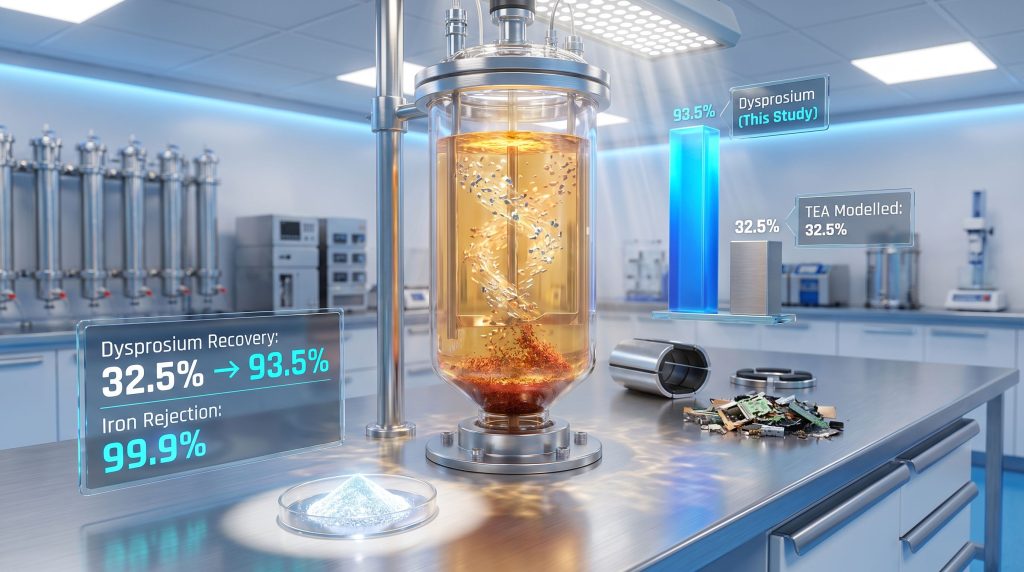
Steps 3 and 4 represent the highest complexity in the flowsheet. The independently validated figure of 99.9% iron rejection with no measurable co-extraction of target rare earths during solvent extraction is a particularly demanding specification, and its confirmation on commercial-grade feedstock is a meaningful process credibility milestone.
How IONSolv Compares to Alternative Recovery Methodologies
| Recovery Methodology | Key Mechanism | Iron Rejection Capability | Dysprosium Selectivity | Scalability Profile |
|---|---|---|---|---|
| Conventional acid leach + SX | Sulphuric/HCl leach, solvent extraction | Moderate (multi-stage required) | Low-moderate | Proven at scale |
| Membrane-assisted separation | Selective membrane permeation | High | High | Early-stage, R&D phase |
| Ionic liquid / IONSolv-type | Selective ionic dissolution | High (99.9% demonstrated) | High (93.5% achieved) | Modular, early commercial |
| Pyrometallurgical pre-treatment + leach | Roasting + acid dissolution | Low without additional steps | Low | Established, energy-intensive |
Feedstock Science: Why the Commercial E-Waste Feed Changes Everything
Three Primary Rare Earth Magnet Feedstock Streams
Understanding what goes into a rare earth recycling process is as important as understanding what comes out. The sector operates across three distinct feedstock categories, each with profoundly different economics:
-
Stream 1 – End-of-life consumer electronics (e-waste): Hard disk drives, speakers, headphones, and small consumer motors. This stream has the lowest rare earth grade and the highest iron and contamination loading. It is also the most abundant and most immediately accessible.
-
Stream 2 – OEM production scrap: Magnet manufacturing offcuts and rejected parts generated during the production of new magnets. Significantly higher rare earth grade, cleaner matrix, and considerably easier to process. Volume is constrained by production rates.
-
Stream 3 – End-of-life motor stators from EVs and industrial equipment: The largest rare earth mass per unit by a substantial margin, and a feedstock stream that will grow dramatically as the global EV fleet reaches end-of-life over the next decade. Complex disassembly requirements are the primary challenge.
The Significance of Testing on Commercial-Grade, High-Iron Feedstock
The IONSolv metallurgical test programme used commercially representative feedstock supplied by Colt Recycling, an active US e-waste recycler. Critically, this material contained higher iron content and lower rare earth grade than the parameters modelled in the original November 2025 Techno-Economic Analysis (TEA). This is the engineering equivalent of a worst-case stress test.
The urban mining resource base has long suffered from a credibility problem known informally as the clean feed fallacy. Laboratory results achieved on pre-processed, homogeneous, or artificially clean feedstock frequently fail to replicate when heterogeneous, contaminated commercial streams are introduced. Demonstrating process stability and superior recovery rates on high-iron, low-grade commercial material directly challenges this historical pattern.
The implication for process credibility is substantial. A recovery rate achieved under adverse feedstock conditions carries significantly more engineering weight than the same recovery rate achieved on clean laboratory samples, because it demonstrates chemistry that is robust to real-world variability rather than optimised for idealised conditions.
Breaking Down the Numbers: What 93.5% Dysprosium Recovery Actually Represents
Actual Performance Versus TEA Modelled Assumptions
The magnitude of the variance between modelled and independently validated recovery rates across the rare earth suite is striking:
| Rare Earth Element | TEA Modelled Recovery (Nov 2025) | Independently Validated Recovery | Variance (Percentage Points) | Performance Multiplier |
|---|---|---|---|---|
| Dysprosium (Dy) | 32.5% | 93.5% | +61.0 pp | ~2.9x |
| Neodymium (Nd) | 95.5% | 96.5% | +1.0 pp | ~1.01x |
| Praseodymium (Pr) | 92.0% | 96.5% | +4.5 pp | ~1.05x |
| Iron rejection | Qualitative only | 99.9% | Quantified for first time | N/A |
The neodymium and praseodymium results represent incremental improvements within a well-modelled range — the kind of modest beats that confirm process assumptions rather than challenge them. The dysprosium result is categorically different in nature. Moving from 32.5% to 93.5% is not a beat; it is a reassignment of dysprosium from a marginal contributor to a primary revenue driver within the same capital footprint.
The Critical Distinction: Leach Efficiency Versus Flowsheet Recovery
Investors assessing these figures must understand a technically important distinction. These results represent unaudited leach efficiencies, meaning performance at the leaching and extraction stage of the process. They do not yet represent confirmed mass balance across the full processing circuit, from ore-equivalent feed through to saleable rare earth oxide product.
The stages between a successful leach and a commercially saleable product include:
- Solvent recycle loops, where ionic liquid or organic extractant performance over multiple cycles must be validated
- Precipitation, where dissolved rare earth ions are converted to solid intermediates
- Calcination, where intermediates are converted to oxide at high temperature
- Product characterisation to confirm commercial purity specifications are met
Losses can accumulate at each of these stages. Consequently, the most rigorous commercial validation will come from a full circuit mass balance that confirms leach-stage efficiency translates through the entire flowsheet to a recovered, specification-grade product. That work remains the next critical technical gate.
How Dysprosium Recovery at Scale Reshapes the Original Economic Model
The Original TEA Parameters
The November 2025 TEA modelled a 2,000 tonne per annum modular processing plant with the following key economic parameters:
- Capex: US$4.6 million
- NPV at 10% discount rate: US$7 million
- IRR: 46%
- Payback period: 2.6 years
Those figures were built on the assumption that dysprosium would be a rounding error in the revenue architecture, with the business fundamentally characterised as a light rare earth recovery operation. At 32.5% dysprosium recovery, that characterisation was accurate. At 93.5% dysprosium recovery, it is no longer valid.
Revenue Architecture Under Three Dysprosium Price Scenarios
Because dysprosium commands a significant price premium over neodymium and praseodymium, a near-tripling of its recovery rate changes not just the revenue total but the composition of revenue per tonne of feedstock processed. A business that was previously approximately 90% dependent on light rare earth pricing now derives a materially larger share of its per-tonne revenue from a heavy rare earth that trades at multiples of neodymium's price.
This matters for three distinct reasons:
- Risk profile diversification: Revenue that was previously concentrated in neodymium and praseodymium price movements is now spread across a different pricing dynamic, including heavy rare earth market conditions
- Supply constraint premium: Dysprosium's supply base is far more constrained than neodymium, with China controlling an estimated 85–90% of global refined dysprosium output. Ex-China alternative supply remains severely limited, which structurally supports price premiums over the medium term
- Capital efficiency improvement: The dysprosium recovery uplift adds revenue without altering the US$4.6 million capital requirement, meaning every dollar of incremental dysprosium revenue flows directly to IRR improvement
Investors evaluating a revised TEA should focus not only on the headline NPV figure, but on how the revenue split between light and heavy rare earths has shifted. A processing operation with 30–40% of per-tonne revenue attributable to dysprosium has a fundamentally different risk, pricing, and supply-chain positioning profile than one that was previously light-rare-earth-dependent.
Important disclaimer: The scenario projections and economic sensitivities discussed above are analytical frameworks for understanding the directional impact of improved recovery rates. They do not constitute financial advice or verified project economics. Investors should await a formally revised TEA and any subsequent Pre-Feasibility Study before forming investment conclusions.
The next major ASX story will hit our subscribers first
The Geopolitical Dimension: Why Western Dysprosium Independence Matters
A Supply Problem That Light Rare Earth Progress Does Not Solve
The rare earth supply chain narrative often conflates light and heavy rare earths, but the supply dynamics are radically different. For neodymium and praseodymium (collectively NdPr), alternative supply capacity is genuinely growing, with projects in Australia, the United States, and Canada advancing toward production. The supply diversification thesis for light rare earths has genuine momentum.
For dysprosium and terbium — the primary heavy rare earths used in magnet applications — the picture is far more constrained. These elements are enriched in ion-adsorption clay deposits that are geographically concentrated in southern China's Jiangxi, Fujian, and Guangdong provinces. Ion-adsorption clays are a fundamentally different ore type from the hard-rock rare earth deposits that underpin most Western rare earth project pipelines.
The practical implication is that even as Western NdPr supply diversifies, dysprosium and terbium remain structurally dependent on Chinese supply chains. China's export restrictions on heavy rare earths have made this vulnerability acutely apparent to governments and manufacturers alike. Western magnet manufacturers building supply chain resilience for light rare earths may find they have simply moved the bottleneck rather than eliminated it.
Why Magnet Recycling Offers a Structurally Different Supply Answer
Recycling-based dysprosium recovery operates on a different resource logic than mining. Rather than requiring access to specific geological formations that are geographically constrained, it draws on an existing and growing urban resource base: the accumulated stock of NdFeB magnets embedded in consumer electronics, industrial equipment, and increasingly, electric vehicles.
The EV fleet dimension is particularly significant. Current-generation EV traction motors contain between 1 and 3 kilograms of rare earth magnet material per vehicle. As early EV models approach end-of-life over the next decade, motor stators will represent a growing and increasingly high-grade dysprosium-bearing feedstock stream. The geographic distribution of this resource mirrors the geography of EV adoption rather than the geology of ion-adsorption clays.
A modular, distributed processing platform deployed as a hub-and-spoke network near existing e-waste collection and automotive dismantling infrastructure can access this resource at lower capital intensity than centralised refinery models. The US$4.6 million capex modelled for a 2,000 tpa node is orders of magnitude below what a comparable greenfield rare earth mining project would require at equivalent rare earth output. In addition, America's rare earth supply chain is increasingly looking to precisely this kind of distributed recycling model to reduce strategic dependency on imported materials.
Outstanding Technical and Commercial Risks
Four Validation Gates That Remain Open
Despite the significance of the metallurgical results, the distance between a successful leach test and a commercially operating processing plant is substantial. The four most important remaining validation gates are:
- Full circuit mass balance: Confirming that 93.5% dysprosium leach efficiency translates through precipitation, calcination, and product recovery without material loss. This is the single most important technical confirmation outstanding.
- Solvent recycle performance: Ionic liquid and solvent extraction systems must be regenerated and reused across commercial operational cycles without significant degradation in selectivity. Long-duration cycling data, not batch test results, is required.
- Feedstock supply security: Current engagement with OEM production scrap and end-of-life motor stator counterparties is described as preliminary and non-binding. Contracted feed volumes are a prerequisite for credible Pre-Feasibility Study economics.
- Pre-Feasibility Study with committed feedstock: A PFS that relies on assumed rather than contracted feed volumes carries a structural caveat on every economic metric it contains.
The Contamination Cascade Risk in Hydrometallurgical Circuits
One of the least-discussed risks in rare earth recycling is what happens to solvent extraction circuit selectivity over extended operational cycles when processing heterogeneous commercial feed. Consumer electronics e-waste contains trace quantities of elements including copper, nickel, zinc, and various rare earth contaminants that do not appear in controlled test samples.
Over multiple leach-extract-strip-recycle cycles, these trace elements can accumulate in the organic phase or at the aqueous-organic interface, progressively degrading the selectivity that produced the strong initial results. This contamination cascade effect has historically been a primary failure mode for hydrometallurgical processes that performed well in batch testing but degraded under continuous commercial operation.
Pilot plant operation over extended duration — not batch leach tests — is the only way to characterise this risk at sufficient resolution for commercial confidence. For further context on extraction rates and recent validation milestones, recent results from Iondrive provide useful supporting detail.
Step-by-Step: From Magnet to Rare Earth Oxide
The pathway from a shredded hard disk drive to a saleable rare earth oxide product involves six distinct stages, each with its own efficiency and loss profile:
- Feed preparation: Mechanical shredding of magnet-bearing e-waste, followed by demagnetisation to prevent clumping, and particle size classification to optimise reagent surface contact
- Selective leaching: Rare earth elements are preferentially dissolved from the iron-dominant matrix. This is where the IONSolv chemistry operates and where the 93.5% dysprosium recovery was measured
- Solvent extraction: The iron-rich, rare-earth-bearing leach solution is contacted with an organic extractant. At 99.9% iron rejection with no measurable rare earth co-extraction, this stage performs the critical separation work
- Selective stripping: Individual rare earth fractions (Nd, Pr, Dy) are sequentially recovered from the loaded organic phase by controlled stripping conditions, yielding separated rare earth streams
- Precipitation and calcination: Stripped rare earth solutions are chemically precipitated as carbonates or oxalates, then calcined at high temperature to produce the rare earth oxides that form the basis of commercial rare earth product specifications
- Product characterisation: Final oxide products are assayed to verify purity against commercial specifications, which typically require rare earth oxide purities of 99%+ for magnet-grade applications
Frequently Asked Questions
Why do TEA models systematically underestimate dysprosium recovery?
Legacy techno-economic models for rare earth recycling were built at a time when dysprosium selectivity in complex, iron-dominant leach solutions was poorly characterised. Early process designs treated dysprosium as a problematic contaminant to manage rather than a high-value target to optimise, and conservative recovery assumptions reflected genuine uncertainty rather than deliberate conservatism. As selective leach chemistry has improved, the gap between modelled and actual dysprosium recovery has widened, creating the systematic downward bias that makes results like 93.5% look surprising relative to prior assumptions.
What makes iron rejection at 99.9% technically difficult to achieve?
Iron constitutes 60–70% of NdFeB magnet mass, meaning any leach solution contains enormously more iron than rare earth elements. At that concentration ratio, achieving 99.9% iron rejection while retaining essentially all of the rare earth content in the organic phase requires an extractant with exceptional selectivity, operating under precisely controlled pH, temperature, and diluent conditions. Small deviations in process conditions can cause iron co-extraction, which contaminates the rare earth product and can render it commercially unsaleable at standard purity specifications.
How does dysprosium recycling interact with the EV transition timeline?
The current EV fleet was largely built after 2015. With typical vehicle lifespans of 10–15 years, the first significant wave of end-of-life EV motor stators will enter the recycling stream in the late 2020s and accelerate through the 2030s. This creates a structural growth curve for high-grade dysprosium-bearing feedstock that does not yet exist at meaningful scale but is highly predictable in its timing. Recycling platforms that establish operational credibility and feedstock relationships now will be positioned to access this growing stream as it materialises. The broader academic case for this approach is well documented in research on recovering rare earths from e-waste, which supports the long-term viability of the recycling pathway.
What is the difference between a TEA and a Pre-Feasibility Study?
A Techno-Economic Analysis is a desktop-level economic screening tool, typically based on assumed process parameters, high-level cost estimates, and limited laboratory data. It answers the question of whether a process is worth pursuing at a conceptual level. A Pre-Feasibility Study involves substantially more detailed engineering design, site-specific capital and operating cost estimation, environmental baseline work, and critically, committed or near-committed feedstock and offtake arrangements. The PFS answers whether a project is viable to develop at a defined scale. Consequently, the transition between the two is where most Iondrive dysprosium recovery from e-waste projects encounter their first hard commercial tests, because it is where feedstock assumptions must convert from modelled to contracted.
Want to Know Which ASX Companies Are Making Major Mineral Discoveries Right Now?
Discovery Alert's proprietary Discovery IQ model scans ASX announcements in real time, instantly identifying significant mineral discoveries — including those in the critical minerals and rare earth sectors reshaping global supply chains — and delivering actionable alerts directly to subscribers. Explore historic discoveries and their extraordinary market returns, then begin your 14-day free trial at Discovery Alert to position yourself ahead of the broader market.