June 15, 2026
The Quiet Geography of America's Rare Earth Deficit
Somewhere beneath the rolling farmland of west Tennessee lies one of the more consequential geological accidents in the story of American industrial resilience. The McNairy Formation, a sedimentary mineral-sands system stretching across parts of the state, hosts a rare combination of heavy rare earth elements, titanium minerals, and zircon within a single geological province. For most of its history, this formation attracted interest primarily for its silica sand content. What previous operators left behind, however, may turn out to be far more strategically valuable than what they extracted.
The IperionX rare earths acquisition in Tennessee, specifically the purchase of Covia Solutions' Camden mineral and mining assets for US$3 million, reflects a calculated effort to consolidate control over this province at a time when domestic critical minerals supply chain development has become one of the defining industrial priorities in the United States. Understanding why this transaction matters requires looking beyond the headline price tag and examining the underlying geological, strategic, and economic architecture of what IperionX (ASX: IPX) is assembling.
When big ASX news breaks, our subscribers know first
Why Heavy Rare Earths Are Not Created Equal
Most discussions of rare earth elements treat the category as monolithic, but the distinction between light and heavy rare earths is critical to understanding where genuine supply chain vulnerability exists. In addition, the geopolitical implications of this divide have become increasingly urgent for Western industrial planners.
Light rare earth elements (LREEs) such as cerium, lanthanum, and neodymium are relatively more abundant and are produced in meaningful quantities at several sites globally, including Mountain Pass in California. Heavy rare earth elements (HREEs), by contrast, including dysprosium, terbium, and holmium, are genuinely scarce, both geologically and in terms of active producing operations. Consequently, rare earth supply chains for HREEs remain among the most fragile in the global critical minerals landscape.
The strategic importance of HREEs is disproportionate to their volume. A small addition of dysprosium to a neodymium-iron-boron (NdFeB) permanent magnet dramatically improves its resistance to demagnetisation at elevated operating temperatures, a property essential for the electric motors in EVs and for the generators in wind turbines.
The global supply of HREEs remains heavily concentrated. Without a meaningful domestic HREE source, Western clean energy and defence supply chains carry a structural vulnerability that cannot be resolved through stockpiling alone. The McNairy Formation's documented heavy rare earth concentrate (HREC) potential positions it as one of the few identified domestic geological systems capable of addressing this gap.
The Mineral-Sands Advantage Over Hard-Rock Deposits
One underappreciated aspect of Tennessee's Big Sandy Critical Minerals Province is the nature of the deposit type itself. Mineral-sands systems differ fundamentally from hard-rock rare earth deposits like Mountain Pass in ways that carry meaningful implications for development economics.
Hard-rock rare earth deposits typically require energy-intensive crushing, grinding, and chemical leaching to liberate target minerals from their host rock. Mineral-sands deposits, by comparison, are unconsolidated or semi-consolidated sedimentary systems where target minerals already exist as discrete, physically separable grains. This characteristic means that conventional gravity separation, wet shaking tables, magnetic separation, and electrostatic separation can be used to concentrate target minerals without the energy costs and tailings complexity associated with hard-rock processing. Furthermore, the rare earth processing challenges associated with hard-rock systems are largely bypassed by this mineral-sands architecture.
The McNairy Formation's mineral-sands architecture therefore represents a geological head start for any development programme, particularly one seeking to minimise processing capital expenditure and environmental footprint.
Dissecting the Camden Transaction
The structure of the IperionX rare earths acquisition in Tennessee deserves careful examination, because the strategic logic extends well beyond the acquisition price.
What US$3 Million Actually Buys
At face value, US$3 million is a modest sum in the context of critical minerals project development. What makes this transaction compelling is the composition of assets acquired rather than the price paid:
- Mineral rights over the Camden property, extending IperionX's land tenure within the McNairy Formation
- Pre-processed mineral stockpiles resulting from historic silica sand operations, which concentrated heavy mineral fractions as a byproduct of prior extraction activity
- Mining and processing equipment already installed on-site, representing significant replacement cost avoidance
- Approximately 2,800 acres of land directly adjacent to the fully permitted Titan Project
The pre-processed stockpiles deserve particular attention. When Covia and its predecessors operated Camden as a silica sand mine, the heavy mineral fraction, including ilmenite, rutile, zircon, and rare earth bearing minerals, was a processing discard. These fractions accumulated in stockpiles that represent pre-liberated, partially sorted critical mineral material. Evaluating and potentially processing this material could provide near-term production optionality at a fraction of the cost of developing a greenfield resource.
Asset Integration Map
| Asset Component | Location | Current Status | Strategic Value |
|---|---|---|---|
| Titan Project | Camden, Tennessee | Fully permitted | Flagship DFS-stage development |
| Camden Acquisition | Adjacent to Titan | Early evaluation | Land consolidation, stockpiles, equipment |
| Virginia Manufacturing | Virginia, USA | Operational | Downstream titanium metal production |
| McNairy Formation tenure | West Tennessee | Expanding | Geological resource optionality |
The Titan Project: Financial Benchmarks for the Combined Platform
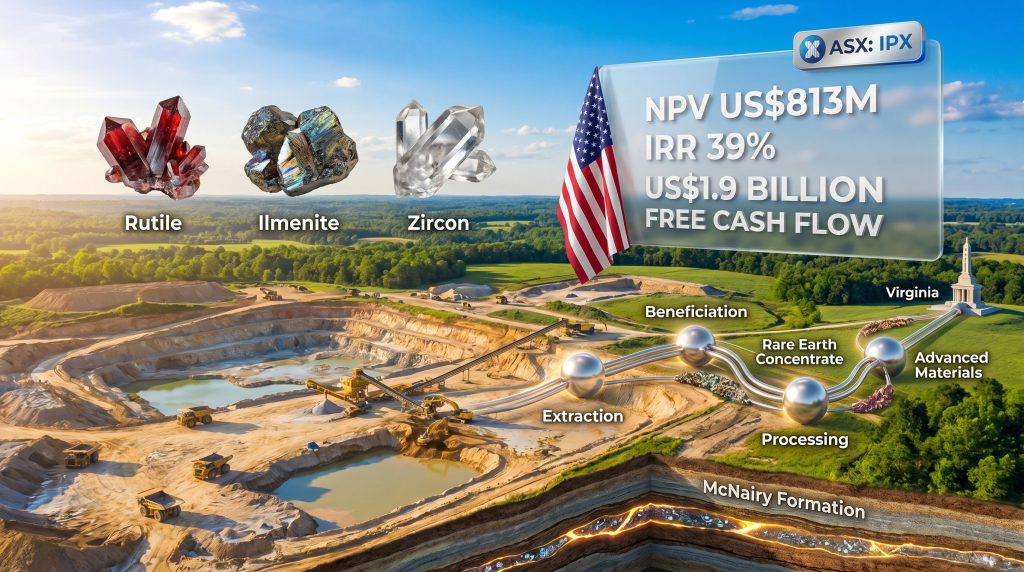
The IperionX Titan milestone reached in June 2026 with the publication of the Definitive Feasibility Study (DFS) established a financial baseline that contextualises the Camden acquisition's potential contribution. The DFS reported:
- After-tax NPV of US$813 million
- After-tax IRR of 39%
- After-tax free cash flow of US$1.9 billion over an initial 14-year mine plan
These metrics were derived from the Titan Project's standalone resource base. The Camden acquisition, however, introduces optionality across several dimensions that could improve upon this base case over time:
- Mine life extension: Additional mineral rights over adjacent McNairy Formation geology could support resource delineation that extends the production horizon beyond the initial 14-year plan
- Feedstock volume expansion: Confirmation of economic mineralisation at Camden could increase annual throughput capacity or reduce per-unit processing costs through shared infrastructure
- Production flexibility: Pre-processed stockpiles at Camden may allow for accelerated early production or blending strategies that optimise mineral recovery
- Capital efficiency: Shared haul routes, processing infrastructure, and permitting frameworks across the combined Titan-Camden footprint could reduce per-tonne development costs
It is important to note that the Camden assets remain in early evaluation phase. No independent mineral resource estimate has been published for the newly acquired land package, and the financial parameters above relate solely to the Titan Project as assessed in the June 2026 DFS. The potential benefits of Camden integration are prospective and subject to technical confirmation through ongoing exploration work.
Understanding the McNairy Formation's Multi-Mineral System
The commercial appeal of the Tennessee platform rests not only on rare earths but on a polymetallic mineral assemblage that creates multiple revenue streams from a single mining operation. You can review IperionX's full minerals operations for further detail on the breadth of the company's resource base.
| Mineral | Classification | Primary Industrial Application |
|---|---|---|
| Heavy Rare Earth Concentrate (HREC) | Critical mineral | NdFeB permanent magnets for EVs, wind turbines, defence |
| Ilmenite | Titanium feedstock | Titanium metal production, titanium dioxide pigment |
| Rutile | High-grade titanium mineral | Aerospace alloys, defence components, specialty welding |
| Zircon | Industrial mineral | Advanced ceramics, nuclear fuel rod cladding, specialty chemicals |
This polymetallic character is strategically significant from an investor perspective. Projects that can generate revenue from multiple co-products are more resilient to price volatility in any single commodity. If rare earth prices were to soften, revenue contribution from titanium minerals and zircon provides a financial buffer. Conversely, if titanium or zircon markets tighten, the HREC component can shoulder more of the revenue burden.
The Rutile Premium Worth Understanding
Within the titanium mineral suite, rutile commands a substantial price premium over ilmenite due to its higher titanium dioxide content, typically above 93% TiO2 compared to ilmenite's 45–65% TiO2 range. Rutile can be fed directly into the chloride process for titanium metal production or used as a feedstock for titanium tetrachloride, a precursor to both titanium sponge and titanium dioxide pigment. The presence of natural rutile in the McNairy Formation's mineral assemblage, rather than requiring synthetic rutile upgrading, represents a processing cost advantage that is not always appreciated in high-level project summaries.
IperionX's Vertical Integration Architecture
The Camden acquisition is most accurately understood not as a standalone land purchase but as one piece of a vertically integrated supply chain strategy connecting Tennessee geology with Virginia manufacturing. Indeed, America's rare earth supply challenges make this kind of end-to-end domestic capability increasingly valuable.
The Five-Stage Integration Model
- Extraction: Mining of unconsolidated mineral sands from the Titan and Camden assets within the McNairy Formation, using conventional open-cut methods suited to the flat-lying sedimentary geometry
- Wet Concentration: Processing of raw mineral sands through gravity and physical separation circuits to produce a heavy mineral concentrate (HMC) at the mine site
- Dry Separation: Secondary processing of HMC through magnetic and electrostatic separation to generate individual mineral products, including ilmenite, rutile, zircon, and HREC
- Downstream Processing (Virginia): Conversion of titanium mineral concentrates into titanium metal using advanced manufacturing processes at IperionX's Virginia operations, targeting defence, aerospace, and advanced manufacturing customers
- Future Rare Earth Separation (Development Stage): Planned but not yet operational development of U.S.-based rare earth separation, magnet alloy, and advanced materials capability to process HREC into separated rare earth oxides and eventually magnet precursors
Vertical integration in critical minerals is increasingly viewed as a prerequisite for accessing U.S. defence procurement. The Department of Defense has signalled a preference for domestic suppliers capable of demonstrating end-to-end supply chain control, rather than those supplying only concentrates or intermediates.
The next major ASX story will hit our subscribers first
Technical Evaluation Roadmap for Camden
IperionX has outlined a structured technical evaluation programme for the Camden assets. Investors should understand both the potential value this work could unlock and the time and capital required to progress through each stage.
Near-Term Technical Work Plan
- Surface sampling and geochemical mapping to characterise the distribution of target minerals across the 2,800-acre land package
- Mineral analysis of existing stockpiles to quantify the grade and volume of heavy mineral fractions already concentrated by historic operations
- Metallurgical testwork on stockpile material to assess beneficiation performance, mineral recovery rates, and concentrate quality
- Subsurface drilling programmes to define resource continuity and grade distribution at depth beneath the Camden property
- Feasibility assessments to determine whether Camden assets should be integrated into the Titan Project's existing mine plan or developed on a separate but complementary production schedule
Key Risks Investors Should Weigh
Exploration and Resource Uncertainty
The Camden assets are at an early stage of technical evaluation. There is no guarantee that surface sampling, stockpile analysis, or drilling will confirm the presence of economically extractable mineralisation across the full 2,800-acre footprint. Metallurgical testing may reveal processing challenges, including unfavourable mineral associations, fine-grained mineral textures, or radioactive mineral content that requires additional regulatory management.
Capital Requirements Beyond the Acquisition Price
The US$3 million acquisition cost is the entry price, not the total development cost. Realising value from Camden will require ongoing expenditure across exploration, feasibility studies, permitting, and eventual infrastructure development. Investors should consider this in the context of IperionX's overall capital position and the funding requirements of the Titan Project itself.
Permitting and Regulatory Timeline
While the Titan Project holds existing permits, integrating Camden into an expanded development programme may require additional environmental assessments, new state mining permits, or federal approvals covering any new land disturbance areas or processing facilities. Regulatory processes in the U.S. mining sector can extend development timelines in ways that are difficult to predict with precision. The broader US critical mineral strategy being pursued at a federal level may, however, help streamline approvals for qualifying domestic projects over time.
A Note on Comparing Domestic Rare Earth Development Approaches
| Development Pathway | Representative Projects | Key Advantage | Primary Challenge |
|---|---|---|---|
| Mineral sands (placer) | Titan/Camden, Tennessee | Pre-liberated minerals, polymetallic revenue | Variable grade, beneficiation complexity |
| Hard-rock mining | Mountain Pass, California | Potentially high grade | Energy-intensive processing, single commodity |
| Ionic clay deposits | Various international | Relatively easy processing | Primarily concentrated outside the U.S. |
| Recycling and secondary recovery | Multiple U.S. programmes | Circular economy, no new land disturbance | Limited scale relative to primary demand |
Long-Term Demand Drivers Underpinning the Tennessee Platform
The investment case for the IperionX rare earths acquisition in Tennessee ultimately rests on structural demand growth across multiple end markets. According to recent mining technology coverage, the project has attracted significant attention for precisely this reason.
- Global NdFeB permanent magnet demand is forecast to grow substantially through the 2030s as EV penetration accelerates and offshore wind capacity expands, with HREE additions to magnet alloys remaining a technical necessity for high-performance applications
- U.S. titanium consumption in aerospace, defence, and medical devices continues to exceed domestic production capacity, creating persistent import dependence that domestic supply chains like IperionX's Virginia operations are positioned to address
- Zircon demand from advanced ceramics and specialty chemical sectors provides revenue diversification that reduces exposure to any single end-market cycle
- The structural shift in U.S. procurement policy toward verified domestic supply chains, particularly for defence-adjacent materials, creates a long-term demand pull for qualifying producers that extends beyond spot market price signals
This article contains general information only and does not constitute financial advice. Investing in ASX-listed resource companies involves significant risk, including exploration risk, commodity price risk, and regulatory uncertainty. Past performance is not indicative of future returns. Readers should seek independent financial advice before making investment decisions.
For further reading on U.S. critical minerals policy and rare earth supply chain development, additional coverage is available through Motley Fool Australia's resources sector reporting at fool.com.au.
Want to Track the Next Major ASX Critical Minerals Discovery in Real Time?
Discovery Alert's proprietary Discovery IQ model instantly identifies significant ASX mineral discoveries across rare earths, titanium, and more than 30 other commodities, delivering actionable alerts to subscribers before the broader market catches on — explore historic discoveries and their returns, then begin your 14-day free trial at Discovery Alert to position yourself ahead of the next major find.