May 20, 2026
Modern industrial facilities face complex environmental evaluation frameworks that extend far beyond traditional chemical plant assessments. The emergence of synthetic fuel production technologies requires comprehensive analysis of renewable energy integration, carbon utilization pathways, and circular economy principles. These evaluations must address unprecedented technical challenges while ensuring compliance with evolving sustainability standards across multiple regulatory jurisdictions.
Understanding E-Methanol Environmental Impact Assessment Frameworks
The e-methanol plant environmental assessment process represents a paradigm shift in industrial evaluation methodologies. Unlike conventional methanol production facilities that rely on fossil fuel feedstocks, synthetic methanol plants require evaluation frameworks that address renewable electricity dependency, green hydrogen sourcing, and carbon dioxide capture integration. Furthermore, these assessments align closely with broader energy transition trends shaping industrial development.
Environmental assessments for these facilities must evaluate complete lifecycle impacts spanning from renewable energy generation through end-use combustion. This comprehensive approach differs significantly from traditional chemical plant evaluations that focus primarily on direct facility emissions and local environmental impacts.
Key Environmental Assessment Categories for E-Methanol Projects
• Carbon footprint analysis across complete production lifecycle
• Air quality impact modeling for synthetic fuel combustion
• Water resource utilisation and treatment system design
• Renewable energy grid integration requirements
• Waste heat recovery and energy efficiency optimisation
• Circular economy compliance and material flow analysis
The NorQuim facility in Mejillones, Chile exemplifies integrated assessment approaches with its US$1.2 billion e-methanol plant designed to produce 420,000 tonnes annually of synthetic fuel for maritime and aviation markets. The project's environmental evaluation addresses both standalone facility impacts and integration with complementary industrial operations.
Environmental assessment frameworks must address feedstock sustainability verification, including green hydrogen certification from renewable electricity sources and biogenic CO₂ qualification from industrial capture systems. Consequently, the complexity increases when facilities integrate multiple renewable energy sources and carbon utilisation technologies within single industrial complexes.
When big ASX news breaks, our subscribers know first
Critical Environmental Performance Metrics
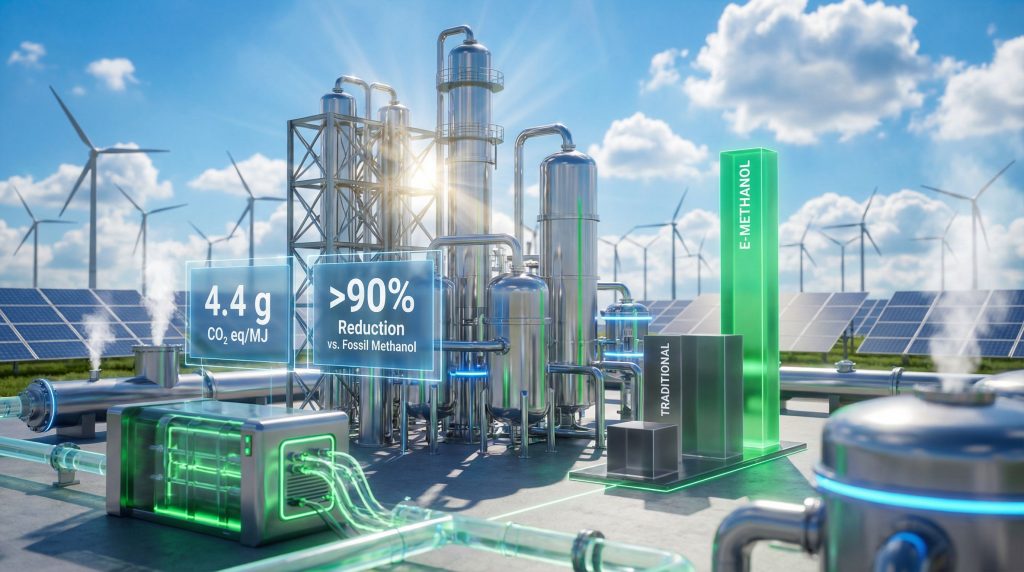
Lifecycle carbon footprint analysis forms the cornerstone of e-methanol plant environmental assessment. Production pathway emissions vary significantly based on electricity sources, hydrogen generation methods, and carbon dioxide acquisition strategies. Facilities utilising renewable electricity and biogenic CO₂ can achieve substantial emission reductions compared to fossil fuel alternatives.
Lifecycle Carbon Footprint Analysis
| Production Pathway | CO₂ Emissions (g CO₂ eq/MJ) | Reduction vs. Fossil Methanol |
|---|---|---|
| E-methanol (renewable + biogenic CO₂) | 4.4 | >90% |
| Natural gas methanol (optimised) | 93-110 | Baseline comparison |
| Coal-based methanol | ~300 | Baseline comparison |
Air quality performance specifications represent another critical assessment dimension. E-methanol combustion achieves zero sulfur oxide emissions during operation, minimal nitrogen oxide generation compared to petroleum derivatives, and negligible particulate matter release across maritime and aviation applications. These benefits complement advanced waste management solutions being implemented across industrial sectors.
The NorQuim project targets export markets for maritime and aviation fuel applications, requiring assessment metrics that address international fuel specifications and emissions standards. Port area air quality improvements become measurable benefits when e-methanol displaces heavy fuel oil or marine gas oil in shipping operations. According to research published by the Royal Society of Chemistry, synthetic fuel pathways demonstrate significant environmental advantages through reduced combustion emissions.
Process-Specific Environmental Benefits
• Elimination of sulfur compounds from fuel composition
• Reduced particulate emissions during combustion cycles
• Lower nitrogen oxide formation in marine diesel engines
• Improved port air quality through bunker fuel displacement
Environmental performance metrics must differentiate between direct facility emissions, indirect emissions from renewable electricity consumption, and scope 3 emissions including transportation and end-use combustion benefits. This multi-dimensional approach ensures comprehensive environmental impact evaluation while supporting broader mining decarbonisation benefits.
Process Integration Environmental Assessment
CO₂ sourcing strategies significantly influence environmental assessment outcomes for e-methanol facilities. Biogenic CO₂ integration from industrial sources achieves near-net-zero well-to-wake emissions when combustion CO₂ offsets feedstock CO₂ acquisition. Co-location reduces transportation emissions while enhancing circular economy credentials.
The NorQuim complex demonstrates integrated process assessment through its Strategic Inputs Plant that produces 520,000 tonnes of soda ash, 520,000 tonnes of calcium chloride, and 200,000 tonnes of high-purity lime from mining residues. Biogenic CO₂ captured from these operations becomes feedstock for e-methanol synthesis, eliminating long-distance CO₂ transport requirements.
Process Optimisation Environmental Performance
| Design Configuration | Total PEI Output Reduction | PEI Generation Reduction |
|---|---|---|
| CO₂ via reformer (0.9 recycle ratio) | 53% (176.3 to 93.4 PEI/h) | 44.7% (149.9 to 67.0 PEI/h) |
| Direct CO₂ feed | Baseline comparison | Baseline comparison |
Process integration evaluation must address waste heat management across multiple facility components. Advanced facilities achieve energy efficiency improvements through thermal integration between electrolysis operations, methanol synthesis reactors, and co-located industrial processes.
Distance and transport challenges create significant environmental assessment considerations. Long-distance CO₂ transport increases lifecycle emissions, while grid electricity dependency can compromise environmental benefits when renewable energy sources are insufficient or intermittent.
Renewable Energy Integration Specifications
• Grid electricity sourcing from verified renewable suppliers
• Backup fuel requirements during renewable generation variability
• Energy storage integration for production continuity
• Grid balancing services potential from flexible operation
Environmental assessments must evaluate infrastructure development requirements including electrolyser manufacturing scaling, CO₂ transport infrastructure development, and renewable energy expansion to support increased electricity demand. The NorQuim facility addresses these challenges through strategic positioning in Mejillones port zone with access to existing LNG infrastructure for supplementary energy requirements.
Regulatory Frameworks and Compliance Requirements
International sustainability standards increasingly govern e-methanol plant environmental assessment. RED III standards for renewable fuel lifecycle assessment establish system boundary definitions for carbon accounting and sustainability criteria for feedstock verification. These frameworks require comprehensive environmental management system integration across facility operations. Moreover, these developments reflect broader industry innovation trends transforming industrial sustainability practices.
The Chilean Sistema de Evaluación de Impacto Ambiental (SEIA) process demonstrates regional regulatory approaches. NorQuim filed its environmental impact assessment on March 27, 2026, initiating evaluation procedures that address local environmental conditions while meeting international sustainability requirements.
Regional Assessment Protocol Requirements
• Air quality standards compliance for industrial zones
• Water use permits and discharge requirements
• Noise and visual impact assessments for port locations
• Biodiversity protection measures in coastal environments
Environmental assessments must address stakeholder engagement protocols and community consultation requirements that accompany industrial development in established port zones. The integration of multiple facility types within industrial complexes requires coordinated environmental management approaches.
Economic sustainability metrics increasingly integrate with environmental assessment outcomes. Standalone e-methanol facilities face production costs of €1,200-1,600 per tonne, while integrated facilities achieve cost reductions through shared infrastructure and waste heat utilisation strategies. Research from the European Investment Bank highlights the importance of comprehensive environmental impact assessments for emerging industrial technologies.
Long-Term Environmental Monitoring and Technology Evolution
Operational phase environmental monitoring requires continuous emissions tracking, energy efficiency optimisation programs, and water quality management systems. Advanced facilities implement real-time monitoring protocols that address both regulatory compliance and operational optimisation objectives.
The NorQuim project's 54-year operational lifespan necessitates adaptive environmental management systems that accommodate technology evolution and efficiency improvements. Construction employment of 3,200 workers and 400 operational positions require environmental training programs focused on emerging technology applications. These developments parallel advances in mine reclamation innovation across industrial sectors.
Technology Evolution Considerations
• Electrolyser efficiency improvements and scaling effects
• CO₂ capture technology advancement and cost reduction
• Renewable electricity grid expansion and reliability enhancement
• Process optimisation through operational experience accumulation
Environmental assessments must account for supply chain integration challenges including feedstock transportation emissions, backup fuel requirements during renewable energy intermittency, and market integration benefits through shipping decarbonisation and chemical industry feedstock diversification.
Investment Perspective: The NorQuim US$2.1 billion integrated complex represents significant capital commitment to e-methanol technology development. Projected 2028 construction commencement and 2030 operational targets align with international shipping decarbonisation timelines and renewable fuel adoption schedules.
Data quality variations across different assessment methodologies create challenges for standardised environmental evaluation. However, conflicting lifecycle data results from different system boundaries, regional renewable electricity carbon intensity variations, and technology maturity assumptions that affect long-term performance projections.
The next major ASX story will hit our subscribers first
Infrastructure Development and Market Integration
Environmental assessment frameworks must address infrastructure development requirements for e-methanol facility support systems. Electrolyser manufacturing scaling, CO₂ transport network development, and renewable energy grid expansion create cumulative environmental impacts beyond individual facility operations.
Market integration environmental benefits include shipping decarbonisation through low-emission fuel supply, chemical industry feedstock diversification, and port area air quality improvements through cleaner fuel adoption in maritime operations.
Supply Chain Environmental Impact Categories
• Green hydrogen production and transportation requirements
• Biogenic CO₂ capture efficiency and purity standards
• Renewable electricity grid mix and backup power systems
• Product distribution logistics and storage infrastructure
The complexity of e-methanol plant environmental assessment reflects the technology's position at the intersection of renewable energy, industrial chemistry, and sustainable transportation sectors. Successful evaluation frameworks must balance technological innovation potential with environmental performance verification and regulatory compliance across multiple jurisdictions.
Disclaimer: This analysis presents general information about e-methanol environmental assessment frameworks and should not be considered investment advice. Environmental assessment outcomes depend on specific project characteristics, regulatory requirements, and technology implementation details that vary significantly across different facilities and jurisdictions. Readers should consult qualified environmental and technical experts before making decisions based on this information.
Ready to Invest in the Next Major Mineral Discovery?
Discovery Alert instantly alerts investors to significant ASX mineral discoveries using its proprietary Discovery IQ model, turning complex mineral data into actionable insights. Understand why historic discoveries can generate substantial returns by visiting Discovery Alert's dedicated discoveries page, and begin your 14-day free trial today to position yourself ahead of the market.