August 22, 2026
The Hidden Mine Beneath Our Feet: Why Urban Ore Is Reshaping Metal Recovery
Every year, humanity extracts billions of tonnes of rock from the earth to access the metals that power modern civilisation. Yet a parallel resource stream, one that requires no drilling, no blasting, and no tailings dams, continues to accumulate in landfills, warehouses, and storage rooms worldwide. Discarded electronics, collectively classified as electronic waste or e-waste, represent one of the most metal-dense material streams ever generated by industrial society. The chemistry to unlock those metals cleanly and selectively has, until recently, lagged far behind the scale of the opportunity.
That gap is beginning to close. The University of Edinburgh e-waste metals recovery rights, now licensed to Lithium Universe through Edinburgh Innovations, represent one of the more technically credible attempts to commercialise a genuinely differentiated approach to urban mining extraction. Understanding why this matters requires stepping back from the licensing announcement itself and examining the structural forces that make selective e-waste metallurgy one of the more compelling frontiers in resource recovery.
When big ASX news breaks, our subscribers know first
E-Waste as a Resource Stream: The Grade Argument
In conventional hard-rock mining, the economic viability of a gold deposit is largely determined by ore grade, the concentration of recoverable metal per tonne of material processed. Many operating gold mines today process ore grading between 1 and 5 grams of gold per tonne. High-grade deposits occasionally reach 10 to 15 grams per tonne, and such assets are considered exceptional.
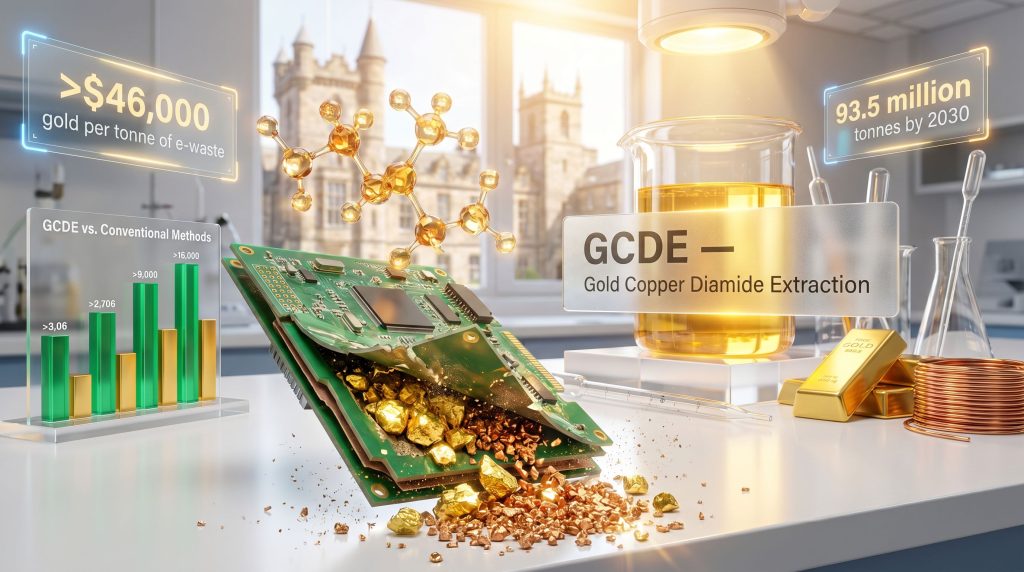
E-waste operates in an entirely different register. At current market prices, a tonne of standard electronic waste contains gold valued at more than $46,000, with copper contributing an additional estimated $2,000 per tonne. The gold concentration in printed circuit boards from smartphones and computers can exceed 300 to 400 grams per tonne, representing ore grades that are orders of magnitude above what any conventional hard-rock mine routinely processes.
This is the core of the urban ore thesis: discarded electronics are not waste in any conventional sense. They are an extraordinarily high-grade, already-surfaced ore body that expands in volume every year. Global e-waste generation is forecast to reach approximately 93.5 million tonnes by 2030, driven by accelerating consumer electronics turnover, expanding middle-class device ownership across emerging markets, and the shortening product replacement cycles endemic to modern technology hardware.
Despite this staggering resource potential, only around one-fifth of global e-waste currently passes through environmentally responsible recycling channels. The remaining 80% is either landfilled, incinerated, or processed through informal sector operations that generate significant toxic contamination.
The recycling gap is not primarily a policy failure. It reflects a deeper technological constraint: the methods available to process e-waste have historically been either environmentally destructive, commercially inefficient, or both.
Why Conventional Processing Methods Are Becoming Untenable
The two dominant approaches to e-waste metal recovery each carry significant liabilities that are becoming harder to ignore as regulatory and ESG scrutiny intensifies.
Pyrometallurgical smelting involves feeding shredded e-waste into high-temperature furnaces operating above 1,200 degrees Celsius. The process recovers a broad range of metals but does so indiscriminately, co-extracting everything present in the feed material and requiring extensive downstream refining to separate individual metal fractions. Energy consumption is enormous, and the process generates toxic flue gases including dioxins, furans, and heavy metal particulates that require expensive abatement infrastructure.
Conventional hydrometallurgy offers lower operating temperatures but introduces a different category of environmental risk. Traditional leaching processes for gold recovery rely heavily on cyanide, while some informal operations still use mercury amalgamation, a technique responsible for severe ecological and human health impacts in unregulated processing environments. Solvent extraction steps frequently involve aggressive organic solvents that present both toxicity and disposal challenges.
| Processing Method | Operating Temperature | Primary Reagents | Key Environmental Risks |
|---|---|---|---|
| Pyrometallurgical smelting | Above 1,200°C | None (thermal) | Toxic gas emissions, high energy use |
| Conventional hydrometallurgy | Low to moderate | Cyanide, mercury, solvents | Toxic leachate, contamination risk |
| GCDE (Edinburgh method) | Low temperature | Reusable organic ligands | Significantly reduced across all categories |
The commercial case for an alternative is clear. Furthermore, what has been lacking is a chemistry capable of delivering selectivity, environmental performance, and economic viability simultaneously. Advanced recycling technologies are beginning to fill this gap in meaningful ways.
Gold Copper Diamide Extraction: How the Chemistry Works
The Gold Copper Diamide Extraction (GCDE) process, developed within the School of Chemistry at the University of Edinburgh by Professor Jason Love and Professor Carole Morrison, addresses this challenge through a fundamentally different mechanistic approach.
Rather than relying on thermal energy or aggressive chemical leaching, GCDE deploys small, reusable organic ligands, specifically diamide compounds, that exhibit high selectivity for target metals. The core mechanism can be understood in two sequential stages:
-
Gold extraction stage: The diamide compound selectively binds gold from the dissolved e-waste matrix. Professor Love has described the diamide as functioning analogously to a molecular magnet for gold, pulling the target metal out of solution while leaving other metals behind. This selectivity is the defining advantage over smelting-based methods, which recover everything indiscriminately.
-
Copper recovery stage: Following gold extraction, a separate selective step recovers copper at high purity from the remaining solution. This stepwise approach minimises cross-contamination between metal fractions and produces output streams suitable for direct re-entry into refined metal supply chains.
Beyond the primary gold and copper targets, the GCDE process design allows for downstream recovery of additional metals from effluent streams, including aluminium, tin, and zinc, as well as potential pathways for platinum-group metals and rare-earth elements depending on feedstock composition.
Critically, the entire process operates without cyanide, mercury, or high-temperature smelting. The organic ligands used in the extraction steps are reusable, which has direct implications for ongoing reagent costs and the long-term economics of industrial-scale deployment.
Technical distinction: The reusability of the ligand chemistry is not a minor operational detail. In conventional hydrometallurgical processes, reagent consumption represents a significant and recurring operating cost. A ligand system that can be regenerated and redeployed across multiple extraction cycles fundamentally changes the cost structure of the process at scale.
What Makes This Approach Commercially Credible?
The University of Edinburgh e-waste metals recovery rights are underpinned by peer-reviewed chemistry that has been independently validated through academic publication. Edinburgh Innovations' role in the licensing breakthrough provides institutional credibility that goes beyond typical corporate R&D claims, offering a documented evidentiary base that reduces technical due diligence risk for commercial operators.
The University-to-Industry IP Pipeline: A Lower-Risk Innovation Pathway
One dimension of the GCDE story that deserves closer attention is the mechanism by which it is reaching commercial deployment. The technology originates from academic chemistry research, peer-reviewed, institutionally validated, and developed without the commercial pressures that can sometimes distort corporate R&D priorities.
Edinburgh Innovations, the University of Edinburgh's dedicated technology transfer office, plays the role of commercialisation conduit, converting laboratory-scale IP into licensable industrial processes. This model has several structural advantages from a risk perspective:
- Academic research undergoes independent peer review, providing a form of technical validation that proprietary corporate R&D typically does not
- Published methodology creates a documented evidentiary base for the process chemistry
- Institutional credibility attached to a globally recognised research university reduces due diligence friction for potential licensees and sub-licensees
- The technology transfer structure separates IP ownership from commercial exploitation rights, allowing the university to maintain intellectual control while enabling commercial scale-up
This university-to-industry model is increasingly common in critical minerals and materials recovery, where the chemistry challenges are sufficiently complex that academic research institutions often lead corporate R&D in developing novel solutions. The GCDE licensing arrangement follows a pattern seen across multiple sectors where university IP becomes the foundation for commercially deployed industrial processes.
The Licensing Structure and Lithium Universe's Role
The University of Edinburgh e-waste metals recovery rights have been granted to Lithium Universe, with Edinburgh Innovations supporting the commercialisation pathway. The structure of the arrangement is important to understand precisely.
| Element | Detail |
|---|---|
| IP Owner | University of Edinburgh, School of Chemistry |
| Commercialisation Support | Edinburgh Innovations |
| Licensed Commercial Operator | Lithium Universe |
| Licensing Scope | Global deployment and sub-licensing rights |
| Integration Context | Precious Metals Recycling Division |
The underlying patents and intellectual property remain with the University of Edinburgh. Lithium Universe holds the rights to deploy, commercialise, and extend sub-licensing arrangements to third-party operators globally. This structure means Lithium Universe can act as a technology licensor itself, potentially generating licensing revenue from operators in multiple jurisdictions without requiring direct capital deployment at each processing site.
The GCDE process is being integrated into Lithium Universe's Precious Metals Recycling Division, which already encompasses silver recovery from decommissioned solar panels. The combination of solar panel silver recovery and e-waste gold and copper extraction within a single division creates a diversified feedstock model underpinned by a common recovery infrastructure theme: recovering high-value metals from end-of-life technology materials.
The next major ASX story will hit our subscribers first
Competitive Positioning Among Emerging Recovery Technologies
GCDE does not exist in isolation. The e-waste metallurgy space has attracted growing research attention, and several competing approaches are at various stages of development and commercialisation. Understanding where GCDE sits in this landscape clarifies its potential advantages. In addition, the battery recycling process in adjacent sectors offers useful parallels for how selective chemistry can transform recovery economics.
-
Bioleaching: Bacterial and fungal metal extraction processes offer low chemical inputs but suffer from slow processing cycles, limited selectivity, and significant sensitivity to feedstock variability. Scaling bioleaching to industrial throughput remains a substantial engineering challenge.
-
Ionic liquid extraction: Ionic liquids offer interesting selectivity profiles but carry high synthesis costs and present their own handling and disposal complexities at industrial scale.
-
Electrochemical recovery: Effective for specific metal types, particularly copper, but energy-intensive and generally limited in the range of metals it can address from complex multi-metal matrices like printed circuit boards.
GCDE's competitive profile rests on four attributes that are difficult to replicate simultaneously:
- Stepwise selectivity enabling high-purity individual metal fractions
- Reusable reagent chemistry reducing ongoing operating costs
- Low environmental impact across energy, chemical, and waste dimensions
- Broad metal applicability with primary, secondary, and effluent recovery pathways
How Does GCDE Compare on Rare Earth Recovery?
Furthermore, while gold and copper are the primary commercial targets, the potential for downstream rare earth recovery is particularly noteworthy. Rare earth processing remains one of the most technically demanding challenges in the secondary metals space, and GCDE's selective ligand chemistry may offer pathways that conventional methods cannot.
Commercial Value Stack and Market Timing
The commercial logic for scaling e-waste precious metals recovery is strengthened by a convergence of supply-side and demand-side forces playing out simultaneously.
On the supply side, primary gold and copper ore grades at operating mines have been in long-term structural decline. The average grade of gold ore mined globally has fallen significantly over the past two decades as high-grade deposits are progressively depleted and new discoveries trend toward lower-quality, more complex mineralogy. This grade decline raises the cost per ounce of primary production and gradually improves the relative economics of secondary recovery from urban ore sources.
On the demand side, copper demand is accelerating structurally due to electrification, with electric vehicles, grid infrastructure, and renewable energy systems all requiring substantially more copper per unit of output than the fossil fuel systems they replace. Gold demand from the electronics sector remains robust as the miniaturisation and performance requirements of modern semiconductors maintain high gold loadings in advanced circuit board designs.
As e-waste volumes approach 93.5 million tonnes annually by 2030, the addressable feedstock for selective low-impact recovery technologies like GCDE expands proportionally. The market is not created by the technology; it already exists and is growing independently of any single process innovation.
Extended Producer Responsibility and the Regulatory Tailwind
Regulatory frameworks across the European Union, United Kingdom, and several Asia-Pacific jurisdictions are progressively tightening requirements on electronics manufacturers and retailers to fund and support end-of-life recovery of their products. Extended Producer Responsibility (EPR) schemes are creating structured financial incentives for increasing e-waste recycling rates beyond the current approximate 20% global average.
These regulatory developments do not represent project-specific support for any individual technology or operator. However, they do create a policy-driven demand environment that increases the commercial viability of scalable e-waste processing solutions generally. Technologies with strong environmental credentials, such as GCDE's avoidance of cyanide, mercury, and high-temperature smelting, are well positioned to meet the ESG requirements that EPR-linked processing contracts are likely to specify. The critical minerals recycling sector more broadly is experiencing analogous regulatory tailwinds that are reshaping investment priorities across the industry.
Frequently Asked Questions: University of Edinburgh E-Waste Metals Recovery
What is the GCDE process developed at the University of Edinburgh?
GCDE, or Gold Copper Diamide Extraction, is a low-temperature hydrometallurgical process using reusable organic compounds to selectively recover gold and then copper from electronic waste. Developed by chemistry researchers at the University of Edinburgh, it operates without cyanide, mercury, or high-temperature smelting. For further technical detail, the Edinburgh metal refining technology page provides additional context on the underlying methodology.
Who holds the commercial rights to the University of Edinburgh's e-waste recovery technology?
Lithium Universe has been granted the University of Edinburgh e-waste metals recovery rights to deploy and sub-license the GCDE process globally. Commercialisation has been facilitated through Edinburgh Innovations, the university's technology transfer office, while the underlying intellectual property remains with the University of Edinburgh.
What metals can be recovered using the Edinburgh method?
Gold and copper are the primary recovery targets. The technology also carries potential for recovering platinum-group metals, rare-earth elements, and base metals including aluminium, tin, and zinc from secondary process streams.
How does GCDE differ from conventional e-waste processing?
Conventional methods rely on furnace smelting above 1,200 degrees Celsius or aggressive chemical leaching using cyanide and mercury. GCDE uses selective organic ligands at low temperatures, significantly reducing energy demand, toxic chemical use, and environmental impact while delivering higher metal selectivity.
What is the commercial value of metals contained in e-waste?
At current market prices, a tonne of standard e-waste contains gold valued at more than $46,000 and copper worth approximately $2,000, making e-waste a commercially compelling secondary metal source that rivals or exceeds many primary mining ore grades on a per-tonne value basis.
How large is the global e-waste problem?
E-waste is one of the fastest-growing hazardous waste categories globally, with volumes projected to reach approximately 93.5 million tonnes by 2030. Currently, only around 20% of this material is recycled through responsible processes, leaving the vast majority of embedded metal value unrecovered.
Disclaimer: This article is for informational purposes only and does not constitute financial or investment advice. Forecasts and market projections referenced herein are subject to change and carry inherent uncertainty. Readers should conduct their own due diligence before making any investment decisions.
Want To Know Which ASX Discoveries Could Deliver the Next Major Return?
Discovery Alert's proprietary Discovery IQ model instantly identifies significant ASX mineral discoveries — from critical minerals to precious metals — turning complex announcement data into clear, actionable insights for investors at every level. Explore why historic discoveries have generated extraordinary returns and begin your 14-day free trial at Discovery Alert to position yourself ahead of the market.