July 15, 2026
The Geology That Makes India's Thorium Ambitions Uniquely Complex
Few energy transitions in modern history have been as constrained by geology as India's pursuit of nuclear self-sufficiency. While most countries approach energy security through the lens of import diversification or renewable buildout, India sits atop one of the largest reserves of a nuclear fuel precursor on the planet and is structurally unable to use it at scale for decades. That paradox is precisely what makes the current debate around India private sector thorium access so consequential, and so technically intricate.
Understanding the current policy environment requires stepping back from the headlines and examining the physical and chemical properties of thorium itself, the infrastructure required to convert it into usable fuel, and the legal architecture that has governed its management since India's earliest years as an independent state.
When big ASX news breaks, our subscribers know first
Why Thorium Cannot Be Used the Way Uranium Can
The Non-Fissile Problem: A Chemistry Lesson With Strategic Consequences
Thorium-232, the naturally occurring isotope that makes up virtually all of the world's thorium deposits, is not fissile in its raw state. Unlike uranium-235, which can directly sustain a nuclear chain reaction, thorium must undergo a two-step transformation inside an operating reactor before it becomes usable as a nuclear fuel.
The process works as follows:
- Thorium-232 absorbs a neutron within a reactor environment.
- The resulting isotope, protactinium-233, is unstable and undergoes beta decay.
- Over a decay period of approximately 27 days, protactinium-233 transforms into uranium-233.
- Uranium-233 is fissile and capable of sustaining a chain reaction.
This conversion requirement has profound strategic implications. It means that thorium cannot be deployed as a standalone fuel source. It requires existing reactor infrastructure, a functioning neutron flux environment, and a separate reprocessing capability to extract the uranium-233 produced. Furthermore, the entire sequence presupposes that a country has already built and operated the preceding stages of its nuclear programme successfully.
India's Three-Stage Nuclear Programme: The Foundational Logic
India's nuclear energy strategy was architected with this constraint at its centre. The three-stage programme, conceived in the 1950s, was not designed to maximise near-term power output. It was designed to transition the country toward energy independence using its most abundant domestic resource over a multi-generational timeframe.
| Programme Stage | Technology | Fuel | Primary Purpose |
|---|---|---|---|
| Stage 1 | Pressurised Heavy Water Reactors (PHWRs) | Natural uranium | Generate power and produce plutonium |
| Stage 2 | Fast Breeder Reactors (FBRs) | Plutonium + uranium-238 | Breed more fuel than consumed |
| Stage 3 | Advanced Heavy Water Reactors | Thorium + uranium-233 | Large-scale thorium utilisation |
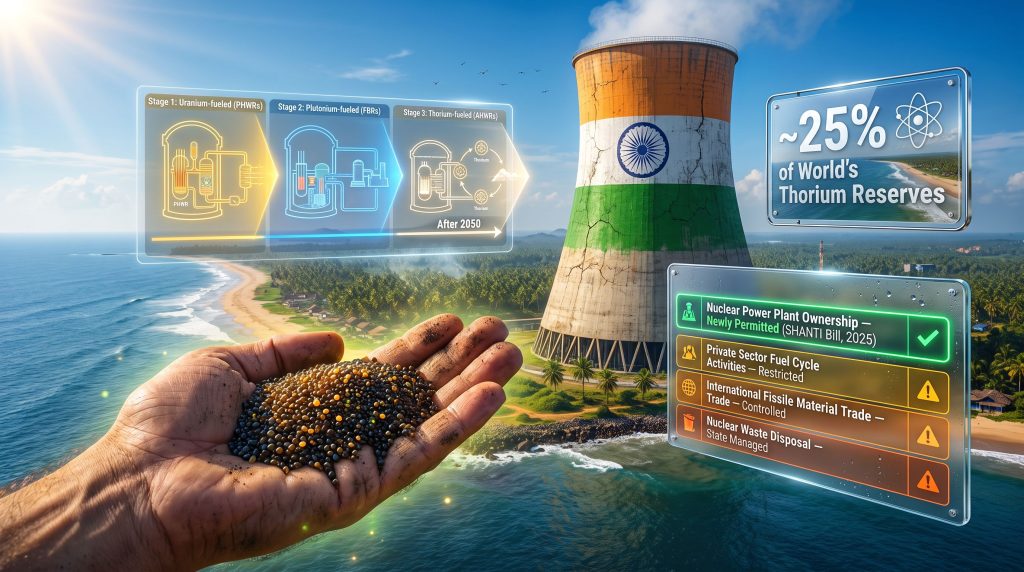
The sequencing is deliberate. Stage 2 must succeed before Stage 3 becomes viable because the plutonium produced in fast breeder reactors is needed to initiate the thorium fuel cycle. As of 2026, India's prototype fast breeder reactor at Kalpakkam remains in pre-commissioning stages, which means full-scale thorium-based power generation is not realistically projected until after 2050.
This timeline is not a policy failure. It reflects the physical realities of a multi-decade nuclear transition that was always designed to unfold across generations, not electoral cycles.
The Resource Position: What India Actually Holds
Scale, Distribution, and Mineral Composition
India holds approximately 25% of the world's total thorium reserves, concentrated within an estimated 13 million tonnes of monazite sand distributed across four coastal states: Kerala, Tamil Nadu, Andhra Pradesh, and Odisha. When examining global thorium reserves, this is not marginal reserve status — it positions India as the single most thorium-rich country on earth by proportion of global reserves.
Monazite itself is a phosphate mineral that carries a compositionally complex profile:
- Approximately 10% thorium by weight
- Trace quantities of uranium
- Significant concentrations of rare earth elements (REEs), including cerium, lanthanum, neodymium, and praseodymium
- Minor quantities of phosphate, which has independent industrial applications
This multi-component nature of monazite is central to understanding both the regulatory difficulty and the emerging economic rationale for reform. The thorium content triggers national security classifications, the REE content creates a separate and growing commercial incentive, and the uranium traces compound the regulatory sensitivity by adding a second prescribed substance to the extraction equation.
The Regulatory Architecture: Layers of Restriction Built Over Decades
The Atomic Energy Act, 1962: Where Everything Begins
The foundational legal instrument governing India's thorium sector is the Atomic Energy Act of 1962. Enacted in the early years of the country's nuclear programme, the Act established comprehensive state authority over all substances classified as "prescribed" under its provisions. Both thorium and uranium fall within this classification, which legally confines their extraction, processing, and commercial use to government-authorised entities.
The Act was not merely a commercial licensing regime. It was a national security framework designed during the Cold War, when nuclear materials were understood primarily through a weapons proliferation lens rather than an energy economics one. That original framing continues to shape regulatory thinking today.
The 2023 Offshore Areas Mineral Act: Closing One Door Further
Passed in 2023, this legislation explicitly restricts atomic mineral licences covering offshore deposits, including thorium-bearing formations, to government entities only. The practical effect is a clear geographic boundary in any future liberalisation discussion: onshore coastal monazite may be subject to future policy reform, but offshore deposits are categorically off-limits under current law.
The SHANTI Bill (December 2025): Opening the Downstream
The passage of the Atomic Energy Amendment Bill, widely referred to as the SHANTI Bill, in December 2025 represents the most structurally significant reform to India's nuclear regulatory framework in the post-independence era. For the first time, private companies are legally permitted to build, own, and operate nuclear power plants in India. However, understanding the bill's limitations is as important as understanding its permissions.
The SHANTI Bill creates a clear bifurcation: private capital may now participate in nuclear power generation, but the fuel supply chain, including thorium extraction, monazite processing, and uranium-233 production, remains exclusively under state control. Any private investment thesis in Indian nuclear power must account for this upstream dependency.
This structural split between liberalised downstream and controlled upstream is not a temporary measure. It reflects a deliberate policy choice to manage proliferation risk while allowing private capital to address India's electricity generation gap. Notably, India opens the door to private investment in nuclear energy, raising legitimate liability concerns that analysts are still working through.
The Current State of Thorium Access: A Regulatory Snapshot
| Sector Activity | Current Private Sector Status (Mid-2026) |
|---|---|
| Thorium mining and processing | Prohibited, exclusively reserved for IREL |
| Coastal monazite exploration | Under active policy deliberation with strict safeguards proposed |
| Offshore atomic mineral licensing | Explicitly banned under the 2023 Offshore Areas Mineral Act |
| Nuclear power plant ownership | Permitted under the SHANTI Bill (December 2025) |
| Thorium fuel cycle operations | State-controlled, outside private sector scope |
Indian Rare Earths Limited (IREL), a public sector undertaking operating under the Department of Atomic Energy, remains the sole entity legally authorised to extract and process monazite in India as of mid-2026. Private companies have been permitted to mine beach sands for non-radioactive minerals such as ilmenite and garnet since 1998, but the explicit prohibition on monazite processing and export remains legally intact.
The next major ASX story will hit our subscribers first
The Policy Deliberation Currently Underway
Three Distinct Reform Tracks Are Being Examined
Internal government discussions around India private sector thorium access are structured around three parallel reform considerations, each with different risk profiles and legislative requirements.
Track One: Partial Coastal Monazite Mining Access
The most actively discussed option involves partially opening commercial mining of coastal monazite sands to private entities under a tightly enforced licensing framework. Critically, the conceptual model under consideration is not full market liberalisation. It treats monazite as a dual-use ore simultaneously functioning as an REE source and a nuclear fuel precursor.
Under this model, private participation would be confined to the REE extraction component, with the government retaining exclusive control over the thorium fraction through mandatory offtake or processing arrangements. This structure would require significant legislative and regulatory architecture to implement, including possible amendments to the Atomic Energy Act.
Track Two: REE and Thorium Co-Extraction Economics
The economic logic driving reform deliberations centres on the argument that thorium recovery integrated with REE extraction from monazite processing could substantially reduce per-unit production costs for both outputs. The FY27 Union Budget allocated resources for establishing dedicated rare earth corridors across Odisha, Kerala, Andhra Pradesh, and Tamil Nadu.
These corridors are designed to develop integrated REE mining, processing, research, and manufacturing infrastructure to meet accelerating demand from:
- Electric vehicle permanent magnets
- Wind turbine generators
- Consumer and industrial electronics
- Aerospace and defence systems
- Precision guidance equipment and sensors
The strategic logic is compelling: thorium recovery becomes an economically viable by-product of REE processing rather than a standalone nuclear fuel operation requiring its own cost justification. This reframing fundamentally changes the investment economics and may make the case for partial private sector involvement significantly easier to build. In this context, rare earth supply chains are becoming increasingly central to how India frames its broader resource strategy.
Track Three: Compressing Exploration-to-Extraction Timelines
A third strand of reform focuses on reducing the period between geological exploration and active extraction. Current timelines are considered a structural bottleneck in building India's domestic nuclear fuel supply chain. Accelerated exploration, potentially involving private sector geological expertise without extending extraction rights, is being positioned as a supply chain security measure.
A formal draft policy is expected following consultations involving the Ministry of Power, Ministry of Mines, and the Department of Atomic Energy.
What Thorium's Physical Properties Mean for Energy Policy
Comparative Advantages That Underpin the Strategic Interest
The technical case for thorium as a long-term fuel source rests on a set of material properties that distinguish it meaningfully from conventional uranium fuel cycles.
| Property | Thorium | Uranium |
|---|---|---|
| Natural fissility | Non-fissile, requires conversion to U-233 | Fissile (U-235 directly usable) |
| Thermal conductivity | Higher, improves reactor efficiency | Lower |
| Long-lived radioactive waste | Significantly less produced | Substantially more produced |
| Safety profile | Generally considered safer | Higher risk profile in comparable designs |
| Weapons proliferation risk | Lower, U-233 harder to weaponise | Higher via U-235 and Pu-239 pathways |
| Domestic reserve position in India | Abundant, approximately 25% of world reserves | Scarce, heavy import dependency |
The proliferation resistance of uranium-233 relative to plutonium-239 and highly enriched uranium-235 is a frequently cited advantage, though it is not absolute. The presence of uranium-232 as a contaminant in the uranium-233 produced through thorium conversion creates intense gamma radiation that complicates weaponisation. However, it does not make it impossible, which is part of why the fuel cycle remains state-controlled even as power plant ownership is being liberalised.
The Critical Minerals Lens: Why Monazite Is About More Than Nuclear Energy
REE Demand Is Reframing the Thorium Debate
Perhaps the most strategically significant development in India's thorium policy landscape is the reframing of monazite from a nuclear fuel precursor mineral into a critical minerals asset with dual strategic value. This reframing is not merely rhetorical. It reflects genuine changes in global REE supply chain dynamics, and the surge in critical minerals demand driven by the energy transition is only amplifying these pressures.
India currently imports significant volumes of processed rare earth elements, with China dominating global REE processing capacity. The strategic vulnerability created by this dependency has intensified interest in domestic monazite development. Since monazite contains both REEs and thorium in commercially meaningful concentrations, the development economics of the two are now structurally interlinked.
The REE revenue stream from monazite processing could effectively cross-subsidise the cost of thorium extraction and management, changing the financial calculus of domestic thorium development substantially. This model has precedent in other jurisdictions where mildly radioactive by-products of REE processing are managed under separate regulatory frameworks with defined liability structures.
The Exploration Gap: A Less-Discussed Bottleneck
One aspect of the thorium access debate that receives less attention than the legal restrictions is the exploration data gap. Commercially viable monazite deposits require detailed geological characterisation to determine deposit grade, continuity, and extractable volume. India's current exploration coverage of its coastal monazite resources, while substantial relative to many countries, does not yet provide the granular deposit-level data needed to underpin large-scale commercial extraction planning.
Private sector geological expertise in beach sand heavy mineral characterisation could accelerate this mapping process significantly without necessarily requiring changes to extraction rights. This is why accelerated exploration is being discussed as a relatively lower-risk entry point for private involvement, even in a regulatory environment that remains cautious about downstream access. Consequently, comparisons with global uranium reserves highlight just how differently thorium is currently managed from a regulatory standpoint.
Three Scenarios for Where India Private Sector Thorium Access Goes Next
Scenario A: Incremental Liberalisation (Highest Near-Term Probability)
Private companies gain exploration licences for onshore coastal monazite deposits under strict regulatory oversight. IREL retains its monopoly over extraction and processing. REE corridors develop as a parallel infrastructure track, creating indirect private sector exposure to monazite economics without requiring amendments to the Atomic Energy Act.
Scenario B: Dual-Use Licensing Framework (Plausible Over a 3-7 Year Horizon)
A new licensing category is created that allows private firms to mine beach sands for REE extraction under conditions that mandate government offtake of the thorium component. This model preserves state control over the nuclear fuel cycle while enabling private capital to participate in the REE value chain. It requires targeted legislative amendment but avoids the more politically sensitive step of removing thorium from the prescribed substances list entirely.
Scenario C: Full Deregulation (Structurally Unlikely Before 2030)
Thorium is removed from the prescribed substances list following sustained private sector lobbying and a comprehensive policy reassessment of proliferation risk management. This scenario faces substantial headwinds from national security considerations, the structure of the Atomic Energy Act, and the absence of an international consensus framework for privatised thorium fuel cycle management. It remains a long-term possibility rather than a near-term probability. In addition, India's broader rare earth and uranium strategy in the geopolitical context offers a useful comparison for how strategic mineral dependencies can reshape policy timelines.
Frequently Asked Questions on India Private Sector Thorium Access
Can private companies mine thorium in India right now?
No. As of mid-2026, all thorium mining and monazite processing activities remain exclusively reserved for IREL under the Department of Atomic Energy. No legislative or regulatory change has been enacted to alter this position.
Does the SHANTI Bill give private companies access to thorium?
The SHANTI Bill permits private ownership and operation of nuclear power plants but does not extend to the fuel cycle. Thorium extraction and uranium-233 production remain state-controlled regardless of the bill's passage.
Why does monazite require such strict regulation?
Monazite contains approximately 10% thorium and trace uranium by composition. Both are classified as prescribed substances under the Atomic Energy Act, 1962, triggering comprehensive state control on national security grounds. The radioactive nature of the mineral and its nuclear fuel pathway are the primary reasons for restricted access.
When is large-scale thorium power generation realistically achievable for India?
Full-scale thorium-based electricity generation is projected to occur after 2050, contingent on the successful completion of India's Stage 2 fast breeder reactor programme, which is still in progress.
Are rare earth corridors relevant to thorium production?
Yes. Since thorium and rare earth elements co-occur in monazite, infrastructure built for REE extraction in the four dedicated corridors has direct relevance to future thorium production economics. The government's own analysis suggests integrated co-extraction could meaningfully reduce costs.
Is private sector lobbying for deregulation having any effect?
Private interests are actively advocating for thorium's removal from the restricted substances list, but no such change has been enacted as of mid-2026. The deliberation is ongoing, and a formal draft policy is expected after multi-ministry consultations conclude. For instance, private sector exploration of India's thorium and monazite reserves has been a subject of public statements by senior ministers, signalling that the conversation is far from dormant.
This article is intended for informational purposes only and does not constitute financial, investment, or legal advice. Policy deliberations described are based on publicly reported information and internal government discussions as reported by ET EnergyWorld. Readers interested in detailed developments on India's thorium sector and nuclear energy policy evolution should consult reporting from ET EnergyWorld.
Want to Track the Next Major Critical Minerals Discovery Before the Market Does?
Discovery Alert's proprietary Discovery IQ model delivers real-time alerts on significant ASX mineral discoveries — including critical minerals tied to the energy transition reshaping global supply chains — instantly translating complex geological data into actionable investment insights. Explore why historic discoveries have generated extraordinary returns on Discovery Alert's dedicated discoveries page, and begin your 14-day free trial today to position yourself ahead of the market.