July 15, 2026
Why Metallurgy Determines Whether a Copper or Gold Deposit Is Worth Mining
The mining industry has a saying that grade is king, but experienced project evaluators know a more accurate version of that truth: recoverable grade is king. A deposit containing spectacular copper or gold values means very little if the mineralogy makes extraction prohibitively expensive. This distinction sits at the heart of one of the most consequential classifications in mineral deposit geology: the difference between sulfide and oxide mineral deposits in copper and gold mining.
Understanding this distinction is not merely academic. It shapes capital requirements, processing costs, development timelines, product types, and ultimately the return profile available to investors. However, the concept is frequently misrepresented, oversimplified, or deployed as marketing shorthand by junior mining companies seeking to inflate project narratives.
This analysis builds a structured, technically grounded framework for understanding sulfide and oxide mineral deposits in copper and gold mining, from the geological processes that create them to the processing economics that define their investability.
When big ASX news breaks, our subscribers know first
What Distinguishes Sulfide From Oxide Deposits at a Mineralogical Level
The Host Mineral Is Everything
The classification of a deposit as sulfide or oxide is fundamentally a statement about which minerals contain the economically valuable metals. This is not a surface-level distinction. It determines every subsequent decision in the development of a mining project.
In sulfide deposits, metals are chemically bound within sulfide mineral structures created during the original formation of the deposit. These are considered primary deposits. For copper, the most significant sulfide mineral is chalcopyrite (CuFeS₂), which is responsible for approximately 70% of global copper production. Other important copper sulfides include bornite (Cu₅FeS₄) and chalcocite (Cu₂S).
Gold in sulfide systems behaves differently from copper. Rather than forming its own sulfide mineral, gold in its native state becomes physically occluded — meaning trapped — within the crystal lattice of sulfide minerals such as pyrite and arsenopyrite. This trapping is the origin of the refractory gold problem discussed later in this article.
Sulfide deposits form through hydrothermal fluid circulation or magmatic processes at depth. Critically, they are not depth-limited in the way oxide deposits are. A sulfide deposit can extend from surface to theoretically any depth, making them the foundation of the world's largest copper and gold mining operations.
In oxide deposits, metals are hosted in oxide or carbonate minerals that formed through the weathering of original sulfide minerals. Common copper oxide minerals include malachite, chrysocolla, cuprite, and tenorite. When pyrite containing occluded gold oxidises, that gold becomes associated with iron oxide minerals such as goethite. These deposits are secondary in origin, produced not by the processes that created the original mineralisation, but by atmospheric oxygen and oxygenated groundwater penetrating downward from the surface.
Because oxidation is a near-surface phenomenon, oxide deposits are constrained by weathering depth, typically extending from surface to a maximum of approximately 400 metres depth, after which the original sulfide deposit reasserts itself. For further context on how these mineralogical distinctions apply to a specific and globally significant deposit class, IOCG deposit formation provides a useful technical reference point.
| Feature | Sulfide Deposits | Oxide Deposits |
|---|---|---|
| Classification | Primary ore | Secondary ore |
| Depth Range | Surface to great depth | Surface to approximately 400m |
| Copper Minerals | Chalcopyrite, Bornite, Chalcocite | Malachite, Chrysocolla, Cuprite |
| Gold Association | Occluded in pyrite/arsenopyrite | Associated with goethite, iron oxides |
| Formation Process | Hydrothermal/magmatic | Surface oxidation and weathering |
| Geographic Prevalence | Global, including cold climates | Arid, tropical, and semi-arid regions |
The Geological Journey From Primary Sulfide to Surface Oxide
A Predictable Transformation Driven by Weathering Chemistry
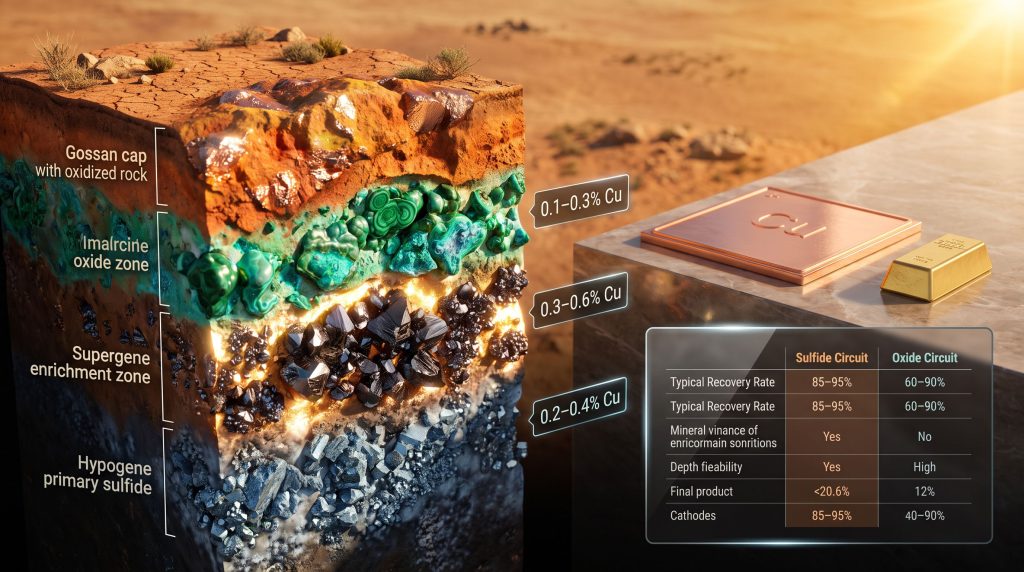
The conversion of sulfide mineralisation into oxide mineralisation is not random. It follows a geochemically predictable sequence from surface downward, producing distinct zones that can be identified through drilling and geological mapping.
-
Leached Cap (Gossan): The uppermost zone, where oxygenated water has dissolved and removed soluble metals including copper. Iron oxides concentrate here, giving gossans their characteristic rusty-red colour. Copper grades are typically well below economic thresholds. However, because gold is far less geochemically mobile than copper, it tends to remain behind, sometimes creating a gold-enriched horizon at surface. Understanding the role of gossans in exploration is consequently an important skill for geologists and informed investors alike.
-
Supergene Alteration Zone: The transitional zone immediately below the gossan, where sulfide minerals are progressively converting into oxide and carbonate equivalents. This is where malachite and chrysocolla replace chalcopyrite.
-
Supergene Enrichment Zone: Arguably the most economically significant zone in many copper porphyry systems. Copper dissolved from the leached cap and upper oxide zone migrates downward in solution until it encounters reducing geochemical conditions at the historical redox boundary. There it precipitates as secondary sulfide minerals, particularly chalcocite, supplementing the original primary copper grades and creating an anomalously high-grade band.
-
Hypogene (Primary) Zone: The original unweathered sulfide deposit, extending to depth.
How Climate and Glacial History Control Oxide Zone Development
Geography plays an underappreciated role in determining whether an oxide deposit exists at all. Arid and tropical environments — including Arizona, northern Mexico, parts of South America, and West Africa — support deep and well-developed oxide zones because sustained weathering has operated over extended geological periods.
Cold and formerly glaciated regions tell a fundamentally different story. In most of Canada, for example, meaningful oxide deposits are essentially absent. The combination of a northern climate limiting warm-season weathering intensity and extensive glacial erosion that stripped near-surface material means that even where sulfide deposits exist at surface, there has been neither the time nor the conditions to regenerate significant oxide zones since glaciation.
Only in select parts of northern British Columbia and the Yukon, where some pre-glacial weathering profiles were preserved or conditions are marginally more favourable, are oxide deposits occasionally encountered. This geographic reality has practical implications. An investor evaluating a copper project in a glaciated Canadian setting should treat any claimed oxide mineralogy with additional scrutiny, as it would be a geological exception rather than the rule.
The Supergene Enrichment Zone: A High-Grade Economic Bonus
Why Early-Life Grade Matters So Much to Project Economics
The supergene enrichment zone occupies a special place in copper-gold deposit evaluation because of its timing within mine life, not just its grade characteristics. Early-year ore grade has a disproportionate effect on project net present value because cash flows generated early are discounted less heavily than cash flows generated later.
A high-grade zone accessible in the first years of mine life can fundamentally improve project economics, sometimes providing the cash flow necessary to fund the higher-capital development of deeper sulfide resources below.
How Supergene Enrichment Forms:
- Copper is dissolved from the leached cap and upper oxide zones by oxygenated groundwater.
- That copper-bearing solution migrates downward until it encounters a redox boundary where oxygen-depleted conditions prevail.
- At this boundary, copper precipitates as chalcocite, a secondary copper sulfide with high copper content.
- The result is a zone where original primary copper grades are augmented by redeposited secondary copper, creating elevated grades relative to both the oxide zone above and the hypogene zone below.
The illustrative grade profile below draws on deposit-type characteristics common to porphyry copper-gold systems and is intended to convey the relative grade relationships between zones rather than represent any specific project.
| Zone | Approximate Copper Grade | Characteristics |
|---|---|---|
| Leached Cap (Gossan) | Below 0.05% Cu | Copper depleted; possible gold enrichment |
| Oxide Zone | 0.1 to 0.3% Cu | Malachite and chrysocolla dominant |
| Supergene Enrichment | 0.3 to 0.6% Cu | Chalcocite-rich; highest near-surface grade |
| Primary Hypogene | 0.2 to 0.4% Cu | Chalcopyrite dominant; original deposit grades |
Note: Grade ranges are illustrative of deposit-type characteristics only and vary significantly between individual projects.
It is worth noting that the leached cap scenario can produce a gold-rich zone where copper has been stripped away but gold has remained. This creates a counterintuitive situation where the copper-depleted upper portion of a deposit carries higher gold values than the copper-enriched zone below it.
Processing Economics: Where the Real Difference Between Oxide and Sulfide Lies
Sulfide Processing: Technically Mature but Capital-Intensive
The processing of sulfide ores follows a well-established flowsheet that has been refined over more than a century of industrial mining. However, technical maturity does not mean low cost. According to iron oxide copper gold ore deposit classifications, the mineralogical character of an ore body fundamentally dictates the applicable processing route.
Standard Sulfide Processing Flowsheet:
- Crushing reduces run-of-mine ore to manageable fragment sizes.
- Grinding is the most energy-intensive stage, using large rotating mills to reduce ore to fine particles measured in micrometres, liberating sulfide minerals from the surrounding waste rock. Grinding circuits are among the highest power-consuming components of any mineral processing plant.
- Froth Flotation uses chemical reagents and air bubbles to separate sulfide minerals from gangue, producing a concentrated sulfide product.
- Smelting and Refining converts sulfide concentrate into refined metal at off-site facilities, adding treatment charges, refining charges (TC/RCs), and logistical costs.
Metal recovery in well-optimised sulfide circuits typically ranges from 85% to 95% for both copper and gold. However, this headline figure masks a critical exception: refractory ores, where gold is so finely disseminated within pyrite or arsenopyrite that grinding alone cannot liberate it. In these cases, additional pre-treatment steps including roasting or pressure oxidation (POX) are required, adding materially to both capital expenditure and operating cost.
Oxide Processing: Lower Barriers, Different Trade-offs
Oxide ores bypass the most capital-intensive elements of sulfide processing entirely.
Standard Oxide Processing Flowsheet:
- Crushing to a coarser fragment size than sulfide processing requires. Fine grinding is eliminated entirely.
- Heap Leaching stacks crushed ore on engineered, lined pads where a leach solution is applied: weak sulphuric acid for copper, cyanide solution for gold. The solution percolates through the ore stack, dissolving target metals.
- Solution Processing recovers dissolved metals: copper through solvent extraction followed by electrowinning (SX-EW), producing copper cathode on-site; gold through carbon adsorption circuits, producing gold doré on-site.
The elimination of grinding alone removes one of the largest capital and energy cost components in mineral processing. For copper specifically, the ability to produce copper cathode on-site is a meaningful economic differentiator. Rather than selling copper concentrate to a smelter at treatment and refining charges negotiated at arm's length, an oxide copper operation can sell finished, high-purity copper directly to industrial end-users such as wire and cable manufacturers.
The trade-off is recovery rate variability. Heap leach gold recovery commonly falls in the range of 65% to 75%, compared to over 90% achievable in a conventional mill for the same ore type. Copper heap leach recovery can range from 60% to 90% depending on ore mineralogy and leach amenability. Whether lower recovery is economically acceptable depends on the grade of the ore and the magnitude of the cost savings achieved by avoiding milling.
| Processing Factor | Sulfide Circuit | Oxide Circuit |
|---|---|---|
| Grinding Required | Yes, energy-intensive | No |
| Flotation Required | Yes | No |
| Smelting Required | Yes for copper | No |
| Final Product | Concentrate | Cathode (Cu) / Doré (Au) |
| Typical Recovery Rate | 85 to 95% | 60 to 90% |
| Capital Cost Intensity | High | Moderate to Low |
| On-Site Final Product | Gold doré only | Both copper cathode and gold doré |
Related Deposit Types That Add Complexity to the Oxide-Sulfide Framework
Refractory Deposits: A High-Stakes Technical Challenge
The term refractory describes ores where the physical or chemical structure of the host minerals prevents adequate metal recovery using conventional processing methods. This is not merely a processing inconvenience; refractory classification can determine whether a deposit is economic at all.
The most common refractory scenario in gold mining involves gold that is too finely disseminated within pyrite or arsenopyrite to be liberated by grinding at any practical particle size. When this occurs, roasting or pressure oxidation must be added to the processing flowsheet ahead of cyanidation, adding significant capital expenditure and operating complexity.
For copper, refractory scenarios often arise in transition zones between oxide and sulfide mineralisation where mixed mineral assemblages create processing challenges. Investors should treat any confirmation of refractory metallurgy in a project as a material risk factor requiring detailed technical assessment.
Supergene vs. Primary Oxide: A Distinction That Matters
Not all oxide deposits are products of weathering. Iron oxide copper-gold (IOCG) deposits represent a globally significant deposit class where copper and gold mineralisation is associated with abundant iron oxide minerals such as magnetite and hematite through primary geological processes — not surface oxidation. Furthermore, as detailed in comprehensive IOCG literature, these deposits should not be evaluated using the same economic assumptions applicable to supergene oxide copper deposits. Processing characteristics, capital requirements, and recovery profiles differ meaningfully.
Laterite Deposits: Weathering Creates the Ore Itself
In nickel and aluminium laterite deposits, extended weathering in humid tropical environments does not merely modify an existing ore body — it creates economic grades that did not exist in the unweathered parent rock. Bauxite deposits are the clearest example: the aluminium-bearing rock prior to tropical weathering is sub-economic; the weathering process leaches away other elements, concentrating aluminium to mineable grades. These deposits follow a fundamentally different economic logic from supergene copper-gold systems and should not be conflated with them.
The next major ASX story will hit our subscribers first
An Investor Framework for Evaluating Oxide and Sulfide Copper-Gold Projects
Strengths and Limitations of Each Deposit Type
Factors Favouring Oxide Projects:
- Lower upfront capital requirement due to elimination of grinding and flotation circuits.
- Faster path from discovery to production given simpler processing infrastructure.
- On-site copper cathode production eliminates smelter dependency and enables direct sales to end-users.
- Supergene enrichment zones provide high-grade early-life ore that improves net present value.
- Near-surface geometry simplifies resource drilling programs and reduces early-stage expenditure.
Factors Favouring Sulfide Projects:
- Greater total resource scale due to unlimited depth extent.
- Higher and more consistent metal recovery rates of 85% to 95%.
- Ability to recover minor and critical metals including silver, molybdenum, rhenium, and cobalt through smelting, which leach-based oxide circuits cannot capture.
- Advancing bioleaching technology is improving copper recovery from primary sulfide ores, with some applications approaching recovery rates of approximately 85% from refractory materials, expanding the long-term economic viability of sulfide deposits as accessible oxide ore bodies are progressively depleted globally.
The Oxide-Funds-Sulfide Narrative: Compelling but Requiring Scrutiny
One of the most frequently encountered narratives in junior copper mining promotion is the oxide-funds-sulfide development sequence: develop a low-capital oxide deposit first, generate cash flow, then use that cash flow to fund the higher-capital development of the underlying sulfide resource.
The concept is geologically and economically valid in principle. When it works, it represents an elegant sequenced development strategy that reduces dilution and funding risk. The challenge, however, is execution risk, which is substantial.
When evaluating the oxide-funds-sulfide story, investors should assess the oxide component as a fully standalone project. The sulfide resource should be treated as optionality, not as a guaranteed development outcome built into the base case valuation.
Key failure modes investors should understand:
- The oxide deposit economics are insufficient on a standalone basis and rely on the sulfide story for justification.
- The sulfide resource has not been adequately drilled and no defined mineral resource exists.
- Metallurgical challenges in either zone were not apparent at the promotional stage.
- Capital cost overruns in oxide development consume the funding capacity that was meant to initiate sulfide development.
Critical Investor Due Diligence Questions:
- Have the oxide deposit economics been assessed on a standalone basis in a preliminary economic assessment or prefeasibility study, and has a definitive feasibility study been scoped for either zone?
- Has the sulfide resource been drilled sufficiently to support a mineral resource estimate under a recognised reporting standard?
- What is the gap between preliminary leach testwork results and column leach or pilot-scale metallurgical data?
- What is the confirmed depth and aerial extent of the oxide zone?
- Does the geographic and climatic setting support the existence of meaningful oxide mineralisation?
- Are there any indications of refractory characteristics in the sulfide zone that would materially affect processing economics?
Metallurgy as the Underappreciated Driver of Project Value
Why Processing Amenability Can Outweigh Raw Grade
A technically educated perspective on copper and gold deposit evaluation consistently arrives at the same conclusion: metallurgy is the most underappreciated variable in project valuation. A deposit with high headline grades and poor metallurgical characteristics can be less valuable in practice than a lower-grade deposit with excellent processing amenability and predictable recovery rates.
Key Metallurgical Variables That Warrant Investor Attention:
- Leach amenability progression: Distinguish between bottle-roll test results, column leach results, and demonstrated full-scale heap leach performance. Each stage provides incrementally more reliable recovery data.
- Grind size sensitivity: Finer grind requirements increase energy consumption and operating cost on an exponential rather than linear basis.
- Reagent consumption: Acid consumption in copper heap leaching and cyanide consumption in gold circuits directly affect operating margins and environmental permitting complexity.
- Deleterious elements: Clay minerals absorb leach reagents and reduce permeability in heap leach stacks. Carbonaceous material in gold ores can preg-rob gold from solution before it reaches recovery circuits.
- Concentrate quality: Impurities including arsenic, bismuth, and mercury in sulfide concentrates attract smelter penalties and can restrict the buyer universe for concentrate sales.
The investor who understands these variables is positioned to distinguish between projects where processing assumptions are conservative and defensible and those where they are optimistic and promotional. In the context of sulfide and oxide mineral deposits in copper and gold mining, interpreting drill results with a metallurgical lens is consequently as important as reading headline grades.
Frequently Asked Questions
Can a Sulfide Deposit Exist Without an Oxide Cap or Supergene Zone?
Yes, and this is more common than many investors appreciate. Oxide caps and supergene enrichment zones require specific climatic conditions and sufficient time for weathering to operate. In regions with cold climates or significant glacial history, such as most of Canada, these zones are largely absent.
Glacial erosion removed near-surface weathered material, and post-glacial weathering has been too limited in duration and intensity to regenerate meaningful oxide zones. In these settings, sulfide mineralisation begins essentially at surface and continues to depth without any oxide overprint.
How Does Refractory Gold Differ From Oxide Gold in Processing Cost?
| Characteristic | Oxide Gold | Refractory Sulfide Gold |
|---|---|---|
| Processing Method | Direct heap leach or cyanidation | Pre-treatment (roasting or POX) plus cyanidation |
| Capital Cost | Low to moderate | High |
| Recovery Rate | 65 to 90% | 80 to 92% with pre-treatment |
| Technical Risk | Low | Moderate to high |
| Reagent Consumption | Moderate | Higher |
What Distinguishes IOCG Deposits From Supergene Oxide Deposits?
Iron oxide copper-gold deposits are primary ore systems formed through magmatic-hydrothermal processes, not near-surface weathering. The iron oxides present — typically magnetite and hematite — are primary minerals, not the product of sulfide oxidation. Copper grades in IOCG deposits typically range from 0.2% to 5% with gold grades of approximately 0.1 to 1.4 g/t.
The processing characteristics, capital requirements, and geological setting of IOCG deposits are fundamentally different from supergene oxide copper systems. Conflating the two represents a meaningful analytical error that can materially distort project valuations.
Want to Identify the Next Major Copper or Gold Discovery Before the Market Does?
Discovery Alert's proprietary Discovery IQ model scans ASX announcements in real time, instantly translating complex mineralogical and metallurgical data into actionable investment insights — so subscribers can position themselves ahead of the broader market. Explore historic mineral discoveries and their returns, then begin your 14-day free trial to gain an immediate edge on significant ASX copper and gold announcements.