June 29, 2026
The Autonomous Mining Technology Race Reaches Public Markets
The transition from experimental deployment to industrial-scale operation rarely announces itself with precision. In most deep-technology sectors, the moment a company moves from venture-backed growth narrative to publicly traded asset class marks an irreversible shift in how markets price innovation risk. Autonomous mining systems are now at exactly that threshold, and the machinery driving that transition is a Chinese company most Western investors have never encountered.
Understanding the significance of the EACON Hong Kong IPO requires stepping back from the filing mechanics and examining what the event actually represents: the first time a company purpose-built around mining truck autonomy has sought institutionalised public capital at meaningful scale. That framing matters considerably more than the headline raise figure. Furthermore, it arrives at a moment when mining automation transformation is reshaping how investors evaluate industrial technology companies globally.
When big ASX news breaks, our subscribers know first
From Pilot Program to Public Market: Why Autonomous Haulage Has Reached an Inflection Point
Autonomous haulage systems (AHS) have existed in commercial mining environments since Komatsu deployed its FrontRunner technology at Codelco's Gabriela Mistral copper mine in Chile back in 2008. For over a decade, the technology remained firmly within the product bundling strategies of large original equipment manufacturers (OEMs), sold as premium add-ons to fleets already committed to specific hardware ecosystems.
What changed the structural dynamics was a combination of three converging pressures:
- Labour cost escalation in mature mining jurisdictions, particularly Australia and Canada, where skilled haul truck operators represent a significant and structurally inflexible operating cost line.
- Zero-harm safety mandates accelerating following high-profile fatality incidents involving haul trucks in surface mining operations, pushing regulators toward automation-friendly frameworks.
- Decarbonisation commitments from major mining companies creating demand for electric autonomous platforms that remove combustion engine constraints from operational planning.
These pressures created a market opening that OEM-integrated solutions were structurally slow to fill. Hardware manufacturers optimise for equipment sales cycles and customer loyalty, not software-led iteration. That gap is precisely where EACON was architected to operate.
What EACON Actually Built and Why the Architecture Matters
EACON Group was founded in May 2018 by Chairman and Co-Founder Zhang Lei with a design philosophy that diverged from the prevailing OEM model from the outset. Rather than developing software to run on third-party truck platforms, the company engineered a full-stack autonomous haulage system that integrates the software intelligence layer directly with purpose-built hardware.
The flagship expression of that approach is the EQ100 cabless electric autonomous mining truck, a vehicle that eliminates the operator cab entirely rather than simply adding autonomous control to a cab-equipped platform. This architectural decision carries meaningful implications:
- Removing the cab reduces vehicle weight, improves payload-to-gross-vehicle-weight ratios, and eliminates the safety engineering constraints associated with protecting a human occupant.
- A cabless design signals genuine commitment to full autonomy rather than assisted or semi-autonomous operation, which is a fundamentally different product positioning.
- The electric powertrain integration creates alignment with battery supply chain partners, explaining the strategic logic of CATL Capital's participation in the Series D round. In addition, electric mining transport trends are accelerating across the broader sector as decarbonisation targets intensify.
Technical Insight: The cabless design is not merely an engineering choice but a commercial signal. A truck built without a cab cannot be easily retrofitted for human operation, which means EACON's customers are making an irreversible commitment to autonomous operation rather than hedging between modes. This creates deeper customer dependency and stronger switching costs than software-overlay competitors.
Revenue Growth, Market Share, and the Profitability Question
EACON's commercial trajectory over the past two years is difficult to contextualise without acknowledging how unusual the growth rate is even within high-velocity technology markets.
| Metric | 2022 | 2024 | Change |
|---|---|---|---|
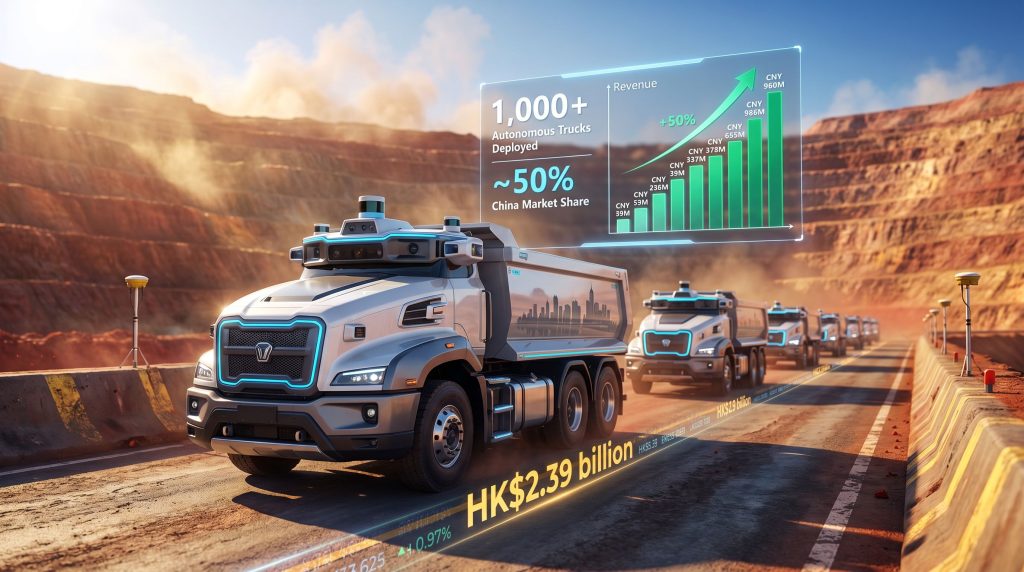
| Annual Revenue (CNY) | 59 million yuan | 986 million yuan | +1,570% |
| Deployed Autonomous Trucks | Early-stage pilots | 1,000+ units | Significant scaling |
| China AHS Market Share | Emerging player | ~50% | Dominant position |
| Net Loss (CNY) | Early-stage | 390 million yuan | Deep-tech R&D cycle |
The approximately 16.7x revenue expansion between 2022 and 2024 reflects a company that moved from proof-of-concept validation to commercial dominance within a single mining cycle. Capturing roughly 50% of China's autonomous haulage market within six years of founding represents a competitive outcome that few technology companies achieve in any domain.
The net loss of 390 million yuan in 2024 is the figure that tends to generate investor caution, but contextualising it against the revenue trajectory is essential. For companies operating at the intersection of hardware manufacturing and software intelligence, the R&D cost structure during scaling phases is characteristically front-loaded.
Perception systems, multi-truck coordination algorithms, edge computing integration, and redundancy architecture require sustained engineering investment before generating recurring software revenue. The critical variable for long-term investors is not whether losses exist today, but whether the business model contains a software-led margin inflection as fleet management services, data analytics licensing, and remote operations contracts begin contributing meaningfully to the revenue mix alongside hardware deployments. Consequently, data-driven mining operations will be central to how EACON's recurring revenue proposition matures over time.
The IPO Structure and What the Capital Stack Reveals
The EACON Hong Kong IPO filing was submitted to the Hong Kong Stock Exchange (HKEX) on June 25, 2025, with a target raise of up to HK$2.39 billion (approximately US$100 million). Haitong International Securities has been appointed as the sole IPO sponsor. As of June 2026, no confirmed pricing date or listing timetable has been announced publicly, with the process remaining subject to standard HKEX regulatory review.
The choice of HKEX as the listing venue is strategically coherent rather than incidental. The exchange provides simultaneous access to mainland Chinese institutional capital through the Stock Connect mechanism and to international investors across Asia-Pacific, Europe, and North America. For a company with dominant domestic operations and declared international expansion ambitions, this dual-audience capital market structure is more appropriate than either a pure A-share or a Western exchange listing.
The US$55 million Series D round closed in June 2025, immediately preceding the IPO filing, and the investor composition deserves careful examination:
- CATL Capital brings battery technology alignment, supply chain integration with the EQ100's electric powertrain, and credibility within China's industrial electrification ecosystem.
- Shaanxi Tonly Heavy Industries contributes heavy equipment manufacturing expertise and established distribution relationships across domestic mining operations.
- CHC Navigation provides precision positioning and GNSS technology capabilities that are foundational to autonomous vehicle operation in dynamic open-pit environments.
Structural Observation: Each Series D participant represents a distinct node in the autonomous electric mining truck supply chain. The collective composition suggests deliberate ecosystem architecture rather than passive financial participation. This type of strategic investor syndicate typically signals that the company is preparing for international deployment complexity that requires integrated supply chain depth rather than component-by-component procurement.
Anticipated Use of IPO Proceeds
Based on the company's stated strategic priorities and competitive positioning, IPO proceeds are expected to be directed toward:
- International market entry in accessible mining jurisdictions, with Southeast Asian markets including Indonesia, Mongolia, and the Philippines representing near-term targets given geographic proximity and growing mining activity.
- Advanced R&D investment focused on next-generation perception systems, fleet coordination at scale beyond 1,000 trucks, and cybersecurity frameworks required for international regulatory compliance.
- Fleet expansion to substantially increase deployed autonomous unit count and establish operational reference sites in new geographies.
- Service infrastructure development to support international customers with local technical capability, which is a prerequisite for winning contracts with major mining operators accustomed to OEM-level support networks.
Competitive Positioning Against Global Autonomy Players
The autonomous mining technology market is not a uniform competitive environment. It segments into structurally distinct business models with different customer relationships, margin profiles, and growth constraints. However, understanding where each player sits within this landscape requires examining their respective autonomy approaches and primary markets.
| Competitor Type | Examples | Autonomy Approach | Primary Market |
|---|---|---|---|
| OEM-Integrated | Caterpillar (Cat MineStar), Komatsu (FrontRunner) | Hardware and software bundled | Global Tier-1 miners |
| Pure-Play Software Overlay | Various Western startups | Autonomy retrofitted to existing fleets | Niche international |
| Full-Stack Autonomous | EACON | Purpose-built hardware plus proprietary software | China, expanding |
| Emerging Domestic Challengers | Various Chinese tech entrants | Partial autonomy at pilot scale | Domestic China only |
EACON occupies an unusual position in this matrix. Unlike software overlay companies that depend on truck manufacturer cooperation for hardware access, EACON controls the full engineering stack. Unlike OEM incumbents, it is not burdened by legacy customer relationships that require backward compatibility with non-autonomous fleet segments.
The barriers EACON faces in international expansion are real and should not be minimised:
- Regulatory certification timelines in markets like Australia, where the Department of Mines, Industry Regulation and Safety maintains detailed autonomous operation approval frameworks, can extend 18 to 36 months for new entrants.
- Customer due diligence cycles at major mining companies typically involve extended pilot periods before full fleet commitment authorisation, creating long lead times before meaningful international revenue contribution.
- Data sovereignty and cybersecurity scrutiny applied to Chinese-developed autonomous systems operating in strategically sensitive mining jurisdictions represents a genuine commercialisation friction point, particularly in Five Eyes allied countries.
- Brand recognition deficits in markets where Caterpillar and Komatsu have operated for decades present a customer trust challenge that requires reference site investment before competitive tender opportunities emerge.
Furthermore, AI mining efficiency developments across competing platforms will intensify the pressure on new market entrants to demonstrate measurable operational advantages quickly.
The next major ASX story will hit our subscribers first
Understanding the HKEX Approval Timeline
The gap between the June 2025 filing and the absence of a confirmed listing date as of mid-2026 warrants examination rather than assumption. HKEX regulatory review processes for technology companies, particularly those involving first-of-category autonomous industrial systems, can extend considerably beyond standard timelines.
Several factors may contribute to the extended review period:
- Novel business model classification: EACON does not fit neatly into existing HKEX technology sector frameworks, potentially requiring additional disclosure guidance development.
- International expansion risk disclosure: Regulators may require detailed scenario analysis for overseas market entry plans given the jurisdictional complexity involved.
- Related party transaction disclosure: The strategic investor relationships with CATL Capital and Shaanxi Tonly, which are also supply chain partners, require careful structural disclosure.
The extended timeline introduces execution risk but does not fundamentally undermine the commercial rationale for pursuing public equity capital. Pre-IPO investors including CATL Capital and Shaanxi Tonly will face extended illiquidity periods, though their strategic rather than purely financial motivations make this a manageable constraint. According to Caixin Global, EACON's filing positions it as a master of autonomous mining technology within China's rapidly expanding industrial automation landscape.
Three Scenarios for What Happens Next
Scenario One: Successful Listing Catalyses Global Sector Investment
A completed EACON Hong Kong IPO would formally establish autonomous mining haulage as a standalone investable technology category. The validation effect would likely accelerate venture and growth capital deployment into competing autonomy startups globally and could trigger M&A activity as OEM incumbents assess whether acquiring pure-play autonomy capability is preferable to internal development timelines. Moreover, mining innovation trends suggest the broader sector is already moving rapidly toward full autonomy as a competitive baseline.
Scenario Two: Extended Approval Prompts Structural Reconsideration
If HKEX approval extends further into 2026 or beyond, EACON may evaluate alternative listing structures or venues. The Shanghai STAR Market, designed for hard-technology companies with high R&D intensity, could serve as an A-share alternative. The Singapore Exchange has also actively courted technology listings with ASEAN growth narratives. Each alternative carries different capital access and investor profile implications.
Scenario Three: Post-Listing International Expansion Execution
A successful raise enables aggressive international market entry within a 24 to 36 month window following listing. The most strategically logical sequence would begin with Southeast Asian surface mining operations where regulatory frameworks are more accessible, before progressing to Central Asian jurisdictions and eventually challenging established OEM relationships in African copper belt and Latin American copper and lithium mining corridors.
Frequently Asked Questions: EACON Hong Kong IPO
What is EACON Group?
EACON Group is a Chinese autonomous mining technology company founded in May 2018 that develops full-stack autonomous haulage systems for surface mining operations. It holds approximately 50% of China's autonomous haulage market and has deployed over 1,000 autonomous trucks as of end-2024.
How much is EACON raising in its Hong Kong IPO?
EACON filed to raise up to HK$2.39 billion (approximately US$100 million) through its HKEX listing, with Haitong International Securities serving as the sole IPO sponsor. Pre-IPO analysis from SmartKarma provides additional detail on the company's financial structure and competitive positioning for prospective investors.
Has a listing date been confirmed?
As of June 2026, no confirmed pricing date or listing timetable has been publicly announced. The IPO remains subject to HKEX regulatory approval following the June 25, 2025 filing.
Is EACON currently profitable?
EACON reported net losses of 390 million yuan in 2024 despite growing revenue to 986 million yuan, reflecting high R&D expenditure associated with maintaining technological leadership in autonomous mining systems during a scaling phase.
Who are EACON's key strategic investors?
The US$55 million Series D round closed in June 2025 and included CATL Capital, Shaanxi Tonly Heavy Industries, and CHC Navigation, each representing a critical component of the autonomous electric mining truck supply and technology chain.
What differentiates EACON from competitors like Caterpillar and Komatsu?
Unlike OEM incumbents that bundle autonomy software into hardware sales, EACON operates as a full-stack autonomous systems developer with its own purpose-built cabless electric truck platform. This architecture provides different margin potential and avoids the legacy customer compatibility constraints that slow OEM autonomy development cycles.
This article is intended for informational purposes only and does not constitute financial or investment advice. Readers should conduct independent research and consult qualified financial advisers before making investment decisions. All financial figures referenced are drawn from publicly available information as of the date of publication. Forward-looking scenarios involve inherent uncertainty and should not be interpreted as predictions of future outcomes.
Want to Track the Next Major Mineral Discovery Before the Market Does?
Discovery Alert's proprietary Discovery IQ model scans ASX announcements in real time, instantly identifying significant mineral discoveries across more than 30 commodities and translating complex data into actionable investment insights — explore historic discovery returns on the Discovery Alert discoveries page to understand what early positioning in transformative finds can mean for a portfolio, then begin your 14-day free trial to secure a market-leading edge.