
June 29, 2026
The Capital Architecture Powering Ultra-Deepwater Development
Offshore infrastructure finance has rarely been a simple business. For decades, the sector operated on a relatively predictable model: a marine lessor would arrange bilateral bank credit lines, carry the asset on its balance sheet throughout construction, and refinance once operations commenced. That approach served the industry through multiple cycles, but it was never particularly capital-efficient, and it placed enormous concentration risk onto single institutions. The deepwater renaissance now unfolding across the Gulf of Mexico is exposing those limitations in real time, creating pressure on major lessors to develop fundamentally more sophisticated funding architectures.
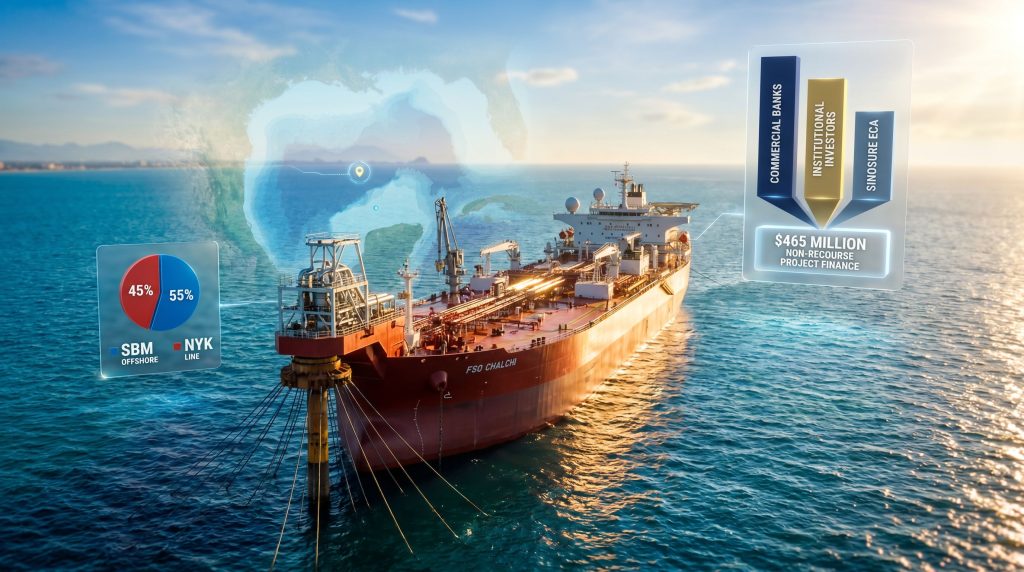
The $465 million SBM Offshore Trion FSO financing package secured for FSO Chalchi represents exactly the kind of structural evolution the sector has been moving toward. This is not simply a large project loan. It is a multi-pillar capital arrangement that integrates three distinct funding sources within a single non-recourse framework, and it establishes a template that could reshape how deepwater lease assets are financed globally.
When big ASX news breaks, our subscribers know first
Understanding the Trion Deepwater Project: Context and Scale
Before examining the financing mechanics, it is worth understanding precisely what kind of development FSO Chalchi is being built to serve, because the asset's operational environment directly shapes every dimension of its funding structure.
The Trion field sits approximately 180 kilometres offshore Mexico, positioned just 30 kilometres south of the U.S.-Mexico maritime boundary in the western Gulf of Mexico. At water depths of roughly 2,500 metres (approximately 8,200 feet), Trion qualifies as an ultra-deepwater development, placing it among the most technically demanding class of offshore projects anywhere in the world.
Woodside Energy operates the field with a 60% working interest, and Petróleos Mexicanos (Pemex) holds the remaining 40% as a non-operating partner. For Woodside, Trion carries particular strategic weight: it represents the company's first operated oil production venture in Mexico, making its execution a direct statement about Woodside's capacity to lead complex international deepwater projects from concept through to production.
Why an FSO Rather Than Fixed Export Infrastructure?
One of the less-discussed but critically important decisions in the Trion development was the selection of a floating storage and offloading vessel rather than a pipeline-based export solution. At ultra-deepwater frontier locations in the Gulf of Mexico, fixed subsea pipeline infrastructure connecting to shore is frequently uneconomical or logistically prohibitive. The absence of pre-existing export infrastructure at Trion's location made an FSO the operationally and commercially rational choice.
FSO vessels store crude oil produced by the field's floating production unit and periodically offload that crude to shuttle tankers for transport to market. The disconnectable mooring design adds a further operational advantage in this specific environment: the vessel can physically disengage from its turret and riser connections and move off-location if extreme weather conditions require it, then return and reconnect when conditions allow.
This capability is not a minor technical footnote. In a region occasionally exposed to Gulf of Mexico weather systems, the ability to demobilise and protect the hull from catastrophic damage is a meaningful risk-mitigation feature embedded directly into the vessel's architecture.
FSO Chalchi: Technical Specifications
| Parameter | Specification |
|---|---|
| Hull Classification | Suezmax-class newbuild |
| Mooring System | Disconnectable Turret Mooring (DTM) |
| Operating Water Depth | ~2,500 m (8,200 ft) |
| Crude Oil Storage Capacity | ~950,000 barrels |
| Construction Facility | COSCO Shipyard, China |
| First Steel Cut | 2025 |
| Lease Term | 20 years |
| Charterer | Woodside Petróleo Operaciones de México |
Dissecting the Three-Pillar Capital Stack
The financing structure underpinning FSO Chalchi is its most instructive aspect, both for industry practitioners and for investors tracking how deepwater infrastructure capital markets are evolving.
Pillar One: Commercial Bank Consortium
The senior debt layer is provided by a consortium of international commercial banks. In conventional offshore financing, a single or small bilateral group of lenders would carry this exposure. The consortium model distributes credit risk across multiple institutions, improves pricing through competitive tension among lenders, and aligns debt tenor with the underlying 20-year lease and operate agreement that serves as the primary revenue security.
Lender credit analysis in this context is fundamentally driven by contracted cash flow visibility: with Woodside's Mexican affiliate committed to 20 years of lease payments, the revenue profile is predictable in a way that few infrastructure assets can match.
Pillar Two: Institutional Investor Participation
The inclusion of institutional investors, typically pension funds and dedicated infrastructure debt funds, alongside conventional bank lenders reflects a broader convergence happening across global infrastructure finance. Long-duration offshore lease assets share several characteristics that infrastructure-focused capital increasingly finds attractive:
- Contracted revenues with investment-grade counterparties over multi-decade tenors
- Physical asset backing with tangible collateral value
- Low correlation with listed equity market volatility hedging strategies
- Yield characteristics that exceed comparable investment-grade corporate debt
Institutional capital has historically been slow to enter offshore energy infrastructure, in part due to perceived operational complexity and hydrocarbon price sensitivity. FSO and FPSO lease structures, where revenue is derived from day-rate lease payments rather than commodity production volumes, substantially reduce that price-linkage concern. The FSO Chalchi transaction appears to have successfully communicated that distinction to institutional allocators.
Pillar Three: Sinosure Export Credit Agency Support
Perhaps the most strategically nuanced element of the capital stack is the partial insurance support provided by China Export & Credit Insurance Corporation, known as Sinosure. Export credit agency (ECA) involvement in offshore project financing is not unprecedented, but the specific logic here is worth unpacking carefully.
Sinosure's participation is directly connected to the fact that FSO Chalchi is being constructed at COSCO Shipyard in China. ECA mandates typically require that the institution's home country's commercial interests are served by the transaction, and COSCO's role as the construction facility satisfies that condition from Sinosure's perspective. In practical terms, Sinosure's insurance coverage reduces the political and commercial risk premium that commercial lenders would otherwise price into their loan terms during the construction phase, when the vessel is most exposed to shipyard performance risk and country-level execution uncertainty.
The involvement of a Chinese ECA in a Mexican deepwater project financed by international banks and institutional investors illustrates how global offshore capital markets increasingly operate across jurisdictional boundaries, with shipyard selection becoming a key variable in determining which ECAs can participate in a given financing.
Furthermore, this three-way combination — commercial banks plus institutional investors plus ECA insurance — within a single non-recourse project finance framework, is described by SBM Offshore's chief financial officer Douglas Wood as the company's first transaction to achieve this precise structural combination. Its significance as a market precedent should not be underestimated.
Construction-Phase Drawdown and Non-Recourse Conversion
A feature of the financing structure that deserves specific attention is the drawdown and conversion mechanism. Rather than receiving the full $465 million at transaction close, SBM Offshore will draw funds progressively as construction milestones are reached at COSCO Shipyard. This staged drawdown limits lender exposure at any single construction milestone and creates a natural checkpoint structure aligned with vessel completion progress.
Critically, the financing will convert to fully non-recourse status once FSO Chalchi commences commercial operations. Until that conversion, the debt sits within SBM Offshore's recourse obligations. After conversion, repayment responsibility transfers entirely to the project-level cash flows generated by the vessel's operations. For SBM Offshore's consolidated balance sheet, this conversion event represents a meaningful deleveraging milestone. You can follow construction progress updates as they are released to track this timeline.
The Sale and Operate Model: Equity Recycling as a Competitive Advantage
Beyond the debt financing structure, the FSO Chalchi transaction demonstrates SBM Offshore's Sale and Operate model operating at full execution. Under this framework, the company sells a partial equity stake in the project entity while retaining operational control and management income, effectively recycling capital that would otherwise remain locked in the asset.
In the FSO Chalchi case, SBM Offshore divested a 45% equity interest to NYK (Nippon Yusen Kabushiki Kaisha), the major Japanese maritime operator, while retaining a 55% majority stake in the project vehicle. This transaction accomplishes several objectives simultaneously:
- Capital recycling: The proceeds from the equity sale reduce SBM Offshore's net capital commitment to the project, freeing resources for deployment across the broader project pipeline.
- Risk sharing: NYK's co-investment distributes project-level equity risk across two sophisticated maritime operators rather than concentrating it within a single entity.
- Quality validation: NYK's decision to invest a substantial equity position in FSO Chalchi functions as third-party endorsement of the asset's commercial and technical quality.
- Operational continuity: Because SBM retains the majority stake and operational mandate, client relationships, technical management standards, and revenue participation over the 20-year term remain intact.
Capital Efficiency Comparison
| Metric | Full Ownership Model | Sale and Operate Model |
|---|---|---|
| Balance Sheet Exposure | Full recourse during construction | Reduced via equity divestment |
| Capital Recycling | Limited until refinancing | Enabled through stake sale |
| Partner Risk Validation | None | NYK co-investment as quality signal |
| Operational Control Retained | Yes | Yes (55% majority) |
| Scalability for New Projects | Constrained by leverage | Enhanced through freed capital |
Implications for the Broader Offshore Lease Market
The structural innovation embedded in the SBM Offshore Trion FSO financing carries implications that extend well beyond the Trion field itself. SBM Offshore's CFO has characterised this approach as scalable for future lease and operate projects, and there are identifiable conditions under which replication is feasible:
- Long-term contracted revenues with investment-grade charterers
- Construction conducted in ECA-eligible jurisdictions (such as China, South Korea, or Japan)
- Project-level cash flows sufficient to support non-recourse debt service coverage ratios acceptable to lenders
Where these conditions align, the three-pillar model demonstrated by FSO Chalchi provides a significantly more capital-efficient funding pathway than conventional balance-sheet financing. Commodity trading giants operating in the offshore space have begun tracking this model closely, recognising that competing offshore lessors lacking established ECA relationships or institutional investor networks may find it difficult to replicate the structure's cost-of-capital advantages, raising the competitive bar across the sector.
Mexico's Ultra-Deepwater Horizon
Trion's development also carries broader significance for Mexico's offshore investment landscape. As one of the largest deepwater projects currently under active construction in Mexican waters, its execution trajectory will be closely monitored by other international operators considering entry into Mexico's ultra-deepwater acreage. Woodside's positioning as Mexico's first international operator of a deepwater oil production facility places the company at the frontier of what could become a more active licensing and development cycle in the region.
Pemex's 40% participation in Trion creates a joint venture dynamic that balances international technical and financial capability with national energy company involvement, a structure that has proven durable in comparable deepwater frontier provinces globally.
Key Risk Factors Investors and Industry Observers Should Monitor
No deepwater development of this scale is without material risk factors, and the FSO Chalchi financing structure incorporates several safeguards worth understanding. Effective risk management in mining and offshore energy sectors shares common principles, and the following factors deserve close attention:
- Construction risk: COSCO Shipyard's track record in offshore newbuilds provides operational confidence, while Sinosure's coverage provides a financial buffer against shipyard performance shortfalls or country-level disruption during the construction period.
- Revenue concentration: The 20-year lease with Woodside's Mexican affiliate is the cornerstone credit instrument for all capital providers. Woodside Energy's investment-grade credit profile is central to lender confidence in the structure's long-term viability.
- Geopolitical positioning: Trion's location 30 kilometres from the U.S.-Mexico maritime boundary introduces a layer of jurisdictional complexity. The evolving geopolitical mining landscape and shifting regulatory frameworks on both sides of the border should be tracked carefully by operators and investors alike.
- Trade and tariff exposure: The trade war economic impact on supply chains and equipment costs remains a variable worth monitoring, particularly given the vessel's construction in China and deployment in Mexican waters.
- Weather and force majeure: The disconnectable turret mooring system is specifically designed to address the physical risk of Gulf of Mexico weather events, allowing the vessel to disconnect and move to safety before reconnecting when conditions allow.
Disclaimer: This article is intended for informational purposes only and does not constitute financial or investment advice. References to forecasts, forward-looking statements, and project timelines involve inherent uncertainty and should not be relied upon as guarantees of future outcomes.
The next major ASX story will hit our subscribers first
Frequently Asked Questions: SBM Offshore Trion FSO Financing
What is the FSO Chalchi vessel and what will it do at Trion?
FSO Chalchi is a Suezmax-class newbuild floating storage and offloading vessel designed to receive crude oil from the Trion field's production infrastructure, store approximately 950,000 barrels of crude, and periodically offload that oil to shuttle tankers for transportation to market. It will operate under a 20-year lease agreement with Woodside's Mexican affiliate. Further detail on the Trion project overview is available directly from Woodside.
Why is the financing described as non-recourse?
Non-recourse financing means that once the vessel begins commercial operations, lenders can only look to the project's own cash flows and assets for debt repayment. They cannot pursue SBM Offshore's broader corporate assets if the project underperforms. This structure protects SBM Offshore's consolidated balance sheet from the project's debt obligations after operations commence.
What is Sinosure and why is it involved?
Sinosure is China's official export credit insurance agency. Its participation in the FSO Chalchi financing is linked to the vessel's construction at COSCO Shipyard in China. By providing partial insurance to the lending consortium, Sinosure reduces the risk premium lenders attach to the construction phase, effectively lowering the overall cost of capital for the transaction.
How does NYK's involvement benefit SBM Offshore?
NYK's acquisition of a 45% equity stake in the project allows SBM Offshore to recycle capital that would otherwise remain locked in a single asset. The arrangement simultaneously validates the project's commercial quality and distributes equity risk, without SBM Offshore surrendering operational control of the vessel or its long-term revenue participation in the SBM Offshore Trion FSO financing structure.
Want to Stay Ahead of the Next Major Resource Discovery?
Discovery Alert's proprietary Discovery IQ model scans ASX announcements in real time, delivering instant alerts on significant mineral discoveries and turning complex data into actionable investment insights — explore historic discoveries and their exceptional returns to see what's possible, then begin your 14-day free trial at Discovery Alert to position yourself ahead of the broader market.