June 29, 2026
Africa's New Mining Frontier: Why Egypt Is Rewriting the Rules of Mineral Investment
Across the global mining industry, a recurring pattern plays out over decades: geological endowment and investment reality diverge, sometimes by a wide margin. A territory can sit atop extraordinary mineral wealth for generations while legislative complexity, fiscal unpredictability, and bureaucratic friction keep exploration capital at bay. When the structural barriers finally shift, the resulting influx of investment can be rapid and transformative. That is precisely the dynamic now unfolding as Egypt overhauling its mining sector moves from policy ambition to tangible regulatory architecture.
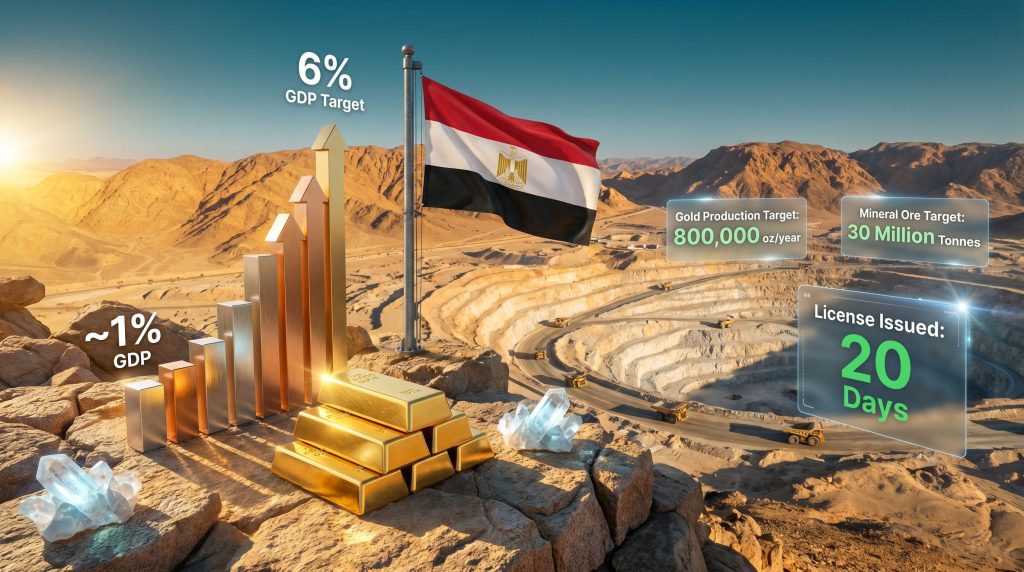
The numbers alone frame the scale of the opportunity. Mining currently contributes roughly 1% of Egypt's GDP despite the country hosting one of Africa's most geologically compelling landscapes. The Eastern Desert and Sinai Peninsula sit atop the Arabian-Nubian Shield, an ancient Precambrian geological formation stretching across northeast Africa and the Arabian Peninsula that has produced significant gold, base metal, and industrial mineral endowment for millennia. Egypt's failure to convert that geological reality into meaningful economic output is not a resource story. It is a governance and investment climate story.
When big ASX news breaks, our subscribers know first
The Arabian-Nubian Shield: What Makes Egypt's Geology so Significant?
The Arabian-Nubian Shield is one of the world's largest exposures of juvenile Precambrian crust, formed approximately 600 to 900 million years ago. Its Egyptian segment, concentrated in the Eastern Desert, hosts hundreds of ancient mine workings that date back to Pharaonic and Roman times, a testament to the region's mineral richness long before modern exploration methods existed.
From a technical standpoint, the shield's geology is characterised by:
- Greenstone belt terranes with VHMS ore deposits potential
- Orogenic gold systems associated with shear zones and quartz veining
- Ophiolite sequences that host chromite and base metal mineralisation
- Alkaline intrusions linked to rare earth element (REE) and niobium occurrences
- Sedimentary basins overlying the shield with phosphate, iron ore, and industrial mineral deposits
What makes this geology particularly interesting to modern explorers is that the Egyptian portion of the shield remains comparatively underexplored by international standards. Historical work was conducted by state entities using legacy methods, meaning systematic modern geophysical surveys, detailed geochemical sampling, and deep drilling programmes have been applied across only a fraction of the prospective ground. Furthermore, Arabian Shield exploration across the broader region confirms this represents a genuine exploration discount — an opportunity to discover economic mineralisation at the grass-roots stage in a jurisdiction with proven geological prospectivity.
What Legislative Changes Are Driving Egypt's Mining Overhaul?
The most structurally significant shift in Egypt's mining framework is the replacement of profit-sharing agreements with a transparent royalty and tax model. Legacy profit-sharing structures were widely cited by international operators as a primary deterrent to investment. Under such arrangements, the government's take was tied to accounting-based profit definitions that could be manipulated through cost recognition timing, transfer pricing, and depreciation schedules. The result was fiscal uncertainty that made long-term financial modelling unreliable.
The Model Mining Exploitation Agreement (MMEA), introduced in 2023, replaced that ambiguity with a globally legible fiscal architecture:
| Fiscal Parameter | New Framework |
|---|---|
| Government Net Smelter Royalty | 5% |
| Corporate Tax Rate | 22.5% |
| Investment Cost Recovery (Tax Deductions) | Up to 50% over 7 years |
| Authority Joint Venture Share Cap | 10% |
| Rent Reductions | Up to 60% |
| Fast-Track Approval Window | Within 30 days |
A Net Smelter Return (NSR) royalty is calculated on gross revenue from mineral sales, minus transportation, smelting, and refining costs. Unlike net profit royalties, it is not affected by operating cost inflation or capital expenditure timing, giving both the state and the investor predictable, auditable cash flows. At 5%, Egypt's NSR royalty sits within the competitive range of established African gold jurisdictions, making it neither punitive nor unusually concessional.
The 22.5% corporate tax rate combined with a 50% investment cost recovery allowance over seven years creates a meaningful front-loaded tax shield for capital-intensive mine development projects. For a project requiring significant upfront infrastructure investment, the effective tax burden in the early production years is materially lower than the headline rate suggests.
Capping the government authority's joint venture participation at 10% is a particularly investor-friendly provision. It signals a deliberate policy choice to limit sovereign equity participation in favour of private sector operational control. This is in direct contrast to the resource nationalism trend that has eroded investor confidence in jurisdictions such as Tanzania and the Democratic Republic of Congo over the past decade.
How Is Egypt Digitising Its Mining Approval Process?
Legislative reform is only effective if the administrative machinery can implement it consistently. Egypt's recognition of this reality has driven parallel investment in digital infrastructure for mining approvals.
The Track License Portal, piloted in June 2025, establishes a unified electronic platform for mining licence applications with a target issuance window of 20 days. For context, the previous administrative process in Egypt could extend to many months, with applicants navigating multiple government departments without a centralised tracking mechanism. A 20-day digital pathway is a structural compression of approval timelines that changes the economics of early-stage exploration.
A companion Digital Mining Platform provides investors with access to prospective opportunity data across Egypt's mining districts. The value of this tool extends beyond convenience. Data transparency directly addresses one of the key friction points for junior exploration companies evaluating new jurisdictions: the cost and time required to conduct preliminary due diligence before committing exploration capital.
Well-designed digital mining portals have been shown to increase exploration licence applications by reducing the information asymmetry between the state and potential investors. Western Australia's TENGRAPH system and mining exploration licences in Saudi Arabia are frequently cited as models for how digital infrastructure can accelerate exploration uptake.
Egypt's Production and GDP Targets: Quantifying the Ambition
The scale of what Egypt is attempting is best understood through the production and economic targets that frame its reform programme:
| Metric | Current Level | 2030 Target |
|---|---|---|
| Mining Sector GDP Contribution | ~1% | 6% |
| Gold Production | ~560,000 oz/year | 800,000 oz/year |
| Mineral Ore Production | 17.5 million tonnes | 30 million tonnes |
A six-fold increase in GDP contribution within five years would require simultaneous expansion across gold production, industrial minerals, phosphate, and construction materials. Some government projections are even more aggressive, with certain officials pointing to the possibility of mining reaching 5 to 10% of GDP within three years. These projections should be treated with analytical caution. GDP contribution at that scale would require not just increased production volume, but sustained high commodity prices, rapid processing capacity expansion, and significant infrastructure investment.
Gold as the Anchor Commodity
Egypt's gold sector is the most developed component of its mining industry and the most credible pathway to near-term production growth. The target of 800,000 ounces per year by 2030, up from approximately 560,000 ounces, represents a roughly 43% increase in output. Achieving this requires:
- Accelerating exploration drilling across underexplored Eastern Desert tenements
- Expanding processing capacity at existing operations
- Progressing advanced-stage deposits toward production decisions, including completing definitive feasibility studies on priority projects
- Attracting new international operators to undeveloped discovery-stage projects
For comparison, Egypt's current gold output already positions it among Africa's mid-tier producers, though well behind Ghana (~2.9 million ounces), Mali (~2 million ounces), and South Africa. The 800,000-ounce target would consolidate Egypt's position in the second tier of African gold producers, a realistic if ambitious objective given the demonstrated geological endowment.
Which Global Mining Companies Are Entering Egypt?
Centamin plc has operated the Sukari Gold Mine in Egypt's Eastern Desert since commercial production began in 2010, making it the country's most significant gold operation and a long-term test case for foreign investor experience in the jurisdiction. Sukari is one of the largest gold mines in Africa, with annual production historically in the range of 400,000 to 450,000 ounces. Centamin's continued operational commitment and reinvestment provides institutional credibility to Egypt's mining investment narrative.
Barrick Gold's engagement with Egypt's reformed framework carries different but equally significant signal value. As one of the world's largest gold mining companies, Barrick's interest in a jurisdiction is a meaningful endorsement of its risk-adjusted investment case. Barrick's evaluation of Egypt reflects the company's broader strategy of securing long-term resource exploitation positions in geologically prospective jurisdictions where fiscal terms are becoming internationally competitive.
The combination of a capped government JV stake, fixed royalties, full foreign ownership rights, and a sub-30-day approval window creates a risk-adjusted return profile that institutional capital can model with confidence — a threshold condition that was absent under Egypt's legacy profit-sharing framework.
The next major ASX story will hit our subscribers first
How Does Egypt's New Mining Framework Compare Globally?
Benchmarking Egypt against peer jurisdictions illustrates where its reformed framework creates genuine competitive differentiation. According to reforms fuelling Egypt's mining growth, the country's trajectory is increasingly drawing favourable comparisons with more established African mining destinations:
| Jurisdiction | Royalty Rate | Foreign Ownership | Approval Timeline | Key Commodity Focus |
|---|---|---|---|---|
| Egypt (Post-Reform) | 5% NSR | 100% permitted | 20-30 days | Gold, phosphate, industrial minerals |
| Saudi Arabia | Variable (2-5%) | Up to 100% | 30-60 days | Phosphate, gold, base metals |
| Ghana | 5% | Up to 100% | 60-90 days | Gold |
| Tanzania | 4-6% | Majority local ownership required | 90+ days | Gold, gemstones |
| Morocco | Variable | Majority foreign permitted | 30-60 days | Phosphate, base metals |
Egypt's 20-day digital licensing target is faster than any comparator jurisdiction in this table. Combined with 100% foreign ownership rights and a government JV cap that prevents equity dilution beyond 10%, the reformed framework addresses three of the most commonly cited deterrents to junior and mid-tier exploration investment in Africa.
The area where Egypt still trails best-in-class jurisdictions is infrastructure. Remote parts of the Eastern Desert lack reliable road access, grid power, and water supply. These are not insurmountable challenges, particularly for open-pit gold operations that can incorporate run-of-mine diesel power and water recycling systems, but they add capital cost and operational complexity that investors must factor into financial models.
What Challenges Could Slow Egypt's Mining Sector Transformation?
Structural and Operational Headwinds
- Water scarcity is an existential constraint for mining operations in arid environments. Egypt's Eastern Desert has very limited surface water, meaning operations depend on groundwater extraction or long-distance water transport pipelines. As global ESG standards increasingly scrutinise water consumption in water-stressed jurisdictions, this creates both operational cost risk and reputational risk.
- Power infrastructure gaps in remote mining districts require off-grid diesel generation or significant capital investment in transmission lines, adding to project development costs.
- Workforce localisation requirements and skills availability represent medium-term constraints. Scaling from Egypt's current mining labour base to the workforce requirements of multiple simultaneous large-scale operations requires sustained investment in technical training and vocational education.
- Processing capacity for mineral ores beyond gold is underdeveloped. Achieving the 30-million-tonne ore processing target requires investment in concentrators, refineries, and export logistics that does not currently exist at scale.
Governance and Implementation Risks
Legislative reform is a necessary but insufficient condition for mining sector transformation. The gap between policy design and on-the-ground regulatory consistency is where many well-intentioned reform programmes have historically faltered.
The restructuring of the Egyptian Mineral Resources Authority into the Mineral Resources and Mining Industries Authority with financial and managerial independence is designed to address bureaucratic execution risk. However, institutional transformation of this kind takes time to embed. Investors will be watching closely whether the new authority's independence translates into faster, more consistent, and less politicised regulatory decisions in practice.
Transparent dispute resolution mechanisms are a particular area of investor focus. The shift to royalty-based fiscal terms reduces one category of investor-state dispute risk, but contract sanctity, environmental permitting processes, and community relations frameworks remain areas where Egypt's track record is still being established relative to more mature mining jurisdictions.
Egypt's Critical Minerals and Decarbonisation Opportunity
Beyond gold, Egypt's mineral endowment includes commodities that are gaining strategic relevance in the context of global energy transition supply chains. In fact, critical minerals demand is reshaping how investors evaluate jurisdictions with diverse geological endowments like Egypt's.
Phosphate is Egypt's second most significant mineral commodity by production volume. Egypt holds some of the world's largest phosphate reserves, concentrated in the Nile Valley and Red Sea governorates. Phosphate's dual role as an agricultural fertiliser input and an emerging battery material component — particularly in lithium iron phosphate (LFP) battery chemistry — positions it at the intersection of global food security and energy storage demand.
The Eastern Desert's geology also indicates potential for rare earth elements, niobium, tantalum, and chromite that remain largely unexplored by modern methods. As supply chain diversification becomes a strategic priority for industrial nations seeking alternatives to Chinese rare earth dominance, Egypt's geological prospectivity for these commodities could attract a new category of exploration interest beyond conventional gold and base metal investors.
Egypt's geographic position also adds a logistical dimension to its mining investment case. Proximity to the Suez Canal corridor means that Egyptian mineral exports can reach both European and Asian markets with competitive shipping economics, a structural advantage over landlocked African mining jurisdictions. For a comprehensive overview of current investment opportunities, the Egypt Mining Forum provides a valuable platform where industry leaders and government representatives converge to discuss the sector's direction.
Frequently Asked Questions: Egypt's Mining Sector Reforms
What is the Model Mining Exploitation Agreement (MMEA)?
The MMEA is the standardised contractual framework introduced by Egypt in 2023 to govern mining exploitation licences. It replaced the previous profit-sharing model with a royalty and tax structure, offering a 5% NSR royalty, a 22.5% corporate tax rate, and up to 50% investment cost recovery over seven years. It applies to international and domestic operators seeking exploitation-stage mining rights and provides standardised terms that reduce negotiation complexity and fiscal uncertainty.
Can foreign companies own 100% of a mining operation in Egypt?
Yes. Egypt's reformed framework permits 100% foreign ownership of mining operations. The government authority's equity participation is capped at 10% as a JV share, meaning private investors retain majority operational and economic control. This provision directly addresses one of the most significant historical barriers to foreign mining investment in the region.
How long does it take to get a mining licence in Egypt now?
Under the Track License Portal launched in June 2025, the target licence issuance timeline is 20 days for standard exploration licences processed through the digital platform. The MMEA framework also specifies a 30-day fast-track approval window for exploitation-related permits. Pre-reform approval timelines were far longer and significantly less predictable.
What minerals does Egypt produce and plan to expand?
Egypt's current production base covers gold, phosphate, iron ore, limestone, silica sand, and various industrial minerals. The 2030 expansion strategy prioritises gold production growth to 800,000 ounces per year and near-doubling of total mineral ore throughput to 30 million tonnes. Longer-term exploration targets include rare earth elements, chromite, base metals, and potentially other critical minerals hosted in the underexplored portions of the Arabian-Nubian Shield.
What is EMRA and how has it changed?
The Egyptian Mineral Resources Authority (EMRA) was the state body historically responsible for mining regulation and administration. Under 2025 legislation, it was restructured into the Mineral Resources and Mining Industries Authority, granted financial and managerial independence, and given a mandate to form commercial partnerships and operate with greater institutional flexibility. The intent is to shift the regulator from a bureaucratic state entity toward a commercially oriented body capable of engaging with international investors on market terms.
Key Takeaways: Egypt Overhauling Its Mining Sector at a Glance
- Egypt is targeting a six-fold increase in mining's GDP contribution, from approximately 1% to 6% by 2030
- The MMEA fiscal framework, combining a 5% NSR royalty, 22.5% corporate tax, and 50% cost recovery, is globally competitive
- A 20-day digital licensing portal and 30-day fast-track approvals represent a fundamental compression of administrative timelines
- 100% foreign ownership rights and a 10% government JV cap materially reduce sovereign risk for international investors
- Gold production is targeted to grow from 560,000 to 800,000 ounces annually; total ore throughput is set to nearly double to 30 million tonnes
- Major operators including Centamin and Barrick Gold are engaged, providing institutional credibility to the reform programme
- The Arabian-Nubian Shield's underexplored geology offers genuine discovery potential beyond existing producing operations
- Infrastructure gaps, water scarcity, and implementation consistency remain the key execution risks that will determine whether Egypt overhauling its mining sector translates ambition into measurable outcomes
This article contains forward-looking information regarding production targets, GDP contribution forecasts, and regulatory timelines. These projections are based on publicly stated government objectives and industry analysis. Actual outcomes will depend on a range of factors including commodity prices, execution of regulatory reform, infrastructure investment, and broader macroeconomic conditions. Nothing in this article constitutes investment advice.
Want to Track the Next Major Mineral Discovery Before the Broader Market Does?
Discovery Alert's proprietary Discovery IQ model delivers real-time alerts on significant ASX mineral discoveries — turning complex geological and market data into actionable investment insights for both short-term traders and long-term investors. Explore historic examples of exceptional discovery returns and begin your 14-day free trial at Discovery Alert to position yourself ahead of the market.