June 29, 2026
Why Royalty Companies Are Reimagining Their Business Models in the Critical Minerals Era
The royalty and streaming business model has long been celebrated for its capital-light structure, exposure to commodity upside, and insulation from operational risk. Yet for years, pure-play uranium royalty companies occupied an awkward middle ground: strategically compelling in theory, but lacking the immediate cash generation that institutional investors typically demand. The sector is now experiencing a quiet but meaningful shift, as royalty platforms evolve beyond single-commodity exposure toward diversified, cash-producing portfolios with multi-decade reserve lives.
The Uranium Royalty Corp Sweetwater arrangement sits squarely at the centre of this evolution. Rather than a straightforward bolt-on acquisition, this transaction represents a fundamental rearchitecting of what a uranium royalty company can be, and who its investors can become. Understanding the uranium market dynamics at play here helps contextualise why this structural shift is happening now.
When big ASX news breaks, our subscribers know first
The Sweetwater Arrangement: A Business Combination, Not a Simple Acquisition
To understand why the Uranium Royalty Corp Sweetwater arrangement is attracting attention across the royalty sector, it helps to first understand what it is not. This is not a conventional purchase of a single asset or royalty stream. Instead, it is a full business combination structured as a statutory plan of arrangement under the Canada Business Corporations Act, a mechanism typically reserved for complex, multi-party corporate reorganisations.
Under the terms of the deal, Uranium Royalty Corp (URC) combines with entities holding a 92% interest in Sweetwater Royalties LLC, a portfolio of trona and soda ash royalty assets and extensive landholdings across Wyoming, Utah, and Colorado. The resulting entity, referred to as New URC throughout the transaction documents, is intended to be a publicly traded, Nasdaq-listed royalty platform with immediate cash flow generation and a reserve life extending beyond 100 years.
"The transaction is not simply about adding assets. It is about converting a development-stage royalty company into a cash-generating institutional-grade platform, a structural shift that has significant implications for how the combined entity is valued, accessed, and scaled."
The deal was filed via a management information circular ahead of a special shareholder meeting, with the independent special committee of URC's board, composed entirely of independent directors, concluding the arrangement is fair and favourable to existing shareholders.
Dissecting the Financial Architecture of the Deal
A $1.9 Billion Enterprise Value Built on Dual Consideration
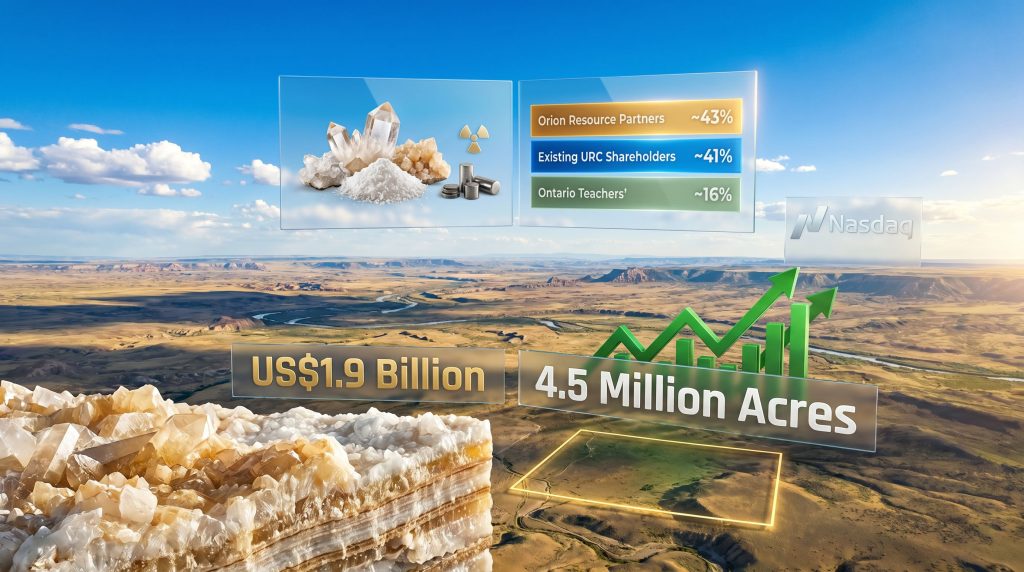
The total enterprise value of the Sweetwater arrangement reaches approximately US$1.9 billion, with URC acquiring the 92% stake for approximately US$1.1 billion in equity consideration. The structure of that consideration is worth examining closely because it reveals a great deal about how risk and reward are being distributed between the parties.
| Financial Parameter | Detail |
|---|---|
| Equity Value of 92% Stake | ~US$1.1 billion |
| Total Enterprise Value | ~US$1.9 billion |
| Cash to Sellers | US$330 million |
| Shares to Sellers | |
| Existing URC Treasury | ~US$242 million |
| Strategic Subscription (UEC) | US$40 million |
| Debt Assumed | US$625 million |
The cash component is assembled from three primary sources. URC's existing treasury of approximately US$242 million provides the foundation, supplemented by a US$40 million strategic equity subscription from Uranium Energy Corporation (UEC), URC's largest shareholder. Additional liquidity facilities bridge the remainder.
A critical and often underappreciated dimension of this deal structure is that the sellers, Orion Resource Partners and Ontario Teachers' Pension Plan, are receiving the majority of their consideration in New URC shares, not cash. This means both institutions are accepting significant ongoing exposure to the performance of the combined group, which functions as an implicit endorsement of the long-term asset quality and growth profile of the Sweetwater portfolio.
Post-Closing Ownership and Governance Protections
Upon closing, the ownership landscape of New URC will reflect this shared-risk structure:
| Shareholder Group | Approximate Ownership |
|---|---|
| Orion Resource Partners | ~43% |
| Existing URC Shareholders | ~41% |
| Ontario Teachers' Pension Plan | ~16% |
Both institutional sellers have committed to an investors' rights agreement that includes a two-year voting commitment in favour of management recommendations (subject to defined carve-outs), advance notice requirements on certain share dispositions, and restrictions designed to preserve control premiums for public shareholders. These provisions provide meaningful structural protection for the retail and institutional investors who currently hold URC shares.
Trona, Soda Ash, and the Green River Basin: What Makes These Assets Exceptional
The World's Largest Known Trona Deposit
The commercial logic underpinning the Uranium Royalty Corp Sweetwater arrangement rests on the quality and scale of the underlying mineral assets. Wyoming's Green River Basin hosts the world's single largest known trona deposit, a geological endowment of remarkable scale that has been mined commercially for decades and shows no signs of resource depletion within any commercially meaningful timeframe.
Trona, formally known as sodium sesquicarbonate, is the primary feedstock for soda ash (sodium carbonate). It is a lesser-known but industrially indispensable mineral used in:
- Glass manufacturing (flat glass, container glass, fibreglass)
- Chemical production (detergents, water treatment compounds)
- Metallurgy (flue gas desulphurisation, aluminium processing)
- Emerging battery-related applications (sodium-ion battery supply chains and lithium carbonate processing)
What distinguishes Wyoming trona from synthetic soda ash produced via the Solvay process elsewhere in the world is its cost structure. Natural trona mining in Wyoming is widely regarded as among the lowest-cost soda ash production globally, giving operators a structural margin advantage that persists across commodity price cycles.
The Royalty Position Is Unusually Broad
Most royalty companies hold financial interests in specific mines or defined production areas. The Sweetwater entities' position is structurally different. With approximately 4.5 million acres of mineral rights in fee and around 850,000 acres of fee surface rights across Wyoming, Utah, and Colorado, the asset base combines royalty income streams with genuine land control, a combination that is structurally uncommon in the royalty sector.
This land control creates several embedded optionality layers that extend well beyond current royalty cash flows:
- Greenfield trona development on non-producing portions of the mineral estate
- Renewable energy development opportunities on surface rights holdings, a growing revenue category as wind and solar developers seek large contiguous land positions in western states
- Non-trona mineral optionality across the broader land package
- Uranium exploration potential across Wyoming landholdings, positioning New URC for leverage to any future uranium price cycle
Furthermore, US uranium production trends reinforce why Wyoming's uranium exploration potential within the Sweetwater land package carries genuine strategic weight. "Wyoming is the leading US state for uranium production and resources. The presence of uranium exploration potential embedded within the Sweetwater land package means New URC's exposure to a uranium price recovery is not limited to its royalty portfolio alone. It extends to the mineral estate itself."
The 60% Production Capacity Expansion: Growth Already Funded at the Operator Level
One of the most strategically compelling features of the Sweetwater arrangement is a growth dynamic that requires no capital deployment from New URC. Based on operator disclosures, attributable soda ash production capacity is expected to increase by more than 60% in the coming years, driven by expansions that are already underway at the operator level.
For a royalty company, this is a near-ideal scenario. Growth is:
- Already funded by the operating companies, not by New URC
- Contractually embedded in existing royalty agreements that will flow proportionate royalties on expanded output
- Not contingent on New URC making further capital commitments or taking on additional balance sheet risk
- Incremental to existing cash flows, meaning the combined group's royalty income trajectory is already locked in without requiring further deal activity
This dynamic is fundamentally different from the growth profile of development-stage resource companies, where expansion requires equity or debt raises that dilute shareholders or increase leverage. Royalty companies that inherit funded operator expansions capture upside without the corresponding capital risk.
What the Arrangement Means for Existing URC Shareholders
Accretion Across Multiple Financial Dimensions
The URC board's independent special committee evaluated the arrangement on multiple financial metrics before concluding it is fair and favourable to existing shareholders. The accretion case rests on several distinct pillars:
- NAV accretion: The implied value of the Sweetwater assets on a per-share basis exceeds the consideration paid, meaning existing shareholders are acquiring assets at below-intrinsic-value pricing relative to comparable royalty portfolio benchmarks
- Cash flow accretion: New URC gains immediate access to royalty cash flows from operating soda ash producers, converting the company from a largely pre-cash-flow business into a distributable-income-generating platform
- EPS accretion: The combined group's earnings profile improves on a per-share basis relative to URC on a standalone basis
- Balance sheet strengthening: The additional cash flows from Sweetwater assets provide New URC with the financial capacity to pursue further uranium royalty acquisitions, which was the original strategic mandate of the business
UEC, holding approximately 14% of URC's issued and outstanding shares, has publicly indicated it will vote in favour of the arrangement, providing a meaningful signal of institutional confidence given its position as URC's largest existing shareholder. Investors exploring uranium investment strategies will note that this level of institutional alignment is relatively rare in junior royalty transactions.
Nasdaq Listing and Institutional Investor Access
New URC's planned listing on the Nasdaq Capital Market carries significance beyond a change of exchange. Nasdaq listing requirements and investor composition differ materially from those of the TSX, particularly with respect to US-domiciled institutional investors, index inclusion eligibility, and analyst coverage patterns.
A US-domiciled parent company listed on Nasdaq is substantially better positioned to attract the attention of large US asset managers, royalty-focused funds, and passive index vehicles than a Canadian-incorporated royalty company with development-stage cash flow characteristics. In addition, those assessing the broader uranium mining outlook will recognise that exchange positioning has become an increasingly important factor in royalty company valuations.
The next major ASX story will hit our subscribers first
Regulatory and Legal Pathway to Closing
| Milestone | Expected Timing |
|---|---|
| Management Information Circular Filed | June 2026 |
| Special Shareholder Meeting | July 2026 |
| Court Approval | Post-shareholder vote |
| Regulatory Clearances | Concurrent with court process |
| Expected Closing | Early July 2026 |
Each existing URC shareholder receives one New URC share for every URC share held, a one-for-one exchange that ensures no dilution to the existing shareholder base from the reorganisation mechanics themselves.
Competitive Positioning: How New URC Compares Within the Royalty Landscape
| Dimension | New URC Position |
|---|---|
| Commodity Diversification | Uranium and trona/soda ash |
| Immediate Cash Flow | Yes, from operating soda ash royalties |
| Land Control | ~4.5M acres mineral rights, ~850K acres surface rights |
| Reserve Life | Beyond 100 years |
| Growth Pipeline | 60%+ soda ash capacity expansion, operator-funded |
| Uranium Optionality | Wyoming mineral estate with exploration potential |
| Exchange | Nasdaq Capital Market |
Upon completion, New URC is expected to rank as one of the largest public company landowners in the United States outside of the REIT sector, and one of the largest landowners in Wyoming by total acreage. These are not simply superlatives for marketing purposes. Scale of land control in the royalty space translates directly into negotiating leverage, optionality density, and the ability to participate in multiple future development cycles without requiring incremental capital deployment.
Consequently, those focused on uranium resource investing will find New URC's dual-commodity structure and land scale represent a notably differentiated proposition within the broader critical minerals royalty landscape.
Key Takeaways for Investors Assessing the Uranium Royalty Corp Sweetwater Arrangement
- The arrangement converts URC from a development-stage uranium royalty company into a dual-commodity, cash-generating royalty platform with a 100-year-plus reserve life
- Soda ash production capacity is set to grow by more than 60% through already-funded operator expansions, delivering royalty income growth without New URC capital outlay
- Wyoming's Green River Basin hosts the world's largest known trona deposit, providing geological scarcity value that underpins long-term royalty durability
- The deal structure, with sellers taking the majority of consideration in shares, aligns institutional interests with New URC's long-term performance
- Uranium exploration optionality within the 4.5 million-acre mineral estate provides a natural bridge between the soda ash cash flow profile and the uranium-focused investor base
- The Nasdaq listing of New URC is designed to broaden institutional access and improve the combined group's market visibility and index eligibility
Disclaimer: This article contains forward-looking statements and financial projections based on publicly available information and corporate disclosures. It is provided for informational and educational purposes only and does not constitute financial advice. Readers should conduct their own due diligence and consult a licensed financial adviser before making investment decisions. All financial figures are expressed in US dollars unless otherwise stated.
Want to Stay Ahead of the Next Major Mineral Discovery?
Discovery Alert's proprietary Discovery IQ model scans ASX announcements in real time, instantly identifying significant mineral discoveries across 30+ commodities and converting complex data into clear, actionable investment opportunities — explore historic discovery returns on the Discovery Alert discoveries page to understand the scale of what early positioning can deliver, then begin your 14-day free trial to secure your market-leading edge.