June 29, 2026
When Distressed Assets Meet Long-Term Capital: Lessons from South Africa's Mining Services Sector
South Africa's mining services industry has long operated as the invisible backbone of a sector that generates billions in export revenue annually. Behind every shaft sunk, every ore body accessed, and every conveying system engineered lies a web of specialist contractors whose survival is rarely guaranteed, even when their technical capabilities are world-class. When a major mining services group enters financial distress, the question is never simply about balance sheets. It is about whether irreplaceable technical expertise, skilled workforces, and decades of operational know-how can be preserved through the turbulence, or whether they dissolve into liquidation.
The completion of the Murray & Roberts Differential Capital transaction for mining businesses offers a rare and instructive answer to that question.
When big ASX news breaks, our subscribers know first
Understanding the Financial Conditions That Led to Business Rescue
Murray & Roberts Limited, referred to throughout the restructuring process as MRL, entered voluntary business rescue in November 2024 after enduring a prolonged period of financial deterioration within the broader Murray & Roberts group. Business rescue, as defined under Chapter 6 of South Africa's Companies Act, is a formal mechanism designed to rehabilitate financially distressed companies while preserving as much value as possible for creditors, employees, and other stakeholders.
A critical distinction that shaped the entire transaction is often misunderstood by outside observers. MRL, the holding entity, entered the rescue process. Its operating subsidiaries, including Cementation Africa, Cementation Americas, Cementation APAC, and Terra Nova Technologies, did not. These businesses continued functioning throughout the rescue period without interruption, servicing existing client commitments and pursuing new project opportunities.
This separation is more than a legal technicality. It meant that the technical workforce, client relationships, and project pipelines of these operating businesses remained intact at all times, creating the conditions necessary for a viable acquisition rather than a distressed wind-down.
How Business Rescue Practitioners Orchestrate Complex Asset Preservation
Under South Africa's Companies Act framework, a business rescue process is overseen by appointed Business Rescue Practitioners (BRPs), who carry statutory responsibility for designing and executing a rescue plan that maximises creditor recovery while preserving viable operations. In this case, the joint BRPs were drawn from Metis Strategic Advisors, who worked alongside legal counsel from Webber Wentzel throughout the process.
The creditor hierarchy in a business rescue situation follows a structured priority sequence:
- Secured lenders hold the highest recovery priority.
- Post-commencement finance, meaning funding drawn after the rescue filing, carries elevated security status.
- Unsecured creditors recover only from residual proceeds after senior obligations are extinguished.
- Equity shareholders in a deeply distressed entity typically receive no distribution whatsoever.
This hierarchy shaped how the transaction's payment architecture was designed, ensuring that the R1-billion initial payment was calibrated specifically to retire all secured lender debt and secured post-commencement finance obligations at closing, providing immediate certainty to the most senior creditors in the structure.
The Assets Transferred: What the Differential Consortium Acquired
The Murray & Roberts Differential Capital transaction for mining businesses encompassed four distinct business units, each carrying its own geographic footprint and strategic value.
| Business Unit | Geography | Operational Status at Transfer |
|---|---|---|
| Cementation Africa | Sub-Saharan Africa | Fully operational, never in rescue |
| Cementation Americas | Canada and USA | Active project delivery across multiple sites |
| Cementation APAC | Asia-Pacific | Operational subsidiary with ongoing commitments |
| Terra Nova Technologies (TNT) | Americas | Specialist conveying systems provider |
Cementation's global reputation centres on underground mine development, a highly specialised field that demands not only engineering expertise but long-standing client trust built across multi-year project cycles. Once a mining company selects an underground development contractor, switching mid-project carries enormous operational and cost risk. This structural characteristic of the market meant that Cementation's client relationships represented durable, defensible value that a well-executed acquisition could preserve.
Terra Nova Technologies occupies a narrower but equally specialised niche. TNT designs and supplies in-pit crushing and conveying systems, a technology segment gaining increasing relevance as open-pit mines deepen and truck-based haulage becomes economically less efficient at depth. Including TNT within the transaction broadened the combined platform's technical service offering and added exposure to a segment with long-term structural tailwinds driven by mining decarbonisation and operational cost pressures. Furthermore, the broader context of mining industry consolidation across Southern Africa makes the preservation of these specialist capabilities even more strategically significant.
The R1.27 Billion Payment Architecture: Sequencing and Strategy
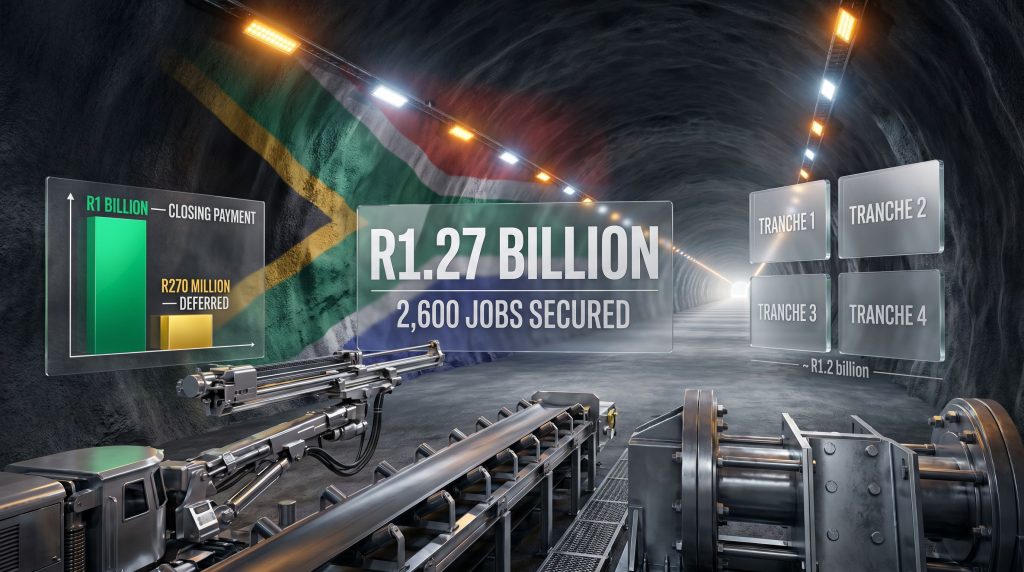
The total consideration of R1.27 billion was structured across two components, each serving a distinct purpose within the rescue framework.
- Initial payment of R1 billion at transaction close, applied immediately to extinguish all secured debt and secured post-commencement finance obligations.
- Deferred consideration of R270 million, payable 12 months following closing, preserving cash flow flexibility for the incoming owners during the initial integration and stabilisation period.
This payment structure reflects a well-established principle in special situations investing: upfront certainty for the most senior creditors reduces negotiation friction and accelerates closing, while a deferred component manages execution risk for the acquirer during the post-transaction transition. The architecture allowed the rescue plan to proceed without protracted creditor disputes, which in comparable transactions have frequently caused value destruction through delay.
"The immediate settlement of secured creditor obligations at closing is a significant outcome in any complex mining services rescue, demonstrating disciplined deal structuring and creditor alignment throughout the process."
Differential Capital and the Special Situations Investment Mandate
Special situations investing operates at the intersection of distressed credit, corporate restructuring, and operational turnaround. Unlike conventional mining private equity, which typically acquires healthy or growing businesses at premium valuations, special situations capital targets complexity, legal uncertainty, and structural dislocation as the source of return.
Differential Capital, a South African investment firm with a specific focus on complex special situations transactions, identified in the Murray & Roberts mining businesses a combination of factors that made this transaction particularly compelling:
- Deep technical capability embedded within experienced workforces that cannot be replicated quickly.
- Long-term project pipelines providing revenue visibility from the moment of acquisition.
- Operational continuity already maintained throughout the rescue period, reducing post-acquisition integration risk.
- A globally diversified footprint spanning Africa and the Americas, reducing single-market concentration risk.
Differential Capital's fund head, Mark Salmon, articulated that the investment thesis extended beyond financial returns, recognising that businesses like Cementation and TNT play foundational roles within South Africa's broader mining economy and supply chain ecosystem. However, evaluating such opportunities also requires careful scrutiny of management red flags and governance structures throughout the distressed period.
Funding the Deal: JSE-Listed Preference Share Structure
Perhaps one of the most technically innovative aspects of this transaction is the funding mechanism deployed by Differential Capital's consortium. Rather than relying solely on bank debt or private credit facilities, Redinc Capital, acting as arranger, debt sponsor, and administrator to the Differential Consortium, raised approximately R1.2 billion across four tranches of JSE-listed preference shares.
The decision to use listed-market instruments carries several advantages worth unpacking for investors and industry observers:
- Transparency and governance: JSE-listed instruments operate within a regulated disclosure framework, providing investors with ongoing visibility.
- Investor access: Listed preference shares allow a broader range of institutional and sophisticated investors to participate in what would otherwise be a privately structured transaction.
- Market pricing signal: The ability to raise R1.2 billion across listed instruments at transaction close reflects genuine market confidence in the underlying asset quality.
This funding structure may represent a replicable model for future distressed acquisitions in South Africa's corporate landscape, particularly where the assets being acquired have identifiable operational value and cash-generating capability. In addition, the approach reflects growing sophistication in how South African capital markets support complex restructuring outcomes, much as a definitive feasibility study anchors investment confidence in greenfield mining projects.
Leadership, Workforce Preservation, and Operational Continuity
With the transaction closed, Japie du Plessis assumed the role of CEO of the newly formed, financially independent mining services group, with Sibulele Songca appointed as CFO. Both appointments signal continuity of management leadership through the ownership transition, a deliberate choice that protects institutional knowledge and client confidence simultaneously.
The preservation of approximately 2,600 jobs across the transferred businesses stands as one of the transaction's most significant outcomes. In the context of South Africa's unemployment challenges, specialist engineering roles carry outsized economic value, both for the individuals employed and for the broader supply chains that depend on functioning mining services companies.
Employee continuity through a business rescue process serves a function beyond social responsibility. Clients who are deciding whether to extend contracts or award new projects during a period of ownership uncertainty take significant comfort from knowing that the people who will actually deliver those projects are still in place. Consequently, Cementation Africa's emergence as an independent entity was widely regarded as a stabilising signal for the broader contracting market.
The next major ASX story will hit our subscribers first
The Advisory Ecosystem That Made It Possible
The complexity of a cross-jurisdictional mining services rescue spanning Africa, the Americas, and the Asia-Pacific region required a multi-disciplinary professional advisory structure.
| Adviser | Role |
|---|---|
| Metis Strategic Advisors | Joint Business Rescue Practitioners |
| Webber Wentzel | Lead legal counsel to the BRPs |
| Werksmans Attorneys | Lead legal counsel to Differential Capital |
| Redinc Capital | Arranger, debt sponsor, and administrator to the Differential Consortium |
| Credeq Africa / Lombard Insurance | Guarantee facility underwriting for Cementation Africa |
The guarantee facility provided by Credeq Africa, acting as underwriting management agent for Lombard Insurance, deserves specific attention. Mining services companies typically rely on performance bonds and guarantee facilities to underwrite their obligations on active projects. Any disruption to those guarantees during a business rescue can trigger contract terminations, creating a cascading operational crisis. The continuity of Cementation Africa's guarantee facilities throughout the transition period was therefore a critical enabler of uninterrupted project delivery.
What This Transaction Means for South Africa's Corporate Rescue Landscape
The Murray & Roberts Differential Capital transaction for mining businesses sets a meaningful precedent within South Africa's business rescue ecosystem. It demonstrates that when distressed entities contain operationally viable, technically sophisticated businesses, the rescue mechanism, properly applied, can achieve outcomes that liquidation never could.
Several broader lessons emerge from this transaction:
- Business rescue works best when the underlying operating businesses remain functional throughout the process, giving acquirers confidence and clients continuity.
- Special situations capital can fill the gap left by distressed listed companies, preventing the permanent loss of strategic industrial capability.
- Listed-market funding instruments can be successfully applied to complex rescue transactions, broadening investor participation and strengthening governance.
- Job preservation at scale is achievable within restructuring frameworks when it is treated as a primary design objective from the outset, rather than an afterthought.
Furthermore, the broader implications for how commodity price impact shapes the financial health of services companies throughout market cycles cannot be overstated. The sustained pressure on mining services margins over the preceding years contributed directly to the conditions that made this rescue necessary. Understanding those dynamics is essential context for any investor or analyst evaluating similar situations.
"It is also worth noting that, notwithstanding the completion of the Differential Capital transaction, the business rescue process in respect of MRL itself remains ongoing. The transaction closing does not represent the conclusion of the rescue proceeding, and residual obligations within the MRL estate continue to be administered by the joint BRPs."
Detailed interim results published in April 2025 provided further transparency on the financial trajectory of the broader MRL estate, reinforcing the importance of creditor communication throughout complex rescue proceedings.
The transaction ultimately reinforces a proposition that is often underappreciated in corporate restructuring discussions: the highest-value outcome in a distressed situation is rarely the fastest one. Disciplined stakeholder coordination, careful creditor sequencing, and the preservation of operational capability over months of complex negotiation produced a result that serves employees, creditors, clients, and investors simultaneously. That combination of outcomes is rare in any market, and rarer still in the complexity of cross-jurisdictional mining services.
This article is intended for informational purposes only and does not constitute financial or investment advice. Readers should conduct their own due diligence and seek independent professional advice before making any investment decisions. Forward-looking statements and assessments of transaction outcomes involve inherent uncertainty and should not be relied upon as guarantees of future performance.
Want to Identify the Next Major ASX Mineral Discovery Before the Broader Market?
Discovery Alert's proprietary Discovery IQ model delivers real-time alerts on significant ASX mineral discoveries, transforming complex mineral data into clear, actionable insights for investors at every experience level — start your 14-day free trial today and gain a market-leading edge, or explore Discovery Alert's dedicated discoveries page to understand how historic mineral discoveries have generated extraordinary returns.