June 29, 2026
Why Refractory Manufacturers Are Under Unprecedented ESG Scrutiny
Industrial sustainability is undergoing a fundamental transformation. For decades, heavy manufacturing sectors operated under a relatively simple accountability model: comply with environmental regulations, publish an annual report, and move on. That model is collapsing under the weight of institutional investor expectations, Scope 3 emission cascades from downstream clients, and the growing commercial reality that ESG performance now shapes procurement decisions at the largest steel, cement, and glass producers on the planet.
Nowhere is this pressure more acutely felt than in the refractory industry. Refractory materials, the heat-resistant linings that make high-temperature industrial processes possible, sit at the upstream intersection of some of the world's most carbon-intensive value chains. Global steel production alone contributes an estimated 7 to 9 percent of total global CO₂ emissions, and as steel producers face intensifying pressure to reduce their Scope 1 and Scope 2 footprints, that scrutiny is migrating upstream to suppliers whose products are embedded within those same processes.
For refractory manufacturers, this creates a strategic inflection point. Companies that treat sustainability as a compliance exercise are increasingly exposed. Those that have invested in embedding ESG within operational architecture are finding it translates into tangible commercial advantages, from preferred supplier status to improved access to institutional capital.
RHI Magnesita, the global leader in refractory solutions, services, and minerals, has positioned itself firmly in the second category. The release of its 2026 Latin American RHI Magnesita Book ESG, published under the theme Sustainability in Action to Transform Tomorrow, offers a detailed look at how that positioning has been built and what it signals for the broader industrial sector.
When big ASX news breaks, our subscribers know first
What the RHI Magnesita Book ESG Actually Measures
Beyond Reporting: ESG as a Strategic Architecture Document
The RHI Magnesita Book ESG is not a standard corporate sustainability report. It functions as a structured disclosure instrument designed to communicate simultaneously across multiple stakeholder audiences: institutional investors conducting ESG due diligence, procurement teams at major steel producers evaluating supplier sustainability credentials, regulatory bodies overseeing environmental and social compliance, and communities in which the company operates mining and manufacturing assets.
The Latin American edition adds a further layer of specificity. Rather than simply translating global sustainability metrics into Portuguese, the publication contextualises RHI Magnesita's performance within the distinct regulatory, environmental, and social landscape of the region. Brazil, as the company's primary Latin American operating base, presents a sustainability context with few equivalents: extraordinary biodiversity sensitivity, a rapidly evolving environmental licensing framework, and growing ESG disclosure expectations from Brazilian institutional investors and mining sector regulators.
The following table summarises how RHI Magnesita's ESG disclosure framework compares to general industrial sector benchmarks:
| Disclosure Dimension | RHI Magnesita Position | Broader Industrial Sector |
|---|---|---|
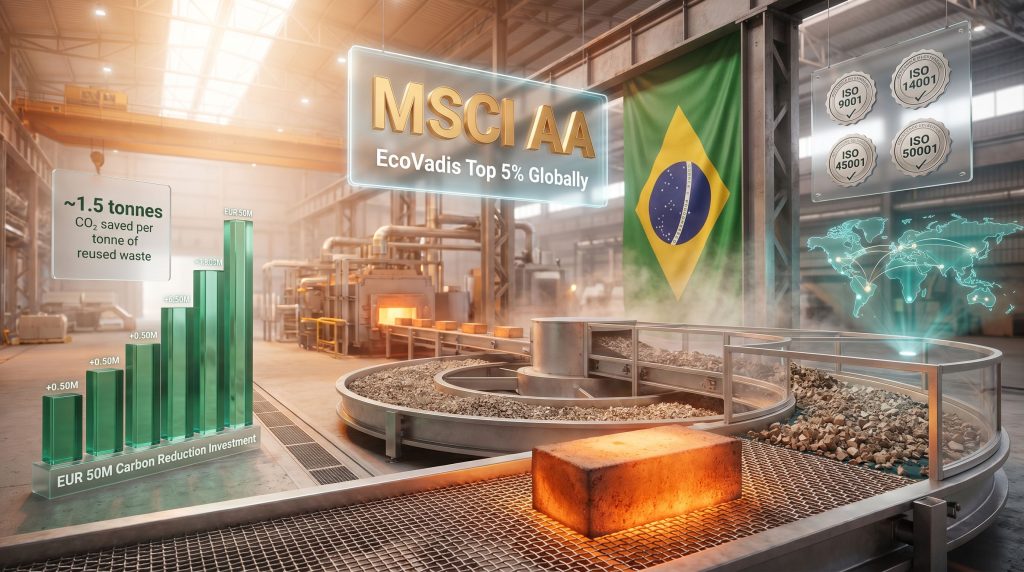
| Carbon Commitment | EUR 50M invested in carbon reduction technologies | Most peers lack quantified investment targets |
| Circular Economy Metric | ~1.5 tonnes CO₂ saved per tonne of reused refractory waste | Limited circularity disclosure among competitors |
| MSCI ESG Rating | AA (Leader category) | BBB average for industrials globally |
| EcoVadis Rating | Top 5% of industrial companies worldwide | Top 25% considered strong performance |
| UN Global Compact | Signatory since 2018 with annual CoP reporting | Partial or recent adoption across the sector |
| ISO Certifications | 9001, 14001, 45001, 50001 | ISO 9001 near-universal; others inconsistently held |
| Governance Structure | Dedicated Corporate Sustainability Committee | Board-level ESG oversight inconsistent across peers |
| SDG Alignment | 6+ SDGs actively addressed | Selective alignment more common |
Strategic insight: An MSCI AA rating is held by fewer than 15% of companies in the global industrials sector. Combined with a top-5% EcoVadis designation, RHI Magnesita achieves a new high in its EcoVadis ESG rating, placing it among the most credentialed ESG performers in the entire heavy manufacturing landscape, not just within refractories.
The Decarbonisation Challenge in Refractory Manufacturing
Why Carbon Reduction Is Technically Complex Here
Reducing carbon emissions in refractory manufacturing is substantially more difficult than in many other industrial categories. Refractory products are engineered to withstand temperatures exceeding 1,600 degrees Celsius in many applications, requiring energy-intensive sintering and firing processes that are not easily electrified with current technology. The mineralogy of key raw materials, including magnesia, alumina, and doloma, demands processing conditions that place inherent physical limits on energy reduction through operational efficiency alone.
This is precisely why RHI Magnesita's EUR 50 million commitment to carbon reduction technologies represents a meaningful signal. Furthermore, the broader shift towards decarbonisation in mining demonstrates that the investment encompasses three interconnected workstreams:
-
Energy efficiency upgrades across kiln and firing operations to reduce the thermal energy intensity of production processes.
-
Renewable energy integration, expanding the share of clean energy sources within operational consumption, particularly across Latin American facilities where renewable infrastructure is advancing.
-
Low-carbon product development, creating refractory solutions that reduce the overall emission footprint of client operations, allowing steel and cement producers to partially address Scope 3 obligations through procurement choices.
The company's Carbon Capture, Utilisation and Storage research programme, alongside its ReSOURCE initiative, represents the longer-horizon frontier of its decarbonisation strategy. CCUS in industrial minerals processing remains at an early commercial stage globally, and companies investing in this space today are positioning for regulatory and technological environments that are still taking shape.
Energy Management Under ISO 50001
A less-discussed but operationally significant element of RHI Magnesita's environmental framework is its ISO 50001 certification for energy management. Unlike the more widely held ISO 14001 environmental management standard, ISO 50001 requires companies to establish systematic processes for continuously improving energy performance, including setting measurable energy intensity targets, monitoring consumption data, and embedding energy management into operational decision-making at the facility level.
For the Latin American operations specifically, ISO 50001 provides the governance scaffolding for renewable energy in mining adoption, ensuring that progress is tracked against a defined baseline rather than reported selectively.
The Circular Economy Model: Turning Waste Into a Carbon Asset
How Refractory Circularity Works in Practice
The circular economy dimension of the RHI Magnesita Book ESG deserves particular attention because it represents a genuine technical and commercial innovation within the refractory sector, not simply a reframing of existing practice.
Used refractory linings, the spent materials recovered from steel furnaces, ladles, and converters after their service life, have historically been classified as industrial waste requiring disposal. RHI Magnesita's circularity model systematically inverts this classification, treating recovered refractory material as a secondary raw material input with quantifiable economic and environmental value.
The operational sequence works as follows:
-
Collection at client sites, where used refractory linings are recovered from steel furnaces, ladles, and converters following their service cycle.
-
Characterisation through laboratory analysis to assess mineral composition, contamination levels, and suitability for reprocessing.
-
Processing via crushing, screening, and grading to prepare secondary material to specification.
-
Reintegration into new product formulations as a partial or full substitute for virgin-extracted raw materials.
-
Quality validation confirming that products incorporating recycled inputs meet the same technical performance standards as virgin-material equivalents.
-
Carbon accounting calculating and reporting the CO₂ avoided through reduced extraction and lower processing energy consumption.
The result is a documented saving of approximately 1.5 tonnes of CO₂ for every tonne of refractory waste successfully reused, a metric that positions circularity as one of the highest-leverage carbon reduction tools within the company's sustainability toolkit.
Why this matters for procurement teams: Steel producers operating under Science Based Targets commitments are increasingly required to demonstrate Scope 3 emission reductions across their supply chains. A refractory supplier with documented, quantified circularity savings provides a verifiable contribution to those Scope 3 reduction accounts, creating a commercial incentive that extends well beyond environmental compliance.
This circularity model also aligns directly with SDG 12 (Responsible Consumption and Production) and anticipates tightening regulatory requirements on industrial waste management in both the European Union and Brazil, where environmental licensing frameworks are progressively raising expectations for waste minimisation and circular material flows. In addition, the growing critical minerals demand across global supply chains makes responsible sourcing and circularity even more commercially compelling.
Social Responsibility and the Operational Licence Question
Community Development as Risk Management
One of the less-discussed but increasingly material dimensions of the RHI Magnesita Book ESG is its treatment of social investment. The company's community programmes, concentrated around its mining and manufacturing operations in Latin America, are deliberately structured around productive inclusion, vocational training, income generation, and educational access.
This approach reflects a sophisticated understanding of how social licence operates in practice. For companies with significant mining footprints in Latin American jurisdictions, community relations are not peripheral stakeholder management exercises. They are directly material to permitting outcomes, operational continuity, and the long-term viability of extraction activities in regions where community opposition has historically delayed or blocked mining operations.
Gender Equity as a Governance Metric
RHI Magnesita's progress in expanding the representation of women in senior leadership positions has become a measurable contributor to its ESG ratings performance. Major rating platforms including MSCI now assign meaningful weighting to gender diversity at the leadership level, reflecting institutional investor evidence that diverse senior teams correlate with stronger long-term governance outcomes. Consequently, the broader conversation around female leadership in mining is directly relevant to how these metrics are evaluated by ratings agencies.
The company's gender equity initiatives are aligned with SDG 5 (Gender Equality) and embedded within its broader human capital strategy, with targets tracked through the same governance structures that monitor environmental performance.
Zero Harm Vision: Safety as a Cultural Infrastructure
The Zero Harm Vision articulated in the RHI Magnesita Book ESG is more than an aspirational label. It is backed by ISO 45001 certification for occupational health and safety management, establishing a systematic framework for hazard identification, risk assessment, incident investigation, and continuous improvement across global operations.
In an industry where contractor management complexity is high and physical risk profiles are significant, ISO 45001 governance provides the audit trail and accountability mechanisms that both regulators and institutional investors increasingly require as evidence of substantive safety commitment.
Governance Architecture and the Double Materiality Principle
What a Dedicated Sustainability Committee Actually Signals
The existence of a dedicated Corporate Sustainability Committee with board-level authority represents a structural governance differentiator that deserves more attention than it typically receives in ESG commentary. In many industrial companies, ESG oversight remains fragmented across functional departments, with sustainability performance reported upward through a finance or risk committee that may lack the technical depth to evaluate environmental and social performance meaningfully.
A dedicated committee with defined terms of reference, formal target-setting authority, and external accountability creates a fundamentally different governance dynamic. It signals that ESG performance is treated as a primary strategic objective rather than a reporting obligation managed at the margin. This commitment is reflected in detail within RHI Magnesita's sustainability data, which provides transparent, publicly accessible performance metrics across all major ESG dimensions.
RHI Magnesita's governance approach is further anchored by the principle of double materiality, assessing both the company's outward impact on environment and society and the reverse influence of sustainability factors on business performance. This dual-lens methodology, now embedded in European sustainability reporting standards, ensures that ESG disclosures capture commercial risk exposure alongside ethical responsibility.
IBRAM and the Brazilian Mining ESG Context
RHI Magnesita's participation in Brazil's mining sector ESG ecosystem adds an important regional accountability layer. IBRAM, the Brazilian Mining Association (Instituto Brasileiro de Mineração), has progressively elevated sustainability standards across its member companies, with the Towards Sustainable Mining Brasil (TSM Brasil) framework providing a structured reference standard for responsible mining practice.
TSM Brasil covers community and Indigenous engagement, crisis management, environmental stewardship, safety and health, and tailings management, among other areas. For a company with significant mineral extraction activities in Brazil, alignment with TSM Brasil expectations contributes to social licence, regulatory credibility, and sector-wide benchmarking visibility. The mining sustainability transformation underway across Latin America makes this regional framework increasingly significant for competitive positioning.
Industry context: The TSM framework originated in Canada through the Mining Association of Canada and has since been adopted by mining associations across multiple countries. Brazil's adoption through IBRAM reflects the global convergence of responsible mining standards and the growing expectation that Brazilian mining operations meet internationally recognised performance benchmarks.
The next major ASX story will hit our subscribers first
ESG Performance Summary: Key Metrics at a Glance
| ESG Dimension | Key Metric or Commitment | Benchmark Context |
|---|---|---|
| Carbon Investment | EUR 50M toward carbon reduction technologies | Among the highest disclosed in the refractory sector |
| Circular Economy | ~1.5 tonnes CO₂ saved per tonne of reused material | Industry-leading documented circularity metric |
| MSCI Rating | AA (Leader) | Fewer than 15% of industrials achieve AA or above |
| EcoVadis Rating | Top 5% globally within industrial sector | Reflects multi-dimensional ESG strength |
| UN Global Compact | Signatory since 2018 | Long-term commitment versus more recent sector adoption |
| SDG Alignment | 6+ SDGs actively addressed (SDG 3, 5, 7, 9, 12, 13) | Broad versus selective alignment among peers |
| ISO Certifications | 9001, 14001, 45001, 50001 | Comprehensive multi-standard certification |
| Governance | Dedicated Corporate Sustainability Committee | Above sector average for board-level ESG oversight |
What the Forward Trajectory Looks Like
The RHI Magnesita Book ESG does not simply document historical performance. It functions as a forward signal for investors, clients, and regulators seeking to understand where the company's sustainability trajectory is heading. Several indicators are worth monitoring in successive editions:
-
Progress toward the company's CO₂-neutrality commitment, including milestones from CCUS and ReSOURCE programme development.
-
The evolution of recycled raw material utilisation as a proportion of total production inputs, particularly as circular economy regulatory expectations tighten in both Europe and Brazil.
-
Continued improvement in gender diversity metrics at senior leadership levels, where incremental gains are likely to influence future MSCI rating assessments.
-
Expansion and measurable impact of community investment programmes across Latin American operating territories.
-
Deepening alignment with TSM Brasil standards as Brazilian mining sector governance frameworks continue to develop.
For the broader refractory and industrial minerals sector, the RHI Magnesita model offers a replicable template: anchor ESG within governance architecture, invest in circular economy infrastructure, quantify performance against third-party rating frameworks, and communicate with the regional specificity that differentiated stakeholder audiences require.
As Scope 3 emission accountability continues to cascade down industrial supply chains, refractory manufacturers with robust, independently validated ESG credentials will be structurally advantaged in supplier selection processes at the world's largest steel and cement producers. The RHI Magnesita Book ESG is, in this sense, both a disclosure document and a competitive positioning instrument.
Readers seeking additional context on Brazil's mining sector ESG standards and the TSM Brasil framework can explore IBRAM's published resources at ibram.org.br, which covers responsible mining commitments, innovation initiatives, and sector-wide sustainability benchmarking across Brazil's mineral extraction industry.
This article contains forward-looking observations and comparative analysis based on publicly available disclosures. Readers should conduct independent due diligence before making investment or procurement decisions based on any ESG ratings or sustainability metrics referenced herein. ESG ratings and certifications reflect assessments at specific points in time and are subject to revision.
Want to Stay Ahead of Significant ASX Mineral Discoveries as They Happen?
Discovery Alert's proprietary Discovery IQ model delivers real-time alerts on major ASX mineral discoveries, instantly transforming complex data across more than 30 commodities into clear, actionable insights for both traders and long-term investors. Explore how historic discoveries have generated substantial returns on Discovery Alert's dedicated discoveries page, and begin your 14-day free trial today to position yourself ahead of the broader market.