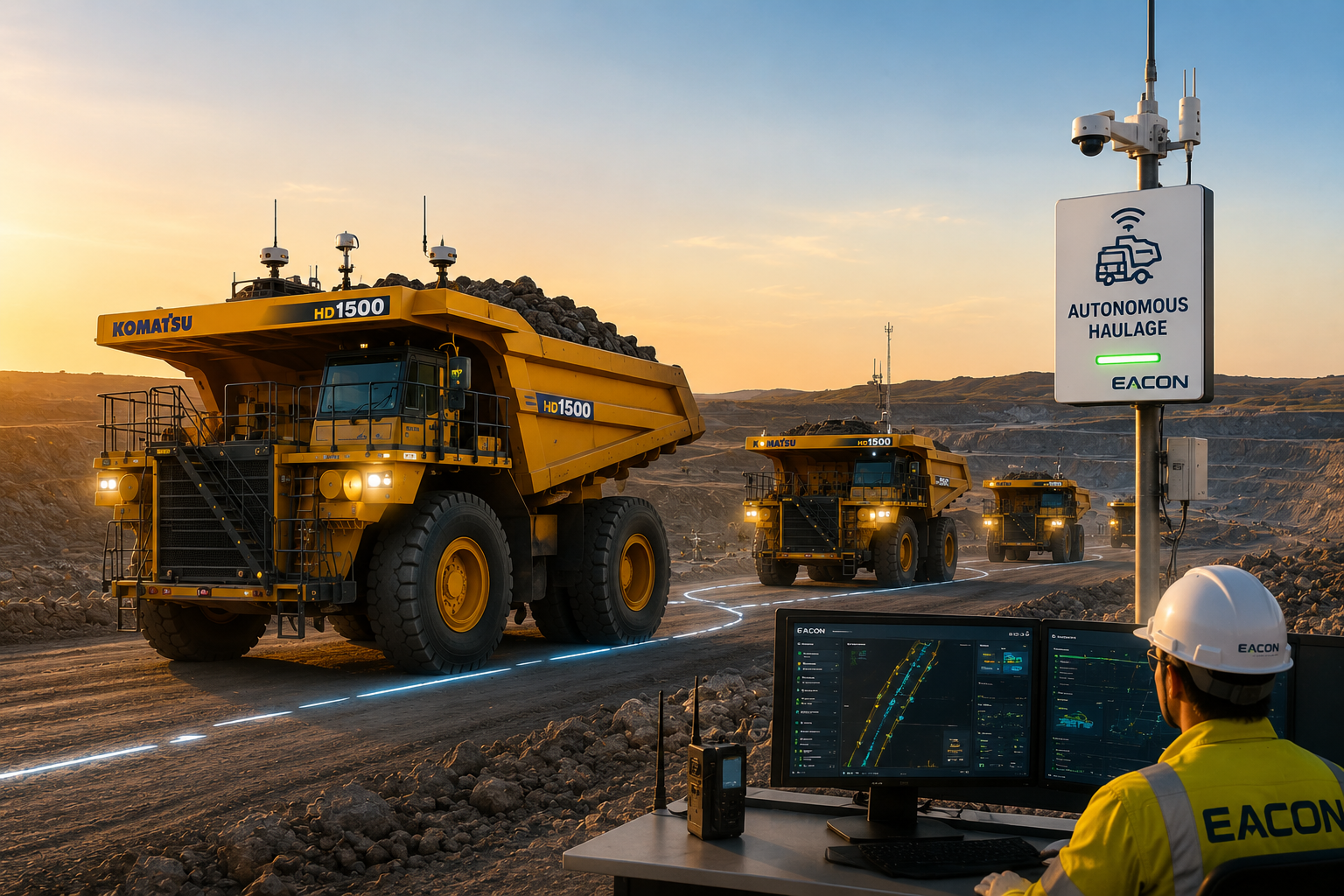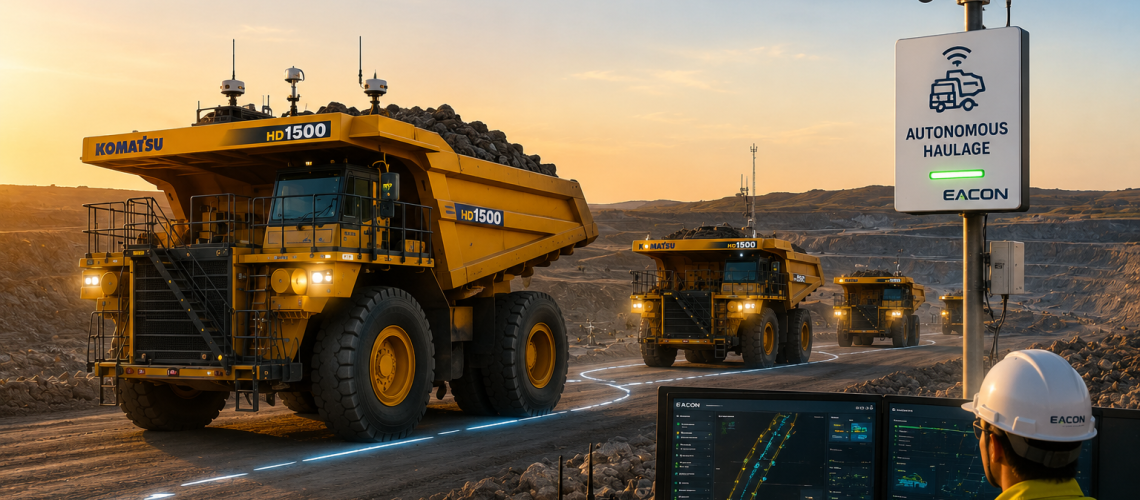
EACON Mining Technology has reached a significant milestone in the deployment of autonomous haulage technology in Australia, commencing day-shift autonomous operations with a fleet of retrofitted Komatsu HD1500 haul trucks at a gold mining operation in Western Australia.
The project, located at the Havana Pit within the Paddington operation of Norton Gold Fields (NGF) in the Kalgoorlie Goldfields region, marks the first deployment of autonomous haulage technology in an active mining production environment in the region. It also represents one of the industry’s pioneering retrofit applications of autonomous technology on Komatsu HD1500 haul trucks.
The rollout involves six Komatsu HD1500 trucks operating autonomously without safety drivers during daytime production activities. Site personnel are simultaneously being trained and upskilled to support the future transition to night-shift autonomous operations.
From Existing Fleet to Autonomous Operations
Unlike traditional autonomous haulage projects that often rely on new equipment, the NGF project leverages existing fleet assets. Each truck has been converted for autonomous operation using EACON’s OEM-agnostic autonomous haulage solution, including a drive-by-wire retrofit system.
The approach demonstrates how mining operations can introduce autonomous haulage using existing equipment, reducing capital expenditure requirements while minimising disruptions to ongoing production.
According to EACON, the project is intended to provide a practical pathway for miners seeking to adopt automation without undertaking wholesale fleet replacement programs.
The transition from conventional operations to a fully autonomous production environment follows an extensive period of system development and validation.
Prior to deployment, the project team completed drive-by-wire system design, autonomy feature validation, system integration, and a comprehensive series of safety assessments tailored to Australian mining conditions.
Extensive Preparation Behind the Rollout
Although autonomous operations officially commenced in June, preparation activities began much earlier.
Following telecommunications infrastructure orders placed in January 2026, more than five months were dedicated to establishing the foundations required for autonomous haulage.
The work included telecommunications upgrades, deployment of on-premise server infrastructure, preparation of the Autonomous Operating Zone (AOZ), risk assessments, and operational process modifications to ensure the technology could be safely integrated into a live production environment.
The shift from isolated testing grounds to an active production pit represents one of the most critical phases in any autonomous haulage project.
Unlike controlled testing environments, production operations require autonomous systems to function alongside dynamic mining activities while maintaining productivity and safety standards.
Building Local Capability for Autonomous Mining
EACON Australia Chief Growth Officer Elaine Jin said the move into live production operations significantly raises the operational requirements for autonomous haulage support.
“Transitioning autonomous haulage into a live production environment raises the bar for on-site support across AHS operations, technical support and training,” Elaine said.
“Through the NGF project, EACON is building a strong local support team and the operational experience required to support future autonomous haulage projects in Australia.”
The company views the project as more than a single deployment. It is also serving as a platform for developing local expertise and operational knowledge that can support broader adoption of autonomous haulage technology across Australian mining operations.
Growing Momentum for Brownfield Autonomy
As mining companies continue to pursue productivity improvements, safety enhancements, and decarbonisation objectives, autonomous haulage systems are increasingly becoming a key component of long-term operational strategies.
Historically, however, many autonomous deployments have focused on large-scale greenfield projects or new equipment purchases.
the NGF project highlights a different approach—retrofitting existing fleet assets to extend their operational life while introducing autonomous capability.
This model may prove particularly attractive for operators seeking to accelerate automation without committing to major fleet replacement programs.
By demonstrating autonomous haulage within an active production environment using existing trucks and haul road infrastructure, the project provides a practical example of how brownfield operations can integrate advanced mining technologies into day-to-day production.
A Global Autonomous Haulage Provider
EACON Mining Technology has emerged as one of the world’s largest autonomous haulage technology providers.
According to the company, its autonomous haulage systems have been deployed on more than 2,500 trucks globally, covering over 120 million kilometres across more than 30 mining projects.
The company’s ORCASTRA® autonomous haulage platform is designed to operate across multiple original equipment manufacturers (OEMs) and powertrain configurations, enabling integration with both new and existing mining fleets.
EACON’s deployments span a range of commodities, including coal, iron ore, copper, gold, and zinc.
As the mining industry continues to expand the adoption of automation technologies, projects such as the NGF deployment are expected to play an important role in demonstrating how autonomous haulage can be integrated into existing operations while maintaining safety, productivity, and operational flexibility.
For Australia’s mining sector, the successful rollout of autonomous HD1500 haul trucks in a live production environment may signal the next stage in the evolution of mine automation—one where autonomous technology is no longer limited to new mines or purpose-built fleets, but increasingly becomes part of the operating model for established mining operations.