South Africa is taking significant steps to establish itself as a future global hub for fluorochemicals, leveraging its vast fluorspar reserves, decades of fluorine chemistry expertise, and a growing industrial strategy focused on critical mineral beneficiation.
A major milestone was reached on June 12, 2026, with the signing of a Memorandum of Agreement (MOA) between Fluorchemicals South Africa (Pty) Ltd, the Technology Innovation Agency (TIA), and Nelson Mandela University to advance the Fluorochemicals Strategic Innovation Programme (FSIP) at the Coega Special Economic Zone (SEZ). The agreement lays the foundation for a domestic fluorochemicals industry designed to capture more value from South Africa’s mineral resources rather than exporting raw materials alone.
Building a New Critical Minerals Value Chain
The initiative comes as governments worldwide race to secure supply chains for critical minerals and advanced materials used in electric vehicles, renewable energy systems, semiconductors, artificial intelligence infrastructure, pharmaceuticals, and rare earth processing.
South Africa designated fluorspar as a critical mineral in 2025, while the country’s newly released Industrial Development Strategy identifies critical mineral beneficiation as a cornerstone of future industrial growth and decarbonisation efforts.
Although South Africa has long been a significant producer of fluorspar, much of the value-added fluorochemical production has historically taken place elsewhere. The new programme aims to change that dynamic by creating an integrated fluorochemicals industry capable of producing higher-value downstream products domestically.
According to project proponents, the FSIP is designed not only to support industrial development but also to build research, training, and technological capabilities that can underpin a long-term fluorochemicals ecosystem.
US$130 Million AHF Plant Anchors Development
At the centre of the strategy is Fluorchemicals South Africa’s planned fluorochemicals complex at the Coega SEZ.
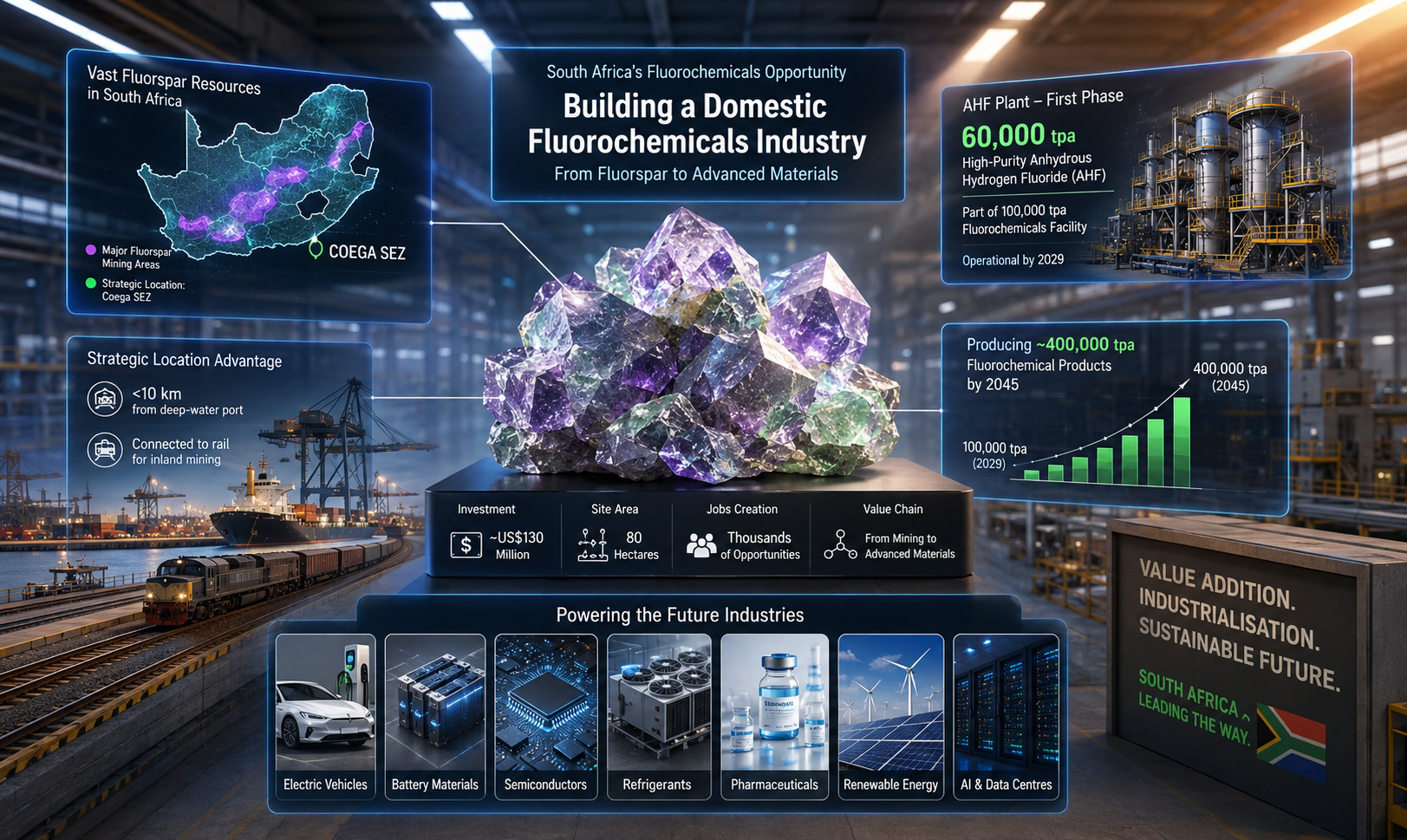
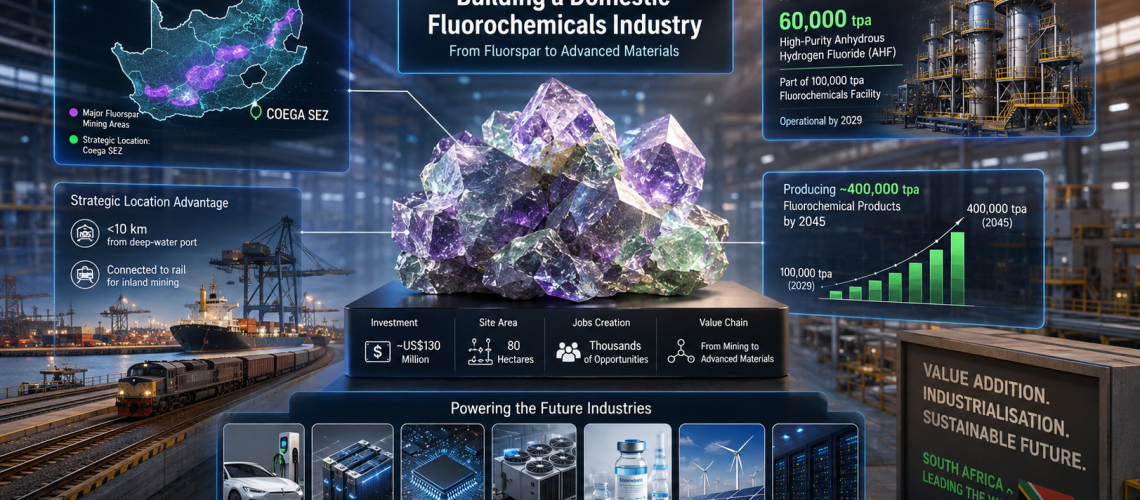
The flagship development will initially consist of a 100,000-tonne-per-annum fluorochemicals facility anchored by a 60,000-tonne-per-annum high-purity Anhydrous Hydrogen Fluoride (AHF) plant. The project is expected to be operational by 2029.
AHF is a key intermediate chemical used in the manufacture of a wide range of downstream fluorochemical products, including fluoropolymers, refrigerants, battery materials, specialty chemicals, and components used in semiconductor manufacturing.
The facility will be built on an 80-hectare site within the Coega SEZ, strategically located less than 10 kilometres from a deep-water port and connected to rail infrastructure capable of transporting acid-grade fluorspar from inland mining operations.
The project is expected to require approximately US$130 million in development capital and is currently advancing through permitting, engineering design, and technology licensing activities. The company plans to launch an Engineering, Procurement and Construction (EPC) tender process later this year.
Positioning for Future Demand Growth
The timing of the project reflects growing expectations of increased demand for fluorochemicals across multiple industries.
Fluorochemicals play a critical role in technologies associated with the energy transition and advanced manufacturing. They are used in lithium battery production, semiconductor fabrication, rare earth processing, refrigeration systems, pharmaceuticals, and numerous industrial applications.
Industry forecasts cited by the project developers suggest demand for fluorochemicals will continue to grow rapidly as investment accelerates in electric vehicles, renewable energy infrastructure, artificial intelligence data centres, and advanced manufacturing.
The developers believe South Africa is well-positioned to capture a larger share of this market due to its substantial fluorspar resources and established scientific expertise in fluorine chemistry.
Creating a Domestic Fluorochemicals Industry
One of the primary objectives of the programme is reducing South Africa’s dependence on imported fluorochemicals while building domestic manufacturing capability.
For decades, the country has exported fluorspar while importing many of the higher-value products derived from it. The FSIP seeks to reverse that trend by creating a fully integrated value chain, beginning with raw material extraction and extending into advanced chemical manufacturing.
The initiative also aims to support workforce development.
Nelson Mandela University will play a central role in training, research, and development activities associated with the programme. New technical skills will be required to safely handle and process hydrogen fluoride and other fluorine-based chemicals, creating opportunities for specialised workforce development.
Expanding Beyond AHF
The AHF facility is intended to be only the first stage of a much broader industrial strategy.
Following the initial development, Fluorchemicals South Africa plans to expand into higher-value downstream products, including fluoropolymers and fluororefrigerants. These products command significantly higher margins and are essential components in many advanced technologies.
The company ultimately aims to produce approximately 400,000 tonnes per annum of various fluorochemical products by 2045, a scale that would position South Africa among the world’s leading fluorochemical producers.
Achieving that ambition will require a substantial increase in domestic fluorspar production. Industry plans currently envision acid-grade fluorspar output increasing from approximately 350,000 tonnes per annum today to around one million tonnes per annum by 2040 through a combination of local and international mining investments.
A Strategic Opportunity in Critical Minerals
The broader significance of the project extends beyond a single chemical facility.
As countries seek to secure supply chains for critical minerals and advanced materials, fluorochemicals are increasingly attracting strategic attention due to their importance in emerging technologies and the limited number of global producers.
Fluorochemicals possess unique properties including exceptional heat resistance, chemical stability, electrical insulation characteristics, and water repellency. These attributes make them difficult to substitute in many industrial applications. At the same time, production requires specialised expertise, intellectual property, and stringent safety standards, creating substantial barriers to entry.
Project director Ivan Radebe described the recent progress as an important step toward creating shared value for South Africa and the broader region, while recognising the contributions of government agencies, industry partners, investors, and academic institutions involved in the initiative.
If successfully delivered, the Coega fluorochemicals project could become one of the most significant examples of critical mineral beneficiation in Africa, transforming South Africa from a supplier of raw fluorspar into a producer of strategic materials essential to the global energy transition and advanced manufacturing economy.