June 5, 2026
Understanding East Africa's Energy Vulnerability Through Economic Disruption
Kenya's persistent fuel crisis exemplifies the acute vulnerability facing developing economies when global supply chains experience disruption. Energy security vulnerabilities across developing economies rarely reveal themselves as starkly as during geopolitical crises. When global supply chains face disruption, nations with concentrated import dependencies experience immediate transmission of external shocks into domestic economic instability.
East Africa's petroleum supply architecture exemplifies this systematic vulnerability, where decades of import concentration have created structural dependencies that amplify global market volatility into local crises. The region's reliance on single-source procurement models, limited strategic reserves, and regulatory frameworks designed for stable market conditions creates compound vulnerabilities when international supply chains face stress.
Understanding these mechanisms provides insight into broader questions of energy security for emerging economies navigating global market integration while maintaining domestic economic stability.
When big ASX news breaks, our subscribers know first
Global Market Forces Amplifying Regional Energy Insecurity
Current market disruptions demonstrate how concentrated import dependencies transform global price shocks into domestic supply emergencies. Crude oil prices have surged more than 40%, topping $100 per barrel following geopolitical tensions that began in February 2026, with the Israel-Iran conflict creating immediate supply chain constraints through critical shipping routes.
The Strait of Hormuz disruption has affected approximately 20% of global oil and liquefied natural gas shipments, creating bottlenecks that disproportionately impact nations dependent on Gulf producers. This chokepoint vulnerability reveals how geographic concentration of energy imports creates systematic risk exposure that extends far beyond individual nation boundaries.
Price Transmission Mechanisms and Regional Impact
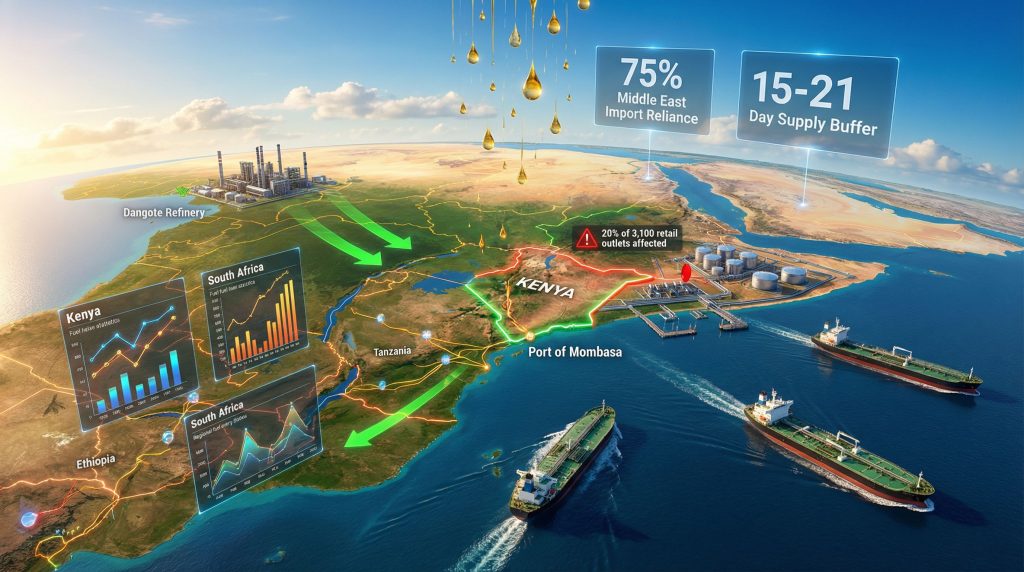
East and Southern Africa face particular vulnerability, importing roughly 75% of their refined fuel from the Middle East. This regional concentration means that disruptions in Gulf production or shipping immediately translate into supply constraints across multiple African economies simultaneously.
Furthermore, the transmission mechanisms operate through several channels. Physical supply disruption occurs through shipping lane constraints, while price volatility amplification results from limited supplier diversification. Inventory management stress emerges when just-in-time procurement faces delays, and currency pressure builds as import costs surge in local currency terms.
Kenya's situation illustrates these dynamics, with the nation relying entirely on government-to-government imports from Gulf producers and refiners. This procurement model lacks the flexibility of competitive private markets, limiting rapid sourcing from alternative suppliers when primary channels experience disruption.
Strategic Reserve Inadequacy Assessment
Current supply buffer levels across the region prove insufficient during extended disruptions. Kenya maintains approximately 15-21 days of strategic petroleum reserves, well below international recommendations for import-dependent economies. When demand surges due to panic purchasing coincide with supply constraints, these limited buffers compress rapidly.
The inadequacy becomes apparent when compared to developed economy standards. Nations with similar import dependencies typically maintain 90-day strategic reserves, providing substantial buffers against supply chain disruptions. Additionally, this reveals how trade war impacts on oil markets can cascade through regional supply chains.
Regulatory Price Controls and Market Distortion Effects
Administrative price interventions during volatile global markets create additional supply chain stress through artificial market signals. Kenya's Energy and Petroleum Regulatory Authority froze pump prices despite rising global oil costs, generating incentive structures that discourage supply replenishment and encourage hoarding behavior.
EPRA Price Freeze Consequences
The regulatory price ceiling mechanism creates multiple distortion effects when global costs exceed administratively set prices. Approximately 20% of Kenya's 3,100 retail fuel outlets have experienced supply shortages following the price freeze implementation, demonstrating how regulatory intervention can amplify rather than mitigate supply stress.
Martin Chomba, chairman of the Petroleum Outlets Association of Kenya, identified the core mechanism: dealers anticipating future price increases withhold current inventory rather than selling at frozen prices. This rational economic response to regulatory price controls transforms temporary supply disruptions into extended shortages.
However, the price freeze operates through several distortion channels:
• Supply withholding incentives as dealers anticipate higher future prices
• Demand surge acceleration as consumers rush to purchase at artificially low prices
• Inventory management disruption preventing market-clearing mechanisms
• Alternative supplier access limitations under government-to-government procurement
Industry Response to Regulatory Constraints
Industry representatives have warned that current conditions represent preliminary phases of more severe supply disruption. According to Reuters, Chomba projected that within two weeks, Kenya could face a total crisis if Middle East tensions continue, highlighting how regulatory constraints compound geopolitical supply risks.
The petroleum retail sector's response demonstrates how price controls create cascading effects throughout supply chains. When regulatory authorities prevent price adjustments that would normally balance supply and demand, market participants adapt through quantity adjustments, creating shortages that regulatory intervention intended to prevent.
EPRA Director General Daniel Kiptoo Bargoria's response that Kenya maintains sufficient stocks does not address the fundamental supply incentive distortions created by price controls. Official reserve assessments may not capture private sector inventory management decisions driven by regulatory uncertainty.
Regional Energy Architecture Vulnerabilities
Kenya's supply crisis reflects broader structural vulnerabilities across East Africa's energy import architecture. The concentration of regional petroleum procurement through Middle Eastern sources creates synchronized vulnerability where geopolitical disruptions affect multiple nations simultaneously.
Comparative Regional Analysis
| Country | Middle East Import Dependency | Strategic Reserves | Current Impact Level |
|---|---|---|---|
| Kenya | 100% (G-to-G only) | 15-21 days | Immediate shortages |
| South Africa | 65% | 30+ days | Treasury warnings issued |
| Ethiopia | 85% | 10-15 days | Conservation appeals |
| Tanzania | 70% | 20-25 days | Regional spillover effects |
Note: Reserve levels and import percentages require independent verification from national petroleum regulatory authorities.
Cross-Border Crisis Transmission
Supply disruptions demonstrate regional interconnection effects where crises in one nation create competition for limited supplies across neighboring countries. South Africa's National Treasury has warned of limited capacity to shield consumers from rising fuel prices, indicating that even the region's largest economy faces constraints managing petroleum price shocks.
Ethiopia has urged citizens to reduce fuel consumption amid tightening supply, suggesting behavioral adaptation requirements extending beyond Kenya. These coordinated responses across multiple nations indicate systematic regional vulnerability rather than isolated national challenges.
Infrastructure Bottleneck Assessment
Beyond the Strait of Hormuz chokepoint, regional infrastructure limitations compound supply vulnerability. Limited refining capacity across East Africa requires reliance on imported refined products rather than crude oil processing, adding logistical complexity and cost to supply chains.
In addition, the just-in-time inventory management prevalent across the region minimizes storage costs during normal conditions but creates rapid supply depletion when demand surges or supply disrupts. Panic buying and hoarding by fuel marketers has compressed already-limited reserves over recent weeks, demonstrating how behavioral responses amplify supply stress.
Alternative Supply Strategy Development
Regional energy security enhancement requires diversification across multiple dimensions: supply sources, procurement mechanisms, storage capacity, and refining infrastructure. Current crisis conditions highlight the urgency of structural reforms that reduce vulnerability to single-point failures in global supply chains.
Emerging Refining Capacity Opportunities
The Dangote Refinery in Nigeria, with 650,000 barrels per day capacity, represents significant potential for regional supply diversification. Recent reports indicate Dangote has supplied 456,000 tonnes of fuel to 5 African countries amid current global disruptions, demonstrating operational capacity to serve regional markets.
South-South trade corridor development for petroleum products could reduce Middle East import dependency through intra-African supply networks. This approach requires several components: regional refinery capacity expansion beyond current domestic demand levels, cross-border pipeline and transport infrastructure development, regional trade facilitation agreements for petroleum product flows, and quality standardization frameworks ensuring product compatibility.
Strategic Reserve Development Models
International Energy Agency recommendations suggest import-dependent nations maintain 90-day strategic petroleum reserves. East African implementation faces financing and infrastructure constraints but could follow several development models.
Public-Private Partnership Structures:
- Government land provision with private storage facility investment
- Shared strategic reserves across East African Community nations
- Regional cooperation frameworks for emergency fuel sharing agreements
Financing Mechanisms:
- Development bank infrastructure lending for storage facilities
- Regional development fund contributions for shared strategic reserves
- Carbon credit monetization supporting decarbonisation economic benefits
Market Liberalization Potential
Kenya's current government-to-government procurement model limits supply source diversification. Industry representatives have urged authorities to allow fuel marketers to access private suppliers as backup options, suggesting competitive procurement could enhance supply security.
Market liberalization could operate through several mechanisms: competitive bidding processes for petroleum import contracts, private sector supplier access beyond G-to-G arrangements, regional bulk purchasing cooperatives among East African nations, and emergency procurement protocols for crisis response.
Economic Transmission Effects and Macroeconomic Implications
The ongoing fuel crisis in Kenya creates cascading effects throughout the economy through transport cost inflation, agricultural input price increases, and manufacturing competitiveness erosion. Understanding these transmission channels helps assess the broader economic significance of energy security vulnerabilities.
Sectoral Impact Analysis
Transport Sector:
Kenya's road-dependent transport network faces immediate cost pressures when fuel prices surge or supplies tighten. Commercial transport operators cannot easily substitute alternative fuels, creating direct transmission of petroleum supply stress into logistics costs across all sectors.
Agricultural Production:
Farming operations depend on petroleum products for machinery fuel, irrigation systems, and fertilizer transport. Supply disruptions during planting or harvesting seasons could affect food security through reduced agricultural productivity and increased input costs.
Manufacturing Competitiveness:
Industrial production faces energy cost increases that affect export competitiveness. Consequently, Kenya's manufacturing sector, already competing with lower-cost regional producers, experiences additional pressure when energy costs surge above competitor nations.
Monetary Policy Challenges
Central Bank of Kenya faces complex inflation targeting challenges when global energy price shocks transmit through domestic supply chains. Traditional monetary policy tools have limited effectiveness against cost-push inflation driven by external supply disruptions.
The inflation transmission operates through multiple channels:
• Direct fuel price effects on consumer price indices
• Transport cost pass-through across all traded goods
• Expectations adjustment as consumers anticipate sustained higher prices
• Exchange rate pressure as import costs strain current account balance
Fiscal Policy Response Options
Government intervention options during energy crises involve trade-offs between fiscal sustainability and economic stability. Current EPRA price controls represent implicit subsidies that strain government budgets when global prices exceed frozen domestic levels.
Furthermore, alternative fiscal approaches include targeted subsidies for essential transport rather than universal price controls, strategic reserve utilization to buffer temporary supply disruptions, tax policy adjustments reducing petroleum product taxation during crises, and external borrowing for emergency fuel imports when reserves prove insufficient.
The next major ASX story will hit our subscribers first
Renewable Energy Transition and Long-term Resilience
Current fuel crisis in Kenya conditions accelerate the strategic case for renewable energy adoption as a method to reduce petroleum import dependency. While transportation fuel substitution requires significant infrastructure development, partial electrification could reduce vulnerability to global oil market volatility.
Electric Vehicle Adoption Framework
Kenya's electric vehicle market remains nascent, but current fuel supply stress may accelerate adoption timelines. Electric vehicle infrastructure development could reduce petroleum consumption for urban transport, though rural and commercial transport applications face greater technical constraints.
Implementation requirements include electricity generation capacity expansion to support transport electrification, charging infrastructure development across urban and highway networks, vehicle financing mechanisms making electric alternatives accessible, and grid stability enhancement managing increased electricity demand.
Biofuel Production Potential
Kenya's agricultural sector could support biofuel production capacity reducing petroleum import requirements. Sugarcane, corn, and oil seed crops provide feedstock for ethanol and biodiesel production, though food security considerations require careful land use planning.
However, regional biofuel development could create intra-African supply chains less vulnerable to Middle Eastern geopolitical disruptions. East African Community coordination on biofuel standards and trade facilitation could enhance regional energy security.
Solar and Wind Integration
Kenya's renewable energy potential for electricity generation could reduce overall energy import dependency, freeing fiscal resources for strategic petroleum reserve development. Solar and wind power integration for industrial and commercial applications reduces pressure on petroleum products for power generation.
Moreover, such developments align with pumped hydro investment trends seen globally, providing storage solutions for intermittent renewable sources.
Critical Assessment: Kenya's current fuel crisis exposes systematic vulnerabilities in East Africa's energy import architecture, where single-source procurement dependencies and inadequate strategic reserves transform global market volatility into domestic economic emergencies, highlighting urgent needs for supply diversification and renewable energy transition acceleration.
Investment and Infrastructure Development Priorities
Addressing East Africa's energy security vulnerabilities requires substantial infrastructure investment across storage, transport, and refining capacity. Current crisis conditions demonstrate the economic costs of underinvestment in energy security infrastructure.
Strategic Infrastructure Requirements
Storage Facility Development:
Regional strategic petroleum reserve construction requires significant capital investment. Coastal storage facilities could serve multiple East African Community nations, sharing costs and enhancing collective energy security.
Port Infrastructure Enhancement:
Kenya's Mombasa port handles petroleum imports for several regional nations. Port capacity expansion and diversification could reduce bottlenecks during supply stress periods and provide alternative routing options when primary supply chains face disruption.
Pipeline and Distribution Networks:
Cross-border pipeline development could facilitate regional petroleum product sharing during supply emergencies. Regional connectivity projects would require multilateral financing and political coordination but could significantly enhance collective energy security.
Risk Management Framework Development
Early Warning Systems:
Regional coordination on petroleum supply monitoring could provide advance notice of potential disruptions. Information sharing mechanisms among East African Community nations could enable coordinated responses to supply threats.
Emergency Response Protocols:
Standardized crisis response procedures could reduce the time required to implement alternative supply arrangements. Contingency planning frameworks should address both bilateral cooperation and multilateral coordination during regional supply emergencies.
Investment Financing Strategies:
Energy security infrastructure development requires patient capital and risk-adjusted financing. Development bank lending, regional development funds, and public-private partnerships could mobilize necessary investment capital for strategic infrastructure projects.
How Changing Global Oil Dynamics Affect East Africa
The current fuel crisis in Kenya demonstrates how changing global oil shipments patterns affect regional supply chains. As OPEC production adjustments and new shipping routes emerge, East African nations must adapt their procurement strategies accordingly.
Furthermore, the vulnerability extends beyond immediate supply concerns. According to Business Insider Africa, Kenya's fuel retailers running low on supplies could signal deeper structural challenges requiring long-term strategic planning.
Frequently Asked Questions About East African Energy Security
How do current fuel reserves compare to international standards?
Kenya's 15-21 day strategic petroleum reserves fall well below the International Energy Agency's recommended 90-day supply buffer for import-dependent nations. Most developed economies maintain substantially larger reserves to manage supply disruptions without immediate economic impacts.
Which economic sectors face the highest risk from fuel shortages?
Transportation, agriculture, and manufacturing face immediate vulnerability due to limited short-term substitution options for petroleum products. Tourism and services sectors experience secondary effects through increased transport costs and reduced economic activity.
What role could regional cooperation play in stabilizing supplies?
East African Community coordination on strategic reserve sharing, joint procurement, and emergency supply arrangements could enhance collective energy security. Regional refining capacity development and cross-border infrastructure investment could reduce individual nation vulnerabilities.
How long could current supply disruptions continue?
Supply stability depends primarily on Middle East geopolitical developments affecting the Strait of Hormuz shipping route. Extended tensions could maintain elevated prices and supply constraints for months, requiring structural adaptation rather than short-term crisis management.
Disclaimer: This analysis contains forward-looking assessments and speculation about energy market developments. Petroleum markets involve substantial volatility and geopolitical risks that could affect outcomes differently than projected. Readers should verify current data and consult qualified professionals before making investment or policy decisions based on this analysis.
Ready to Capitalise on Energy Transition Investment Opportunities?
Discovery Alert's proprietary Discovery IQ model delivers real-time alerts on significant mineral discoveries across critical energy transition commodities, instantly empowering subscribers to identify actionable opportunities ahead of the broader market. Understand why major mineral discoveries can generate substantial returns by exploring historic examples of exceptional outcomes, then begin your 14-day free trial today to position yourself ahead of the market.