June 16, 2026
The Hidden Cost of Crude: Why East Africa Pays Twice for Its Own Oil
Across the global energy economy, one of the most persistent wealth transfer mechanisms is rarely discussed in boardrooms or policy forums: the crude-export, refined-import cycle. Nations rich in underground hydrocarbons pump raw oil to foreign shores, collect a fraction of its eventual value, and then pay a significant premium to import the finished fuel their own economies run on. East Africa has lived inside this cycle for decades, and the compounding cost is staggering.
The East African regional refinery project, now gaining renewed momentum following high-level diplomatic meetings and the sustained interest of Africa's most prominent private industrial investor, represents the most serious attempt yet to break this cycle. However, the path from ambition to commissioning runs through financing complexity, geopolitical competition, and governance challenges that have derailed similar visions across the continent.
Understanding what this project could actually deliver, and where it could fail, requires moving beyond the headlines.
When big ASX news breaks, our subscribers know first
The Economics of Dependency: What the Crude Export Cycle Actually Costs
The value destruction embedded in East Africa's current petroleum supply chain is structural, not incidental. The region's landlocked economies, including Uganda, Rwanda, South Sudan, and Burundi, have no direct coastal refining capacity. They purchase petroleum products refined predominantly in Middle Eastern facilities, transported by tanker to coastal ports, and distributed inland via pipeline and road networks.
The financial arithmetic is unambiguous. The difference between the export price of crude oil and the retail price of refined petroleum products can represent a 3x to 5x multiplier in per-barrel revenue capture. Every barrel of crude that leaves East African soil without being processed domestically surrenders that multiplier to foreign refiners, foreign logistics operators, and foreign capital markets. For a broader crude oil market overview, the dynamics driving these pricing gaps are well documented in current market analysis.
This structural deficit creates a second-order vulnerability that is often underappreciated: price volatility amplification. Landlocked East African economies with limited strategic fuel reserves absorb global oil market shocks without the buffer that domestic refining capacity would provide. When tanker freight rates spike, when Middle Eastern supply chains face disruption, or when currency movements compress import purchasing power, the economic pain transmits directly and immediately to fuel prices across the region.
Furthermore, crude oil price trends in 2025 have demonstrated precisely how exposed import-dependent economies remain when global supply dynamics shift unexpectedly.
Strategic Context: West Africa's experience with refining deficits offers a cautionary precedent. Nigeria, despite being one of Africa's largest crude producers, spent decades paying foreign refiners to process its own oil before domestic refining capacity began to change the calculus. East Africa risks repeating that generational wealth transfer if the regional refinery conversation remains perpetually at the planning stage.
What the East African Regional Refinery Project Actually Proposes
The project under active discussion is not a modest national facility. The parameters being evaluated describe one of the largest single infrastructure commitments in sub-Saharan African history.
Core Project Parameters
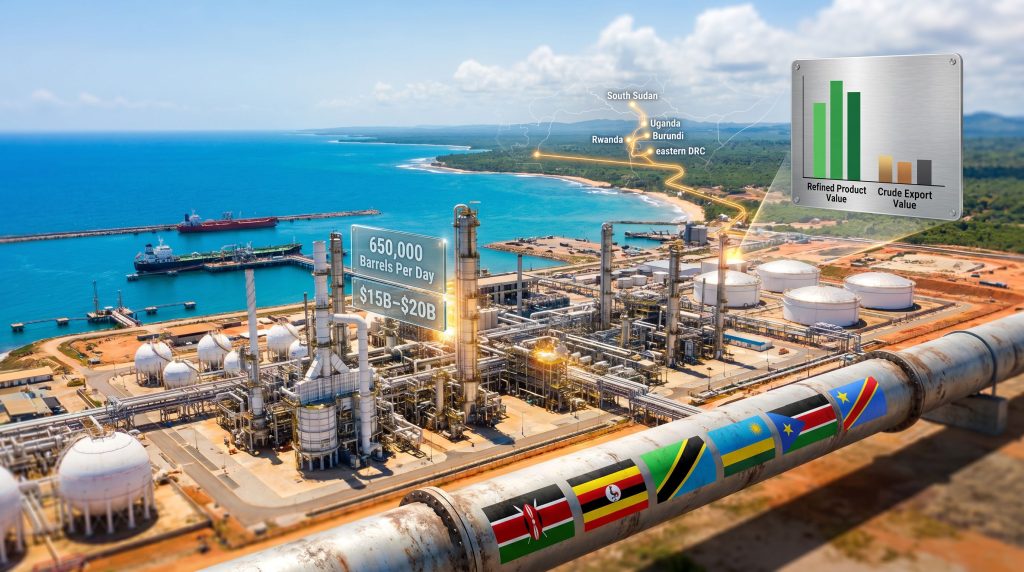
- Proposed investment range: $15 billion to $20 billion
- Estimated processing capacity: approximately 650,000 barrels per day
- Feedstock sources: Uganda, South Sudan, Tanzania, and the Democratic Republic of the Congo
- Markets served: Kenya, Uganda, Tanzania, Rwanda, South Sudan, Burundi, and parts of eastern DRC
- Project model: Regional shared facility rather than individual national refineries
The distinction between a regional shared refinery model and the conventional national refinery approach is more than a question of scale. It determines financing structure, political complexity, and long-term market reach in ways that fundamentally change the project's risk-return profile.
| Dimension | National Refinery Model | Regional Shared Refinery Model |
|---|---|---|
| Investment Scale | $2B to $5B | $15B to $20B |
| Feedstock Diversity | Single-country crude | Multi-country crude inputs |
| Market Served | Domestic only | 6 to 8 countries |
| Financing Structure | Sovereign debt / FDI | Blended: equity + syndicated debt |
| Political Complexity | Low to Medium | High (multi-government alignment) |
| Strategic Impact | National energy security | Regional industrial transformation |
The private sector dimension is critical. State-led refinery projects in Africa have a poor historical performance record, frequently plagued by cost overruns, delayed commissioning, and political interference in operational decisions. The active interest of Africa's most accomplished private industrial investor, whose $4 billion commitment to an Ethiopian fertilizer complex signals a pattern of large-scale continental ambition, introduces a different risk-management discipline to the project.
Kenya vs. Tanzania: A Location Decision With Continental Consequences
No aspect of the East African regional refinery project carries higher strategic stakes than the host country selection. The two primary candidate locations, Kenya's Mombasa corridor and Tanzania's Tanga port zone, each present a compelling but distinct case.
Why Kenya Holds the Infrastructure Advantage
Kenya's position as East Africa's dominant fuel import and logistics hub is not incidental. It is the product of decades of infrastructure investment that created a deeply integrated regional supply chain. The Port of Mombasa currently serves as the primary petroleum products entry point for Uganda, Rwanda, South Sudan, and eastern DRC.
The existing Kenya-Uganda pipeline system, fuel storage terminal networks, and road distribution infrastructure represent sunk capital that would be extraordinarily costly to replicate elsewhere. Technical evaluations conducted as part of the project feasibility process have reportedly placed Kenya first based on these existing infrastructure advantages.
The domestic anchor demand from Kenya's own fuel consumption base further strengthens the economic case, providing immediate utilisation for refinery output from day one of commissioning.
Tanzania's Strategic Counter-Argument
Tanzania is not a passive participant in this competition. The Tanga port zone has been actively positioned by Tanzanian leadership as a credible alternative, with pipeline connectivity proposals linking it to landlocked crude-producing nations including Uganda and South Sudan.
Tanzania's leverage as a potential crude transit corridor nation gives it genuine negotiating power, and its government has framed itself as a co-equal partner in the regional conversation rather than an observer. Tanzania's President Samia Suulu Hassan has directly engaged with the project's key private investor, signalling Dar es Salaam's serious intent to secure hosting rights for what could become the country's most transformative industrial facility.
Three Scenarios for the Location Decision
Scenario A: Kenya Selected – Mombasa consolidates its position as East Africa's refining and distribution capital. Kenya's logistics dominance deepens. Tanzania faces a significant redirection of long-term infrastructure investment away from its northern corridor.
Scenario B: Tanzania Selected – Tanga emerges as a new continental energy corridor anchor. Tanzania captures long-term refining, storage, and transit revenues. Kenya must adapt its supply chain model to a fundamentally redistributed regional energy architecture.
Scenario C: Phased Hybrid Model – Political compromise enables a staged approach where initial refining capacity is built at one location while pipeline and distribution infrastructure connects both countries. This structure broadens financing participation but adds coordination complexity.
Uganda's Dual-Track Energy Strategy
Uganda's position within the East African regional refinery project is complicated by its own longstanding domestic ambitions. The Hoima refinery development program, anchored by Uganda's confirmed oil reserves in the Albertine Graben, has been an active policy priority for years.
Ugandan President Yoweri Museveni has publicly stated that participation in the regional initiative does not require abandoning the national Hoima facility, framing the two tracks as complementary rather than competing priorities. Museveni's underlying economic philosophy is consistent and clearly articulated. He has argued for years that exporting raw crude oil without domestic processing effectively transfers Uganda's natural resource wealth to foreign entities who capture the value of finished products.
Uganda's crude reserves also give it tangible supply-side leverage in regional negotiations. Its participation in the refinery as both a feedstock contributor and an equity partner changes its bargaining position on offtake agreements, pipeline access rights, and ownership structures in ways that pure consumer nations cannot replicate.
However, the public announcement of Museveni's endorsement drew pointed criticism from segments of Ugandan civil society, who noted the absence of disclosed equity terms and questioned how Uganda's ownership stake in the venture would be structured and protected. These transparency concerns are not peripheral, as they directly affect the project's ability to attract institutional financing.
Financing $15 to $20 Billion: Why a New Funding Architecture Is Required
No single government in East Africa, and few sovereign wealth structures on the continent, can anchor financing at this scale. The project requires a blended capital structure that distributes risk across multiple participant categories. In addition, OPEC's influence on oil supply and pricing creates further complexity for long-term revenue modelling underpinning any financing framework.
| Financing Layer | Likely Contributors | Estimated Share |
|---|---|---|
| Private Equity | Lead industrial investor + co-investors | 25 to 35% |
| Syndicated Commercial Debt | Regional and international banks | 30 to 40% |
| Multilateral Development Finance | AfDB, IFC, Afreximbank | 15 to 25% |
| Sovereign Equity Contributions | Participating governments | 10 to 20% |
Multilateral development bank participation is not optional at this scale. It is structurally necessary for two reasons: the financing quantum exceeds commercial bank appetite for single-project African infrastructure exposure, and multilateral participation provides the governance signalling that institutional equity investors require before committing capital.
Risk Flag: African infrastructure mega-projects have historically experienced cost overruns of 40 to 80% above initial estimates in environments where governance frameworks were established after financial close rather than before. Transparent equity structures, independent audit mechanisms, and parliamentary oversight are prerequisites for institutional financing participation, not post-commissioning amenities.
The absence of publicly disclosed equity term sheets has already generated meaningful scepticism among financial analysts and civil society observers. This is not a reputational concern alone. Undisclosed equity structures are a practical barrier to multilateral financing commitments, since institutions like the African Development Bank and IFC require transparent ownership frameworks as a condition of credit committee approval.
Furthermore, the trade war impact on oil markets adds another layer of uncertainty to the revenue assumptions that underpin the project's financial model, complicating long-term offtake pricing agreements between participating governments and private investors.
The next major ASX story will hit our subscribers first
The Economic Multiplier Case: What Successful Commissioning Would Deliver
The direct energy security benefits of the East African regional refinery project are well understood. Less discussed, however, are the second and third-order economic effects that would accompany a functioning regional refinery at this scale.
Energy Security Transformation
- Reduction in import dependency, with modelling suggesting 60 to 70% of regional refined fuel demand could be met domestically within a decade of commissioning
- Structural insulation from Middle Eastern supply chain disruptions and global tanker freight cost volatility
- Strategic fuel reserve capacity enabled by domestic refining infrastructure
Industrial Multiplier Effects
- Direct construction-phase employment estimated at 10,000 to 15,000 direct jobs, with a broader indirect employment multiplier across logistics, services, and materials supply chains
- Downstream petrochemical industry development potential spanning plastics, fertilisers, lubricants, and specialty chemicals
- Industrial zone development anchored by the refinery's location, creating concentrated economic activity around the host port city
Trade Balance Improvement
Landlocked nations including Uganda, Rwanda, and South Sudan carry persistent current account deficits driven significantly by refined fuel import costs. Domestic refining capacity at the scale proposed would materially reduce annual foreign exchange outflows across all participating nations, strengthening currency stability and expanding fiscal headroom for development spending.
Governance and Political Risk: The Variables That Override Everything Else
The East African Community's track record on multi-government infrastructure coordination is mixed at best. The Standard Gauge Railway experience demonstrated both the transformative potential and the execution vulnerabilities of cross-border infrastructure commitments in the region, including cost overruns, debt sustainability concerns, and disputes over utilisation obligations.
The East African regional refinery project faces analogous governance pressures at a larger scale and with more complex equity structures. The domestic political economy in several participating nations creates resistance from incumbent fuel importers, logistics companies, and downstream distributors whose business models depend on the current fragmented supply chain.
These interests are not merely academic obstacles. They are politically connected stakeholders with strong incentives to delay, dilute, or redirect the project. Community benefit agreements, environmental impact assessment processes, and transparent revenue-sharing frameworks between host governments and affected populations represent governance requirements that must be established before financial close, not negotiated under construction-phase time pressure.
The AfCFTA Connection: Refining as a Continental Integration Signal
The East African regional refinery project does not exist in isolation from the broader pan-African economic integration agenda. The African Continental Free Trade Area explicitly identifies energy and industrial infrastructure as foundational enablers of intra-African trade growth. A functioning regional refinery serving six to eight East African markets would represent one of the most concrete expressions of AfCFTA's industrial development objectives yet attempted.
The precedent it sets, or fails to set, carries weight beyond East Africa. North African refining capacity is relatively developed. West Africa is navigating its own downstream transformation. East Africa's ability to execute a cross-border energy infrastructure project at this scale would signal to international capital markets that the continent's regional integration frameworks can support large-scale private and blended-finance industrial commitments. A coherent resource development strategy at the national level, as demonstrated in other resource-rich contexts, reinforces how decisive policy frameworks can unlock private capital at scale.
Frequently Asked Questions: East African Regional Refinery Project
What is the proposed capacity of the East African regional refinery?
The project is being discussed at an estimated processing capacity of approximately 650,000 barrels per day, which would make it one of the largest refining facilities on the African continent.
Where will the East African regional refinery be located?
As of mid-2026, no final public decision has been announced. Kenya's Mombasa corridor and Tanzania's Tanga port zone remain the two primary candidate sites, with technical assessments reportedly favouring Kenya based on existing infrastructure advantages.
How much will the East African regional refinery cost?
Investment estimates range from $15 billion to $20 billion, requiring a blended financing structure combining private equity, multilateral development finance, syndicated commercial debt, and sovereign equity contributions.
Is Uganda building its own separate refinery at Hoima?
Yes. Uganda's domestic Hoima refinery development program remains active. Ugandan leadership has stated publicly that participation in the regional project does not preclude continued development of the national Hoima facility.
What are the biggest risks facing the East African regional refinery project?
The primary risk factors include multi-government political alignment challenges, financing complexity at the $15 to $20 billion scale, governance and transparency concerns regarding equity structure disclosure, and competing national refinery priorities that could fracture regional consensus.
Three Pathways Forward: Scenario Modelling the Project's Future
Scenario 1: Full Regional Alignment (Optimistic Case)
- Timeline: Financial close within 24 to 36 months; construction commencing 2028; first production 2032 to 2033
- Conditions required: Host country selected within 12 months; equity terms publicly disclosed; multilateral financing commitments secured
- Outcome: East Africa reduces refined fuel import dependency by over 60% within a decade of commissioning; the project becomes the continent's defining downstream energy infrastructure benchmark
Scenario 2: Partial Progress (Base Case)
- Timeline: Location decision delayed 18 to 24 months; financing negotiations extend the project timeline significantly
- Conditions: One or two governments withdraw from the regional model and pursue national alternatives; project scale reduced to 300,000 to 400,000 barrels per day
- Outcome: Partial energy security improvement achieved but the full multiplier effects of regional integration remain unrealised
Scenario 3: Project Collapse (Downside Case)
- Timeline: Political fragmentation, financing failure, or governance disputes cause indefinite suspension within 36 months
- Conditions: Competing national refinery priorities fracture regional consensus; institutional investors withdraw citing unresolved governance risk
- Outcome: East Africa continues importing refined fuel; individual nations pursue smaller, less efficient national facilities at higher per-barrel cost
The window for regional consensus is narrower than it appears. Every year of delay compounds the economic cost of continued import dependency while allowing the political conditions that enable regional alignment to erode as national electoral cycles and bilateral disputes reshape the diplomatic landscape.
The next 24 months — specifically the host country selection decision, the first public disclosure of equity terms, and the initial financing commitment from a multilateral institution — will signal which of these three scenarios is most likely to materialise. For now, the East African regional refinery project remains what it has been for several years: the region's most consequential infrastructure ambition, still searching for the governance architecture it needs to become a reality.
This article contains forward-looking analysis and scenario projections based on publicly available information as of mid-2026. Readers should note that infrastructure projects of this scale are subject to significant financing, political, and execution risks. Nothing in this article constitutes investment advice.
Want to Catch the Next Major Resource Discovery Before the Market Does?
The East African refinery project highlights how transformative resource infrastructure can reshape commodity markets and investor returns — and Discovery Alert's proprietary Discovery IQ model delivers real-time ASX mineral discovery alerts, turning complex resource data into actionable opportunities the moment they are announced. Explore Discovery Alert's dedicated discoveries page to understand how historic finds have generated substantial returns, and begin your 14-day free trial today to position yourself ahead of the broader market.