May 18, 2026
The World's Most Consequential 33 Kilometres
Energy markets run on confidence as much as they run on crude. When that confidence fractures, the tremors spread far beyond trading floors, reaching household fuel bills, central bank inflation models, and the foreign policy calculations of every major economy on earth. Few geographic features have the capacity to shatter that confidence quite like the Strait of Hormuz, a narrow passage barely 33 kilometres wide at its tightest point, wedged between Iran and Oman at the mouth of the Persian Gulf.
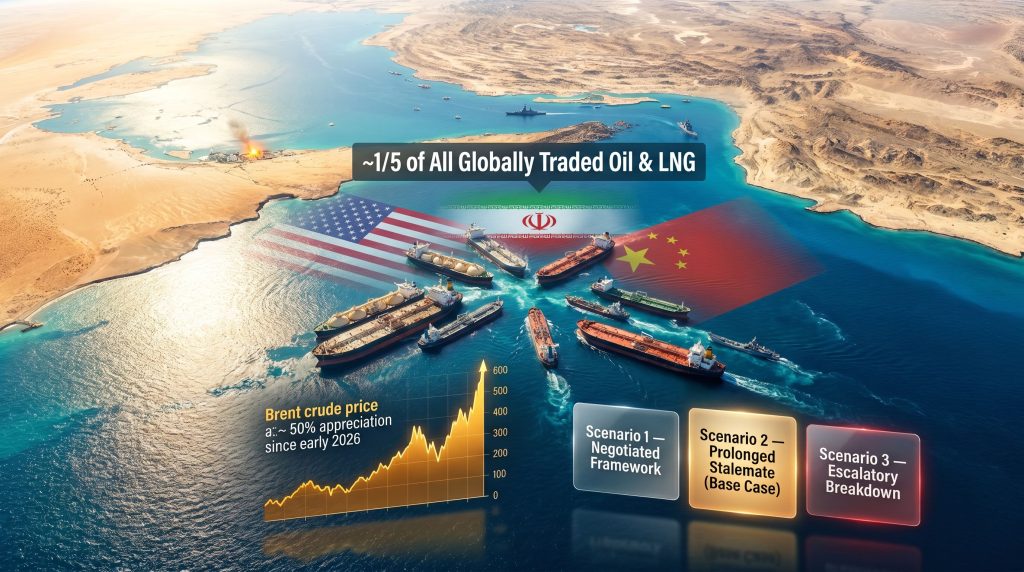
Roughly one-fifth of all globally traded oil and liquefied natural gas moves through this corridor every single day. That concentration of energy flow through such a geographically constrained passage creates what strategic analysts describe as an asymmetric leverage dynamic: a small actor controlling a small piece of territory can impose enormous costs on the global economy, costs that vastly exceed the military or economic weight of that actor considered in isolation.
Historical episodes reinforce this reality. During the Tanker War of the 1980s, Iranian mining and attacks on commercial vessels sent freight insurance premiums soaring and prompted the United States to reflag Kuwaiti tankers under the American flag to provide naval protection. The economic consequences of even partial disruption proved disproportionate to the size of the military operations involved. The current standoff, now well into 2026, is tracking a similar logic but with considerably greater complexity.
When big ASX news breaks, our subscribers know first
Three Simultaneous Pressure Systems
What distinguishes the current US Iran Hormuz deal impasse from prior confrontations is the simultaneous operation of three distinct but deeply interconnected pressure systems. Understanding why resolution has proven so difficult requires mapping each of these systems separately before examining how they interact. Furthermore, the oil price shock implications extend well beyond regional boundaries, affecting every economy dependent on stable energy supply.
The first system involves military posturing and maritime access. US naval restrictions near Iranian ports have sharply curtailed commercial traffic through the strait. Iranian threats against commercial shipping have compounded this effect. The result is a dramatic reduction in Hormuz transit volume, with global energy supply chains absorbing the disruption through elevated prices and rerouting costs.
The second system is sanctions architecture and enforcement. Washington has deployed economic pressure across multiple dimensions, targeting Iran's oil revenues while simultaneously threatening secondary sanctions against third-country entities that continue purchasing Iranian crude. This creates a coercive economic framework designed to force concessions.
The third system is nuclear non-proliferation negotiation. Iran's enriched uranium stockpile and the future of its nuclear infrastructure sit at the centre of any comprehensive settlement. These demands carry timelines, verification requirements, and red lines that operate on a fundamentally different logic from maritime access agreements.
These three systems do not resolve on the same schedule or through the same mechanisms. A maritime ceasefire does not automatically produce a nuclear agreement, and a sanctions relief package does not guarantee Iranian compliance with enrichment limits. Each track creates its own obstacles, its own domestic political constraints, and its own opportunities for spoiler actors to derail progress.
What Each Side Is Actually Demanding
Washington's Position
The US negotiating posture treats sanctions relief as a conditional instrument rather than an opening gesture of goodwill. American demands centre on meaningful reductions to Iran's enriched uranium stockpile, limitations on nuclear infrastructure, and broader postwar settlement conditions that extend well beyond simple Hormuz transit rights. The underlying logic is that any agreement that reopens the strait without addressing the nuclear dimension simply resets the confrontation at a lower level of tension without resolving its structural causes.
US naval restrictions near Iranian ports serve as a parallel pressure mechanism, designed to impose immediate economic costs on Tehran while diplomacy proceeds. President Trump's public signalling in mid-May 2026 reinforced this posture, with social media warnings directed at Iranian leadership emphasising the urgency of a decision and the consequences of further delay. However, the trade war oil markets dynamic adds a further layer of complexity to Washington's leverage calculus.
Tehran's Calculus
Iranian state-affiliated media reported in mid-May 2026 that Tehran has rejected several US demand packages, with disagreements spanning sanctions relief sequencing, nuclear material disposition, and postwar conditions. Iran's strategic posture treats Hormuz access as leverage to be preserved rather than a concession to be offered.
Crucially, Iranian authorities have been developing a framework that would allow selected commercial vessels to transit Hormuz under controlled conditions. This partial opening signals tactical flexibility but falls well short of the full, unrestricted access that Washington is demanding. It reflects Tehran's preference for managed de-escalation on its own terms, preserving strategic optionality rather than accepting a comprehensive settlement.
The Gap in Numbers
| Negotiation Variable | US Position | Iran's Reported Stance | Gap Assessment |
|---|---|---|---|
| Sanctions Relief Sequencing | Conditional on nuclear concessions | Demands upfront relief | Wide |
| Enriched Uranium Stockpile | Significant reduction required | Retention as deterrent | Critical |
| Hormuz Commercial Transit | Full, unrestricted reopening | Controlled, selective access | Moderate |
| Nuclear Infrastructure | Dismantlement of key facilities | Preservation of civilian programme | Wide |
| Chinese Crude Purchases | Secondary sanctions on buyers | Opposed by Beijing and Tehran | Triangulated |
How Markets Are Responding
Brent crude has climbed approximately 50% since the conflict began earlier in 2026, a price appreciation that reflects sustained market concern about the durability of Hormuz transit and the risk of further escalatory incidents. This is not a short-term spike driven by a single event. It represents the accumulation of risk premium across months of uncertainty, compounded by each new incident or diplomatic failure.
Energy traders are currently navigating a complex pricing environment that requires them to simultaneously model two very different scenarios: a diplomatic breakthrough that could rapidly deflate the risk premium, and a further deterioration that could drive prices materially higher. This bifurcated pricing environment is reflected in elevated options market volatility and wide bid-ask spreads on Gulf-origin crude cargo.
Economies Most Exposed to Prolonged Disruption
-
Japan and South Korea import the overwhelming majority of their crude and LNG from Gulf producers, with limited ability to substitute at short notice. A sustained Hormuz closure would force emergency drawdowns of strategic petroleum reserves and accelerate LNG spot market competition.
-
India is simultaneously a significant Iranian crude customer and a major Gulf LNG importer. Its exposure is compounded by currency vulnerability to oil price shocks.
-
China maintains the largest absolute exposure by volume. Beijing's opposition to US secondary sanctions stems partly from self-interest as Iran's largest crude customer, but also reflects broader strategic resistance to extraterritorial US economic jurisdiction.
-
European energy markets, having restructured supply chains away from Russian sources since 2022, have increased their reliance on Middle Eastern LNG. A prolonged Hormuz disruption would reintroduce supply uncertainty into a system that has not fully stabilised.
-
Emerging market economies across South Asia and Africa face compounding inflation risk from elevated oil prices, with limited fiscal capacity to absorb the shock through subsidies or monetary intervention.
Analysts note that the longer the Hormuz disruption persists, the greater the probability that secondary inflation effects, including elevated borrowing costs and reduced consumer purchasing power, begin compounding across both developed and emerging economies simultaneously.
The China Variable
No analysis of the US Iran Hormuz deal impasse is complete without a thorough examination of China's role, because Beijing functions as both a direct participant in the economic architecture sustaining Iran and a geopolitical counterweight limiting Washington's coercive options. In addition, the broader US-China trade tensions create a structurally fraught backdrop against which any secondary sanctions decision must be evaluated.
China is Iran's largest crude oil customer by a significant margin. This purchasing relationship provides Tehran with economic insulation against the full force of US sanctions, creating a backstop that reduces the urgency Iran feels to make concessions at the negotiating table. Remove that backstop and Iran's cost-benefit calculation around the current deadlock changes materially.
Washington has been actively considering secondary sanctions targeting Chinese firms involved in Iranian crude transactions. Trump confirmed in mid-May 2026 that he discussed this issue with Chinese President Xi Jinping and indicated a decision on sanctions relief was expected within days.
The dilemma this creates for Washington is significant. Imposing secondary sanctions on Chinese buyers risks escalating bilateral friction at a moment when both sides are managing a fragile economic relationship. Beijing has consistently and publicly opposed US extraterritorial sanctions jurisdiction, and compliance cannot be assumed.
If Washington proceeds with secondary sanctions on Chinese crude buyers, Beijing faces a binary choice: absorb an energy supply disruption by complying, or defy the sanctions and accept the diplomatic and economic cost of doing so. Neither outcome is clean, and both introduce additional variables into an already structurally complex Hormuz negotiation.
The Barakah Incident and Escalation Risk
On the security dimension, a drone strike in mid-May 2026 caused a fire at an electrical generator located near the Barakah nuclear power plant in the UAE. UAE authorities confirmed no injuries and no radiological hazard. The International Atomic Energy Agency independently verified that radiation levels at the facility remained within normal parameters. Two additional drones were intercepted before reaching their targets, and an investigation into the origin of the attack was underway as of mid-May 2026.
The incident carries significance beyond its immediate physical consequences. Strikes on or near nuclear infrastructure, even when they cause no radiological damage, recalibrate risk assessments across the entire Gulf region. Shipping insurers revise underwriting models. Energy companies reassess evacuation protocols. Government security agencies elevate threat classifications for regional assets.
Even without official attribution, the Barakah incident illustrates the persistent risk of miscalculation in a theatre where multiple armed actors are operating with overlapping objectives and limited deconfliction mechanisms. Consequently, the broader geopolitical risk landscape for commodity markets has shifted materially in response to these events.
The next major ASX story will hit our subscribers first
Deterrence Architecture: What Washington Is Maintaining
| Strategic Instrument | Current Status | Effectiveness Assessment |
|---|---|---|
| US Naval Presence in Gulf | Active and elevated | High deterrence value, limited compellence capacity |
| Port Restriction Enforcement | Ongoing near Iranian waters | Creates pressure but not resolution |
| Secondary Sanctions Threat | Under active consideration | Uncertain, depends on Chinese compliance |
| Diplomatic Backchannel | Reported but stalled | Low effectiveness, significant gaps remain |
| Multilateral Coalition Building | Limited engagement | Nascent, Gulf states proceeding cautiously |
Defence analysts broadly agree that while US forces possess the capability to suppress Iran's maritime interdiction assets in the short term, sustaining open passage indefinitely through military force alone is not a viable strategic framework. A durable solution requires removing Iran's incentive to threaten shipping, which demands a negotiated settlement rather than simply degrading Tehran's operational capacity temporarily.
The Domestic Political Dimension
The White House faces a compounding political problem. Elevated oil prices translate directly into domestic fuel costs, a metric that American voters notice and respond to with speed. With US midterm elections approaching later in 2026, the administration faces pressure to demonstrate either diplomatic progress on Hormuz or a credible pathway to energy market stabilisation.
This timeline dynamic cuts in multiple directions simultaneously. It creates urgency for Washington to reach an agreement, which could reduce negotiating leverage. It also creates an incentive for Tehran to delay, calculating that domestic US political pressure may eventually soften the American negotiating position.
Trump's public social media warnings directed at Iran serve multiple audiences at once: domestic voters who want to see decisive presidential posture, Gulf allies who need reassurance of American commitment, and Iranian negotiators who need to understand the consequences of continued deadlock. The challenge is that rhetorical escalation, if sustained without diplomatic progress, carries the risk of narrowing the political space for compromise on both sides. Furthermore, the safe-haven price response across precious metals markets reflects this growing investor uncertainty.
Three Scenarios for Resolution
Scenario 1: Negotiated Framework Agreement
For a comprehensive agreement to materialise, Iran would need to accept phased reductions in its enriched uranium stockpile, the US would need to provide conditional and sequenced sanctions relief, and China would need to reduce Iranian crude purchases in exchange for some form of diplomatic accommodation. Market impact under this scenario would likely include a Brent crude correction of 20 to 30% from current elevated levels, normalisation of LNG freight premiums, and a significant reduction in Gulf shipping insurance costs.
In the near term, this outcome carries a low probability. Over a six-month horizon, it becomes more plausible if both sides begin perceiving the cost of continued deadlock as exceeding the cost of compromise. Bloomberg's ongoing coverage of US-Iran negotiations provides useful real-time insight into how these talks are progressing.
Scenario 2: Prolonged Stalemate with Managed Partial Access
This is the base case that energy markets are currently pricing. Neither side makes material concessions. Iran's controlled transit framework becomes a de facto operational norm, allowing limited vessel traffic while preserving Tehran's leverage. Oil prices remain elevated but range-bound. Supply chains adapt, but at higher cost structures that embed inflation across multiple sectors. This scenario is the most probable outcome through the third quarter of 2026.
Scenario 3: Escalatory Breakdown
A miscalculation, whether a military incident, an additional infrastructure strike with greater consequences, or a sanctions overreach that produces a retaliatory Iranian response, triggers a full Hormuz closure. Under this scenario, oil prices would spike materially beyond current levels, Asian importers would face an LNG supply emergency, and global recessionary pressure would intensify substantially. This outcome carries a low but non-negligible probability, as the Barakah drone incident illustrates.
Energy market participants are currently pricing Scenario 2 as the base case, with options markets reflecting a meaningful probability weighting toward Scenario 3. A Scenario 1 resolution would represent a substantial positive supply-side shock to global energy markets and would likely produce one of the sharpest crude price corrections seen in years.
Key Indicators to Watch
Investors and market participants tracking the US Iran Hormuz deal should monitor several distinct signal categories:
Diplomatic and political signals:
- Presidential decisions on secondary sanctions against Chinese crude buyers, expected within days of mid-May 2026
- Any resumption or breakdown of formal US-Iran negotiating sessions
- Gulf Cooperation Council positioning on a potential multilateral maritime security framework
Market and operational indicators:
- Brent crude price trajectory relative to the roughly 50% appreciation established since conflict onset
- Shipping insurance premium movements for Gulf-origin cargo
- LNG spot price differentials between Gulf-origin and alternative supply routes
- Hormuz vessel transit volume data from maritime tracking services
Security and escalation markers:
- Attribution findings from the Barakah drone strike investigation
- US naval activity levels and any changes to force disposition in the Gulf
- Iranian statements regarding the controlled transit framework and its operational parameters
Why Resolution Is Difficult but Not Structurally Impossible
The structural case for continued deadlock is genuine. The gap between US demands and Iranian red lines spans multiple negotiating dimensions simultaneously. China's role as an economic backstop for Tehran reduces the urgency Tehran feels to make concessions. Domestic political constraints on both sides limit negotiators' room to offer meaningful compromises. Furthermore, The Hill's analysis of the Hormuz negotiations highlights just how entrenched these positions have become.
Yet the structural case for eventual resolution also has substance. Both parties face mounting costs from prolonged deadlock. Iran endures economic isolation and sanctions pressure. The United States absorbs elevated domestic energy prices and the political consequences of visible diplomatic failure. The existence of Iran's partial transit framework demonstrates that Tehran recognises the value of a managed de-escalation pathway and is not committed to permanent closure.
Historical precedent from prior US-Iran negotiations, including the 2015 Joint Comprehensive Plan of Action, demonstrates that agreements are achievable when both parties reach the threshold where the cost of non-agreement clearly exceeds the cost of compromise. The critical and unresolved question in mid-2026 is whether either side has yet crossed that threshold.
A genuine US Iran Hormuz deal, if it eventually materialises, will not be a simple maritime access agreement. It will represent a partial resolution of a multi-dimensional geopolitical contest involving nuclear non-proliferation, sanctions architecture, great power competition between Washington and Beijing, and the long-term structure of global energy security. The pathway exists. The political will to walk it remains the central, unanswered variable.
This article contains forward-looking analysis, scenario modelling, and market assessments that reflect conditions as of mid-May 2026. Geopolitical situations evolve rapidly and this content should not be interpreted as financial, investment, or strategic advice. Readers should conduct their own due diligence before making decisions based on the information presented here.
Want to Stay Ahead of the Market Moves Driven by Geopolitical Shocks Like the Hormuz Crisis?
Discovery Alert's proprietary Discovery IQ model delivers real-time alerts on significant ASX mineral discoveries, instantly translating complex market data into actionable opportunities — ensuring subscribers are positioned ahead of the broader market during periods of elevated commodity volatility. Explore how historic mineral discoveries have generated substantial returns and begin your 14-day free trial today to secure your market-leading advantage.