August 11, 2026
The Purification Bottleneck That Quietly Controls the Battery Industry
Before a single kilowatt-hour of energy flows through an electric vehicle, the carbon that lines its battery anode must pass through one of the most chemically aggressive industrial processes in modern manufacturing. Graphite purification, the step that transforms raw flake graphite into the ultra-pure anode material that lithium-ion batteries demand, has for decades been dominated by a single reagent: hydrofluoric acid. Understanding why this matters, and why the industry is urgently searching for alternatives, is the lens through which the significance of securing an EcoGraf patent in India for HFfree graphite purification comes sharply into focus.
Hydrofluoric acid is extraordinarily effective at dissolving silicate impurities from graphite. It is also one of the most hazardous industrial substances in widespread commercial use. It penetrates skin rapidly, attacks bone tissue, and generates waste streams that pose serious risks to soil and groundwater systems. The countries and jurisdictions now building battery supply chains outside of China face a structural problem: replicating Chinese-style HF-based processing infrastructure would require either accepting those environmental and regulatory liabilities, or finding a fundamentally different technological pathway.
That technological choice is now becoming a defining competitive variable across the battery materials sector.
When big ASX news breaks, our subscribers know first
Why China's Processing Dominance Creates a Systemic Risk
China's position in the global battery graphite supply chain extends well beyond mining. The country accounts for an estimated 70 to 80 percent of global natural graphite processing capacity, according to industry assessments, with the purification stage representing the highest-value step in converting raw flake graphite into spherical purified graphite, the form used in lithium-ion battery anodes. This concentration creates a single point of failure for any battery manufacturer, EV producer, or energy storage developer operating outside China's industrial ecosystem.
The risk is not theoretical. Beginning in 2023, Chinese authorities introduced export licensing requirements for certain graphite products, citing dual-use concerns. These measures sent a clear signal to battery supply chain planners in the EU, United States, Japan, South Korea, and India: dependence on Chinese graphite processing carries geopolitical exposure that commercial risk models had previously underweighted. Furthermore, the global graphite shortage has added urgency to finding sustainable, non-Chinese processing alternatives.
The Regulatory Frameworks Adding Structural Pressure
Western and allied governments have responded by embedding supply chain diversification requirements directly into industrial policy:
- The EU Critical Raw Materials Act (CRMA), which came into force in 2024, sets explicit benchmarks for domestic processing and sourcing diversification of strategic raw materials, including graphite
- The US Inflation Reduction Act (IRA) links electric vehicle tax credits to the sourcing of battery materials from domestic producers or free trade agreement partners, creating a financial disincentive for Chinese-processed inputs
- The EU Battery Regulation, phasing in requirements from 2024 onward, mandates carbon footprint declarations and supply chain due diligence for industrial and EV batteries, areas where HF-free processing carries measurable advantages
- India's Production-Linked Incentive (PLI) scheme for Advanced Chemistry Cells provides capital subsidies for domestic battery manufacturing capacity, creating structural demand for locally processed, high-purity anode materials
These frameworks collectively create a market architecture in which non-Chinese, environmentally compliant graphite processing is not merely preferable but increasingly a commercial prerequisite.
India as the Next Frontier for Battery Anode Demand
India occupies a unique position in the global battery materials landscape. It is simultaneously a large and fast-growing EV market, an emerging battery manufacturing hub, and a country without established domestic graphite purification infrastructure. This combination makes it one of the most strategically important jurisdictions for companies holding alternative processing technologies.
India's electrification ambitions are anchored by successive policy frameworks including the FAME scheme, which has driven two-wheeler and three-wheeler EV adoption at scale, and the broader push toward domestic battery cell manufacturing under the PLI scheme for Advanced Chemistry Cells. The broader India battery materials buildout illustrates just how rapidly the country is developing its battery supply chain infrastructure. Battery manufacturers operating within the PLI framework face incentive structures that reward domestic sourcing and processing, creating pull-through demand for technology that can be licensed or deployed within India's borders.
The absence of a domestic HF-free graphite processing capability means India currently imports or relies on Chinese-processed anode materials. Whoever establishes enforceable intellectual property in this space before large-scale domestic manufacturing comes online holds a structurally advantaged negotiating position.
This is precisely the context in which the EcoGraf patent in India for HFfree graphite purification carries significance beyond a standard IP milestone.
How the HFfree® Process Actually Works
The technical architecture of the HFfree® process represents a meaningful departure from conventional graphite purification. Where Chinese facilities rely on hydrofluoric acid to strip silicate and other mineral impurities from raw graphite flakes, the HFfree® approach employs a multi-stage chemical pathway using commercially available, lower-hazard reagents, including controlled caustic leaching steps and sequential washing cycles.
The chemistry targets the same impurity removal objective but through reagents that carry substantially lower occupational health risk profiles, more manageable waste treatment obligations, and significantly reduced environmental liability. For a battery manufacturer or EV OEM conducting supply chain due diligence, this difference is increasingly material. In addition, cleaner processing technologies are gaining traction across multiple battery material classes as the industry moves away from hazardous reagents.
Purity Levels and Performance Benchmarks
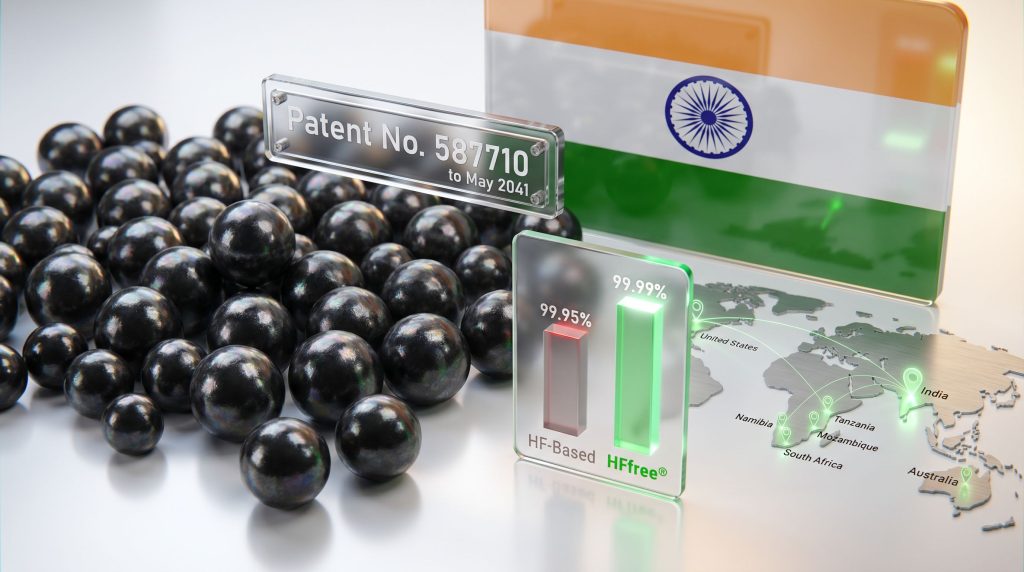
Performance is the non-negotiable qualification for any battery anode material. The HFfree® process achieves carbon purity levels of 99.95% or higher, with Product Qualification Facility testwork confirming results reaching 99.99% purity in operational campaigns. To contextualise these figures:
| Purity Level | Application Suitability |
|---|---|
| Below 99.90% | Generally insufficient for lithium-ion battery anodes |
| 99.90% to 99.95% | Minimum threshold range for most commercial battery chemistries |
| 99.95% to 99.99% | Standard specification for premium battery anode material |
| 99.99%+ | Exceeds baseline specification; suitable for high-performance and next-generation cell chemistries |
The HFfree® process consistently operates in the upper range of this table, meeting or exceeding the purity thresholds demanded by leading lithium-ion battery producers.
Three Application Domains Within a Single Technology
One underappreciated aspect of the HFfree® framework is its versatility across distinct processing contexts:
- Natural flake graphite to battery anode material: The primary commercial pathway, converting mined graphite into spherical purified graphite (SPG) suitable for lithium-ion battery anodes
- High-purity specialty graphite: Covering industrial and technical applications where consistent ultra-high purity is required, including electronics, aerospace components, and advanced manufacturing
- Lithium-ion battery anode recycling: Enabling the recovery and re-purification of graphite from end-of-life battery cells, positioning the technology within the circular economy for battery materials
This third domain is particularly forward-looking. As battery recycling regulations tighten across the EU and increasingly in Asia, the ability to process recovered graphite through the same HF-free pathway creates a closed-loop value proposition that few competing technologies currently offer. Indeed, the recent battery recycling breakthrough in China demonstrates how seriously major players are investing in end-of-life battery material recovery.
What Patent No. 587710 Actually Protects
The Indian Patent Office has formally granted Patent No. 587710 to EcoGraf Limited, covering the HFfree® graphite purification technology with a term extending to May 2041. This represents approximately two decades of legally enforceable commercial exclusivity within the Indian jurisdiction.
The protection is substantive rather than symbolic. Under India's Patents Act 1970 and its subsequent amendments, a granted patent provides enforceable exclusivity against:
- Domestic manufacturers operating a substantially similar process without a licence
- Importers of products manufactured using the protected process in other jurisdictions
- Joint venture partners or technology licensees who might seek to operate outside agreed terms
Why Timing Matters More Than It Appears
There is a strategic logic to securing IP protection in a market before that market reaches commercial scale. Once India's battery manufacturing sector matures under the PLI scheme, the number of potential licensees, joint venture candidates, and competing technology providers will increase substantially. Any company seeking to establish IP protection at that stage would face higher prosecution costs, more crowded prior art landscapes, and a weaker negotiating position with prospective partners.
By securing the EcoGraf patent in India for HFfree graphite purification now, the company effectively locks in its legal standing at a point when the commercial stakes are still being defined, not after they have already been captured by others.
Mapping the Global Patent Architecture
The India grant is one component of a systematically constructed, multi-jurisdictional intellectual property portfolio. EcoGraf's approach reflects a deliberate strategy of mirroring patent coverage to the geographic footprint of the global battery supply chain, protecting the technology at both the point of raw material production and the point of downstream manufacturing.
First Patent Family: Granted and Accepted Jurisdictions
| Jurisdiction | Status |
|---|---|
| Australia | Granted |
| United States | Granted |
| South Africa | Granted / Accepted |
| Tanzania | Granted / Accepted |
| Mozambique | Granted / Accepted |
| Namibia | Granted / Accepted |
| India | Granted (Patent No. 587710, term to May 2041) |
First Patent Family: Applications in Progress
| Jurisdiction | Status |
|---|---|
| Europe | Pending |
| Malaysia | Pending |
| South Korea | Pending |
The Second and Third Patent Families
Beyond the first patent family, EcoGraf has secured a grant in Australia for a second patent family covering iterative refinements to the core HFfree® process, with a corresponding application filed in Canada. A third patent application has been lodged to address further technical advancements, indicating an active research and development pipeline that continuously extends the technology's legal moat.
This three-family architecture deserves attention from both a legal and competitive intelligence perspective. Multi-family patent structures create layered protection: even if a competitor successfully designs around the claims of one patent family, the subsequent families covering process improvements maintain the barrier. Each new family also resets the protection timeline for the refined iterations, meaning the overall IP position strengthens rather than simply ageing toward expiry.
The geographic breadth of this portfolio is not accidental. Filing across major graphite-producing nations in Africa simultaneously with key consuming and processing jurisdictions in North America, Europe, and Asia reflects a full value-chain IP strategy, one that protects the technology wherever it might be deployed or infringed.
The next major ASX story will hit our subscribers first
From Mine to Purification: The Vertical Integration Model
EcoGraf's commercial strategy extends beyond technology licensing into physical asset development. The company is building a vertically integrated supply chain anchored at the upstream end by the Epanko Graphite Project in Tanzania, a natural flake graphite mining operation that provides the raw material feedstock for purification facilities.
NMB Bank's on-site programme activity at the Epanko project has been cited as a sign of advancing project finance discussions, a prerequisite for construction commencement. At the downstream end, the company has articulated plans for regional purification hubs across North America, Europe, and the Asia-Pacific region, designed to process graphite close to end-use battery manufacturing centres rather than shipping processed material across long supply chains.
The patent portfolio is the legal infrastructure that makes this model commercially viable. Without enforceable IP protection in each jurisdiction where a purification hub might operate or where a licensing partner might be located, the technology itself would be exposed to replication by local competitors at significantly lower capital cost.
What a Technology Licensing Arrangement in India Could Look Like
For investors and industry participants seeking to understand the commercial mechanics, a technology licensing arrangement with an Indian Advanced Chemistry Cell manufacturer under the PLI scheme could involve several components working together:
- An upfront technology access fee reflecting the value of the patent protection and process know-how
- Ongoing royalty payments structured per tonne of battery-grade graphite produced using the licensed process
- A preferred supplier arrangement for spherical purified graphite feedstock from the Epanko project, creating integrated revenue streams across the supply chain
- ESG certification co-branding of the battery product as HF-free processed, addressing the growing demand from European and US automotive OEMs for supply chain transparency
This structure would generate recurring revenue for EcoGraf while enabling the Indian partner to differentiate its battery materials on both environmental and geopolitical grounds, a combination of commercial attributes with growing demand among global OEMs.
This scenario is illustrative. No specific licensing agreement has been announced, and investors should not interpret this as confirmation of any commercial arrangement.
The Emerging Market for Clean Graphite
Natural graphite anodes account for approximately 95 to 100 percent of the anode material in most commercial lithium-ion battery chemistries today, with spherical purified graphite representing the dominant processed form delivered to cell manufacturers. The purification step, converting raw flake graphite into 99.95%+ purity SPG, is the highest-value-add stage in the graphite supply chain and the point at which processing technology creates its primary commercial leverage.
Comparative Advantages of HF-Free Processing
| Attribute | HF-Based Purification | HFfree® Process |
|---|---|---|
| Primary Reagent | Hydrofluoric acid (acutely toxic) | Commercially available, lower-hazard reagents |
| Achievable Carbon Purity | 99.90 to 99.95% | 99.95 to 99.99% |
| Environmental Risk | High (HF waste streams, contamination risk) | Significantly reduced |
| Regulatory Compliance Burden | High and increasing | Lower; aligned with ESG mandates |
| Battery Recycling Capability | Limited | Integrated and designed-in |
| Geographic Flexibility | Concentrated in China | Deployable across multiple jurisdictions |
A nascent market segment for what the industry is beginning to call clean graphite is emerging in direct response to these differences. The concept is analogous to the conflict-free minerals designation that reshaped cobalt sourcing practices after 2017: a verified production attribute that commands a price premium and opens access to OEM supply chains that would otherwise remain closed.
European and US automotive manufacturers conducting battery supply chain due diligence are increasingly requesting carbon footprint declarations and process-level environmental certification from their material suppliers. The EU Battery Regulation, with its phased requirements for carbon footprint transparency and supply chain documentation, formalises this demand into a regulatory obligation rather than a voluntary preference. Consequently, the EV battery recycling process is also becoming a key consideration for manufacturers seeking to close the loop on material sustainability.
Graphite processed without hydrofluoric acid, with verifiable low-carbon production methods, and with documented chain of custody from mine to cell is positioned to meet these requirements more readily than conventionally processed material. This is not merely a competitive differentiator for today's market; it is likely to become a baseline compliance requirement as regulatory frameworks continue tightening across the EU and, progressively, in India and Southeast Asia.
Frequently Asked Questions
What is the EcoGraf patent in India for HFfree graphite purification?
The Indian Patent Office has granted EcoGraf Limited Patent No. 587710, covering the company's proprietary HFfree® graphite purification technology. The patent protects a chemical purification process that produces battery-grade graphite at 99.95% or higher carbon purity without the use of hydrofluoric acid. The patent term extends to May 2041, providing approximately 20 years of enforceable commercial exclusivity within India.
Why is hydrofluoric acid so widely used in graphite purification despite its hazards?
Hydrofluoric acid is highly effective at dissolving silicate impurities embedded in natural graphite flake, making it technically capable and economically efficient within industrial settings where environmental and regulatory costs are externalised or minimised. China's graphite processing industry was built around HF infrastructure at a time when those costs were not fully priced. As environmental standards tighten globally and new processing facilities must meet contemporary regulatory standards, the economics of HF-based processing become increasingly unfavourable relative to cleaner alternatives.
What purity levels does the HFfree® process achieve?
Product Qualification Facility testwork has confirmed that the HFfree® process consistently achieves carbon purity of 99.95% or higher, with operational campaign results reaching 99.99%, meeting or exceeding the specification requirements for lithium-ion battery anode applications across most commercial cell chemistries.
How does the India patent support EcoGraf's broader commercialisation strategy?
Patent protection in India enables EcoGraf to pursue technology licensing arrangements, joint ventures, and supply agreements with Indian battery manufacturers from a position of enforceable IP exclusivity. It prevents local replication of the process without authorisation and establishes a legal basis for royalty negotiations, preferred supplier arrangements, and technology access fee structures with prospective commercial partners.
What is the connection between the HFfree® technology and battery recycling?
The HFfree® process is designed to handle not only virgin natural flake graphite but also graphite recovered from spent lithium-ion battery anodes. This recycling capability positions the technology within the circular economy for battery materials, an area of growing regulatory priority in the EU and increasingly across Asia, where end-of-life battery volumes are beginning to reach commercially significant scale.
Does the three-family patent structure offer materially stronger protection than a single patent?
Yes. A multi-family patent architecture creates layered legal barriers: competitors seeking to design around the core process must navigate multiple distinct families, each covering different technical elements and improvements. Subsequent families covering process refinements also carry later priority dates, meaning the overall IP position continues to evolve and strengthen rather than simply ageing toward expiry on a fixed timeline.
Key Signals for Long-Term Industry Observers
The systematic construction of a three-family patent portfolio spanning more than ten jurisdictions, culminating in the EcoGraf patent in India for HFfree graphite purification, communicates several things that are worth separating from the immediate news cycle:
- The transition from project developer to technology company is structural, not rhetorical. Multi-revenue-stream licensing models require enforceable IP foundations. The portfolio now in place provides that foundation across the geographies where battery manufacturing is expanding most rapidly.
- India's timing as a patent jurisdiction is deliberate. Securing protection ahead of large-scale domestic battery manufacturing scale-up mirrors the strategic logic applied in the US and Australia, where patents were established before those markets reached full commercial deployment.
- The recycling dimension is underappreciated. Most commentary on battery graphite focuses on the primary production pathway. The HFfree® technology's designed-in capability to process recovered anode graphite from end-of-life cells positions it within a secondary market that will grow substantially as first-generation EV batteries begin reaching end of life in volume through the late 2020s and into the 2030s.
- Regulatory alignment is a durable structural advantage. HF-free processing is not merely an ESG preference today. It is directionally aligned with where battery material regulations are heading across the EU, and increasingly in markets that follow EU regulatory frameworks as de facto standards.
This article is intended for informational purposes only and does not constitute financial advice. Investing in mining, materials, or technology companies involves significant risks, including the possibility of total capital loss. Readers should conduct their own due diligence and consult a qualified financial adviser before making any investment decisions. Forecasts, projections, and scenario analyses presented in this article are illustrative and should not be relied upon as predictions of future performance.
Want to Know Which ASX Companies Are Leading the Battery Materials Revolution?
Discovery Alert's proprietary Discovery IQ model scans ASX announcements in real time, delivering instant alerts on significant mineral discoveries — including the graphite and battery materials companies shaping tomorrow's supply chains. Explore historic discoveries and their returns on Discovery Alert's dedicated discoveries page, and begin your 14-day free trial to position yourself ahead of the broader market.