
May 11, 2026
When Geology Outpaces Governance: Madagascar's Permit Thaw in Context
Critical mineral supply chains rarely fail because the ore isn't there. They fail because the institutional architecture needed to extract, process, and trade that ore cannot keep pace with demand. Across the African continent, the gap between geological endowment and functional regulatory systems represents one of the most consequential investment risks of the energy transition era. Nowhere does this tension sit more uncomfortably than on the world's fourth-largest island, where a sixteen-year moratorium on new mining permits has just been formally dissolved.
The Madagascar mining permit freeze lifted in January 2026 matters not simply as a local regulatory event but as a case study in how political instability, geopolitical competition, and critical minerals and energy security interact in real time. Understanding what was frozen, what has been thawed, and what remains structurally unresolved is essential for anyone tracking the global race to secure battery supply chains and energy transition inputs.
When big ASX news breaks, our subscribers know first
Why Madagascar's Mineral Endowment Demands Attention
Madagascar is not a marginal producer making a marginal contribution. According to the U.S. Geological Survey's Mineral Commodity Summaries, the country ranks as the world's second-largest graphite producer behind China, a position earned through a suite of large-flake, high-purity deposits concentrated in the country's south and southeast. These are not the fine-flake, lower-grade occurrences common across parts of sub-Saharan Africa. Madagascar's graphite is characterised by coarse crystalline morphology and elevated carbon purity levels that make it directly relevant to battery anode material production.
Beyond graphite, the island's geological diversity is exceptional for a jurisdiction of its size:
- Rare earth deposits at the Ampasindava Peninsula exhibit ionic clay characteristics structurally comparable to southern China's Jiangxi Province deposits, which supply the majority of global heavy rare earth elements. Harena Rare Earths completed a pre-feasibility study on the Ampasindava project in January 2026, confirming the project's technical viability.
- The Ambatovy nickel-cobalt laterite complex in central Madagascar represents one of the most significant nickel-cobalt operations on the African continent, with project capital expenditure approaching US$8 billion.
- Heavy mineral sands along the southwest coastline host ilmenite, rutile, zircon, and monazite concentrations of commercial significance, anchoring Energy Fuels' Vara Mada project.
- Iron ore mineralisation at the Bekisopa deposit in the central highlands underpins Akora Resources' development programme.
Despite this portfolio, mining contributes less than 5% of Madagascar's GDP, a figure that simultaneously reflects the country's agricultural and subsistence economic base and the scale of productive capacity that has remained locked in the ground. For comparison, mining contributes roughly 8% of GDP in neighbouring Tanzania and over 12% in Zambia. Madagascar's figure signals structural underperformance, not geological limitation.
The Ionic Clay Distinction: A Technical Point Worth Understanding
The comparison between Madagascar's rare earth deposits and southern China's ionic clays carries specific technical weight. Ionic clay deposits, known in industry as ion-adsorption clay (IAC) deposits, host rare earth elements adsorbed onto clay mineral surfaces rather than locked within hard crystalline structures. This means they are amenable to low-temperature in-situ or heap leaching rather than energy-intensive smelting, dramatically lowering operating costs and environmental disruption relative to hard-rock rare earth mines.
The IAC deposit type is responsible for supplying the majority of global heavy rare earth elements, including dysprosium and terbium, which are critical for permanent magnets used in EV motors and wind turbines. Identifying IAC-style mineralisation in Madagascar is therefore strategically significant beyond headline tonnage figures.
The Ampasindava pre-feasibility study's completion in January 2026 marked a milestone in confirming that this mineralisation model is economically actionable in Madagascar, not merely geologically present.
The Sixteen-Year Freeze: What It Actually Locked Out
The moratorium imposed in November 2010 was a response to genuine dysfunction. Following the 2009 constitutional crisis that removed President Marc Ravalomanana, the mining cadastre had deteriorated into a system of overlapping title claims, speculative permit accumulation by politically connected parties, and governance failures that made reliable tenure impossible. The government's decision to suspend new issuance was, at its origin, defensible.
What the moratorium did not anticipate was that suspending formal permitting would not suspend resource extraction. Artisanal and illegal mining activity accelerated across graphite, gemstone, and gold sub-sectors throughout the freeze period. By the time the EITI Madagascar Reconciliation Report for 2023 was published, approximately 1,650 permit applications had accumulated in the backlog.
The economic activity that should have flowed through a regulated, royalty-paying formal sector was instead flowing through informal channels that generated no fiscal revenue, offered no environmental oversight, and provided no legal protection to workers. Furthermore, this dynamic is critical to understanding why gold's exclusion from the January 2026 permit reopening is not a minor footnote.
Gold artisanal mining is so deeply entrenched in Madagascar's informal economy that the government chose to maintain the freeze on gold permits rather than risk creating a regulatory framework that would be immediately undercut by pre-existing informal operations. The political economy of formalisation is not the same as the political economy of new issuance.
January 2026: The Permit Thaw and the Government Behind It
The Council of Ministers, led by Minister of Mines Carl Andriamparany, formally announced the lifting of the mining permit moratorium across the period of January 27 to 29, 2026. The reopening applies to critical mineral categories including nickel, cobalt, graphite, rare earths, mineral sands, and iron ore. Gold remains explicitly excluded pending further review.
What complicates this announcement is the identity of the authority making it. Colonel Michaël Randrianirina's military government came to power following a coup in October 2025, triggered by widespread youth and student protests over chronic poverty and institutional corruption. The African Union suspended Madagascar immediately following the transition, removing a key multilateral accountability mechanism at precisely the moment the country is reopening its resource sector to foreign capital.
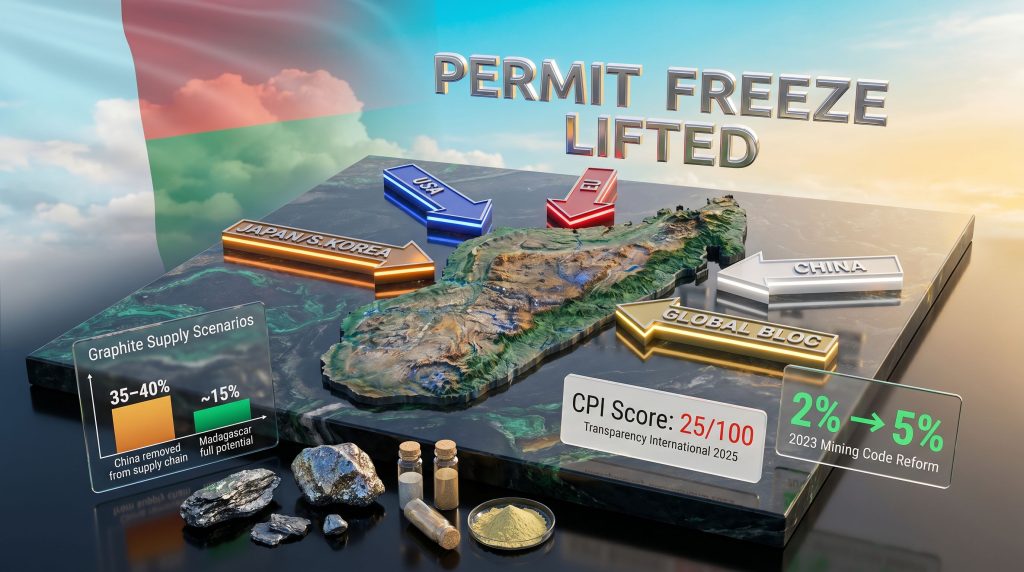
The EITI placed Madagascar under enhanced scrutiny via Board Decision 2025-45, imposing a one-year compliance window before potential delisting from the initiative entirely. Transparency International's 2025 Corruption Perceptions Index scored Madagascar at 25 out of 100, placing it in the bottom quartile globally for corruption control.
This is not merely a reputational concern. For institutional investors operating under ESG mandates or fiduciary frameworks that require political risk assessment, a CPI score of 25 under a military administration subject to AU suspension represents a category of governance risk that standard country risk pricing models are not calibrated to handle.
The military government's decision to grant Australian explorer Akora Resources a 25-year mining permit for the Bekisopa iron ore project within months of taking power signals pragmatic openness to foreign capital. However, pragmatism and institutional reliability are not the same thing, and investors in long-cycle mining assets require both.
The 2023 Mining Code: Framework Built by a Government No Longer in Power
The January 2026 permit reopening was framed as a downstream consequence of the July 2023 mining code reforms enacted under the prior civilian administration. Understanding what those reforms require is essential to evaluating whether the permit thaw translates into a genuinely improved operating environment or simply a return to the conditions that justified the 2010 moratorium in the first place.
| Reform Element | Pre-2023 Status | Post-2023 Framework |
|---|---|---|
| Royalty Rate | 2% | 5% |
| Social Mining Fund | Not mandated | Mandatory |
| Permit Registry | Manual and fragmented | Digitised cadastre |
| Gold Permit Status | Included | Excluded pending review |
| EITI Compliance Status | Standard | Enhanced scrutiny |
The royalty increase from 2% to 5% represents a meaningful improvement in fiscal take, though it remains below the 6% to 8% range common in comparable African jurisdictions. The mandatory Social Mining Fund was designed to direct a portion of revenue toward community development, addressing one of the recurring criticisms of Madagascar's extractive sector: that mineral wealth generated near rural communities has historically failed to translate into local economic benefit.
The cadastral modernisation mandate targeted the overlapping title problem directly, introducing a digitised permit registry intended to prevent the speculative accumulation that characterised the pre-2010 system. Whether the approximately 1,650 pending applications will be processed through this new system or resolved through a separate administrative mechanism has not been publicly confirmed by the current administration.
The fundamental uncertainty is enforceability. The 2023 code was enacted by a civilian government that no longer holds power. The military administration's legal obligations under that framework have not been tested in any independent judicial proceeding, and Madagascar's judiciary does not operate with institutional independence under the current governance structure.
Five Geopolitical Blocs Competing for Access
The Madagascar mining permit freeze lifted has not been received as a neutral administrative event. It has, however, accelerated competition among five distinct geopolitical blocs, each with different strategic interests, different investment instruments, and different leverage over the mining sector's future direction. The dimensions of this contest reflect broader critical minerals geopolitics playing out across multiple continents simultaneously.
Japan and South Korea hold the most established position through the Ambatovy nickel-cobalt complex. Sumitomo Metal Mining and KOMIR's joint investment, valued at approximately US$8 billion, represents the largest single foreign direct investment in Madagascar's history. Ambatovy produces nickel and cobalt in sulphate form directly relevant to battery precursor supply chains. POSCO International separately holds a 10-year offtake agreement with NextSource Materials covering 30,000 tonnes of flake graphite annually from the Molo mine, positioning South Korea as both an upstream investor and a downstream processor seeking to diversify away from Chinese-controlled refining.
The United States is positioning primarily through Energy Fuels' Vara Mada mineral sands project, for which an updated feasibility study released in January 2026 confirmed a net present value of US$1.8 billion, a 38-year mine life, and projected annual EBITDA ramping to over US$500 million. This project targets rare earth and heavy mineral sands production, directly relevant to US efforts to rebuild domestic rare earth supply chains.
China operates as the structurally indispensable actor regardless of Western investment preferences. Chinese entities purchase the overwhelming majority of Madagascar's graphite output and control more than 90% of global graphite processing capacity. This creates a market access dependency that functions independently of geopolitical sentiment. No matter which flag flies over a Malagasy graphite mine, the product must travel through Chinese processing infrastructure to reach battery supply chains at commercial scale.
This processing monopoly is not a preference; it is a physical infrastructure reality that cannot be arbitraged away through offtake agreements alone. Furthermore, China's rare earth restrictions have only intensified the urgency with which Western governments and investors are pursuing alternative supply chains.
The European Union has formalised its interest through the Critical Raw Materials Act, under which Evion Group's Maniry graphite deposit has been designated as a strategic project. The CRMA designation signals European intent to secure upstream supply, and the European critical minerals supply chain challenge remains acute. However, it does not resolve the downstream processing bottleneck that limits the practical strategic value of any non-Chinese graphite investment until European or allied processing capacity is built.
The next major ASX story will hit our subscribers first
The Processing Bottleneck: The Constraint That Governs Everything Else
The most consequential structural limitation on Madagascar's strategic value as a critical raw materials transition supplier is not geological, political, or fiscal. It is the near-total concentration of graphite processing capacity inside China's borders.
The IEA's Global Critical Minerals Outlook 2025 modelled the implications of this concentration with precision: removing China from global graphite supply chains entirely would leave only 35% to 40% of projected 2035 demand covered by remaining producers. Separate modelling on supply disruption scenarios found that if Chinese graphite production were reduced by 50%, Madagascar's share of global supply could theoretically rise to approximately 15%, but this outcome is conditional on non-Chinese processing infrastructure being developed at commercial scale.
Without that infrastructure, additional raw graphite production from Madagascar simply creates more feedstock for Chinese processors, deepening rather than diversifying the dependency.
| Scenario | Global Graphite Demand Coverage (2035 Projection) |
|---|---|
| Current trajectory, China-dominant | Approximately 100% of modelled demand met |
| China fully removed from supply chain | 35% to 40% of demand covered |
| Madagascar scales to full potential | Up to 15% of global supply (processing-dependent) |
| Non-Chinese processing built at scale | Meaningful diversification achievable |
Source: IEA Global Critical Minerals Outlook 2025 (modelled projections). All figures represent scenario modelling and should not be read as forecasts or guarantees of future market outcomes.
NextSource Materials has announced plans for battery anode material facilities in Mauritius and the Gulf region that would process Malagasy graphite into spherical graphite and coated battery-grade anode material outside Chinese jurisdiction. Both facilities remain in pre-construction phases as of early 2026. Their development timeline and financing represent one of the most consequential variables in whether the Madagascar mining permit freeze lifted translates into genuine supply chain diversification or simply more raw ore flowing to existing processors.
Why Large-Flake Graphite Commands a Premium
Not all graphite is interchangeable. Industry terminology distinguishes between large-flake, medium-flake, and fine-flake graphite based on particle size after processing, with large-flake material commanding significant price premiums for applications including fuel cells, expandable graphite, and specialty industrial uses. Madagascar's deposits are particularly noted for high proportions of large-flake content, which is relatively scarce globally and less directly substitutable by synthetic graphite alternatives.
Battery anode production, by contrast, can utilise both natural and synthetic graphite, with synthetic graphite increasingly competitive in cost terms. This means Madagascar's large-flake premium is most defensible in non-battery applications, while its battery-grade value proposition depends on downstream processing economics relative to synthetic alternatives. Investors evaluating Malagasy graphite projects need to understand which demand segment each project is targeting, as the competitive dynamics differ materially between large-flake industrial markets and spherical graphite battery markets.
Governance Risk Under a Military Administration: What Standard Frameworks Miss
Political risk assessment in mining typically focuses on country risk ratings, sovereign credit spreads, World Bank governance indicators, and historical expropriation data. These instruments are calibrated for civilian governments operating within constitutional frameworks. They are, however, poorly suited to evaluating the specific risk profile of a military administration operating under AU suspension and EITI enhanced scrutiny while simultaneously issuing long-dated mining permits.
Three specific risk vectors warrant attention beyond standard country risk models:
Legal continuity risk. Mining permits granted by the current administration carry an implicit question: would a successor civilian government, potentially one that came to power on an anti-corruption or resource nationalism platform, honour the terms of permits issued by a military government widely regarded as illegitimate? The 25-year permit granted to Akora Resources for Bekisopa is a real-world test case for this question, though it will not be answered for years.
Artisanal mining overhang. The sixteen-year freeze did not eliminate informal resource extraction. It formalised informality. Any regulatory framework that reopens the formal sector while leaving a large artisanal sector operating in legal grey zones faces enforcement challenges that consume regulatory capacity and create competitive distortions.
The two-tier system risk. Gold's exclusion from the permit reopening creates precisely this dynamic. Formal operators in permitted commodities will face operating environments where artisanal and illegal activity continues in adjacent areas, creating security, environmental, and community relations challenges that project-level due diligence typically underestimates.
Three Levers That Could Shift the Outcome
The Madagascar mining permit freeze lifted is a necessary condition for investment. It is not, however, a sufficient one. Three policy mechanisms could determine whether the permit thaw generates durable economic development or repeats the extraction-without-benefit pattern documented across comparable resource-rich jurisdictions.
Conditional development finance. Western development finance institutions including the US International Development Finance Corporation, the European Investment Bank, and the IFC retain structural leverage through project financing conditionality. Requiring adherence to the 2023 mining code's royalty structure and Social Mining Fund contribution mechanisms as non-negotiable financing terms creates a floor of accountability that bilateral investment agreements cannot replicate. This mechanism functions regardless of which government is in power in Antananarivo.
Priority investment in non-Chinese processing infrastructure. The strategic value of every graphite mine in Madagascar is fundamentally constrained by the processing bottleneck. NextSource's planned downstream facilities in Mauritius and the Gulf represent the most advanced non-Chinese processing initiative directly linked to Malagasy supply. Multilateral development banks and strategic minerals investment funds treating these facilities as infrastructure-equivalent priorities would accelerate the timeline for meaningful supply chain diversification.
Sustained multilateral engagement on civilian transition. The African Union and SADC suspension of Madagascar creates diplomatic leverage that, if maintained with coherence and used constructively, can support the conditions for a return to constitutional governance without sacrificing engagement on mining sector accountability. The EITI's one-year compliance window is the most concrete near-term accountability mechanism in operation. Allowing it to expire without enforcement consequences would remove the last credible multilateral lever over Madagascar's resource governance at the moment when foreign capital is accelerating its engagement.
Frequently Asked Questions
What Was the Madagascar Mining Permit Freeze?
The moratorium was a suspension on the issuance of new mining permits introduced in November 2010 following Madagascar's 2009 constitutional crisis. It was designed to address speculative permit accumulation, overlapping title disputes, and governance failures in the mining cadastre. The freeze remained in place for approximately sixteen years, during which an estimated 1,650 permit applications accumulated in the backlog while artisanal and illegal mining activity expanded significantly across multiple commodity types.
When Was the Madagascar Mining Permit Freeze Lifted?
The freeze was formally lifted on January 27 to 29, 2026, following an announcement by the Council of Ministers and Minister of Mines Carl Andriamparany under the military administration led by Colonel Michaël Randrianirina. Investors responded swiftly, with significant interest reported across multiple critical mineral categories.
Does the Permit Reopening Include Gold Mining?
No. Gold mining permits remain excluded from the January 2026 reopening. The government cited the severity of illegal and artisanal gold mining activity as the rationale for maintaining the gold permit freeze pending further review of how formalisation could be managed without creating a regulatory framework immediately undermined by entrenched informal operations.
Which Minerals Are Now Open for New Permit Applications?
The reopening applies broadly to critical minerals including nickel, cobalt, graphite, rare earths, mineral sands, and iron ore, covering the commodity categories most directly relevant to global energy transition supply chains.
Why Does China's Processing Dominance Matter Specifically for Madagascar?
China controls over 90% of global graphite processing capacity. Raw graphite mined in Madagascar cannot reach battery supply chains without passing through processing facilities, the vast majority of which are located in China. This means that even as Western countries invest in Malagasy graphite mining, the processed material re-enters Chinese-controlled supply chains unless alternative processing infrastructure is developed and commercially operationalised. Until that infrastructure exists, Chinese market access remains structurally non-negotiable for Malagasy producers.
What Is the Current Governance Situation in Madagascar?
Madagascar is governed by a military administration following a coup in October 2025. The African Union has suspended the country, and the EITI has placed it under enhanced scrutiny with a one-year window to demonstrate compliance. Transparency International's 2025 CPI scores Madagascar at 25 out of 100, placing it among the world's most corruption-affected jurisdictions by that measure.
The Core Tension: Generational Assets, Institutional Deficits
Madagascar's geological case does not require advocacy. The deposits are world-class, the commodities are strategically consequential, and the timing of the permit thaw coincides with peak global anxiety about critical mineral supply chain concentration. The Madagascar mining permit freeze lifted has unlocked access to one of Africa's most mineral-diverse jurisdictions after a regulatory standstill that lasted longer than the entire smartphone era.
What the permit thaw has not resolved is the deeper institutional question: whether Madagascar can translate mineral wealth into durable economic development rather than repeating the extraction-without-benefit pattern that has characterised resource booms across the continent from Guinea to the DRC. The 2023 mining code provides a framework for better outcomes. A military government operating under AU suspension provides limited institutional credibility for enforcing that framework.
The processing bottleneck limits the strategic value that any party other than China can actually extract from Malagasy graphite without sustained investment in downstream infrastructure. The permit reopening is real. The geological endowment is real. The governance deficit and the processing constraint are equally real.
For investors, development financiers, and policymakers, the question is not whether Madagascar matters to critical mineral supply chains. It is whether the institutional conditions necessary to make that mattering durable can be constructed quickly enough to capitalise on the opening before the next political disruption resets the clock.
This article contains forward-looking scenario analysis based on published data from the IEA, EITI, and Transparency International. Scenario projections regarding supply coverage and project economics represent modelled outcomes and should not be interpreted as investment advice or guarantees of future performance. Readers are encouraged to conduct independent due diligence before making investment decisions related to any jurisdiction or project discussed.
For ongoing coverage of Madagascar's mining sector and the broader African critical minerals landscape, African Mining Market at africanminingmarket.com provides regular reporting on regulatory and investment developments across the continent.
Ready to Track the Next Major Critical Minerals Discovery Before the Market Does?
Discovery Alert's proprietary Discovery IQ model delivers real-time alerts on significant ASX mineral discoveries across graphite, rare earths, nickel, cobalt, and beyond — instantly translating complex geological and market data into actionable investment insights for both short-term traders and long-term investors. Explore why historic mineral discoveries have generated extraordinary returns and begin your 14-day free trial today to position yourself ahead of the broader market.