July 3, 2026
The Energy Procurement Shift Reshaping Heavy Industry
The conventional wisdom in corporate energy procurement has long favoured short-duration agreements, typically spanning ten to fifteen years, on the basis that market conditions and technology costs shift too rapidly to justify longer commitments. That logic is now being challenged at scale. Across the global resources sector, a fundamentally different calculus has taken hold, one that treats energy not as a commodity to be sourced opportunistically but as a long-term operational input requiring the same strategic discipline applied to mine planning or capital allocation.
The convergence of three forces is driving this shift. First, carbon pricing mechanisms in major export markets are beginning to impose real costs on Scope 2 emissions from industrial electricity consumption, making gas-fired power progressively more expensive to justify. Second, ESG-linked financing conditions have tightened significantly, with lenders increasingly attaching decarbonisation milestones to credit facilities for resource companies. Third, renewable energy in mining projects in remote or semi-grid-connected locations require offtake certainty that extends well beyond what a technology company or retailer can realistically provide.
Mining operators, with decades-long asset lives and stable baseload demand profiles, are uniquely positioned to fill that role. The Rio Tinto 30-year PPA in Western Australia, executed in May 2026 with the Yindjibarndi Energy Corporation, sits at the intersection of all three forces and represents one of the most structurally significant renewable energy transactions in Australian mining history.
When big ASX news breaks, our subscribers know first
The Pilbara: Where Solar Resource Meets Industrial Energy Demand
Understanding the Energy Challenge in Australia's Iron Ore Heartland
Western Australia's Pilbara region is one of the world's most solar-rich environments. Annual solar irradiance levels in the area surrounding Karratha routinely exceed those recorded in most of the world's established solar markets, including comparable operations in the Middle East and the American Southwest. This translates directly into project economics, producing higher capacity factors, lower levelised costs of energy, and faster payback periods for utility-scale solar installations relative to most other jurisdictions.
The operational reality against which this solar resource sits, however, has historically been dominated by gas-fired generation. Pilbara iron ore operations rely on gas turbines and reciprocating engines for electricity supply, a legacy infrastructure arrangement that made sense when natural gas was cheap and carbon accountability was minimal. Neither of those conditions holds today, and the cost and emissions implications of continued gas dependency have become increasingly difficult for major miners to defend to investors, customers, and regulators.
A further structural advantage of solar development in the Pilbara is the proximity between potential generation sites and the energy loads they serve. Transmission distance is one of the most underappreciated cost drivers in renewable energy project finance. When a solar facility can be co-located near mine infrastructure, the capital required for transmission infrastructure decreases substantially, improving green iron project economics and reducing the complexity of grid interconnection approvals.
What the Jinbi Solar Project Involves
Project Fundamentals at a Glance
| Feature | Detail |
|---|---|
| Project Name | Jinbi Solar Project |
| Location | Approximately 55 km south of Karratha, Pilbara, WA |
| Stage 1 Capacity | 75 MWac |
| Expansion Potential | Up to 150 MWac |
| Battery Storage | Potential future integration |
| Target Commercial Operations | Mid-2028 |
| EPC Contractor | DT Infrastructure |
| Accommodation Provider | Rapid Camps |
| PPA Duration | 30 years |
| Energy Offtaker | Rio Tinto |
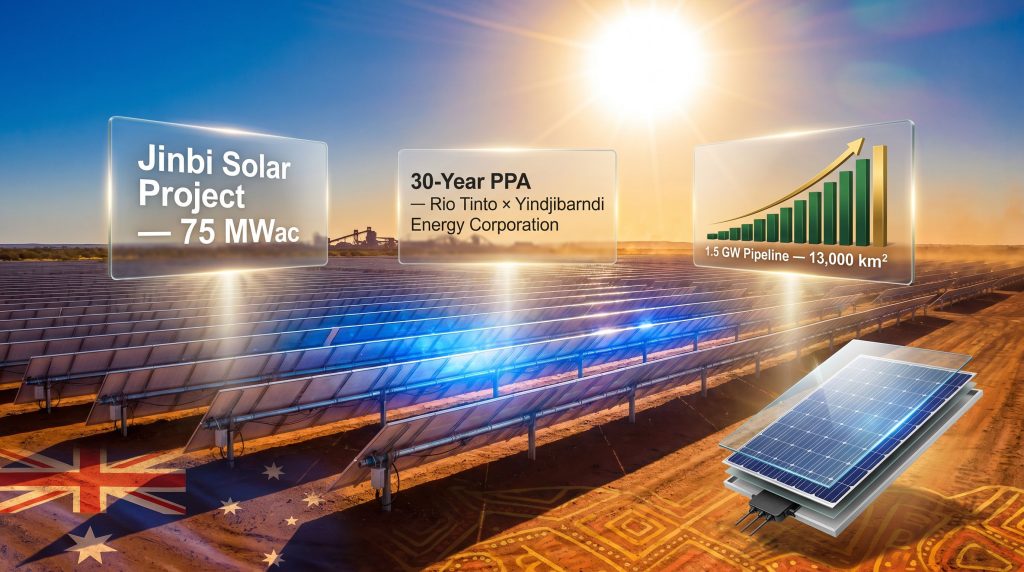
Stage 1 of the Jinbi Solar Project is designed to deliver 75 megawatts alternating current of solar generation capacity, with a clear engineering pathway to double that output to 150 MWac in subsequent development phases. Future-stage battery storage integration has also been flagged as part of the project's long-term architecture, which carries significant implications for the proportion of consumption that can be met with renewable generation outside of peak solar hours.
Construction has commenced following financial close achieved in May 2026. Notices to proceed have been issued to EPC contractor DT Infrastructure and accommodation provider Rapid Camps, with early site works already underway. Commercial operations are targeted for mid-2028.
The Yindjibarndi Energy Corporation: Indigenous Ownership at Industrial Scale
The Yindjibarndi Energy Corporation is a development entity formed through a partnership between the Yindjibarndi People, the Traditional Owners of the land on which the Jinbi project is being constructed, and ACEN Corporation, a Philippines-headquartered renewable energy developer with a growing Asia-Pacific portfolio. What distinguishes YEC from many previous First Nations energy arrangements is the nature of the participation itself. Rather than a consultation or royalty framework layered onto a third-party development, the Yindjibarndi People hold a direct ownership stake in the entity developing the project.
YEC's ambitions extend well beyond the Jinbi project alone. The corporation holds a development pipeline exceeding 1.5 gigawatts across solar, wind, and battery storage technologies, spanning approximately 13,000 square kilometres of Yindjibarndi Country. The breadth of that pipeline suggests that the Jinbi project, significant as it is, functions as an entry point into a much larger strategic vision for Indigenous-led energy infrastructure in Western Australia.
The foundation of the Rio Tinto relationship dates to a Memorandum of Understanding signed in 2023. The three years between that conceptual agreement and the binding Rio Tinto 30-year PPA and financial close in 2026 reflect the complexity involved in structuring a transaction of this scale, satisfying lender requirements, navigating land access frameworks, and assembling a contractor supply chain capable of delivering construction in a remote location on schedule.
How a 30-Year Mining PPA Actually Functions
Structural Mechanics and Risk Architecture
A power purchase agreement of 30-year duration operates on fundamentally different financial logic than the shorter contracts more common in the corporate renewable market. The extended tenor serves several simultaneous purposes that shorter agreements cannot replicate.
For the developer and its lenders, a 30-year offtake commitment provides the revenue certainty necessary to service project debt across the full amortisation period. Solar and wind projects carry high upfront capital costs and low operating costs. Project finance lenders, who typically fund 60 to 80 percent of construction costs through non-recourse debt, require contracted revenue streams that extend well beyond the loan term to justify credit approval. A 15-year PPA may be insufficient to underwrite the full debt structure of a capital-intensive remote project; 30 years eliminates that constraint almost entirely.
For Rio Tinto as the offtaker, the agreement locks in a known energy cost profile across the operational life of assets that carry their own multi-decade investment horizons. Pilbara iron ore infrastructure represents capital commitments measured in billions of dollars, with operational lives routinely extending beyond thirty years. An energy agreement aligned to that timeline converts electricity from a variable operating cost into a predictable budgetary line item, simplifying both financial planning and long-term capital allocation.
Under the structure of this agreement, Rio Tinto has committed to purchasing 100 percent of the electricity generated by the Jinbi Solar Project. This total offtake obligation is significant for two reasons. It eliminates merchant revenue risk for YEC entirely, ensuring that every unit of generation produced has a guaranteed buyer. It also places volume risk management squarely within Rio Tinto's operational planning, meaning the mining company must integrate solar intermittency into its broader energy management framework — a complexity that battery storage expansion in future stages is designed to address.
Key risk consideration: Solar intermittency under a 100% offtake obligation means that Rio Tinto effectively absorbs the cost of any curtailment events caused by generation shortfalls during cloudy periods. Future battery storage integration is therefore not simply a capacity enhancement but a risk management instrument for the offtaker.
Why Rio Tinto's Credit Profile Is Central to the Deal
One element of this transaction that receives insufficient attention in standard reporting is the role of the offtaker's creditworthiness in enabling project finance. Lenders providing non-recourse debt to YEC are not lending against YEC's own balance sheet. They are lending against the contracted revenue stream, which is only as valuable as the counterparty obligated to pay it.
Rio Tinto's investment-grade credit rating is, in practical terms, the collateral underpinning the project's bankability. Without an offtaker of that credit quality, the terms available to YEC would be materially worse, the debt quantum lower, and the project economics potentially unviable. This structural reality explains why Indigenous-led or community energy developers have historically found it difficult to access project finance at competitive terms, and why the YEC-Rio Tinto partnership represents a meaningful structural breakthrough.
Rio Tinto's Broader Renewable Energy Procurement Approach
A Multi-Site, Multi-Technology Decarbonisation Strategy
The Jinbi Solar Project is one component within a progressively more ambitious renewable energy procurement strategy that Rio Tinto has been assembling across its Australian operations. Furthermore, Rio Tinto's Gladstone renewable push demonstrates the breadth of this commitment, with the company underwriting approximately $7.5 billion in wind, solar, and battery storage infrastructure to serve its Queensland Gladstone aluminium smelting operations, one of the most energy-intensive industrial facilities in the southern hemisphere.
Comparative Overview: Rio Tinto's Major Australian Renewable Agreements
| Agreement | Partner | Capacity | Duration | State | Target Operations |
|---|---|---|---|---|---|
| Jinbi Solar Project | Yindjibarndi Energy Corp / ACEN | 75–150 MWac solar | 30 years | WA | Mid-2028 |
| Upper Calliope Solar Farm | European Energy | Undisclosed | 25 years | QLD | TBC |
| Solar and Battery Storage | Edify Energy | 600 MW solar / 2,400 MWh BESS | 20 years | QLD | 2028 |
The Edify Energy agreement, covering 600 megawatts of solar capacity paired with 2,400 megawatt-hours of battery storage, illustrates the direction in which Rio Tinto's energy strategy is moving: toward integrated renewable and storage solutions that can sustain high renewable penetration rates across multiple operating shifts, not merely during daylight hours. The Upper Calliope Solar Farm arrangement with European Energy adds a further dimension, demonstrating that Rio Tinto is deliberately diversifying its renewable counterparty exposure rather than concentrating procurement with a single developer.
The Gas Displacement Calculation
Each megawatt-hour of solar generation delivered to a Pilbara mine site directly replaces a megawatt-hour that would otherwise require gas combustion in a turbine or reciprocating engine. The financial impact operates in two directions simultaneously: reducing gas procurement volumes, and eliminating the Scope 2 emissions associated with those displaced megawatt-hours.
As carbon accounting frameworks in export markets become more sophisticated, particularly given the European Union's Carbon Border Adjustment Mechanism, the emissions embedded in iron ore production are moving from an ESG reporting consideration to a commercial one. Consequently, buyers of iron ore in steelmaking markets are beginning to differentiate on the basis of product carbon intensity, and Rio Tinto's renewable procurement strategy positions its Pilbara output more favourably in that emerging competitive dynamic. This dynamic is also accelerating interest in green iron production across Australia more broadly.
Indigenous Economic Participation: A Structural Shift, Not a Symbolic One
The Architecture of Ownership-Based Benefit
The economic model embodied in the YEC ownership structure represents a meaningful departure from the way First Nations communities have historically been incorporated into major resource and infrastructure projects in Australia. The conventional arrangement has typically involved consultation obligations, native title compensation payments, or royalty-style benefit-sharing mechanisms. These arrangements generate income for communities but do not build asset ownership, and they do not create long-term equity participation in the value created by development on Country.
YEC's direct ownership stake in the Jinbi project means that the Yindjibarndi People receive a share of the long-term commercial returns generated by energy infrastructure operating on their land, for as long as that infrastructure operates. The economic difference between receiving a royalty for access and holding an equity stake in a 30-year contracted energy asset is substantial, both in terms of total value and in terms of the governance rights and capability development that come with ownership participation.
ACEN Corporation's role as co-developer provides the technical expertise, development capital, and regulatory navigation capability that makes the partnership functional. This model of pairing Indigenous land rights and community standing with external technical and financial capability is one that could potentially be replicated across other high-resource areas in Western Australia. In addition, considerations around critical minerals and energy transition further underscore why such Indigenous-led partnerships are attracting increasing institutional interest across the region.
Sector observation: Australia currently lacks a standardised regulatory framework specifically designed to streamline First Nations-led energy project development. The Jinbi project's successful path from MOU to financial close demonstrates that existing frameworks can accommodate such transactions, but the absence of a dedicated pathway adds complexity and time to the development process that purpose-built policy could reduce.
What YEC's Pipeline Signals for Western Australia's Energy Future
The 1.5 GW development pipeline held by YEC across approximately 13,000 square kilometres of Yindjibarndi Country is not a speculative aspiration. It is a development agenda backed by a completed financial close transaction, an investment-grade offtake relationship, and an experienced international co-developer. Whether that pipeline translates into constructed capacity will depend on the availability of further offtake agreements, grid connection opportunities, and capital — but the Jinbi project provides proof-of-concept for all three preconditions.
The next major ASX story will hit our subscribers first
Australia's Industrial Decarbonisation in a Global Context
The Scale of the Challenge in Remote Mining Operations
Decarbonising remote mining operations presents challenges that are structurally different from those facing grid-connected industrial facilities. Many Pilbara operations are either entirely off-grid or connected to isolated regional networks that have limited capacity to absorb large volumes of variable renewable generation without storage support. This means that solar and wind development in the region must be accompanied by adequate storage or dispatchable backup capacity to maintain operational reliability, raising the capital requirement per megawatt of renewable capacity compared with grid-connected deployments.
Australia's selection of 2.4 gigawatts of renewables and battery storage capacity across its Capacity Investment Scheme rounds 5 and 6 provides broader context for the pace at which the national renewable buildout is accelerating. The resources sector is not operating in isolation from this national trajectory, but it faces the additional complexity of remote locations, high industrial loads, and the operational reliability requirements of continuous mining processes that cannot tolerate unplanned power interruptions.
Where the Jinbi PPA Sits in Global Mining Energy Transition
Benchmarking the Rio Tinto 30-year PPA in Western Australia against comparable transactions in other major mining jurisdictions reveals its structural distinctiveness. Long-duration corporate PPAs have been executed in Chile's copper-producing regions, in South Africa's gold and platinum belts, and in Canadian mining provinces, but the combination of features present in the Jinbi transaction is rare even by global standards.
However, few mining PPAs globally combine:
- A 30-year tenor, compared to the 10–15 year industry norm
- 100 percent offtake commitment eliminating all merchant risk
- Indigenous ownership of the generating entity
- An international co-developer bridging Asian capital into an Australian Indigenous land asset
- Immediate financial close and construction commencement
ACEN Corporation's involvement is worth examining through a capital flows lens. The company's decision to co-invest alongside a Yindjibarndi-led entity in a Western Australian solar project reflects a broader pattern of Southeast Asian renewable energy capital seeking deployment in Australia's resource-rich regions. As Australia positions itself as a renewable energy superpower, the sources of development capital for that build-out are diversifying geographically, with Philippine, Japanese, Korean, and Singaporean institutions all taking positions in the Australian market.
Five Structural Shifts This Transaction Represents
The Jinbi Solar Project and the 30-year PPA underpinning it are significant not simply as a single project milestone but as a signal of deeper structural change across multiple dimensions:
-
Ultra-long-duration PPAs becoming viable in heavy industry: As mining companies align energy procurement with asset operational lives rather than budget cycles, 30-year agreements may establish a new benchmark for how large industrial offtakers structure renewable contracts.
-
Indigenous ownership satisfying institutional finance requirements: YEC's path to financial close demonstrates that First Nations equity ownership structures can meet lender criteria and attract investment-grade offtakers, removing one of the primary perceived barriers to Indigenous-led infrastructure development.
-
The Pilbara emerging as a concentrated solar energy hub: The combination of world-class irradiance, large co-located energy loads, and proximity advantages positions the region for continued renewable development well beyond the Jinbi project.
-
Asian capital accelerating Australian renewable deployment: ACEN Corporation's co-investment role reflects a maturing pattern of Southeast Asian institutional capital seeking Australian renewable opportunities, diversifying the development funding landscape.
-
Decarbonisation integrated into operational procurement, not just reporting: Rio Tinto's multi-site, multi-technology, multi-decade renewable procurement portfolio reflects genuine operational integration of emissions reduction objectives rather than disclosure-driven compliance activity.
This article is intended for informational purposes only and does not constitute financial advice. Claims regarding project timelines, capacities, and agreement structures are drawn from publicly reported information and should be independently verified. Forward-looking statements regarding project outcomes, development pipelines, and decarbonisation trajectories involve inherent uncertainty and actual results may differ materially from projections referenced herein.
Want to Stay Ahead of the Next Major ASX Resource Discovery?
While Rio Tinto's 30-year renewable energy strategy reshapes industrial procurement, the broader resources sector continues to generate significant investment opportunities through major mineral discoveries — and Discovery Alert's proprietary Discovery IQ model instantly alerts subscribers to significant ASX discoveries as they happen, turning complex data across 30-plus commodities into clear, actionable insights. Explore historic examples of discovery-driven returns and begin your 14-day free trial at Discovery Alert to position yourself ahead of the market.