
June 6, 2026
Economic Forces Reshape Latin America's Resource-Dependent Landscape
Emerging market economies across Latin America face mounting pressures from structural transitions away from traditional commodity dependence. Resource-rich nations must navigate complex policy environments where short-term fiscal demands compete with long-term productivity investments. These dynamics create investment opportunities in non-traditional sectors while simultaneously challenging established extractive industries through regulatory uncertainty and tax burden increases.
Furthermore, these mining industry trends create investment opportunities in non-traditional sectors whilst simultaneously challenging established extractive industries through regulatory uncertainty. Colombia's economic trajectory exemplifies this broader regional shift, where domestic consumption patterns increasingly drive growth momentum while extractive sectors experience sustained contraction. Understanding these structural changes provides insight into investment allocation strategies across developing economies facing similar commodity transition challenges.
When big ASX news breaks, our subscribers know first
Understanding Colombia's Growth Fundamentals
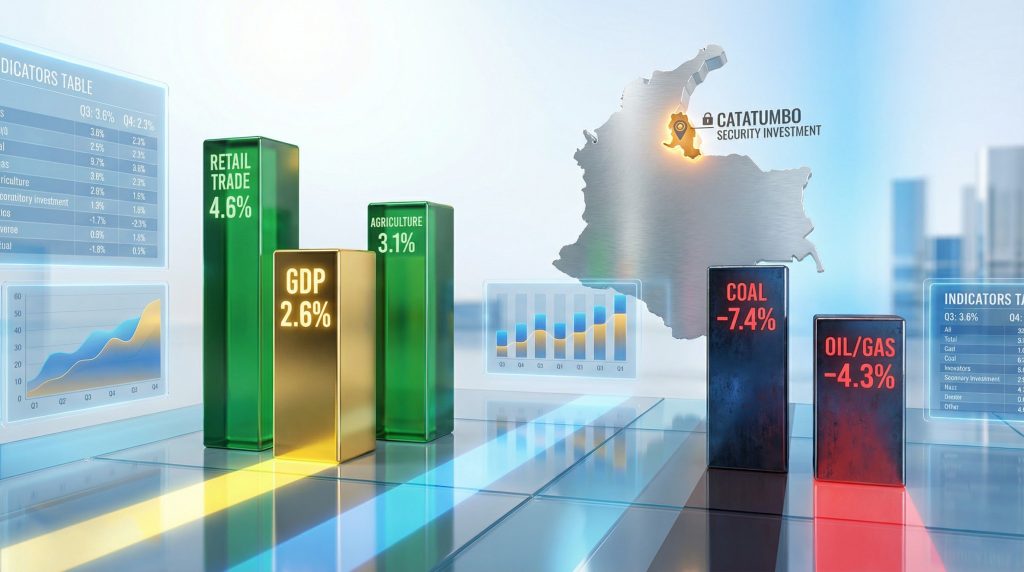
Colombia's economic growth 2025 reached 2.6%, representing modest acceleration from the previous year's 2.3% performance. This expansion occurred despite significant headwinds in traditional export sectors, demonstrating the economy's evolving structure toward domestic demand dependency.
The growth architecture revealed critical imbalances between expanding consumption sectors and contracting resource industries. Retail trade expansion of 4.6% significantly outpaced overall GDP growth, indicating consumption's outsized contribution to economic momentum. In addition, public spending surged 4.5% year-over-year, while agricultural activity expanded 3.1% despite global commodity headwinds.
Key Economic Performance Metrics
| Sector | 2024 Performance | 2025 Performance | Growth Rate Change |
|---|---|---|---|
| Overall GDP | 2.3% | 2.6% | +0.3pp |
| Retail Trade | 3.2% | 4.6% | +1.4pp |
| Agriculture | 1.8% | 3.1% | +1.3pp |
| Manufacturing | 0.5% | 1.9% | +1.4pp |
| Mining/Hydrocarbons | -4.1% | -6.2% | -2.1pp |
| Coal Subsector | -5.2% | -7.4% | -2.2pp |
| Oil/Gas Subsector | -2.8% | -4.3% | -1.5pp |
The divergence between domestic demand strength and extractive sector weakness reveals policy trade-offs between short-term demand stimulus and longer-term productive capacity. This pattern reflects broader challenges facing commodity-dependent economies where fiscal pressures drive consumption support at the expense of productive investment.
Manufacturing recovery patterns showed encouraging signs with 1.9% growth following previous contractions. Import substitution policies and accelerated technology adoption supported local manufacturers, though the sustainability of protectionist measures warrants scrutiny regarding long-term efficiency impacts.
How Does Domestic Demand Shape Colombia's Economic Trajectory?
Consumer Spending Dynamics Drive Economic Momentum
Household consumption patterns reflected strengthened consumer sentiment as retail expansion significantly outpaced overall economic growth. The 4.6% retail trade growth occurred within a context of government transfer programs and maintained employment levels despite sectoral contractions.
Consumer spending patterns demonstrated several key characteristics:
- Durable goods purchases increased reflecting improved consumer confidence
- Service sector activities showed robust performance throughout 2025
- Urban consumption patterns diverged significantly from rural spending behaviors
- Real wage improvements supported sustained household purchasing power
The relationship between public spending increases (4.5%) and retail trade expansion (4.6%) suggests approximately 1:1 transmission of fiscal stimulus to consumer spending. This multiplier effect indicates typical emerging market dynamics where limited credit constraints allow direct translation of government transfers into household consumption.
Government Expenditure Impact Analysis
Public spending growth of 4.5% constituted an expansionary fiscal stance during structural economic challenges. Rather than investing in productive capacity enhancement, spending emphasised current consumption through social transfers and security expenditures. However, the tariffs impact on investments creates additional complexity in policy implementation.
Government spending allocation included:
- Infrastructure investments supporting employment levels in construction sectors
- Social program expansions boosting household incomes through direct transfers
- Defence spending increases concentrated in conflict-affected border regions
- Emergency security measures responding to escalating violence in Catatumbo region
The implementation of emergency tax measures on coal and crude exports revealed fiscal pressures stemming from security concerns. A 1% surcharge implemented in late January 2025 created regulatory uncertainty through subsequent removal and reinstatement attempts, adding burdens to already struggling extractive sectors.
Policy Uncertainty Warning: The contradictory signals from emergency taxation measures—implementation, withdrawal, and attempted reinstatement within 12 months—demonstrate the challenging regulatory environment facing Colombia's resource sectors.
What Role Do Sectoral Imbalances Play in Colombia's Economy?
Agricultural Sector Demonstrates Unexpected Resilience
Agricultural expansion of 3.1% in 2025 represented notable resilience amid commodity price volatility and extractive sector contraction. This performance was driven by export volume growth in fruits and fish products, achieving record levels despite global demand headwinds.
The sector's outperformance reflected several strategic developments:
- Diversification away from traditional crops showed measurable progress
- Climate adaptation strategies improved productivity despite weather challenges
- Value chain positioning enhanced through higher-value-added products
- Market access development enabled profitability at lower commodity prices
Fruit and fish export volumes reached unprecedented levels, suggesting either market share gains within existing trade relationships or successful new market access development. This achievement occurred despite global headwinds, indicating improved production efficiency enabling profitability under challenging price conditions.
Manufacturing Recovery Signals Structural Transition
Industrial production growth of 1.9% represented recovery from near-stagnation, with acceleration of +1.4 percentage points from the previous year. Import substitution policies supported local manufacturers while technology adoption accelerated across key industries.
Manufacturing sector improvements included:
- Technology adoption acceleration across key manufacturing industries
- Supply chain optimisation reducing production costs through efficiency gains
- Local content policies supporting domestic production capabilities
- Productivity improvements offsetting labour cost pressures and exchange rate challenges
The manufacturing recovery occurred through multiple policy support mechanisms including tariff protection, local content requirements, and government procurement preferences for domestic manufacturers. Furthermore, mineral exploration benefits indicate potential for resource sector revival through strategic investment.
Why Are Extractive Industries Contracting Despite Global Demand?
Coal Sector Faces Accelerating Decline
Coal production contracted 7.4% in 2025, representing deterioration from the previous year's 5.2% decline. This severe contraction reflects convergence of policy-driven pressures and structural challenges including security concerns and environmental compliance costs.
The coal sector faced multiple simultaneous pressures:
- Withholding tax increases from 2.2% to 4.5%, representing a 104.5% tax burden escalation
- Export restrictions limiting market access opportunities for producers
- Emergency surcharges creating planning uncertainty through inconsistent implementation
- Environmental compliance costs increasing operational expenses across mining operations
Regional security issues disrupted mining operations, particularly in areas experiencing escalating violence along the Venezuelan border. The Catatumbo region's security deterioration necessitated emergency military expenditure, funded through controversial export surcharges that created additional sectoral burdens.
Hydrocarbon Sector Experiences Sustained Weakness
Oil and gas production declined 4.3% during 2025, following the established pattern of sector deterioration that began in early 2024. This contraction occurred despite relatively stable global energy demand and pricing conditions. However, developments in energy transition security suggest opportunities for diversification.
Hydrocarbon sector challenges included:
- Exploration activity constraints due to policy uncertainty and regulatory delays
- Infrastructure maintenance challenges affecting output levels across existing fields
- International price volatility impacting revenue streams and investment planning
- Production decline rates exceeding replacement through new field development
Colombia produced 746,400 barrels per day of crude during January-November 2025, representing a 3.6% decline from the previous year according to industry data. This production decrease occurred amid global energy market conditions that generally favoured increased output from established producers.
How Do Tax Policies Influence Colombia's Resource Sectors?
Mining Tax Burden Analysis
The withholding tax increase from 2.2% to 4.5% fundamentally altered coal sector economics during a period of challenging market conditions. For an industry competing against lower-cost producers in Australia and Indonesia, this tax burden escalation likely rendered marginal operations uneconomic.
Tax policy impacts included:
- Emergency surcharges implemented, withdrawn, and reinstated within 12 months
- Constitutional court interventions creating regulatory uncertainty for planning purposes
- Revenue generation versus competitiveness trade-offs affecting sector viability
- Regional security spending requirements driving emergency taxation measures
The contradictory policy signals—emergency taxation implementation followed by withdrawal and attempted reinstatement—created planning uncertainty that compounds operational challenges. Mining companies require stable regulatory frameworks for long-term investment decisions, particularly given the capital-intensive nature of extraction operations.
Regional Security Spending Imperatives
Catatumbo region military expenditure necessitated additional funding sources as escalating violence along the Venezuelan border created security challenges for both mining operations and civilian populations. Emergency decree implementation of export surcharges reflected immediate fiscal pressures but created additional sectoral burdens.
Security-related spending requirements encompassed:
- Border security concerns driving emergency tax measure implementation
- Social investment requirements in conflict zones increasing government expenditure
- International cooperation agreements influencing spending priorities and funding allocation
- Military presence expansion requiring sustained financial resources for operations
The next major ASX story will hit our subscribers first
What Does Quarterly Performance Reveal About Economic Momentum?
Fourth Quarter Deceleration Patterns
Economic growth slowed to 2.3% in the fourth quarter from 3.6% in the third quarter, indicating momentum loss as the year progressed. This deceleration occurred despite continued public spending support and suggested limits to consumption-driven expansion.
Quarterly performance analysis revealed:
- Sequential growth pattern showing peak momentum in mid-2025
- Seasonal consumption effects influencing retail and production cycles
- External demand weakness contributing to slower fourth-quarter performance
- Mining sector deterioration accelerating during the final quarter
The mining and hydrocarbons sector contracted for a seventh consecutive quarter, shrinking 2.9% in the fourth quarter. This sustained decline followed a 5.7% contraction in the third quarter and 10.2% decline in the second quarter, demonstrating accelerating sector deterioration.
Comparative Regional Context
Colombia's economic growth 2025 positioned it within typical Latin American performance ranges, though the emphasis on domestic demand over commodity exports contrasted with economies more dependent on sustained resource export revenues. Additionally, Argentina lithium insights provide comparative context for regional resource sector dynamics.
Regional economic performance comparisons highlight:
- Commodity-dependent economies facing similar extractive sector challenges
- Diversification strategies showing varying success rates across countries
- Regional trade integration opportunities remaining underutilised for growth
- Policy response effectiveness differing significantly between similar economies
Investment Implications of Colombia's Economic Transition
Infrastructure Development Opportunities
The shift toward domestic consumption and away from extractive sector dependence creates investment opportunities in infrastructure supporting internal economic activity. Transportation network modernisation and digital connectivity expansion represent priority areas requiring sustained capital investment.
Key infrastructure development areas include:
- Transportation network modernisation supporting domestic commerce and agriculture
- Energy transition infrastructure reducing dependence on hydrocarbon revenues
- Digital connectivity expansion enabling service sector growth and efficiency
- Water resource management systems supporting agricultural productivity improvements
Sectoral Reallocation Investment Trends
Employment shifts from extractive industries toward service sectors create investment opportunities in education, healthcare, and financial services. The 4.6% retail trade expansion indicates strengthened domestic consumption capacity supporting service sector development.
Investment reallocation opportunities encompass:
- Service sector employment growth potential in urban areas
- Technology adoption acceleration across traditional industries
- Agricultural value-added processing expansion beyond primary production
- Tourism industry recovery and infrastructure development initiatives
Economic Risks and Growth Strategy Optimisation
Downside Risk Assessment for 2026 Outlook
Continued extractive sector contraction poses risks to government revenue and foreign exchange earnings. The 6.2% mining and hydrocarbon sector decline represents significant economic drag that domestic consumption may not fully offset.
Primary economic risks include:
- Extractive sector contraction continuation affecting government revenues
- Regional security situation deterioration impacting business confidence
- Global commodity price volatility exposure through remaining export dependence
- Climate change effects on agricultural productivity and water resource availability
Structural Reform Implementation Priorities
Tax system optimisation for competitiveness requires balancing revenue generation with sectoral viability. The current approach of emergency taxation and withholding tax increases may undermine long-term productive capacity.
Policy optimisation opportunities include:
- Regulatory framework modernisation reducing planning uncertainty for investors
- Labour market flexibility improvements supporting sectoral transition
- Financial sector development enabling improved capital allocation efficiency
- Investment climate enhancement attracting foreign direct investment in non-traditional sectors
Disclaimer: This analysis is based on preliminary economic data and policy developments that may be subject to revision. Investment decisions should consider additional risk factors and market conditions beyond those discussed in this assessment. For additional context, the OECD Economic Survey provides comprehensive analysis of Colombia's economic structure. Economic forecasts and sector performance projections involve inherent uncertainty and should not be relied upon as guarantees of future results.
Colombia's economic growth 2025 demonstrates the complex challenges facing resource-dependent economies transitioning toward domestic demand-driven models. While short-term consumption support has maintained growth momentum, sustainable development requires addressing structural imbalances between expanding domestic sectors and contracting extractive industries. Success in this transition will depend on policy frameworks that support sectoral diversification whilst maintaining fiscal sustainability and investment attractiveness.
Could Colombia's Economic Shift Signal Broader Latin American Mining Opportunities?
Colombia's transition away from traditional mining highlights the complex dynamics reshaping Latin America's resource landscape, creating both challenges and opportunities for astute investors. Discovery Alert's proprietary Discovery IQ model helps investors navigate these shifting markets by delivering real-time alerts on significant ASX mineral discoveries, ensuring you're positioned to capitalise on major discovery opportunities before the broader market responds.