
August 9, 2026
Economic Forces Reshaping Global Silver Markets Through Industrial and Investment Demand
Global precious metals markets face unprecedented structural transformation as emerging economies accelerate their transition toward industrial modernization and wealth preservation strategies. This evolution represents more than cyclical commodity demand—it reflects fundamental shifts in how developing nations allocate capital during periods of monetary uncertainty and technological advancement. Furthermore, silver demand in India exemplifies this broader trend as the nation becomes a dominant force in global precious metals allocation.
The convergence of industrial demand growth, renewable energy deployment, and investment portfolio diversification creates sustained pressure on silver supply chains that have operated under different assumptions for decades. Traditional models assumed industrial users could indefinitely reduce silver content through technological improvements, while investment demand remained concentrated in developed markets with established financial infrastructure.
These assumptions no longer hold. Industrial applications increasingly require higher silver content per unit of output, particularly in advanced solar cell technologies and electric vehicle components. Simultaneously, emerging market investors demonstrate sustained demand despite significant price appreciation, suggesting fundamental changes in precious metal allocation psychology across global demographics.
When big ASX news breaks, our subscribers know first
What Economic Factors Drive Sustained Silver Demand in Emerging Markets?
GDP Growth Correlation with Precious Metal Allocation
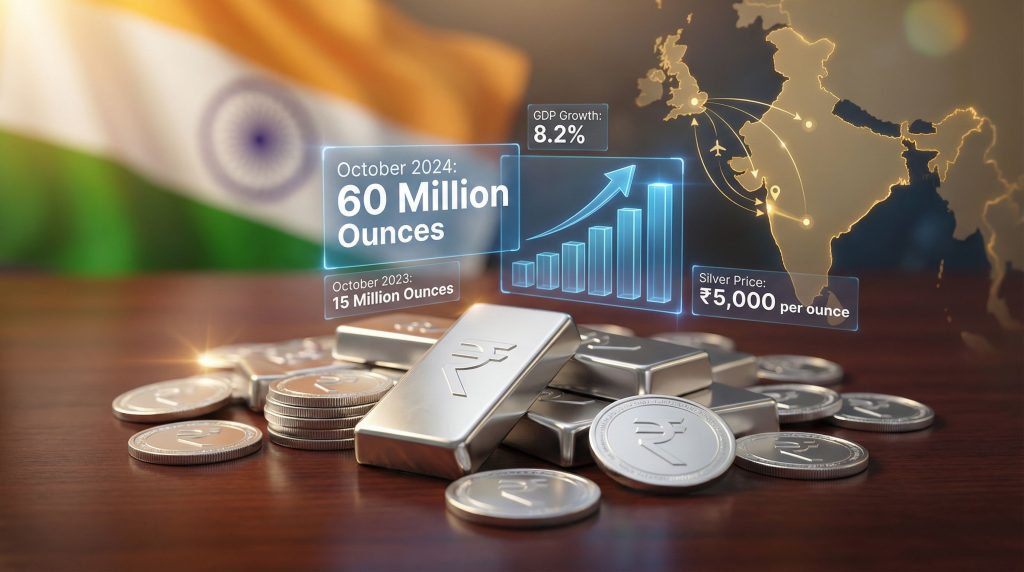
India's economic expansion at approximately 8.2% annually creates structural conditions for precious metal demand acceleration. According to the International Monetary Fund's World Economic Outlook October 2024 report, India maintains its position as the world's fastest-growing major economy, with real GDP growth projected at 6.8% for 2025. The World Bank confirms India's ranking as the fifth-largest global economy by nominal GDP.
This growth trajectory generates disposable income expansion across multiple demographic segments, particularly impacting investment allocation toward tangible assets during global economic uncertainty. The demographic dividend—approximately 65% of India's population under age 35 according to World Population Review 2023 data—creates a cohort simultaneously entering peak earning and investment years.
The relationship between discretionary income growth and precious metal investment demonstrates specific elasticity patterns. As household disposable income increases from $2,000-$5,000 annually to higher levels, allocation toward stores of value increases disproportionately, following established wealth preservation behaviors observed across emerging market transitions.
Currency Dynamics and Asset Allocation Patterns
Currency devaluation creates immediate portfolio rebalancing pressures toward hard assets. The Indian rupee has experienced significant depreciation, trading at approximately 83.5 against the US dollar in December 2024, compared to 74.5 in January 2022—representing approximately 12% depreciation over two years, according to Reserve Bank of India exchange rate archives.
When local currency depreciates, domestic investors increasingly view silver as dual protection against both currency erosion and global economic instability. This psychology distinguishes emerging market demand from developed market patterns, where currency hedging through precious metals typically plays secondary roles to geopolitical risk concerns.
The hedging mechanism functions through purchasing power parity dynamics. Despite domestic silver prices increasing substantially in local currency terms—from approximately ₹1,500 per ounce at 2024's start to over ₹5,000 per ounce by December—Indian investors continued robust purchasing behavior, demonstrating demand inelasticity typically associated with strategic rather than speculative positioning.
How Has Import Volume Growth Transformed Global Supply Distribution?
Import Surge Analysis and Supply Chain Implications
October 2024 demonstrated unprecedented monthly import acceleration, with volumes reaching approximately 60 million ounces compared to 15 million ounces in October 2023—representing 300% year-over-year growth. This dramatic expansion positions India as a primary demand driver capable of influencing global market dynamics.
Monthly Import Comparison Analysis:
- October 2024: 60 million ounces imported
- October 2023: 15 million ounces imported
- Growth magnitude: Four-fold increase
- Annual context: India typically consumes 200-250 million ounces across all applications
According to U.S. Geological Survey Mineral Commodity Summaries, India historically ranks as the world's largest consumer of silver for jewellery purposes. The October surge suggests demand expansion beyond traditional applications into investment positioning and industrial stockpiling.
Physical Metal Movement and Logistics Infrastructure
The displacement of silver from London Bullion Market Association vaults to Mumbai represents fundamental supply chain reorientation. Physical metal movement required emergency logistics deployment, including air freight utilisation rather than standard maritime shipping, indicating severe supply constraints and price inelasticity among importers.
Standard maritime shipping from London to Mumbai requires 4-6 weeks, while air freight reduces delivery time to 1-2 days at 8-12x higher transportation costs. This cost escalation suggests Indian importers prioritised delivery certainty over logistics economics, demonstrating market stress conditions typically reserved for critical shortage situations.
LBMA vaults maintain global silver inventory pools serving multiple simultaneous functions: COMEX futures settlement, ETF physical backing, and regional trading facilitation. When Indian demand increases 300% month-over-month while Western ETF inflows simultaneously expand, inventory drawdown accelerates across all categories, creating competitive allocation dynamics between market participants.
What Role Does Investment Demand Play in Market Structure Evolution?
Retail Trading Activity and Market Participation
Micro silver futures contracts designed for smaller traders experienced 238% volume increases year-over-year through late 2024, according to CME data. This retail engagement acceleration represents qualitative market structure shift, as individual traders coordinate positioning during fundamental supply constraints rather than speculative momentum.
The distinction between current retail participation and historical patterns proves critical. Previous cycles demonstrated retail activity marking local price peaks through momentum chasing without fundamental justification. Current retail engagement appears informed by media coverage of physical market dynamics and industrial demand growth, suggesting educated positioning rather than speculative exhaustion.
Micro futures contracts reduce capital requirements from approximately $290,000 to $5,800 per contract (at $58/oz silver), democratising participation during volatile price movements. In addition, this barrier reduction accelerates retail activity when combined with institutional positioning, creating layered demand pressure on relatively fixed global supply.
Price Performance Versus Demand Elasticity Characteristics
Indian Silver Price Movement (Rupee Terms):
- 2011 peak: ₹2,200 per ounce
- 2024 start: ₹1,500 per ounce
- December 2024: ₹5,000+ per ounce
- Year-to-date appreciation: +233%
Global Silver Price (USD Terms):
- Current level: $58 per ounce
- 2024 starting price: $24-26 per ounce
- Year-to-date appreciation: +125%
Demand inelasticity demonstrates through continued purchasing despite substantial price appreciation in both local and global terms. Typical consumer goods exhibit elasticity where quantity demanded decreases as prices increase. Silver demand maintained robust levels despite visible price increases, suggesting allocation driven by strategic necessity rather than discretionary speculation.
This behaviour indicates Indian investors increasingly view silver as strategic asset allocation component rather than speculative position. Strategic allocations typically persist through price cycles, while speculative positions reverse during volatility periods, creating different market dynamics and demand sustainability characteristics.
How Do Industrial Applications Support Long-Term Structural Demand?
Renewable Energy Infrastructure and Technology Requirements
India's renewable energy targets include 500 GW capacity by 2030, according to Government of India Ministry of Power National Mission documentation and International Renewable Energy Agency capacity statistics. This deployment necessitates substantial silver consumption through solar panel manufacturing and grid infrastructure development.
Solar Cell Technology Evolution:
Advanced photovoltaic technologies demonstrate increased rather than decreased silver requirements per watt of capacity:
- Traditional PERC cells: 100-120 mg silver per watt
- Topcon (Tunnel Oxide Passivated Contact): 120-150 mg silver per watt
- HTT (Heterojunction with Intrinsic Thin layer): Similar elevated requirements
- Efficiency improvements: 23-24% versus 22-23% traditional levels
This evolution contradicts assumptions about indefinite industrial silver content reduction through technological advancement. While manufacturers continue efficiency improvements to reduce materials costs per unit output, advanced cell technologies require increased silver content to achieve higher conversion efficiencies demanded by space-constrained installations.
Electronics Manufacturing and Electric Vehicle Sector Integration
India's expanding electronics manufacturing base and electric vehicle adoption create non-recyclable silver consumption beyond traditional jewellery applications. These industrial uses permanently remove silver from available supply pools, unlike jewellery applications where metal remains recoverable through recycling infrastructure.
Electric vehicle components require silver for battery management systems, charging infrastructure, and power electronics. As India accelerates EV adoption through policy incentives and infrastructure development, industrial silver demand expands independently from traditional applications, creating multiple simultaneous demand drivers within single national markets.
Electronics manufacturing encompasses smartphones, computers, renewable energy inverters, and communication equipment—all requiring silver for electrical conductivity and thermal management. Consequently, this diversified industrial base provides demand stability across economic cycles, as different sectors experience varying growth and contraction phases.
What Are the Macroeconomic Implications of Concentrated Demand Growth?
Global Inventory Management and Liquidity Constraints
Indian demand directly impacts London Bullion Market Association vault levels—the same inventory pool supporting COMEX futures delivery obligations and global ETF physical backing. This creates potential liquidity constraints across multiple markets simultaneously, as competing demands stress shared inventory infrastructure. Moreover, market stress in silver reflects these underlying supply-demand imbalances.
Key Market Pressure Points:
- COMEX delivery stress during high-volume contract months
- LBMA inventory depletion rates exceeding replenishment capacity
- Silver lease rate volatility indicating periodic physical shortages
- Premium expansion in Asian markets during supply disruptions
The December 2024 COMEX contract month demonstrated these dynamics, with approximately 44 million ounces standing for delivery according to exchange data. Unlike historical patterns where financial participants dominated delivery requests, commercial users increasingly demand physical settlement rather than cash alternatives, indicating genuine metal requirements rather than financial positioning.
Monetary Policy Environment and Asset Allocation Trends
Central bank accommodative policies globally encourage precious metal allocation as inflation hedges and portfolio diversification tools. Indian investors demonstrate sustained silver demand independent of short-term price volatility, suggesting allocation decisions based on long-term economic protection rather than speculative timing considerations.
The combination of currency depreciation concerns, inflation expectations, and wealth preservation needs creates multiple simultaneous drivers for precious metal allocation. Unlike developed markets where single factors typically dominate allocation decisions, emerging market investors respond to complex economic environments requiring multi-factor hedging strategies.
The next major ASX story will hit our subscribers first
How Does Regional Demand Compare to Established Market Centers?
Market Share Evolution and Geographic Concentration
Combined Indian and United States physical silver demand represents substantial portions of global annual offtake. This geographic concentration creates new market dynamics, as traditional European and Asian trading patterns adapt to accommodate sustained import requirements from specific regions.
Historical silver demand distribution demonstrated broader geographic dispersion, with European industrial users, North American investment demand, and Asian jewellery consumption creating balanced regional allocation patterns. Current concentration in specific markets creates supply chain bottlenecks and regional premium variations not observed during more distributed demand periods.
Investment Versus Industrial Demand Balance Characteristics
Unlike mature markets where industrial demand typically dominates silver consumption at approximately 55% of global usage according to Silver Institute data, India maintains balanced allocation between investment positioning and traditional applications. This diversification provides demand stability across economic cycles, as different use categories experience varying sensitivity to economic conditions.
Industrial demand demonstrates relative inelasticity during economic slowdowns, as manufacturers require specific silver content regardless of price levels. Investment demand exhibits different characteristics, potentially increasing during economic uncertainty while decreasing during stability periods, creating complex demand interaction patterns within regional markets.
What Supply-Side Constraints Amplify Demand Impact?
Mine Production Limitations and Development Timeline Realities
Global silver mine output peaked at approximately 900 million ounces in 2016 and faces structural decline through 2035, according to U.S. Geological Survey historical production data. New mine development requires 10-20 years from discovery to production in current regulatory environments, creating supply inelasticity that magnifies demand shocks from concentrated markets.
Mining Industry Scale Perspective:
- Fifth-largest global silver mine: Produces only 2% of world supply
- Typical large silver mine: 3-5 million ounces annual production
- Most silver mining: Byproduct of copper, gold, lead, and zinc operations
- Pure silver mines: Nearly non-existent in global production
This production scale limitation means individual mine expansions or new discoveries cannot meaningfully offset demand increases from major consuming regions. Unlike other commodities where single large projects can rebalance global supply-demand dynamics, silver requires multiple simultaneous developments to impact market conditions significantly.
Secondary Supply Infrastructure and Recovery Limitations
Silver recycling represents approximately 150-200 million ounces annually regardless of price levels, according to industry recycling data. Unlike gold, which maintains substantial central bank holdings available for market stabilisation during supply shortages, silver lacks concentrated inventory pools capable of rapid market intervention.
Historical Recycling Source Evolution:
- 25 years ago: Photography represented primary recycling source
- Current sources: Electronics, jewellery, coins, and silver rounds
- Infrastructure limitations: Fixed processing capacity regardless of price incentives
- Recovery challenges: Silver dispersed across multiple applications and geographic locations
The elimination of photographic silver usage removed a major recycling source without equivalent replacement. Current recycling sources demonstrate different characteristics—electronics recycling requires complex processing infrastructure, while jewellery recycling depends on individual decisions influenced by cultural factors beyond pure economic considerations.
How Do Geopolitical Factors Influence Strategic Metal Allocation?
Critical Minerals Recognition and National Security Considerations
The United States designated silver as a critical mineral in 2024, recognising supply vulnerability and strategic importance for industrial applications. This designation signals formal recognition that silver availability affects national economic security through its role in renewable energy, defence electronics, and telecommunications infrastructure.
Russia's addition of silver to state reserves represents the first such allocation in the country's modern history. While specific reserve quantities remain undisclosed, this policy shift potentially influences other nations' precious metal allocation strategies, particularly among countries seeking to reduce dollar-denominated reserve concentrations.
China's customs data indicates increased silver and ore imports from Mexico and the United States, suggesting supply chain diversification efforts amid trade relationship uncertainty. These patterns demonstrate how geopolitical considerations influence commodity flows independently from pure economic optimisation.
International Coordination and Reserve Diversification Strategies
BRICS nations' coordination on resource policies may influence individual member countries' precious metal strategies. India's sustained silver accumulation aligns with broader resource security objectives common among emerging economies seeking reduced dependence on Western financial infrastructure and dollar-denominated assets.
The combination of industrial necessity and monetary diversification creates dual justification for strategic silver allocation. Unlike purely investment-motivated precious metal accumulation, strategic allocation serves both immediate industrial requirements and long-term monetary policy objectives, potentially sustaining demand through various economic scenarios.
What Economic Scenarios Could Alter Future Demand Trajectories?
Upside Demand Acceleration Factors
Potential Demand Enhancement Scenarios:
- Sustained GDP growth above 8% annually across major emerging economies
- Further currency depreciation accelerating precious metal allocation globally
- Expanded renewable energy deployment exceeding current installation projections
- Increased middle-class wealth creation driving investment demand across Asia
Technological advancement in solar efficiency could paradoxically increase rather than decrease silver demand if higher-efficiency cells require increased silver content per watt. Current technology trends suggest this outcome for advanced cell types entering mass production during the next deployment phase.
Potential Demand Moderation Considerations
Factors Potentially Reducing Demand Growth:
- Significant economic slowdown reducing discretionary investment capacity
- Major currency stabilisation reducing hedge demand internationally
- Alternative technology development reducing industrial silver requirements
- Recycling infrastructure expansion increasing secondary supply availability
Economic recession in major consuming regions could temporarily reduce industrial demand, though investment demand might simultaneously increase as investors seek economic protection. The relationship between economic conditions and precious metal demand demonstrates complexity requiring scenario-specific analysis rather than simple correlations.
What Does Concentrated Demand Growth Signal for Market Structure Evolution?
Structural Transformation Rather Than Cyclical Fluctuation
India's emergence as dominant demand force represents permanent market structure evolution rather than cyclical demand fluctuation. This transformation requires global supply chain adaptation and inventory management strategy revision across all market participants, from miners to financial intermediaries.
The speed and magnitude of demand growth suggest fundamental changes in how emerging economies participate in global commodity markets. Traditional models assumed gradual demand increases correlated with economic development phases. Current patterns demonstrate potential for rapid acceleration when economic, technological, and monetary factors align simultaneously.
Furthermore, understanding silver squeeze strategies becomes essential as markets adapt to these structural changes, whilst tariff impacts on silver add additional complexity to global pricing dynamics.
Price Discovery Mechanism Evolution and Market Function
Physical market influence over futures pricing increases as concentrated demand creates sustained inventory pressure on exchange-deliverable supply. This represents significant change from historically futures-dominated silver markets where financial trading determined prices subsequently reflected in physical markets.
The London Bullion Market Association annual meeting consensus described current conditions as *"physical is king"*—indicating market participant recognition that physical supply constraints now drive financial market pricing rather than financial market activity determining physical allocation patterns.
Market Structure Implications:
- Physical premiums increasingly influence futures pricing
- Regional demand concentrations create supply bottlenecks
- Inventory management becomes critical competitive advantage
- Traditional arbitrage relationships require recalibration
This evolution suggests silver markets transitioning from financial-market-dominated price discovery toward physical-market-driven allocation mechanisms. Such transitions typically create extended adjustment periods as participants adapt to new market structure realities and develop appropriate risk management strategies.
However, investors and analysts should also consider silver premium analysis to understand regional pricing disparities, whilst recognising that silver market squeeze dynamics could significantly impact global financial markets.
The convergence of industrial demand growth, investment allocation expansion, and supply constraint recognition creates market conditions not observed during previous decades. Understanding these dynamics proves essential for investors, industrial users, and policymakers as silver's role in global economic infrastructure continues expanding through technological advancement and emerging market development.
Ready to Capitalise on Silver Market Disruptions?
Discovery Alert's proprietary Discovery IQ model delivers instant alerts on significant precious metals discoveries across the ASX, empowering subscribers to identify actionable opportunities as structural demand shifts reshape global markets. Begin your 30-day free trial today and position yourself ahead of these transformative market dynamics at Discovery Alert.