July 17, 2026
## Why Indonesia now shapes the global nickel cost floor
Nickel markets rarely move on a single headline. They reprice when geology, chemistry, logistics, and regulation begin pushing in the same direction at once. That is why Indonesia nickel policy tightening and HPAL costs matter far beyond one country’s mining sector. The immediate issue is not only whether less ore reaches market.
The deeper issue is that Indonesia’s dominant laterite processing chain now faces a more expensive operating base, especially for plants using High Pressure Acid Leach, or HPAL. Furthermore, the shift looks structural rather than temporary, particularly when viewed against broader Indonesian nickel market trends.
For readers trying to understand what changed, the central point is straightforward: Indonesia’s tighter ore quotas, higher state-linked pricing pressure, and sulphuric acid supply vulnerability are resetting the HPAL cost curve upward. Consequently, this should be read as a lasting change in nickel economics, not merely a short-term squeeze.
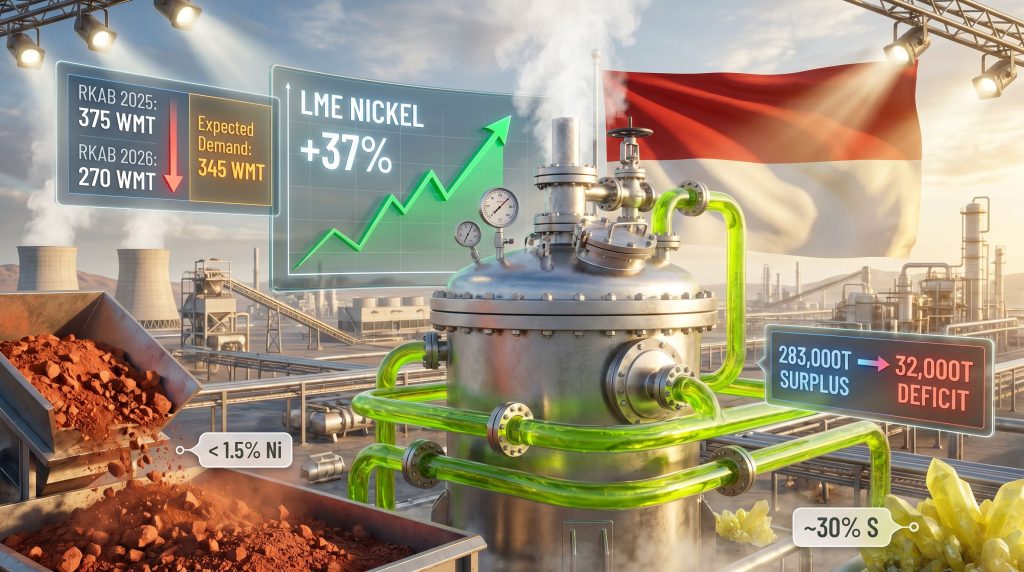
| Metric | 2025 | 2026 | Why it matters |
|---|---|---|---|
| RKAB allocation | 375 wet metric tonnes | 270 wet metric tonnes | Lower approved mining volumes reduce ore flexibility for processors |
| Expected ore demand | n/a | 345 wet metric tonnes | Indicates a gap between planned supply and processing needs |
| LME nickel price move | Baseline late Dec 2025 | +37% by April 2026 | Suggests the market repriced supply durability |
| INSG market balance | 283,000-tonne surplus | 32,000-tonne deficit | A sharp balance swing implies tighter market conditions |
| Typical ore grade trend in many producing areas | Under pressure | Below 1.5% Ni in many areas | Lower grade usually means higher acid and operating intensity |
| Sulphide ore chemistry contrast | Project-specific | Some sulphide ores contain roughly 30% sulfur | Can support internal acid generation in some process routes |
Indonesia is not just a large ore supplier. It has become a price-setting jurisdiction for large parts of the nickel market because it dominates the supply chain most closely linked to laterite processing and battery raw materials. In addition, this reinforces the wider discussion around Indonesia nickel challenges.
That influence reaches across several layers:
- Ore availability, because mine output depends on approved production volumes under the RKAB system
- Refining economics, because many Indonesian assets rely on HPAL or related processing pathways with high reagent intensity
- Battery supply assumptions, because laterite-derived nickel intermediates are embedded in many forward supply forecasts
- Marginal pricing, because the cost of the highest-cost necessary tonnes often helps anchor the market
This is why policy changes in Indonesia ripple through global nickel sentiment. When costs rise there, the market is not simply losing cheap ore. It may be losing supply that previously sat near the marginal cost of balance.
Official Indonesian mining ministry materials, LME pricing, and International Nickel Study Group data remain useful reference points. Moreover, industry commentary on the revised ore price policy helps explain how benchmark pricing is flowing into producer costs.
## How HPAL works and why it is unusually exposed
HPAL is a hydrometallurgical process used to extract nickel and cobalt from laterite ores. In simple terms, ore is mixed with sulphuric acid and processed under high pressure and temperature so the target metals dissolve and can later be recovered.
That sounds straightforward. However, HPAL economics are fragile because several variables must work together at once:
- Ore grade must be adequate
- Acid supply must be reliable
- Plant throughput must stay steady
- Maintenance must be tightly managed
- Logistics must function smoothly
A typical HPAL cost stack includes:
- Ore mining and haulage
- Sulphuric acid consumption
- Power and fuel
- Maintenance and equipment reliability
- Tailings handling and environmental compliance
- Royalties and benchmark-linked ore pricing
The crucial point is that acid is not a discretionary input. HPAL operators cannot easily substitute away from it when prices spike. For readers less familiar with the metal itself, understanding nickel properties and uses helps clarify why these processing routes matter to industrial and battery markets.
HPAL cost sensitivity, simplified
- Lower ore grade means more material must be mined and processed.
- More material throughput generally increases acid use per tonne of nickel recovered.
- If acid is imported, freight and shipping disruption add another layer of cost risk.
- If ore quotas tighten at the same time, plants have less flexibility to optimise throughput.
- The result is a rapidly rising production cost floor.
## Which Indonesian policy changes are squeezing HPAL economics in 2026
The best way to understand the 2026 shift is as stacked policy pressure rather than a single rule change. As a result, Indonesia nickel policy tightening and HPAL costs should be analysed together.
### RKAB quotas as a throughput constraint
Indonesia’s RKAB system governs how much ore can be mined under government-approved plans. The 2026 allocation of 270 wet metric tonnes sits below both the 375 wet metric tonnes allocated in 2025 and the 345 wet metric tonnes expected demand cited in the research.
That gap matters because HPAL plants need predictable ore flow. Reduced mine approvals can affect volumes, blending flexibility, and planning confidence. In addition, shorter approval visibility can undermine capital allocation and procurement decisions.
### Benchmark pricing and fiscal pressure
The HPM benchmark pricing mechanism has become more relevant to processing economics. If benchmark-linked ore prices rise, HPAL plants face higher feed costs before acid, energy, and maintenance are even counted. On top of that, tiered royalty adjustments can compress margins further.
An export tax risk has also been discussed in market commentary. However, unless confirmed in official policy, it remains more a scenario than a settled fact. Even so, commentary on policy changes for western nickel companies shows how investors are already reassessing competitive positioning.
### Why the overlap matters
A quota cut on its own can hurt. A royalty increase on its own can hurt. Higher benchmark pricing can hurt. Yet when all of them apply together, the effect becomes multiplicative rather than additive. Therefore, HPAL becomes less resilient because every major cost lever is moving in the same adverse direction.
## Why sulphuric acid prices are central to Indonesian HPAL costs
Sulphuric acid is the non-negotiable reagent in the HPAL chain. If domestic acid production is insufficient, import dependence turns a plant-level chemical requirement into a geopolitical and shipping risk.
The supplied research points to two major disruptions in early 2026:
- Closure of the Strait of Hormuz
- A Chinese sulphuric acid export ban
Together, these reportedly lifted delivered acid costs and increased shortage risk for Indonesian HPAL producers. Even if those specific events ease, the larger lesson remains clear: a system dependent on imported reagent carries structural logistics exposure.
| Processing route | Acid source | Freight disruption exposure | Export restriction exposure | Margin sensitivity | Ability to mitigate quickly |
|---|---|---|---|---|---|
| Indonesian laterite HPAL with imported acid | Imported | High | High | High | Low to moderate |
| Integrated route with domestic acid supply | Domestic/internal | Lower | Lower | Moderate | Moderate |
| Sulphide-linked process with internal acid generation potential | Ore chemistry linked | Low | Low | Lower | Higher relative resilience |
This is not just chemistry risk. It is supply-chain risk embedded inside metallurgy. That is also why many investors now connect nickel economics to the broader battery metals investment landscape.
## How lower ore grades amplify HPAL cost inflation
Ore grade is one of the least visible but most powerful drivers of nickel processing costs. If many producing areas are now operating below 1.5% nickel, each tonne of ore contains fewer payable nickel units.
That generally means:
- More ore must be mined
- More material must be crushed, slurried, and processed
- Acid consumption rises per unit of nickel recovered
- Energy and waste handling intensity increase
- Unit costs trend higher even if the plant runs efficiently
Key insight: deteriorating ore grade can push HPAL economics into a zone where acid intensity and recovery pressure worsen faster than management teams can offset through routine efficiency gains.
This is a geological problem, not simply an operational one. Consequently, the distinction matters for investors because geological decline can persist even if prices recover or policy pressure softens.
## Temporary disruption or structural reset
A useful framework is to separate cyclical shocks from structural changes.
| Factor | Mostly cyclical or structural? | Why |
|---|---|---|
| Shipping disruption | Partly cyclical | Can ease, but may recur |
| Export restrictions on acid | Policy-sensitive | Can reverse, but not instantly |
| Ore grade decline | Structural | Geological trend, not easily reversed |
| Stricter quota governance | Structural if sustained | Changes planning visibility and throughput assumptions |
| Benchmark and royalty reform | Structural while in force | Directly affects recurring costs |
The market reaction suggests traders are not treating this as a passing inconvenience. The LME nickel price rose 37% from late December 2025 to April 2026, and the INSG balance shifted from a 283,000-tonne surplus in 2025 to a 32,000-tonne deficit in 2026.
That is a significant swing. It implies the market is reassessing supply durability and the cost of the marginal tonne. Furthermore, this matters for downstream users tied to long-term battery storage demand, where reliable raw material supply is increasingly valuable.
## How the global nickel cost curve is being redrawn
Commodity markets are often set by the cost of the highest-cost supply still required to balance demand. If Indonesian HPAL costs rise, that marginal cost threshold can rise with them. In that sense, Indonesia nickel policy tightening and HPAL costs are reshaping the global cost floor.
Not all nickel production routes respond in the same way:
| Route | Feedstock type | Main cost sensitivities | Reagent dependency | Grade decline exposure | Indonesia policy exposure |
|---|---|---|---|---|---|
| Indonesian HPAL | Laterite | Ore quotas, acid, energy, royalties | Very high | High | Very high |
| RKEF/NPI pathways | Laterite | Energy, ore supply, policy | Lower than HPAL | Moderate | High |
| Sulphide concentrate to refined nickel | Sulphide | Mining cost, concentrate quality, smelting/refining terms | Lower | Variable | Low |
| Integrated sulphide hydromet routes | Sulphide | Metallurgy, capital intensity, by-product credits | Often lower than HPAL | Variable | Low |
This is where process architecture becomes critical. Some sulphide systems are better insulated because their ore chemistry can reduce reagent import dependence. The supplied research highlights one example of a sulphide orebody containing about 30% sulfur, allowing acid to be generated internally during processing.
## What this means for battery supply chains and investors
For downstream buyers, tighter laterite-to-battery economics may change procurement behaviour. Instead of focusing only on the lowest nominal feed cost, buyers may place a higher premium on secure, repeatable, and chemically resilient supply.
Likely responses include:
- Long-term offtake agreements
- Upstream equity stakes in supply assets
- Diversified sourcing across laterite and sulphide routes
- Greater use of recycling where chemistry allows
- Hedging of reagent and freight exposure
For investors and industry observers, a practical due diligence checklist is often more useful than a simple bullish or bearish call:
- What ore grade is actually assumed?
- How much acid is needed per tonne of nickel output?
- Is acid imported, locally contracted, or internally generated?
- How exposed is the operation to quota resets or benchmark pricing changes?
- What royalty assumptions are embedded in project economics?
- How much margin remains at current nickel prices?
## Key takeaways on Indonesia nickel policy tightening and HPAL costs
Indonesia nickel policy tightening and HPAL costs matter because they change the economics of the world’s most important laterite processing hub.
The main conclusions are clear:
- Indonesia’s 2026 RKAB allocation of 270 wet metric tonnes sits below expected demand of 345 wet metric tonnes
- HPAL is especially vulnerable because it depends on stable ore supply, heavy sulphuric acid use, and manageable ore grades
- Ore grades below 1.5% in many producing areas worsen acid intensity and unit costs
- The reported 37% LME nickel rally and INSG shift to a 32,000-tonne deficit suggest markets are pricing durable tightening
- Processing routes with lower reagent dependence or internal acid generation may prove more resilient
This article is for educational purposes only and does not constitute financial advice.
## FAQs
### What is Indonesia’s RKAB system in nickel mining?
It is a government approval mechanism that sets how much ore miners are permitted to extract over the approval period.
### Why does HPAL require so much sulphuric acid?
Because the process uses sulphuric acid to dissolve nickel and cobalt from laterite ore under heat and pressure.
### Why do lower nickel grades push HPAL costs higher?
Lower grades mean more ore must be processed to recover the same nickel units. As a result, acid consumption, energy use, and waste handling intensity usually rise.
### Did Indonesia’s 2026 policy tightening affect global nickel prices?
The supplied market data suggests it likely contributed to tighter supply expectations, alongside acid supply disruption and broader logistics stress.
### Are all nickel producers affected equally?
No. Operations with stronger ore quality, lower reagent dependence, or integrated processing can be less exposed than laterite HPAL plants dependent on imported acid.
Want Early Insight Into The Next Major ASX Discovery?
Discovery Alert’s proprietary Discovery IQ model delivers real-time alerts on significant ASX mineral discoveries, helping investors spot actionable opportunities across battery metals and beyond before the broader market reacts. See how major discoveries have historically driven exceptional returns on Discovery Alert’s discoveries page and start a 14-day free trial at the Discovery Alert home page.