July 15, 2026
The Economic Foundation: Understanding Australia's Indigenous Procurement Revolution
Australia's resources sector has emerged as the primary commercial driver of Indigenous business development, fundamentally reshaping economic opportunities across the continent. The framework governing this transformation centers on Supply Nation's certification architecture, where businesses must demonstrate 51% or greater Indigenous ownership, management, and control to achieve Certified Supplier status.
This ownership threshold represents more than administrative compliance—it reflects a strategic policy alignment between federal government reforms and commercial sector engagement. The distinction between Certified Suppliers (51%+ ownership) and Registered Suppliers (50%+ ownership) creates a tiered system that procurement decision-makers increasingly favour at the higher threshold level.
The regulatory architecture supporting Indigenous business certification encompasses comprehensive due diligence frameworks, capability assessments, and ongoing compliance monitoring. These systems ensure that mining leads in indigenous business growth through verified, sustainable partnerships rather than superficial engagement initiatives.
Supply Nation's verification processes require detailed documentation of ownership structures, governance arrangements, and operational control mechanisms. This rigorous approach has established market confidence among procurement professionals, particularly in capital-intensive sectors like mining where supply chain reliability remains paramount.
When big ASX news breaks, our subscribers know first
Mining's Unprecedented Procurement Leadership Achievement
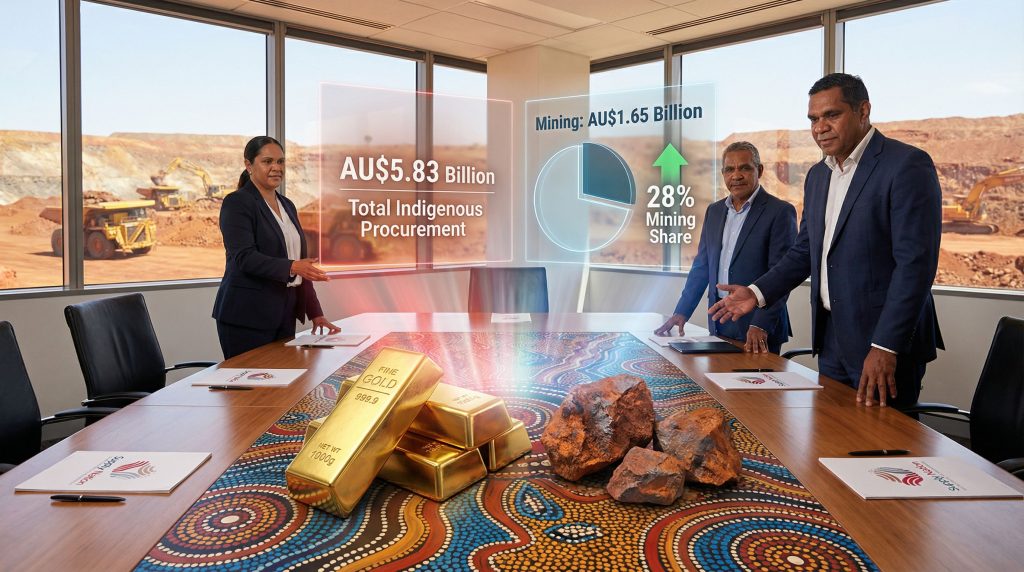
The mining sector's AU$1.65 billion Indigenous procurement expenditure during 2024-25 positions resources companies as Australia's most significant Indigenous business development catalyst. This figure surpasses construction's AU$1.26 billion and government departments' AU$1.53 billion, demonstrating private sector leadership in Indigenous economic empowerment.
Mining's 28.3% market share of total Indigenous procurement spending reflects systematic industry transformation rather than isolated corporate initiatives. The sector's procurement leadership emerges from operational necessities in remote regions where Indigenous communities maintain traditional connections and contemporary business capabilities.
Year-over-year growth trajectories reveal mining's sustained commitment despite broader economic uncertainties. Kate Russell from Supply Nation emphasised how procurement partners continued seeking commercial collaboration opportunities during challenging periods characterised by trade disruptions, economic volatility, and cost-of-living pressures.
The overwhelming preference for Certified Suppliers across mining operations indicates strategic alignment with federal government reforms elevating Indigenous business definitions to 51% ownership thresholds. This policy-commercial convergence validates regulatory frameworks while demonstrating industry leadership in Indigenous economic development.
Mining Procurement by Value Categories
| Sector | Procurement Value | Market Share | Growth Trajectory |
|---|---|---|---|
| Mining | AU$1.65 billion | 28.3% | Leading sector |
| Government | AU$1.53 billion | 26.2% | Policy-driven |
| Construction | AU$1.26 billion | 21.6% | Infrastructure-focused |
| Other Industries | AU$1.39 billion | 23.9% | Diverse sectors |
Mining's procurement leadership extends beyond absolute spending figures to encompass transformational business development models. The sector's engagement with Indigenous enterprises creates sustainable economic pathways that transcend traditional employment relationships, fostering entrepreneurship and business ownership across traditional territories.
Regional Distribution Dynamics and Economic Geography
Western Australia and New South Wales command the highest Indigenous procurement spending levels, reflecting these states' mining industry concentration and Indigenous business development infrastructure. However, the 82% urban versus 18% remote and rural supplier distribution reveals complex geographic dynamics within Indigenous procurement ecosystems.
This distribution pattern doesn't necessarily indicate where procurement activities occur, but rather where Indigenous businesses maintain operational headquarters and administrative functions. Mining operations in remote locations frequently contract with urban-based Indigenous enterprises for specialised services, creating spatial disconnects between extraction sites and business registration locations.
The 18% remote and rural supplier engagement represents significant economic activity considering the smaller population bases and business infrastructure in these regions. Furthermore, remote area Indigenous businesses often provide services directly connected to traditional territories, including environmental monitoring, cultural heritage management, and land access facilitation.
Mining operations create unique economic multiplier effects in remote regions through infrastructure development, accommodation requirements, transportation networks, and environmental management services. These secondary opportunities enable Indigenous businesses to develop capabilities across multiple service categories while maintaining connections to traditional territories.
"The geographic concentration of Indigenous business registration in urban centres reflects access to business development support, professional services, and capital markets, while remote operations provide direct economic opportunities through traditional territory connections."
Regional economic development models emerging from mining-Indigenous partnerships demonstrate how resource extraction can generate sustainable business opportunities beyond direct employment. These partnerships create pathways for Indigenous communities to participate in economic development while maintaining cultural connections and traditional governance structures.
Women's Leadership in Indigenous Mining Enterprises
Women-led Indigenous businesses captured AU$1.52 billion in procurement spending during 2024-25, representing 26.1% of total Indigenous business engagement. This substantial figure demonstrates significant female entrepreneurship and leadership presence across procurement ecosystems serving mining operations.
The concentration of women-led businesses in Indigenous procurement reflects broader trends toward female entrepreneurship in Australia's Indigenous communities. These enterprises span multiple service categories, from professional consulting and environmental services to equipment supply and logistics coordination.
Mining sector engagement with women-led Indigenous businesses creates leadership development opportunities through mentorship programmes, capacity building initiatives, and long-term contract relationships. Major mining operators increasingly recognise women-led enterprises as strategic suppliers capable of delivering specialised services across complex operational environments.
Female leadership in Indigenous mining businesses often combines traditional knowledge systems with contemporary business practices, creating unique value propositions for mining companies seeking culturally informed approaches to community engagement, environmental management, and stakeholder consultation.
What Are the Key Success Metrics for Women-Led Indigenous Mining Businesses?
• Financial Performance: AU$1.52 billion procurement capture demonstrates market leadership
• Market Representation: 26.1% share indicates strong competitive positioning
• Sector Diversity: Engagement across equipment supply, environmental services, and professional consulting
• Growth Trajectory: Year-over-year expansion aligned with total Indigenous procurement growth
• Leadership Development: Mentorship and capacity building programme participation
Moreover, women mining leadership in Indigenous businesses demonstrates how gender diversity intersects with Indigenous economic development to create innovative business models. These enterprises frequently emphasise sustainable practices, community consultation, and holistic approaches to resource development that align with environmental, social, and governance (ESG) frameworks adopted by major mining operators.
Mining Subsector Analysis and Service Categories
The AU$1.65 billion mining sector Indigenous procurement encompasses diverse commodity types and operational categories, though specific subsector breakdowns require careful analysis beyond aggregate figures. Iron ore operations in Western Australia, coal mining in New South Wales and Queensland, and gold extraction across multiple states each create distinct Indigenous business opportunities.
Primary resource extraction operations generate Indigenous business engagement through equipment supply partnerships, maintenance contracting, and specialised technical services. These relationships often develop from proximity to traditional territories where Indigenous enterprises possess unique geographic knowledge and community relationships essential for operational success.
Environmental monitoring and rehabilitation services represent rapidly growing categories for Indigenous businesses in mining. Traditional ecological knowledge combined with contemporary environmental science creates competitive advantages for Indigenous enterprises in habitat restoration, water quality monitoring, and biodiversity assessment services.
Indigenous Business Service Categories in Mining
Equipment Supply and Maintenance
- Heavy machinery supply partnerships
- Specialised equipment rental agreements
- Preventive maintenance contracting
- Component supply and logistics coordination
Environmental and Heritage Services
- Cultural heritage assessment and management
- Environmental impact monitoring
- Rehabilitation and remediation services
- Traditional ecological knowledge consultation
Professional and Technical Services
- Engineering consulting and design
- Surveying and mapping services
- Legal and regulatory compliance support
- Community engagement and consultation
Logistics and Transportation
- Personnel transportation services
- Equipment and material logistics
- Remote area supply coordination
- Emergency response and medical services
In addition, critical minerals transition activities, including lithium, rare earth elements, and battery materials extraction, create emerging opportunities for Indigenous businesses with specialised capabilities. These newer commodities often require enhanced environmental monitoring and community consultation, areas where Indigenous enterprises demonstrate competitive advantages.
Certification Standards and Mining Procurement Integration
Supply Nation's certification framework has achieved remarkable adoption across mining operations, with procurement data demonstrating overwhelming preference for Certified Suppliers meeting 51% Indigenous ownership requirements. This alignment supports recent federal government reforms while establishing clear standards for mining industry compliance.
The certification process requires comprehensive documentation of ownership structures, management control mechanisms, and operational governance arrangements. Mining companies utilise these verification frameworks to ensure supply chain compliance while mitigating risks associated with Indigenous business engagement misrepresentation.
Due diligence processes employed by mining operators typically encompass financial capability assessments, technical competency evaluations, and cultural authenticity verification. These multi-dimensional assessments ensure Indigenous businesses possess both commercial capabilities and authentic Indigenous ownership structures required for meaningful partnership development.
Quality assurance protocols integrated into mining procurement systems create accountability frameworks benefiting both Indigenous suppliers and mining operators. Standardised assessment criteria enable fair evaluation while protecting Indigenous businesses from discriminatory practices that might otherwise limit market access.
"Mining industry adoption of rigorous certification standards demonstrates how private sector leadership can drive policy implementation while creating sustainable business development opportunities for Indigenous enterprises."
The integration of Indigenous procurement requirements with ESG reporting frameworks creates additional incentives for mining companies to engage Certified Suppliers. Sustainability reporting standards increasingly require detailed Indigenous engagement metrics, making certified supplier relationships valuable for regulatory compliance and stakeholder reporting.
The next major ASX story will hit our subscribers first
Economic Development Models and Partnership Structures
Mining-Indigenous partnerships have evolved beyond traditional contractor-client relationships toward sophisticated joint venture structures, equity participation arrangements, and revenue-sharing frameworks. These models enable Indigenous communities to participate directly in resource development while maintaining cultural governance systems.
Joint venture partnerships between mining operators and Indigenous enterprises create pathways for technology transfer, skills development, and capital accumulation. These arrangements often combine mining company operational expertise with Indigenous businesses' traditional knowledge and community relationships.
Equity participation models allow Indigenous communities to acquire ownership stakes in mining projects, creating long-term economic benefits extending beyond operational timeframes. Consequently, revenue-sharing agreements provide predictable income streams supporting community development initiatives and business expansion opportunities.
Capacity building programmes integrated into mining-Indigenous partnerships encompass technical training, business development support, and leadership development initiatives. These comprehensive approaches address historical barriers while building sustainable Indigenous business capabilities across multiple generations.
Partnership Model Categories
-
Service Contracting: Traditional supplier relationships with Indigenous businesses
-
Joint Ventures: Shared ownership structures combining resources and expertise
-
Equity Participation: Indigenous ownership stakes in mining operations
-
Revenue Sharing: Negotiated benefit distribution from mining activities
-
Capacity Building: Training and development programme partnerships
Traditional knowledge integration represents a unique value proposition in mining-Indigenous partnerships. Environmental management practices, sustainable resource extraction methods, and community consultation approaches developed through generations of traditional land management create competitive advantages for mining operations.
Cross-Industry Comparative Analysis and Market Position
Mining's AU$1.65 billion Indigenous procurement expenditure surpasses government departments' AU$1.53 billion despite government's strategic focus on Indigenous business development through targeted procurement policies. This private sector leadership demonstrates commercial viability of Indigenous business engagement beyond policy compliance requirements.
Construction sector procurement of AU$1.26 billion reflects infrastructure development activities but lacks mining's geographic reach into remote Indigenous territories. Government procurement, while substantial, operates within policy frameworks that may limit innovative partnership development compared to private sector flexibility.
The total Indigenous procurement market of AU$5.83 billion represents a 26.7% increase from the previous year's AU$4.6 billion, with mining contributing proportionally to this growth trajectory. However, this expansion occurs despite economic headwinds including trade disruptions and cost-of-living pressures affecting broader business environments.
Long-term sustainability analysis reveals mining's Indigenous procurement leadership stems from operational necessities rather than purely philanthropic motivations. Remote operations require local partnerships, specialised services, and community relationships that Indigenous businesses are uniquely positioned to provide.
Market Growth Drivers by Industry
| Factor | Mining | Government | Construction |
|---|---|---|---|
| Policy Compliance | Moderate | High | Moderate |
| Operational Necessity | High | Low | Moderate |
| Geographic Requirements | High | Variable | Moderate |
| Specialised Services | High | Moderate | Moderate |
| Community Relationships | High | Moderate | Low |
International best practice adoption increasingly influences Australian mining companies' Indigenous engagement strategies. Comparative analysis with Canadian, South African, and Chilean mining industries reveals Australia's leadership in systematic Indigenous business development through procurement-focused approaches.
Future Growth Trajectories and Market Expansion
Conservative growth projections suggest 15% annual expansion maintaining current Indigenous procurement trajectories, while optimistic scenarios incorporating expanded certification programmes and policy support could achieve 25% growth rates. Mining sector leadership positions the industry to drive continued market expansion.
The ongoing mining industry evolution presents substantial opportunities for Indigenous business expansion as Australia develops supply chains for battery materials, rare earth elements, and strategic minerals. These emerging commodities often require enhanced environmental and community consultation services where Indigenous enterprises demonstrate competitive advantages.
Technology integration creates new service categories for Indigenous businesses, including drone-based environmental monitoring, digital mapping services, and remote sensing applications. These technological capabilities combined with traditional knowledge systems create unique value propositions for mining operations.
Policy environment evolution, including potential changes to Indigenous business definitions, certification requirements, or procurement targets, will significantly influence market development. Current alignment between 51% ownership thresholds and commercial preferences suggests stable regulatory frameworks supporting continued growth.
Growth Opportunity Categories
Emerging Commodities
- Lithium and battery materials extraction
- Rare earth element processing
- Critical minerals development
- Renewable energy infrastructure
Technology Integration
- Environmental monitoring systems
- Digital surveying and mapping
- Remote sensing applications
- Data analysis and reporting services
Regional Expansion
- Northern Territory mining development
- Tasmania mineral exploration
- South Australian resource projects
- Offshore territory opportunities
Market expansion potential extends beyond Australian borders as mining companies operating internationally seek to replicate successful Indigenous engagement models developed domestically. This international expansion could create export opportunities for Indigenous businesses with proven capabilities in mining sector services.
Strategic Implications for Mining Industry Optimisation
Mining companies can optimise Indigenous business integration through early engagement during project development phases, ensuring Indigenous enterprises participate in planning rather than only operational stages. This proactive approach creates more meaningful partnerships while addressing potential community concerns before they escalate.
Supplier development programmes that provide mentoring, technical assistance, and capacity building support enable Indigenous businesses to scale capabilities matching mining industry requirements. These investments create sustainable supplier relationships while building Indigenous business capabilities across multiple projects.
Long-term contract structures that provide predictable revenue streams enable Indigenous businesses to invest in equipment, training, and expansion opportunities. For instance, multi-year agreements create stability supporting business development while ensuring mining companies maintain reliable supplier relationships.
Performance measurement frameworks incorporating both commercial metrics and social impact indicators provide comprehensive assessment approaches. These balanced scorecards enable mining companies to demonstrate ESG compliance while ensuring Indigenous suppliers meet operational requirements.
"Strategic Indigenous business integration requires long-term commitment, systematic capacity building, and recognition that sustainable partnerships create mutual benefits extending beyond immediate procurement requirements."
How Can the Mining Industry Maintain Growth Leadership?
The evidence demonstrates that mining leads in indigenous business growth through systematic, commercially viable engagement models that create sustainable economic opportunities. With AU$5.83 billion in total Indigenous procurement spending and mining's AU$1.65 billion leadership position, the sector has established frameworks for continued expansion supporting Indigenous economic sovereignty.
Furthermore, the WA mining conference provides crucial platforms for developing these partnerships, whilst current iron ore price trends influence the financial capacity for expanded Indigenous business engagement.
Recent analysis of indigenous business growth confirms mining's transformative impact while meeting operational requirements across Australia's diverse resource extraction landscape. The sector's leadership in mining leads in indigenous business growth continues driving national economic development through authentic, commercially viable partnerships.
Ready to Identify the Next Major Mining Discovery?
Discovery Alert's proprietary Discovery IQ model delivers real-time notifications on significant ASX mineral discoveries, helping investors capitalise on breakthrough announcements before the broader market responds. Explore how major mineral discoveries can generate substantial returns by examining the historic successes showcased on Discovery Alert's discoveries page.