July 15, 2026
When a Single Waterway Holds a Nation's Kitchens Hostage
Energy security planners have long understood that the most dangerous vulnerabilities are not the ones that appear suddenly, but the ones that build quietly over decades, hidden behind the comfort of uninterrupted supply. India LPG imports from the Gulf at risk due to Strait of Hormuz conflict represent precisely this kind of slow-motion structural risk. For years, the country's cooking gas supply chain functioned without incident, even as its geographic concentration deepened. Then, in mid-2026, the Strait of Hormuz became a flashpoint, and a vulnerability that had been systematically underweighted in national energy planning became impossible to ignore.
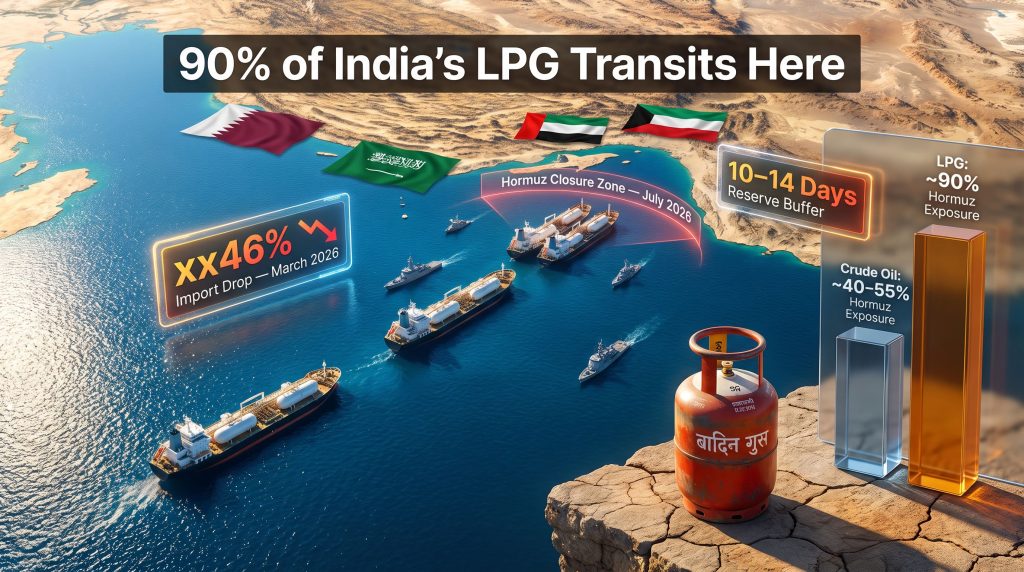
The crisis has exposed something that crude oil import data had long obscured: India's LPG import exposure to the Strait of Hormuz is dramatically more concentrated than its oil exposure. While roughly 40 to 55 percent of India's crude oil imports transit Hormuz, the figure for LPG sits at approximately 90 percent. This asymmetry matters enormously, because imported LPG accounts for around 60 percent of India's total domestic cooking gas consumption. A disruption to the strait does not merely raise prices — it threatens to empty cylinders in hundreds of millions of households.
When big ASX news breaks, our subscribers know first
The Architecture of a Chokepoint Dependency
The Strait of Hormuz is a narrow maritime corridor, roughly 33 kilometres wide at its most constricted point, connecting the Persian Gulf to the Arabian Sea. It represents the only viable deep-water exit for energy exports from Qatar, Kuwait, the UAE, Saudi Arabia, and Iran. Collectively, these nations account for the overwhelming majority of India's LPG import volumes. Understanding these energy transport chokepoints is essential for assessing the full scale of structural risk facing Asian energy importers.
At peak flow, an estimated 20 to 21 million barrels of oil equivalent in energy products — including crude oil, LPG, and LNG — transit the strait daily. There is no alternative routing that can replicate Hormuz-based delivery timelines or volumes at comparable cost. Overland pipelines capable of bypassing the strait do not exist at the scale required, and the logistical cost of rerouting around the Cape of Good Hope or through alternative Pacific corridors makes such options commercially prohibitive for time-sensitive LPG cargoes.
What makes India's LPG exposure uniquely acute is the geographic concentration of its suppliers. The country's cooking gas import base is dominated by four Gulf nations: Qatar, Saudi Arabia, the UAE, and Kuwait. All four route their LPG shipments through the same waterway. Furthermore, unlike crude oil — where India has gradually built supply relationships with African producers, Russian exporters, and US suppliers — LPG diversification has lagged significantly behind consumption growth.
The 2026 Escalation: What Happened and When
The current crisis traces its origins to a US-Iran conflict that began on February 28, 2026. For several months, LPG flows were disrupted but not catastrophically severed. The situation deteriorated sharply in July 2026, when Iran formally declared the Strait of Hormuz closed to international shipping. The US responded by announcing a resumption of its naval blockade of Iran and committing military assets to keeping the waterway open, according to reporting by ET EnergyWorld.
The Houthi movement in Yemen — an Iranian-aligned force that had remained largely inactive since the conflict's onset — entered the theatre by launching missile strikes against Saudi Arabia. The Houthis cited Saudi airstrikes on Sana'a airport as justification, a claim that Saudi Arabia contested. The involvement of a third actor introduced a new layer of unpredictability: even if US-Iran negotiations were to produce a ceasefire, Houthi operational autonomy creates a residual threat to Gulf shipping that is not easily resolved through bilateral diplomacy.
Adding a further dimension of complexity, US President Donald Trump proposed a 20 percent transit charge on all cargo passing through the Strait of Hormuz. Industry executives, as reported by ET EnergyWorld, estimated this levy would add approximately $15 per barrel to the cost of Gulf crude at current prices. The economic logic of the proposal has been questioned by market participants, who note that a $15 per barrel premium would render Gulf crude structurally uncompetitive against Atlantic Basin, African, and US supplies for many buyers.
The tariff-driven market disruption created by this proposed toll — layered on top of an already acute supply crisis — has further destabilised long-term procurement planning across Asian LPG markets. The practical enforceability of such a toll, given the multilateral opposition it would likely generate, remains deeply contested.
Industry executives have noted that the proposed Hormuz transit levy creates a fundamental economic paradox: a cost premium large enough to discourage buyers from ordering Gulf crude would simultaneously undermine the commercial rationale for producers to ship through the strait at all, raising serious questions about whether the measure could ever be coherently implemented.
The Numbers Behind the Crisis: How Deep Is the Import Collapse?
The scale of India's LPG import disruption in early 2026 is striking. The following table summarises the key metrics that define the crisis window:
| Metric | Value |
|---|---|
| India LPG imports, March 2026 | ~1.22 million tonnes |
| Decline versus January 2026 levels | ~46% |
| Decline versus February 2026 levels | ~40% |
| Domestic LPG reserve buffer | 10 to 14 days |
| Potential unmet demand window | 2 to 3 weeks |
| Indian vessels stranded in the Gulf | ~20 ships, including 5 LPG carriers |
A 46 percent collapse in import volumes within a single quarter represents an extraordinary supply shock for any commodity. For LPG, which functions as the primary cooking fuel for a significant share of India's population, the consequences are not abstract — they translate directly into cylinder shortages at the household level.
What makes the situation particularly precarious is the absence of any meaningful strategic buffer. India maintains a Strategic Petroleum Reserve for crude oil, but there is no equivalent emergency stockpile for LPG. The country's current reserve buffer, estimated at just 10 to 14 days of consumption, provides an extremely narrow window before rationing protocols become unavoidable.
Domestic refineries do offer some mitigation capacity, but it is limited. Indian refiners can increase LPG output by approximately 10 to 20 percent under normal operating conditions, covering an estimated 47 to 50 percent of total household demand at best. Even the emergency production surge achieved in March 2026 — which exceeded 30 percent above baseline output — could not compensate for the full magnitude of the import shortfall. The arithmetic is unambiguous: domestic swing capacity alone cannot solve a crisis of this scale.
Finding Alternative Supply: A Geography Problem as Much as a Policy Problem
India has moved rapidly to activate non-Gulf LPG supply corridors; however, each alternative comes with its own set of constraints.
Primary alternative suppliers being approached:
- United States: The most scalable near-term option, with growing LPG export capacity from Gulf Coast terminals. However, longer shipping distances from the US Gulf Coast to Indian ports add both time and cost to landed prices.
- Norway: A secondary European option with established LPG export infrastructure, though aggregate volume capacity is insufficient to meaningfully replace Gulf supply at India's scale of requirement.
- Canada: Viable in principle, but constrained by Pacific export terminal capacity and routing logistics that add transit time compared to Middle East cargoes.
- Russia: Being explored as a cost-competitive alternative, though sanctions compliance considerations and geopolitical sensitivities add layers of commercial and legal complexity.
The most diplomatically charged development in the diversification effort has been India's emergency procurement of LPG from Iran. A tanker originally destined for Chinese buyers was redirected to Indian purchasers during the crisis period, marking India's first LPG cargo from Iran in several years. The Ministry of External Affairs has simultaneously been engaged in diplomatic negotiations with Tehran to secure passage rights for the approximately 20 Indian vessels stranded in the Gulf, including 5 LPG carriers.
The decision to source emergency LPG from Iran places India in a structurally awkward position relative to its strategic partnership with the United States, which maintains an active sanctions framework around Iranian energy exports. New Delhi's ability to manage both relationships simultaneously will be a defining test of its energy diplomacy in the second half of 2026.
The True Cost of the Proposed Hormuz Toll
The proposed 20 percent transit charge deserves analysis beyond its headline figure. The table below models the differential cost impact across India's key energy import categories:
| Energy Type | India's Hormuz Dependency | Estimated Cost Impact |
|---|---|---|
| LPG | ~90% | Near-total exposure; highest vulnerability |
| Crude Oil | ~40 to 55% | Moderate; partial diversification possible |
| LNG | Significant | High; Qatar is India's primary LNG supplier |
For LPG specifically, the toll compounds an already acute supply shortage. Higher per-unit costs layered on top of constrained import volumes create a dual-pressure scenario for downstream distributors and, ultimately, for the subsidised household cylinder distribution system that India's government operates through state-owned oil marketing companies. India's LNG import structure faces similarly acute exposure, given Qatar's dominant role as a LNG supplier routing through the same corridor.
If the toll were enforced, it would accelerate a longer-term structural shift in India's energy import geography, making Gulf crude and LPG less competitive relative to US, African, and Australian energy exports. Whether this outcome would serve the policy objectives of either Washington or Riyadh is far from clear.
The next major ASX story will hit our subscribers first
Three Structural Vulnerabilities the Crisis Has Exposed
The 2026 Hormuz disruption has functioned as a stress test for India's energy security architecture, and the results have identified three specific structural weaknesses requiring policy attention.
1. No Strategic LPG Reserve
India operates a Strategic Petroleum Reserve covering crude oil, with storage capacity at underground facilities in Visakhapatnam, Mangalore, and Padur. There is no equivalent infrastructure for LPG. Establishing a 30-day strategic LPG buffer modelled on crude oil reserve frameworks would require investment in pressurised storage at key port terminals, including Kandla, Nhava Sheva, and Kochi. The capital cost would be substantial, but the alternative is accepting a structural 10 to 14 day crisis window every time Persian Gulf tensions escalate.
2. Over-Concentration in Gulf Supply Relationships
India's LPG import base remains dominated by four countries, all routing through the same chokepoint. Building structural supply relationships with US LPG exporters, Australian North West Shelf and Gorgon facilities, and East African producers would reduce single-corridor dependency in a way that emergency procurement cannot. Long-term supply agreements with non-Gulf producers, even at a modest price premium to spot Gulf cargoes, would provide the diversification buffer that the current crisis has demonstrated is urgently needed.
3. Limited Domestic Refinery Swing Capacity
Indian refineries face processing constraints that cap LPG yield increases at 10 to 20 percent above baseline output. Investment in dedicated LPG recovery units at major refining complexes would expand the domestic production ceiling, providing a larger buffer against import disruptions. This is a medium-term infrastructure priority, not an immediate solution, but the 2026 crisis has provided the clearest possible justification for accelerating such investment.
How India Compares to Other Asian LPG Importers
India's vulnerability profile looks significantly more exposed when placed alongside its regional peers:
| Country | LPG Gulf Import Dependency | Strategic Reserve Buffer | Diversification Status |
|---|---|---|---|
| India | ~90% via Hormuz | 10 to 14 days | Limited; actively diversifying |
| China | ~50 to 60% via Hormuz | 30+ days (estimated) | More diversified (US, Australia) |
| Japan | ~70% via Hormuz | 50+ days (statutory) | Moderate diversification |
| South Korea | ~65% via Hormuz | 40+ days | Moderate diversification |
Japan and South Korea have long maintained statutory reserve requirements that provide buffer windows of 40 to 50 days or more, reflecting lessons absorbed from the 1970s oil shocks. China has prioritised supply diversification more aggressively than India, partly because its scale of LPG demand growth has been accompanied by a more deliberate effort to build non-Gulf supply relationships. Furthermore, the broader trade war impacts reshaping Asian energy procurement have, in some respects, accelerated China's diversification away from single-corridor dependencies. India's combination of high Hormuz dependency and thin strategic reserves places it in the most exposed position among major Asian importers.
Three Scenarios for India's LPG Supply Outlook
Scenario 1: Partial Recovery Under Ceasefire (Base Case)
Maritime traffic resumes at reduced capacity. Indian vessels stranded in the Gulf begin returning to operational status. LPG imports recover to 60 to 70 percent of pre-crisis levels within four to six weeks. Household supply is maintained through a combination of domestic production increases and non-Gulf imports, though at higher cost. The week-long ceasefire observed in mid-July 2026 has not yet translated into meaningful improvement in cooking gas availability, and ceasefire fragility remains a material residual risk.
Scenario 2: Prolonged Conflict with Intermittent Closure (Adverse Case)
LPG imports remain suppressed at 50 to 60 percent of normal volumes for two to three months. Domestic refinery output reaches its operational ceiling. Non-Gulf import volumes cannot fully compensate for the shortfall. Consequently, the government implements rationing protocols for household LPG cylinders. Elevated Brent crude prices add fiscal pressure to the subsidised distribution system operated by state oil marketing companies.
Scenario 3: Full Hormuz Closure and Conflict Escalation (Tail Risk)
All Gulf LPG shipments halt. India's 10 to 14 day reserve buffer is exhausted within two weeks. Emergency imports from the US and Norway cover at most 30 to 40 percent of the shortfall. Severe household supply disruptions emerge in rural and semi-urban areas where LPG is the primary cooking fuel. Government invokes national energy emergency provisions and suspends industrial LPG use to protect household allocations.
Frequently Asked Questions
How much of India's LPG comes through the Strait of Hormuz?
Approximately 90 percent of India's imported LPG transits the Strait of Hormuz. Since imported LPG accounts for around 60 percent of total domestic consumption, a full closure of the strait would directly affect more than half of the country's cooking gas supply.
How much did India's LPG imports fall during the 2026 Hormuz crisis?
India's LPG imports dropped to approximately 1.22 million tonnes in March 2026, representing a decline of roughly 46 percent compared to January 2026 levels and approximately 40 percent below February volumes.
Can India replace Gulf LPG with domestic production?
Only partially. Indian refineries can increase LPG output by approximately 10 to 20 percent, covering an estimated 47 to 50 percent of total domestic demand at best. The emergency 30-plus percent production surge achieved in March 2026 demonstrated the limits of this option.
What alternative LPG suppliers is India approaching?
India is actively sourcing LPG from the United States, Norway, Canada, and Russia, and has secured at least one emergency cargo from Iran. Longer shipping distances, higher landed costs, and limited aggregate volume availability constrain how quickly these sources can replace Gulf supply. The US Energy Information Administration tracks evolving LPG export flows that will be critical in monitoring India's diversification progress.
Does India have a strategic LPG reserve?
No. Unlike crude oil, for which India maintains a Strategic Petroleum Reserve, there is no equivalent emergency stockpile for LPG. India's current buffer is estimated at just 10 to 14 days of consumption, a figure that the International Energy Agency considers critically insufficient by developed-nation emergency reserve standards.
What is the proposed US transit toll on the Strait of Hormuz?
US President Trump proposed a 20 percent charge on all cargo transiting the strait. Industry executives, as reported by ET EnergyWorld, estimate this would add approximately $15 per barrel to Gulf crude costs, potentially rendering Gulf energy exports economically uncompetitive against alternative supply sources.
Disclaimer: This article contains forward-looking analysis, scenario projections, and market assessments that involve uncertainty. Figures cited reflect data available as of July 2026. Readers should not rely on any projections herein as financial or investment advice. Energy supply conditions, geopolitical developments, and policy decisions can change rapidly and without warning.
Want to Stay Ahead of the Resource Shifts Reshaping Global Energy Markets?
The geopolitical pressures exposed by the Strait of Hormuz crisis are already rippling through commodity markets and mineral demand forecasts — and Discovery Alert's proprietary Discovery IQ model scans the ASX daily to deliver real-time alerts on significant mineral discoveries, translating complex market signals into actionable investment opportunities before the broader market catches on. Begin your 14-day free trial today, or explore Discovery Alert's dedicated discoveries page to see how historic ASX mineral discoveries have delivered extraordinary returns for investors positioned ahead of the curve.