July 15, 2026
The Hidden Cost Architecture Behind the World's Largest Iron Ore Export System
Most investors tracking commodity markets focus on price charts and quarterly tonnage figures. Fewer pause to examine the mechanical reality beneath those numbers: the extraordinary logistical complexity required to move hundreds of millions of tonnes of iron ore from remote inland mines to ocean-going vessels, year after year, across one of the most cyclone-prone coastlines on Earth. Understanding that mechanical reality is the starting point for making sense of why Rio Tinto iron ore exports rebound matters beyond the headline figures.
The Pilbara region of Western Australia is not simply a mining district. It is an integrated industrial system spanning mine hubs, private rail corridors, port terminals, and fuel supply chains that collectively underpin a material share of global steel production capacity. When that system absorbs disruptions and continues operating within guidance parameters, it signals something important about the structural depth of Rio Tinto's operational design.
When big ASX news breaks, our subscribers know first
Q1 2026 Pilbara Shipments: Reading Beyond the Headline Numbers
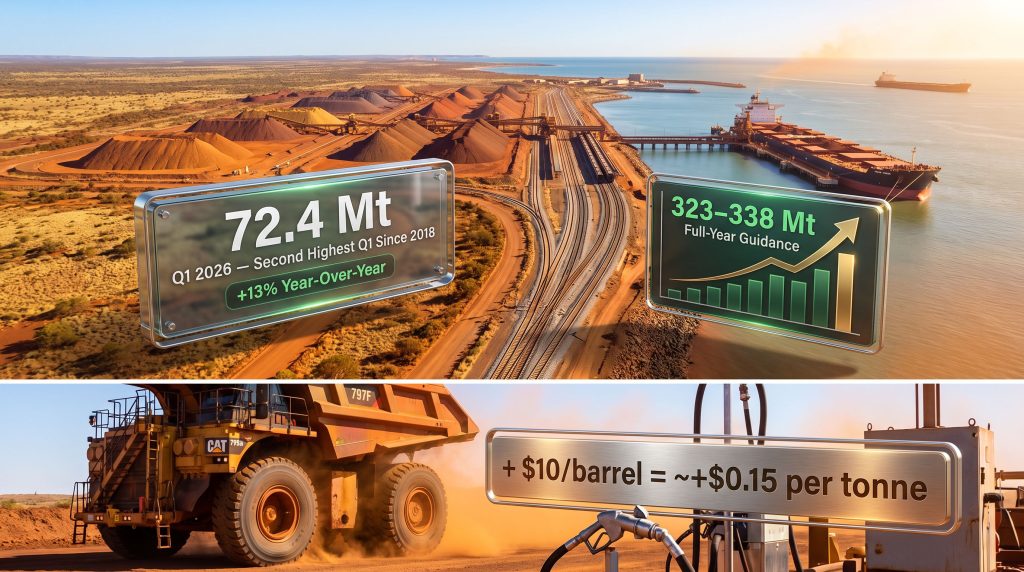
Rio Tinto shipped 72.4 million metric tons (Mt) of iron ore from its Pilbara operations during the first quarter of 2026. That single figure sits as the second-highest Q1 output recorded since 2018, and it arrived despite the quarter being materially disrupted by tropical weather events. Year-over-year, output climbed 13%, with sales volumes also rising 2% against the same period in the prior year.
What makes this result analytically interesting is not the tonnage alone, but the context surrounding it. The quarter absorbed estimated volume losses of approximately 8 Mt from cyclone-related port and logistics closures, meaning the underlying operational run-rate was higher still. For a system of this scale, maintaining throughput momentum while simultaneously managing force-majeure events is a non-trivial achievement.
Rio Tinto has reaffirmed its full-year 2026 Pilbara shipment guidance range of 323 to 338 Mt. Operational commentary suggests actual shipments may trend toward the lower boundary of this range, reflecting the partial nature of post-cyclone volume recovery. The guidance reaffirmation itself carries a credibility signal: management is indicating that H2 2026 operational capacity is sufficient to absorb the Q1 shortfall without requiring a revision.
Cyclone Disruption Mechanics: How the Pilbara System Absorbs Weather Events
Understanding the true impact of cyclone disruptions on iron ore export systems requires moving beyond simple volume-loss accounting. When a tropical cyclone makes landfall near the Pilbara coast, the sequence of disruptions is layered and compounding.
Two tropical cyclones struck the region during Q1 2026, including Cyclone Narelle, forcing temporary closures across port facilities, suspension of rail loading schedules, and interruptions to personnel movement between mine sites and coastal infrastructure. The combined estimated volume impact sits at approximately 8 Mt, though the precise figure depends on the duration of individual closure windows and pre-storm stockpile drawdown rates. For further context on how Rio Tinto iron ore operations resumed following Cyclone Narelle, industry coverage confirms the scale of logistical coordination involved.
Rio Tinto's planning indicates that roughly half of this lost volume is recoverable across Q2 and Q3 2026, with the remainder classified as structurally unrecoverable within the calendar year. This recovery projection is consistent with how post-cyclone ramp-up patterns have historically behaved in the Pilbara, where rail and port systems can accelerate throughput rates for several weeks following reopening to compensate for backlogged ore movements.
This Q1 disruption did not occur in isolation. The immediately preceding period, Q4 2025, had already demonstrated the system's recovery capacity, delivering production growth of 4% year-over-year and shipment growth of 7% year-over-year following its own weather-related disruptions. That sequential evidence of rebound capacity is what underpins management's confidence in sustaining 2026 guidance.
Pilbara port infrastructure is designed with redundancy across multiple loading berths and stockpile systems specifically because cyclone disruption is a recurring seasonal variable, not an exceptional risk event.
The Diesel Cost Problem: Why Fuel Is Iron Ore's Invisible Margin Lever
Diesel fuel occupies an outsized and frequently underappreciated role in the economics of Pilbara iron ore mining. Unlike underground operations where ventilation and rock mechanics dominate cost structures, open-cut bulk mining in the Pilbara is dominated by surface haulage, where enormous diesel-powered trucks and auxiliary equipment consume fuel continuously across multi-decade mine lives.
Rio Tinto consumes approximately 1.6 billion litres of diesel annually across its global operations, with an estimated two-thirds of that volume attributable to Pilbara iron ore activities. This concentration in a single operational basin creates a structurally significant sensitivity to global fuel price movements. Furthermore, iron ore price trends add another layer of complexity to how fuel costs ultimately translate into margin outcomes for investors.
The cost sensitivity mathematics are relatively straightforward:
| Oil Price Movement | Estimated Pilbara Unit Cost Impact |
|---|---|
| +$10 per barrel | Approximately +$0.15 per tonne |
| -$10 per barrel | Approximately -$0.15 per tonne |
| Sustained +$20 per barrel | Approximately +$0.30 per tonne across full-year output |
Cost sensitivity estimates based on Argus market analysis, effective May 2026.
Across a 330 Mt production year, a sustained $20 per barrel oil price increase translates to a cost headwind approaching $100 million at the annual level before mitigation strategies are applied. This is not a catastrophic margin event for an operation of Rio Tinto's scale, but it is material enough to influence unit cost guidance and investor earnings modelling.
How Rio Tinto Manages Its Diesel Exposure
Several structural levers are available to large-scale operators facing fuel cost inflation:
- Bulk procurement contracts at volumes that provide pricing leverage unavailable to smaller operators
- Fleet optimisation programs that reduce per-tonne diesel consumption through haul route redesign and equipment utilisation improvements
- Partial forward purchasing to smooth quarterly cost exposure and reduce sensitivity to spot market spikes
- Autonomous haulage deployment which, while primarily a labour and safety initiative, also produces efficiency gains that compress fuel consumption per tonne moved
Rio Tinto has been progressively expanding its autonomous haulage fleet across Pilbara operations for over a decade. The efficiency benefits compound over time and provide a partial structural hedge against diesel cost inflation that is often overlooked in short-term cost analysis. Indeed, Rio Tinto has stated it has the global supply chain leverage to manage steep diesel price pressures, reinforcing confidence in these mitigation mechanisms.
The H2 2026 Diesel Supply Risk: A Different Problem Entirely
Industry analysts have flagged a risk scenario for the second half of 2026 that goes beyond price sensitivity: the possibility of physical diesel supply tightness in Australian fuel markets. This is a categorically different challenge from managing a price increase.
A physical shortage scenario could affect:
- Availability of fuel for heavy haulage trucks and auxiliary mining equipment
- Rail logistics fuel supply for the approximately 1,700 kilometres of private Pilbara rail network
- Personnel transport to remote mine site locations
- Contingency stockpile maintenance across multiple operational hubs
Price hedging strategies offer no protection against volume unavailability. This distinction matters for operational risk assessment and may necessitate proactive fuel inventory building ahead of the H2 2026 period.
Simandou: What Guinea's High-Grade Ore Means for Rio Tinto's Revenue Quality
The first full commercial shipment of Simandou iron ore from Guinea reached its Chinese buyers during Q1 2026, with revenue realised in April. This milestone marks more than a logistics achievement; it represents a deliberate evolution in Rio Tinto's product portfolio strategy.
Understanding why Simandou matters requires understanding iron ore grade economics. The iron content of ore, measured as percentage of iron by weight (% Fe), directly determines its value in steelmaking. Higher-grade ores reduce the quantity of gangue material that blast furnaces must process, improving energy efficiency and reducing carbon emissions per tonne of steel produced. In addition, iron ore grades and deposits vary considerably across global supply sources, making grade differentiation a key competitive lever.
| Product Category | Typical Fe Grade | Approximate Market Premium | Primary Buyer Profile |
|---|---|---|---|
| Standard Pilbara Blend Fines | ~61 to 62% Fe | Base reference pricing | Volume-focused integrated mills |
| High-grade fines and lump | ~63 to 65% Fe | $5 to $15 per tonne above base | Efficiency-focused steel producers |
| Simandou (SimFer) ore | 65%+ Fe | Significant premium | Premium Chinese blast furnace operators |
Chinese steel mills have been systematically shifting their procurement preferences toward higher-grade feedstocks over recent years. This trend is driven by a combination of blast furnace efficiency economics, increasingly stringent environmental compliance requirements, and the operational flexibility that high-grade inputs provide. Consequently, China steel demand patterns will significantly shape how quickly Simandou's premium positioning translates into revenue gains for Rio Tinto.
Simandou ore, characterised by exceptionally low levels of alumina and silica impurities alongside its high iron content, is precisely the product profile that premium Chinese mills are seeking. The low alumina content is particularly valued because alumina accumulation in blast furnace slag increases operational complexity and reduces furnace productivity.
The strategic significance of Simandou for Rio Tinto extends beyond tonnage. It repositions the company's revenue mix from volume-driven to grade-and-margin-driven growth, with structural implications for long-term earnings quality.
Infrastructure Scale as a Structural Cost Moat
One dimension of Rio Tinto's competitive position that receives insufficient analytical attention is the role of its integrated Pilbara infrastructure in creating durable cost advantages that are effectively non-replicable. Furthermore, Australia's iron ore advantage stems in large part from precisely this kind of entrenched infrastructure depth.
The full Pilbara system encompasses:
- Multiple producing mine hubs across the Hamersley and Robe River deposit systems
- Approximately 1,700 kilometres of private-gauge rail network, one of the largest privately-owned rail systems in the world
- Three export terminals at Dampier and Cape Lambert with multiple ship-loading berths
- Integrated ore-blending systems that allow product grade management across different mine sources
This infrastructure cannot be replicated by a new market entrant within any commercially relevant timeframe or at any economically viable capital cost. The resulting per-tonne cost advantage compounds across multiple operational variables simultaneously.
| Cost Driver | Rio Tinto Exposure Level | Primary Mitigation Mechanism |
|---|---|---|
| Diesel fuel | High (approx. 1.6B litres per year globally) | Bulk procurement and fleet efficiency programs |
| Labour | Moderate | FIFO workforce model and progressive automation |
| Maintenance | Moderate to High | Predictive maintenance and condition monitoring |
| Port and rail per-tonne cost | Low (infrastructure scale benefit) | Multi-berth redundancy and throughput flexibility |
| Cyclone and weather disruption | Seasonal and variable | Post-disruption volume recovery protocols |
The next major ASX story will hit our subscribers first
Iron Ore Grade Dynamics: A Closer Look at Pilbara Blend Chemistry
Pilbara Blend, Rio Tinto's flagship export product, occupies a well-established position in the Chinese import market. Its consistency and predictability are valued by blast furnace operators who optimise burden recipes months in advance. However, the product's mid-grade iron content (~61 to 62% Fe) places it in an increasingly competitive segment as both African high-grade supply and low-cost scrap alternatives gain market share.
The alumina content of Pilbara ores has been a topic of ongoing technical discussion within the steel industry. Elevated alumina in iron ore increases slag viscosity in blast furnaces, which in turn raises coke consumption rates and reduces furnace productivity. As Rio Tinto mines deeper into certain Hamersley deposits, managing alumina levels within acceptable parameters for Chinese customers becomes an increasingly active blending challenge.
This is one reason why the Simandou asset carries strategic weight beyond its volume contribution. Its low-impurity chemistry provides a high-grade blending component that can offset alumina loading from other parts of the Pilbara portfolio. However, the broader context of China iron ore surplus conditions means that even premium-grade additions must be calibrated carefully against prevailing demand signals.
Seaborne Market Implications: Why Rio Tinto's Output Data Functions as a Leading Indicator
The Pilbara region collectively accounts for approximately 55 to 60% of Australia's total iron ore export volume. Rio Tinto's share of that output positions its quarterly production data as one of the most closely watched leading indicators for global seaborne iron ore supply conditions.
When Rio Tinto reports a disrupted quarter followed by a volume rebound, the market reads that as a signal of supply restoration. Conversely, any sustained production shortfall from the Pilbara system would tighten seaborne supply and provide upward support to iron ore benchmark pricing. This dynamic gives Rio Tinto's operational updates a market-moving relevance that extends well beyond the company's own financial results.
Key variables that will define the iron ore supply-demand balance through the remainder of 2026 include:
- Diesel supply and price trajectory in Australian fuel markets, particularly any H2 shortage materialisation
- Simandou ramp-up velocity and the pace at which additional West African high-grade tonnes enter Chinese ports
- Chinese steel sector demand signals, particularly from property sector activity and any government-directed infrastructure spending programmes
- Australia's upcoming cyclone season, which typically runs from November through April, creating the next window of Pilbara weather exposure from late 2026 onward
- Autonomous haulage and operational technology deployment rates, which influence both throughput capacity and cost structure across multi-year timeframes
Frequently Asked Questions
How much iron ore did Rio Tinto ship from the Pilbara in Q1 2026?
Rio Tinto shipped 72.4 million metric tons from its Pilbara operations in Q1 2026, representing a 13% year-over-year increase in output and the second-highest Q1 result recorded since 2018.
What is Rio Tinto's full-year 2026 iron ore shipment guidance?
The company has maintained its 2026 Pilbara shipment guidance at 323 to 338 Mt, with actual volumes expected to trend toward the lower boundary of this range following Q1 cyclone-related disruptions.
How do rising diesel prices affect Rio Tinto's iron ore production costs?
Every $10 per barrel movement in oil prices translates to approximately $0.15 per tonne in Pilbara unit cost variation. Given annual diesel consumption of approximately 1.6 billion litres, sustained fuel price increases represent a meaningful cost variable for earnings modelling purposes.
What is Simandou iron ore and why does the grade matter?
The Simandou deposit in Guinea produces iron ore with iron content exceeding 65% Fe, placing it in the premium tier of global seaborne supply. Its low alumina and silica impurity profile makes it highly valued by Chinese blast furnace operators seeking to improve furnace efficiency and reduce carbon emissions per tonne of steel produced.
How did cyclone disruptions affect Q1 2026 shipments?
Cyclone Narelle and a second tropical weather event disrupted Pilbara port and logistics operations during Q1 2026, removing an estimated approximately 8 Mt from quarterly shipment totals. Rio Tinto expects to recover roughly half of this volume across subsequent quarters.
Is a diesel shortage a bigger risk than a price increase?
Operationally, yes. Price increases can be partially absorbed through procurement scale, forward purchasing, and efficiency programmes. A physical supply shortage constrains machinery availability, transport logistics, and site access in ways that cost management strategies cannot fully offset. This distinction makes H2 2026 diesel supply conditions a qualitatively different risk category from ordinary fuel cost inflation.
Operational Resilience as a Durable Competitive Characteristic
The Q1 2026 performance demonstrates something that quarterly reporting cycles often obscure: the distinction between systems that are merely large and systems that are architecturally resilient. Rio Tinto iron ore exports rebound to the second-highest Q1 output in eight years while absorbing approximately 8 Mt of cyclone-related disruption confirms the structural depth of the Pilbara system.
The diesel cost exposure is real and quantifiable, but it exists within a cost structure that benefits from infrastructure scale advantages no new entrant can replicate. The Simandou entry into the product portfolio addresses the medium-term challenge of grade competitiveness in the Chinese import market. And the system's demonstrated ability to rebuild throughput momentum after weather events provides a credible foundation for the H2 2026 recovery trajectory management has outlined.
This article is intended for informational purposes only and does not constitute financial advice. Forward-looking statements, production guidance ranges, and cost sensitivity estimates involve inherent uncertainty and should not be relied upon as predictions of future performance. Readers should conduct their own due diligence and consult qualified financial advisers before making investment decisions.
Want to Capitalise on Major ASX Mineral Discoveries Before the Broader Market?
Discovery Alert's proprietary Discovery IQ model delivers real-time alerts on significant ASX mineral discoveries, transforming complex geological and market data into actionable insights for both short-term traders and long-term investors — explore the historic returns major discoveries have generated and begin your 14-day free trial to position yourself ahead of the market.