
August 7, 2026
Economic Framework Models for Geopolitical Risk Assessment
Modern macroeconomic modelling faces unprecedented challenges when attempting to quantify the systemic impacts of prolonged regional conflicts. Traditional economic frameworks, originally designed for peacetime market analysis, struggle to capture the cascading effects that occur when critical infrastructure becomes militarised and global supply chains face sustained disruption. Understanding Iran war economic implications requires sophisticated scenario planning that goes far beyond conventional risk assessment models, particularly when examining tariffs and inflation risks that can compound geopolitical pressures.
Energy Security Disruption Models
The mathematical modelling of energy supply disruption follows complex probability matrices that account for multiple failure points across interconnected systems. When examining potential closure scenarios for critical maritime chokepoints, economists utilise Monte Carlo simulations to assess probability distributions across thousands of potential outcomes. These models incorporate variables ranging from weather patterns and seasonal shipping schedules to military positioning and diplomatic intervention timelines.
Global oil supply elasticity calculations reveal that even temporary disruptions can trigger price volatility that persists for months beyond the initial incident. The relationship between supply shock magnitude and price response follows non-linear patterns, where relatively small percentage reductions in available supply can generate disproportionately large price increases due to inelastic short-term demand characteristics. Furthermore, the Russian uranium ban impact demonstrates how multiple energy sector disruptions can compound economic pressures.
LNG export capacity redistribution presents particular analytical challenges because alternative routing requires significant infrastructure modifications that cannot be implemented rapidly. Economic models must account for the time lag between disruption events and alternative supply activation, during which price discovery mechanisms operate under extreme stress conditions.
Stagflation Risk Assessment Frameworks
Historical precedent analysis from the 1973 Arab oil embargo and the 1979 Iranian Revolution provides crucial baseline data for contemporary risk modelling. During the 1973 crisis, oil prices increased by approximately 300% over a six-month period, contributing to inflation rates that exceeded 12% in major developed economies. The 1979 disruption demonstrated how geopolitical events could trigger stagflation, where high inflation coincided with economic stagnation and rising unemployment.
Central bank policy response modelling across major economies reveals fundamental structural differences in institutional capacity to address simultaneous inflation and growth challenges. The Federal Reserve's dual mandate creates inherent policy conflicts when energy price shocks threaten both price stability and employment objectives simultaneously. In addition, European Central Bank frameworks face additional complexity due to divergent economic conditions across eurozone member states, similar to challenges seen with Canada energy transition policies.
Inflation transmission mechanisms through global supply chains operate through multiple channels that compound over time. Initial energy cost increases affect transportation expenses, which subsequently impact manufacturing costs, retail prices, and wage expectations. This sequential transmission process can sustain inflationary pressure for extended periods, even after the original supply disruption resolves.
When big ASX news breaks, our subscribers know first
Regional Economic Vulnerability Assessment
Economic resilience varies dramatically across geographic regions, with some economies demonstrating structural characteristics that provide natural hedges against energy market disruptions, while others exhibit vulnerabilities that amplify external shocks. Systematic vulnerability assessment requires comprehensive analysis of import dependency ratios, foreign exchange reserve adequacy, and domestic production capacity across multiple critical sectors.
Gulf Cooperation Council Stress Testing
Economic diversification readiness varies significantly among GCC member states, with implications for long-term sustainability during prolonged conflict scenarios. Recent developments in the region have highlighted these disparities, as market analysts observe varying degrees of preparedness across different economies.
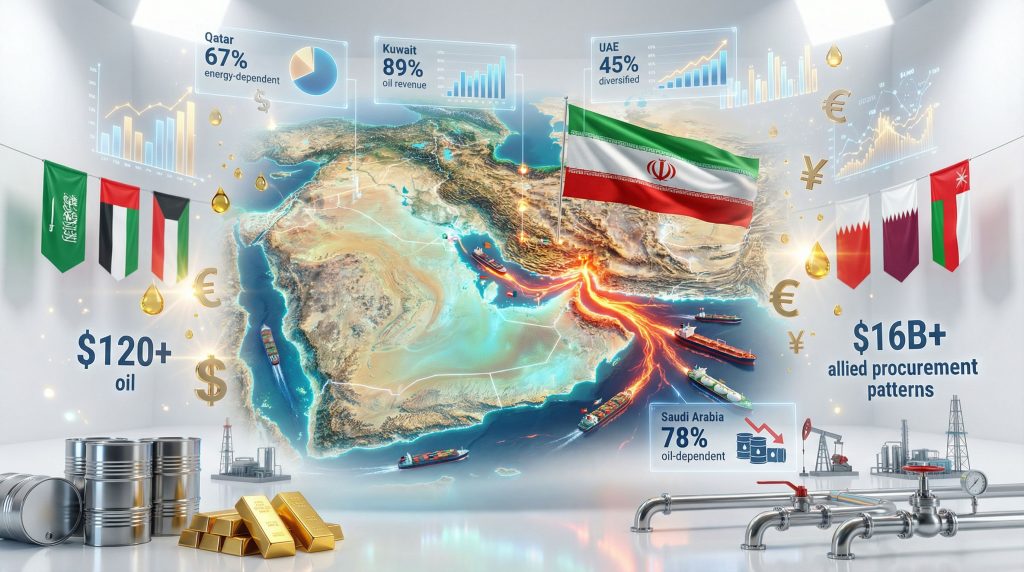
| GCC Economy | Energy Dependency | Diversification Index | Critical Threshold | Recovery Timeline |
|---|---|---|---|---|
| Qatar | 67% | Low | 8-12 weeks | 18-24 months |
| Kuwait | 89% | Very Low | 6-8 weeks | 24-36 months |
| UAE | 45% | Moderate | 12-16 weeks | 12-18 months |
| Saudi Arabia | 78% | Low-Moderate | 10-14 weeks | 20-30 months |
Infrastructure resilience under sustained conflict conditions depends heavily on geographic positioning, redundant systems, and alternative supply arrangements. Economies with greater diversification in revenue sources demonstrate superior capacity to maintain essential services and economic activity during extended disruption periods.
Sovereign wealth fund depletion timelines provide critical indicators of fiscal sustainability under stress conditions. Countries with larger reserve accumulations can maintain government spending and social programs for longer periods, providing social stability that supports overall economic resilience.
European Industrial Competitiveness Analysis
Manufacturing cost structure analysis reveals that energy-intensive industries face fundamental viability challenges when oil prices exceed $120 per barrel for sustained periods. Chemical and steel production, which require significant energy inputs, experience margin compression that can force temporary shutdowns or permanent capacity reductions. However, the investment impact of tariffs may create additional pressures on these already vulnerable sectors.
European industrial sectors demonstrate varying degrees of sensitivity to energy price volatility:
- Chemical Manufacturing: 35-40% cost structure vulnerability
- Steel Production: 42-45% energy cost exposure
- Aluminium Smelting: 55-60% electricity dependency
- Automotive Assembly: 15-20% direct energy costs
Deindustrialisation acceleration patterns emerge when energy costs remain elevated for periods exceeding six months. Historical analysis suggests that temporary price spikes can trigger permanent industrial capacity loss if alternative production locations offer sustained cost advantages.
Monetary Policy Response Mechanisms
Central banking institutions face complex trade-offs when responding to geopolitically-driven economic disruptions. Traditional monetary policy tools designed for demand-side economic management prove less effective when inflationary pressure originates from supply-side constraints. This creates policy dilemmas where conventional responses may exacerbate rather than alleviate economic stress.
Federal Reserve Strategic Positioning
The dual mandate framework requires Federal Reserve policymakers to balance price stability objectives against employment considerations under conditions where these goals may conflict directly. Energy supply shocks can simultaneously threaten price stability through inflation while endangering employment through reduced economic activity. Consequently, Iran war economic implications extend far beyond regional impacts to global monetary policy decisions.
Recent economic data indicates growing challenges for monetary policy implementation. According to current market analysis, U.S. national debt levels exceeding $39 trillion create constraints on fiscal policy flexibility, placing additional pressure on monetary authorities to address economic stabilisation independently.
Dollar strength implications extend beyond domestic considerations, as emerging market economies with significant dollar-denominated debt face increased servicing costs when the Federal Reserve raises interest rates. This creates feedback mechanisms where U.S. monetary tightening can trigger financial instability in developing economies, potentially amplifying global economic disruption.
Quantitative tightening sustainability during geopolitical stress requires careful calibration to avoid triggering liquidity crises in financial markets. Bond market dynamics become particularly important as rising yields reduce the market value of existing government debt holdings across institutional portfolios.
European Central Bank Crisis Navigation
Eurozone monetary policy faces additional complexity due to heterogeneous economic conditions across member states. Countries with different energy import dependencies experience varying inflation pressures, creating challenges for unified monetary policy implementation.
Southern European sovereign debt vulnerability increases during periods of economic stress, as investors demand higher risk premiums for countries with elevated debt-to-GDP ratios. This fragmentation can threaten eurozone cohesion if yield spreads widen significantly.
Energy subsidy fiscal burden distribution across EU member states creates additional pressure on public finances. Countries implementing consumer energy subsidies face growing budget deficits that may require either subsidy reduction or increased borrowing.
Investment Capital Flow Dynamics
Financial market behaviour during geopolitical crises reflects complex interactions between risk perception, liquidity preferences, and return expectations. Capital flows often exhibit non-linear characteristics where initial movements accelerate as market participants adjust portfolios based on evolving risk assessments. For instance, recent analysis of the Iran wars' global economic impact highlights how sustained conflicts reshape investment patterns.
Defense Sector Capital Reallocation
Arms export surge analysis reveals significant increases in allied procurement activities during periods of heightened geopolitical tension. Defence spending patterns typically demonstrate counter-cyclical characteristics, with government procurement increasing even as private sector investment declines.
Military-industrial complex expansion trajectories follow predictable patterns where increased government spending drives capacity expansion, employment growth, and technological development within defence-related industries. These sectors often outperform broader market indices during conflict periods.
Geopolitical risk premium integration into equity valuations creates sector rotation effects where defensive investments outperform cyclical sectors. Utilities, consumer staples, and healthcare typically attract capital during periods of increased uncertainty.
Commodity Market Structural Transformation
Recent market analysis indicates significant volatility in precious metals markets, with gold as inflation hedge experiencing correction of approximately 18% and silver declining 41% from recent peaks. These movements occur despite ongoing geopolitical tensions, highlighting the complex relationship between conflict events and traditional safe-haven asset performance.
Gold volatility patterns during extended conflicts reveal that markets can experience significant price swings even when fundamental drivers suggest upward pressure. Technical market corrections can temporarily override geopolitical premium effects, creating apparent contradictions between traditional safe-haven theory and actual market behaviour.
Mining sector performance demonstrates extreme volatility characteristics, with gold and silver mining indices experiencing declines exceeding 25% from recent peaks over relatively short periods. This volatility reflects both operational leverage to underlying commodity prices and market perception changes regarding future profitability.
Energy futures market liquidity stress indicators suggest that prolonged conflicts can reduce market depth and increase transaction costs, particularly for longer-dated contracts where uncertainty premiums become substantial. Furthermore, economic and market implications extend beyond immediate price movements to structural market changes.
Emerging Market Differentiation Strategies
Developing economies demonstrate varying degrees of resilience when confronting external economic shocks, with success factors including economic diversification, foreign exchange reserves, and regional trade partnerships. Countries with stronger fundamentals often emerge from crisis periods with improved relative positioning.
Import Dependency Vulnerability Assessment
Energy import bill sustainability analysis reveals critical thresholds beyond which countries face balance of payments crises. Nations importing more than 70% of energy requirements typically experience severe economic stress when energy prices increase by more than 50% for extended periods.
Foreign exchange reserve adequacy ratios provide early warning indicators of potential currency crises. The International Monetary Fund considers reserves equivalent to at least three months of imports as minimum adequacy levels, though countries facing energy import price volatility may require higher buffers.
Social stability thresholds under subsidy pressure create additional complexity for policymakers in developing countries. Governments often maintain energy subsidies to preserve social cohesion, but these programmes can become fiscally unsustainable during prolonged price elevation periods.
Economic Resilience Factors
Diversified export base advantages become apparent during global economic stress periods, as countries dependent on single commodity exports face greater volatility than those with varied revenue sources. Manufacturing capability, agricultural production, and service sector development all contribute to economic stability.
Regional trade partnership leverage allows countries to maintain economic activity even when global trade patterns experience disruption. Bilateral trade agreements and regional economic blocs can provide alternative markets and supply sources.
Domestic energy production capabilities create natural hedges against global energy price volatility. Countries with significant domestic production often experience economic benefits during price spike periods, offsetting other negative economic effects.
Conflict Duration Impact Analysis
The temporal dimension of economic impact assessment requires sophisticated modelling that accounts for both immediate shock effects and longer-term structural adjustments. Economic systems demonstrate different response patterns depending on whether disruptions appear temporary or permanent. Therefore, Iran war economic implications vary significantly based on conflict duration and intensity.
Short-Term Scenario Frameworks
Market volatility normalisation timelines typically range from 4-8 weeks for conflicts that resolve quickly without permanent infrastructure damage. Financial markets generally demonstrate rapid adjustment capabilities when geopolitical tensions subside and normal economic activity resumes.
Supply chain restoration sequences follow predictable patterns where critical sectors receive priority attention. Energy transportation infrastructure, food distribution networks, and medical supply chains typically achieve restoration before consumer goods and non-essential services.
Temporary inflation spike management requires coordinated policy responses to prevent short-term price increases from becoming embedded in long-term expectations. Central bank communication strategies play crucial roles in maintaining inflation expectations during temporary supply disruptions.
Extended Conflict Scenarios
Permanent supply chain restructuring requirements emerge when conflicts persist beyond six months, forcing businesses to develop alternative sourcing strategies and redundant supply networks. These adjustments often involve higher costs that become embedded in long-term price structures.
Alternative energy infrastructure acceleration occurs as countries prioritise energy security over short-term cost considerations. Investment in renewable energy sources, strategic reserves, and alternative supply routes increases substantially during extended conflict periods.
Geopolitical alliance economic integration strengthens as countries seek reliable partners for critical supply needs. Trade relationships often shift toward countries perceived as stable long-term partners rather than lowest-cost providers.
The next major ASX story will hit our subscribers first
Post-Conflict Economic Architecture
Economic systems emerging from extended geopolitical conflicts often exhibit structural changes that persist long after hostilities cease. These modifications reflect lessons learned during crisis periods and strategic adaptations designed to enhance future resilience.
Energy Market Reorganisation
Middle East production capacity permanent shifts can result from infrastructure damage, investment diversion, or strategic policy changes implemented during conflict periods. Countries may prioritise domestic consumption over exports or implement production limitations based on national security considerations.
Alternative supplier market share gains often prove persistent, as importers develop relationships with non-traditional sources during disruption periods. These new trade patterns can continue even after original suppliers restore full capacity, permanently altering global market dynamics.
Strategic petroleum reserve policy evolution reflects lessons learned about vulnerability to supply disruptions. Countries often increase reserve targets and diversify storage locations to enhance energy security capabilities.
Global Trade Route Reconfiguration
Maritime chokepoint alternative development receives increased investment priority as countries seek to reduce dependence on vulnerable shipping routes. Infrastructure projects that appeared economically marginal during peacetime can become strategic necessities.
Regional economic bloc strengthening occurs as countries prioritise trade relationships with geographically proximate partners. Economic integration within regions often accelerates as nations seek reduced exposure to distant supply chain vulnerabilities.
Supply chain sovereignty prioritisation leads to reshoring or near-shoring initiatives where countries bring critical production capabilities closer to home markets. These changes often involve higher costs but provide enhanced security and reduced logistics complexity.
Early Warning System Development
Effective economic monitoring during geopolitical stress periods requires sophisticated indicator systems that can distinguish between temporary market fluctuations and signals of systemic instability. Leading indicators often provide advance warning of significant economic changes before they become apparent in traditional economic statistics.
Real-Time Monitoring Frameworks
Currency volatility threshold alerts provide among the earliest indications of economic stress, as foreign exchange markets typically respond rapidly to changing risk perceptions. Sustained volatility above historical norms often precedes broader economic disruption.
Corporate earnings guidance revision patterns reveal management assessment of business environment changes before these effects appear in reported financial results. Widespread guidance reductions across multiple sectors can signal broad-based economic deterioration.
Consumer confidence leading indicators reflect household perception changes that subsequently affect spending patterns and economic growth. Confidence measures often decline before employment statistics or retail sales data show deterioration.
Systemic Risk Assessment Tools
Banking sector stress test requirements become critical during periods of economic uncertainty, as financial institutions face both direct exposure to affected regions and indirect effects through global financial market disruption.
Insurance industry exposure calculations reveal potential claims from business interruption, political risk, and physical damage coverage. Large-scale geopolitical events can trigger significant insurance industry payouts that affect capital availability.
Pension fund portfolio rebalancing necessities emerge as extended market volatility threatens retirement security for large populations. Asset allocation changes by institutional investors can amplify market movements and create feedback effects.
Fiscal Policy Response Coordination
Government spending decisions during crisis periods significantly influence both short-term economic stability and long-term recovery trajectories. Fiscal policy effectiveness depends on coordination between different spending priorities and careful consideration of financing sustainability.
Government Spending Prioritisation
Infrastructure investment versus social support allocation creates fundamental trade-offs for policymakers during crisis periods. Countries must balance immediate social needs against longer-term economic capacity building while operating under fiscal constraints.
Defence spending crowd-out effects on civilian programmes become significant during extended conflicts, as military expenditure increases can reduce funding available for education, healthcare, and social services. These trade-offs can affect long-term economic competitiveness.
Tax policy adjustments under revenue pressure require careful calibration to maintain government financing capability without further damaging economic activity. Revenue enhancement measures must consider both immediate fiscal needs and longer-term growth implications.
International Coordination Mechanisms
Multilateral financial institution response capacity provides crucial support during global economic stress periods. International Monetary Fund facilities, World Bank emergency lending, and regional development bank programmes offer financing alternatives when traditional capital markets become inaccessible.
Currency swap agreement activation protocols enable countries to maintain foreign exchange liquidity during periods of market stress. These arrangements provide alternatives to depleting national reserves or accessing expensive emergency financing.
Trade policy coordination frameworks help maintain international economic cooperation during periods when protectionist pressures typically increase. Multilateral trade agreements and dispute resolution mechanisms become particularly important for preventing economic fragmentation.
"The economic consequences of prolonged regional conflicts extend far beyond immediate energy markets to fundamentally reshape global trade patterns, monetary policies, and investment flows." Understanding these complex interactions remains crucial for policymakers and investors navigating uncertain geopolitical landscapes.
Disclaimer: This analysis is based on economic modelling techniques and historical precedent studies. Economic forecasting involves inherent uncertainty, particularly during periods of geopolitical instability. Market conditions can change rapidly, and past performance does not guarantee future results. Readers should conduct independent research and consider multiple perspectives when making investment or policy decisions related to geopolitical risk assessment.
Are You Positioning Your Portfolio for Geopolitical Volatility?
Discovery Alert's proprietary Discovery IQ model delivers real-time notifications on significant ASX mineral discoveries, helping investors identify opportunities that thrive during periods of economic uncertainty and market volatility. Explore Discovery Alert's dedicated discoveries page to understand how major mineral discoveries can generate substantial returns even during challenging geopolitical periods, then begin your 14-day free trial today to secure your market-leading advantage.