June 20, 2026
Economic Fundamentals of Resource-Dependent Nations
The global economy increasingly revolves around nations that can effectively monetise their natural resource endowments while maintaining long-term economic stability. Resource-dependent economies face unique challenges in converting raw material abundance into sustained prosperity, requiring sophisticated frameworks for managing commodity price volatility, infrastructure development, and fiscal planning. South Africa exemplifies this dynamic, demonstrating how mineral extraction can serve as the foundation for broader economic development when properly structured and managed.
Understanding how resource economies function requires examining the complex interplay between geological advantages, market positioning, and institutional capacity. These nations must balance immediate revenue generation against long-term sustainability, while navigating international market dynamics that can dramatically affect economic performance. Furthermore, the success of such economies depends largely on their ability to transform natural resource wealth into diversified industrial capacity and human capital development.
When big ASX news breaks, our subscribers know first
South Africa's Mineral Economy Foundation
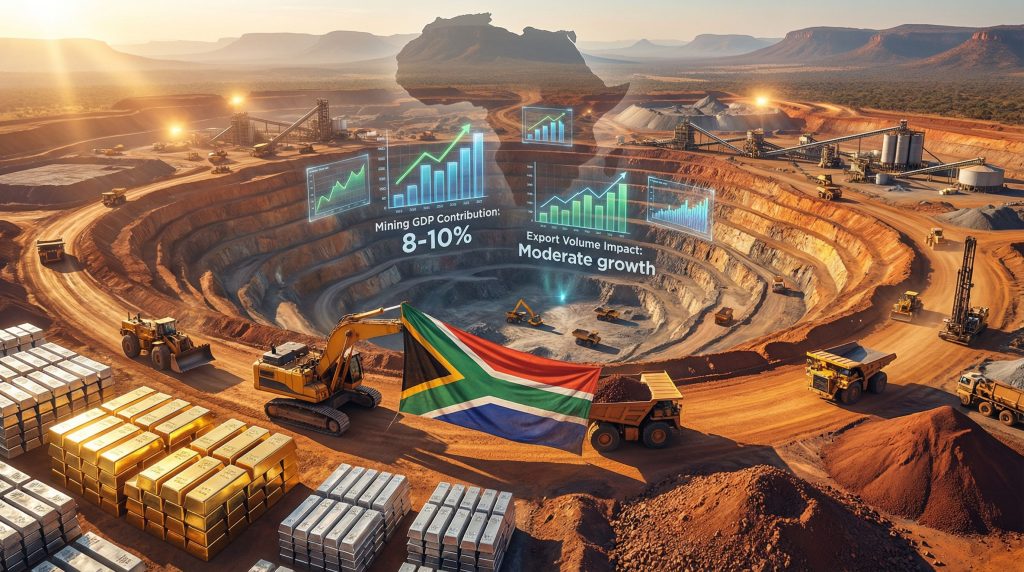
South Africa's economic architecture rests fundamentally on its extraordinary geological endowments, with the mining sector functioning as both a primary revenue generator and a catalyst for broader industrial development. The country's mineral wealth extends across multiple commodity categories, creating a diversified resource portfolio that provides stability against single-commodity price shocks while supporting complex value chains throughout the economy.
The sector's structural importance becomes evident when examining its multiple economic functions. Beyond direct employment in extraction operations, mining activities support extensive supplier networks, transportation systems, and processing facilities that multiply the economic impact of each ton of mineral production. This interconnected system generates foreign exchange earnings that stabilise the national currency while providing the fiscal resources necessary for infrastructure development and social programs.
Recent performance data illustrates the sector's continued relevance. South Africa mineral sales rise reflected in the 7.3% growth recorded in 2025 demonstrates the industry's resilience despite global economic uncertainties. This expansion occurred across multiple commodity categories, with mineral sales rising by 7.3% in 2025 documenting improved performance in platinum group metals, coal exports, iron ore shipments, and gold sales, indicating broad-based strength rather than dependence on single-commodity price movements.
The mining sector's integration with global supply chains positions South Africa as a critical supplier for international industrial production. Asian markets, particularly China and India, continue to absorb significant volumes of South African minerals, creating stable demand channels that support predictable revenue flows. In addition, these trade relationships provide economic stability by ensuring consistent export volumes even during periods of global economic uncertainty.
Market Dynamics Driving Mineral Revenue Performance
Global commodity markets operate through complex mechanisms that translate international demand patterns, currency fluctuations, and geopolitical developments into price signals that directly impact resource-producing nations. Understanding these dynamics requires analysing how different commodity categories respond to various market forces, from industrial demand cycles to monetary policy changes in major economies.
Platinum Group Metals Performance Analysis
Platinum group metals demonstrated particularly strong performance in 2025, benefiting from multiple demand drivers including automotive industry requirements for catalytic converters, growing industrial applications, and investment demand during periods of currency instability. South Africa's dominant global market position in PGM production provides significant pricing power, allowing the country to capture premium prices when international demand strengthens.
The automotive sector's continued reliance on PGM for emission control systems creates steady baseline demand, while emerging applications in hydrogen fuel cell technology offer potential growth opportunities. However, industrial users require consistent supply relationships, leading to long-term contract arrangements that provide revenue stability for South African producers even during price volatility periods.
Coal Export Market Resilience
South African coal exports maintained strong performance despite global energy transition trends, reflecting the commodity's continued importance in steel production and industrial processes. Asian markets, particularly those with expanding steel manufacturing capacity, provided steady demand for South African coal products throughout 2025.
The thermal coal market faced different dynamics, with some utilities reducing consumption while others increased imports to meet baseload electricity requirements. Consequently, South African producers adapted by optimising product specifications for specific market requirements, maintaining export volumes through targeted marketing approaches.
Iron Ore Demand Fundamentals
Iron ore markets demonstrated stable demand patterns, supported by continued infrastructure development projects across Asia and steady steel production requirements. South Africa's iron ore grades compete effectively in international markets, providing consistent demand from steel producers seeking reliable supply relationships.
Price stability in iron ore trends throughout 2025 reflected balanced supply-demand conditions, with South African producers benefiting from established logistics networks and quality specifications that meet international steel industry requirements. For instance, long-term supply contracts provided revenue predictability while spot market sales captured favourable pricing opportunities.
Currency Stability and Export Earnings Impact
Export earnings from mineral sales create crucial foreign exchange inflows that support national currency stability and enable imports of essential goods and technologies. The relationship between commodity export performance and exchange rate stability operates through multiple channels, affecting everything from inflation rates to investment flows and economic confidence indicators.
South Africa mineral sales rise generated substantial foreign currency earnings throughout 2025, supporting the rand's stability against major international currencies. These inflows help offset import costs for energy, manufactured goods, and technology products essential for economic development, while providing the Reserve Bank with foreign exchange reserves needed for monetary policy implementation.
The timing of export earnings also influences quarterly economic performance patterns. Strong mineral export quarters typically correlate with improved trade balance figures, supporting broader economic confidence indicators that affect investment decisions and capital flows. Furthermore, this dynamic creates positive feedback loops where mining sector strength reinforces overall economic stability.
Infrastructure Dependencies and Operational Challenges
Mining sector productivity depends critically on infrastructure systems that transport commodities from production sites to international markets. South Africa's mining operations rely on integrated rail networks, port facilities, and road systems that must function reliably to maintain export commitments and competitive positioning in global markets.
Rail Network Capacity Constraints
South African mineral exports depend heavily on rail transportation, with bulk commodities requiring efficient rail connections between mining areas and port facilities. The rail network's capacity and reliability directly influence mining companies' ability to fulfil export contracts and maintain competitive shipping costs.
Infrastructure investment in rail systems creates multiplier effects throughout the economy by reducing transportation costs for all freight users while improving mining sector competitiveness. However, recent developments like the onslow iron haulage operations demonstrate how upgrades to rail capacity support higher export volumes, enabling mining companies to capitalise on favourable market conditions when they arise.
Port Infrastructure and Export Efficiency
Port capacity at key export facilities determines how quickly South African minerals reach international markets, affecting both shipping costs and customer satisfaction levels. Efficient port operations enable mining companies to maintain flexible shipping schedules that respond to market opportunities while minimising storage and handling costs.
Investment in port infrastructure supports the entire export sector by reducing vessel waiting times and improving cargo handling efficiency. These improvements translate directly into reduced costs for mining companies while enhancing South Africa's reputation as a reliable supplier in international commodity markets.
Energy Security Considerations
Mining operations require consistent, reliable electricity supply for production processes, with power outages creating immediate production losses and equipment damage risks. Energy infrastructure reliability affects not only current production levels but also long-term investment decisions by mining companies evaluating expansion opportunities.
Power supply stability influences mining companies' operational costs and production planning capabilities. Moreover, reliable energy infrastructure enables optimised production schedules that maximise equipment utilisation while minimising operational disruptions that can affect customer relationships and profitability.
Fiscal Revenue Generation and Government Planning
Mining sector performance directly influences government fiscal capacity through multiple revenue channels, including corporate income taxes, mineral royalty payments, and indirect taxes on mining-related economic activity. Understanding these fiscal linkages reveals how mining sector growth translates into enhanced government capacity for infrastructure investment and social programs.
Corporate Tax Revenue Patterns
Mining companies contribute substantially to government revenues through corporate income tax payments that fluctuate with commodity prices and production levels. The 7.3% increase in South Africa mineral sales during 2025 generated corresponding increases in corporate tax obligations, providing additional fiscal resources for government operations.
Corporate tax receipts from mining companies typically lag commodity price movements by several months due to tax payment schedules, creating predictable revenue flows that support government budget planning. Higher mineral sales volumes translate into increased taxable income, generating additional fiscal resources that can support infrastructure development and economic diversification initiatives.
Mineral Royalty Payment Systems
South Africa's mineral royalty system captures a portion of mining revenues directly for government coffers, providing fiscal income that reflects current production levels and commodity prices. These payments create immediate fiscal benefits from mining sector performance while ensuring government participation in commodity price upturns.
According to statistics on mining production, resource revenues remain a critical component of budget planning, with mineral royalty payments providing predictable income streams that support long-term fiscal planning. The royalty system's structure enables government revenue to benefit directly from improved mining sector performance while maintaining competitive tax treatment for mining investments.
Foreign Exchange Reserve Management
The South African Reserve Bank monitors commodity trends closely given their influence on export earnings and currency stability. Strong mining export performance provides foreign exchange reserves that support monetary policy implementation while reducing external debt service costs denominated in foreign currencies.
Export earnings from mineral sales create foreign currency inflows that strengthen the Reserve Bank's capacity to intervene in foreign exchange markets when necessary. These reserves provide economic stability during periods of capital outflow while supporting confidence in the national currency among international investors and trading partners.
The next major ASX story will hit our subscribers first
Global Market Positioning and Trade Relationships
South Africa's mineral exports maintain significant global market share across multiple commodity categories, creating strategic positioning that influences international trade relationships and economic partnerships. This market presence provides negotiating leverage in trade discussions while supporting long-term economic relationships with key importing nations.
Asian Market Integration
Asian economies continue to absorb substantial volumes of South African mineral exports, creating interdependent trade relationships that support both regions' economic development objectives. China, Japan, India, and other Asian nations rely on South African minerals for steel production, manufacturing processes, and infrastructure development projects.
These trade relationships extend beyond simple commodity transactions to include technology transfer, investment flows, and collaborative development projects that enhance South Africa's economic integration with dynamic Asian markets. In addition, long-term supply agreements provide revenue stability while creating opportunities for value-added processing and industrial development.
Diversified Export Portfolio Benefits
South Africa's diversified mineral export portfolio reduces dependence on single commodity markets while providing flexibility to respond to changing global demand patterns. The country produces significant volumes of platinum group metals, iron ore, coal, gold, chromium, and other minerals that serve different industrial applications and market segments.
This commodity diversification creates natural hedging against individual market volatility while enabling optimisation of production and export schedules based on relative price movements across different mineral categories. Furthermore, the gold market surge demonstrates how mining companies can adjust production emphasis toward higher-priced commodities while maintaining baseline production across the full portfolio.
Technology Integration and Operational Efficiency
Modern mining operations increasingly rely on advanced technologies that improve productivity, reduce costs, and enhance safety performance while supporting environmental compliance objectives. South African mining companies have invested substantially in technology upgrades that maintain competitive positioning in global markets.
Automation and Digital Systems
Mining companies have implemented automated systems for equipment operation, ore processing, and logistics management that reduce operational costs while improving production consistency. These technologies enable optimised resource utilisation while reducing labour requirements and safety risks in challenging operating environments.
Digital monitoring systems provide real-time data on equipment performance, ore quality, and operational efficiency that enables immediate optimisation decisions. Consequently, predictive maintenance systems reduce equipment downtime while extending asset life cycles, improving overall operational efficiency and reducing capital requirements.
Processing Technology Advances
Improved mineral processing technologies enable mining companies to extract higher values from ore bodies while reducing environmental impact through more efficient resource utilisation. Advanced processing techniques can improve recovery rates while reducing energy consumption and waste generation.
Investment in efficiency and technology has helped South African mining companies maintain output levels despite infrastructure constraints and operational challenges. However, these technological improvements provide competitive advantages in global markets while supporting long-term operational sustainability.
Investment Flows and Capital Allocation Strategies
Mining sector performance influences broader investment patterns through demonstrated returns in resource extraction while creating opportunities for downstream processing and industrial development. International investors evaluate South African mining opportunities based on geological potential, regulatory stability, and infrastructure capacity.
Foreign Direct Investment Patterns
International mining companies continue investing in South African operations, reflecting confidence in long-term commodity demand and regulatory frameworks that support private investment in mining development. These investment flows provide capital for expansion projects while bringing advanced technologies and management practices.
Foreign investment in mining projects creates multiplier effects throughout the economy by supporting equipment suppliers, construction companies, and service providers while generating employment opportunities in mining regions. For instance, investment in capital-intensive projects demonstrates international confidence in South Africa's long-term economic stability.
Domestic Capital Market Development
Strong mining sector performance supports broader capital market development by providing investment opportunities for domestic pension funds, insurance companies, and retail investors seeking exposure to commodity markets. Mining company equity performance influences overall stock market indices while providing dividend income for shareholders.
A stable mining outlook supports investor confidence in capital-intensive projects, encouraging both domestic and international investment in mining expansion and processing facilities. This investment confidence extends beyond mining to support broader industrial development and infrastructure projects.
Regulatory Framework and Policy Considerations
South Africa's mining regulatory environment balances private investment incentives with national development objectives through policies that ensure local economic benefits while maintaining competitive conditions for international investors. Understanding this regulatory framework reveals how policy decisions influence mining sector performance and long-term development patterns.
Mining Charter Compliance Requirements
Regulatory requirements for local ownership participation, skills development programmes, and community investment create additional considerations for mining companies while ensuring broader economic benefits from mineral extraction activities. These requirements aim to transform mining revenues into sustainable economic development for previously disadvantaged communities.
Compliance with transformation requirements influences mining company investment decisions and operational planning while creating opportunities for local businesses and communities to participate directly in mining sector economic benefits. Skills development requirements build local technical capacity that supports long-term industry development.
Tax Policy Framework
Government policies regarding mining taxation directly influence sector profitability and international competitiveness while determining fiscal revenue generation from mineral extraction activities. Tax policy must balance revenue generation objectives against the need to maintain competitive investment conditions.
Looking ahead, sustained gains will depend on infrastructure upgrades and policy certainty that support continued investment in mining development projects. The 7.3% rise in South Africa mineral sales suggests that current policies provide adequate incentives for operational optimisation while generating substantial fiscal benefits.
Economic Multiplier Effects and Employment Generation
Mining operations create extensive economic linkages that multiply the direct impact of mineral production through supplier relationships, transportation requirements, and service industry support. These multiplier effects extend mining sector benefits throughout regional economies while creating employment opportunities beyond direct mining operations.
Direct and Indirect Employment Creation
Mining companies employ substantial workforces directly while supporting additional employment in supplier industries, transportation services, and local businesses that serve mining communities. This employment generation creates income flows that support broader economic activity in mining regions.
Technical skills development in mining operations creates human capital that supports broader industrial development while providing career opportunities for workers in mining communities. Training programmes and skills transfer initiatives build local capacity that extends beyond mining to support other industrial sectors.
Regional Development Impact
Mining activities drive infrastructure development in rural areas, creating road networks, utilities, and communication systems that support broader economic development. These infrastructure investments benefit entire regions by improving access to markets and services while creating business opportunities beyond mining.
Local procurement requirements encourage development of supplier industries that can serve multiple economic sectors while building technical capacity in manufacturing and services. This supplier development creates economic diversification that reduces regional dependence on mining while maintaining competitive supply relationships.
Future Outlook and Strategic Development Considerations
The mining sector's performance in 2025 reflects both global market dynamics and domestic operational capabilities, suggesting continued relevance in supporting South Africa's economic development objectives across multiple time horizons. Long-term success requires balancing immediate revenue generation against sustainable development practices that ensure continued resource access and environmental compliance.
Commodity Cycle Management
Understanding long-term commodity price cycles enables better strategic planning for both government fiscal policy and private sector investment decisions. Historical analysis suggests that commodity markets operate in extended cycles that require patient capital and flexible operational strategies.
Mining companies and government planners benefit from maintaining long-term perspectives that extend beyond current market conditions while maintaining operational flexibility to respond to near-term opportunities and challenges. This balance requires sophisticated planning frameworks that integrate geological, technical, and market analysis.
Sustainable Development Integration
Environmental regulations and social responsibility requirements are reshaping mining operational practices while creating new investment opportunities in clean technologies and sustainable resource management. These requirements reflect growing global attention to environmental impact and community development considerations.
Modern mining operations must integrate sustainability considerations into core business planning while maintaining competitive positioning in global markets. This integration creates opportunities for technological innovation and operational efficiency improvements that support both environmental objectives and economic performance.
Economic Diversification Strategies
Economic resilience depends partly on developing complementary industries that leverage mining sector strengths while reducing overall commodity dependence. Value-added processing, manufacturing, and service industries can build on mining sector foundations while creating more diversified economic structures.
The mining industry evolution and global mining landscape suggest that South Africa mineral sales rise remains structurally significant within Africa's most industrialised economy. This performance provides a foundation for broader economic development while generating resources needed for diversification investments and infrastructure development projects.
Mining continues to shape South Africa's trade position and its role within global commodity markets, providing economic stability and growth opportunities that support national development objectives. Consequently, the sector's ability to generate foreign exchange, support fiscal revenues, and drive industrial development positions it as a critical component of the country's long-term economic strategy.
Investment Disclaimer: This analysis is for informational purposes only and does not constitute investment advice. Commodity markets are subject to significant volatility and regulatory changes that can affect investment outcomes. Readers should conduct independent research and consult qualified financial advisors before making investment decisions.
Ready to Capitalise on the Next Major Mineral Discovery?
Discovery Alert instantly alerts investors to significant ASX mineral discoveries using its proprietary Discovery IQ model, turning complex mineral data into actionable insights. Begin your 14-day free trial today to position yourself ahead of the market and understand why historic discoveries can generate substantial returns by exploring Discovery Alert's dedicated discoveries page.