August 10, 2026
Economic Leverage Through Strategic Maritime Corridors
Maritime chokepoints represent some of the most valuable real estate on Earth, controlling the flow of global commerce through narrow geographic passages. When coastal states develop sophisticated revenue extraction models for these strategic waterways, the economic implications extend far beyond simple transit fees. The concept of monetising critical shipping lanes through a toll on Strait of Hormuz passage creates complex webs of financial incentives, operational constraints, and geopolitical power dynamics that reshape international trade architecture.
When big ASX news breaks, our subscribers know first
What Economic Models Drive Maritime Chokepoint Monetisation?
Revenue Generation Frameworks for Critical Shipping Lanes
The economics of chokepoint monetisation depend heavily on the specific fee structure implemented and the legal framework supporting collection mechanisms. Historical precedent demonstrates that successful maritime toll systems typically generate substantial revenue streams through carefully calibrated pricing models that balance maximum extraction with operational viability. Furthermore, understanding how tariffs impact investment markets provides crucial context for evaluating broader trade policy implications.
Established Revenue Benchmarks:
| Chokepoint | Annual Revenue | Legal Framework | Compliance Rate |
|---|---|---|---|
| Suez Canal | $7B+ annually | Sovereign territorial control | 99%+ |
| Panama Canal | $4B+ annually | Sovereign territorial control | 99%+ |
| Turkish Straits | $200M+ annually | Montreux Convention | 95%+ |
| Strait of Hormuz (Proposed) | $50B+ potential | Disputed under UNCLOS | Variable |
Source: UN-OCEANS Compendium of Maritime Chokepoints and respective national maritime authorities
The proposed toll on Strait of Hormuz passage presents unique challenges compared to established systems. According to maritime industry analysis from BBC reporting, the suggested fee structure involves a flat rate of $2 million per vessel transit, which would represent a significant departure from traditional tonnage-based or cargo-value calculations used elsewhere.
Compliance Driver Analysis:
Norwegian oil tanker manager Olav Myklebust noted that despite legal ambiguities under international maritime law, shipping companies would likely accept substantial toll payments due to insurance industry requirements mandating comprehensive risk mitigation before coverage approval. This insurance-driven compliance mechanism represents a critical innovation in chokepoint monetisation strategy, bypassing traditional enforcement challenges through financial market intermediaries.
Market Impact Assessment of Transit Fee Implementation
The implementation of systematic tolling for the toll on Strait of Hormuz passage would create cascading effects throughout global supply chains. Maritime risk analyst Dimitris Ampatzidis from MarineTraffic identified that increased transit costs or operational inefficiencies would generate upward pressure on freight rates and potentially drive energy price volatility across international markets. Moreover, these dynamics connect directly to broader oil price rally analysis patterns affecting global energy markets.
Vessel-Specific Cost Impact Calculations:
- Large Crude Carriers: Individual shipments often carry hundreds of millions of dollars in cargo value, making a $2 million toll represent approximately 0.5-1% of total shipment value
- Product Tankers: Lower per-barrel volumes increase proportional toll impact relative to cargo value
- LNG Carriers: Physical draft restrictions severely limit alternative routing options, creating higher compliance likelihood
- Container Ships: Mixed cargo calculations complicate cost allocation across multiple shippers
The economic efficiency of flat-rate versus percentage-based fee structures becomes critical when evaluating long-term sustainability. Flat-rate systems provide administrative simplicity but may undervalue high-value cargo transits while disproportionately impacting smaller shipments.
How Do International Maritime Laws Shape Toll Enforcement Strategies?
UNCLOS Framework Analysis for Transit Passage Rights
The legal foundation for any toll on Strait of Hormuz passage rests on complex interpretations of the United Nations Convention on the Law of the Sea (UNCLOS), which entered into force November 16, 1994, and currently includes 168 State Parties. The convention establishes clear distinctions between different types of maritime passage rights that directly impact toll implementation viability.
Critical Legal Distinctions:
Innocent Passage (UNCLOS Articles 14-23):
- Applied to territorial waters within 12 nautical miles of established baselines
- Foreign vessels maintain passage rights provided activities remain non-prejudicial to coastal state security
- Coastal states explicitly prohibited from charging fees for passage itself
- Covers narrowest sections of Strait of Hormuz geography
Transit Passage (UNCLOS Articles 37-44):
- Applied to international straits connecting international waters
- More restrictive conditions with enhanced coastal state regulatory authority
- Fee prohibition remains in effect for basic transit rights
- Classification disputes create enforcement ambiguity for Strait of Hormuz
Maritime legal expert analysis indicates that while UNCLOS prohibits direct transit fees, Article 60 provisions allow coastal states to charge for specific services including piloting operations, salvage coordination, and security escort services.
Enforcement Mechanism Viability Assessment
The practical implementation of any toll collection system requires substantial naval capacity and administrative infrastructure. However, recent developments have significantly impacted enforcement capabilities in the Hormuz region. According to maritime industry reporting, Iran's naval capacity was largely degraded following February 28, 2026 US-Israeli strikes, creating a fundamental contradiction between service-based fee justification and actual service provision capability.
Diplomatic Framework Complications:
Iran's Deputy Foreign Minister Kazem Gharibabadi initially proposed developing a permit protocol with Oman for coordinated fee collection. However, this diplomatic approach collapsed when Oman explicitly denied seeking any transit fees, as reported by Voice of Emirates on April 8, 2026. This denial eliminated potential regional legitimacy for the toll structure and highlighted the challenges of building international consensus around chokepoint monetisation.
What Strategic Scenarios Emerge from Hormuz Toll Implementation?
High-Compliance Scenario: Industry Adaptation Patterns
Insurance market dynamics create the most likely pathway for achieving high compliance rates with any implemented toll on Strait of Hormuz passage. Industry analysis suggests that shipping companies would accept significant fee payments not due to legal obligations, but because insurance underwriters would mandate toll payment as a condition for coverage in high-risk transit zones. These considerations become particularly relevant when examining the broader global trade impact of new trade barriers and regulatory requirements.
Projected Compliance Framework:
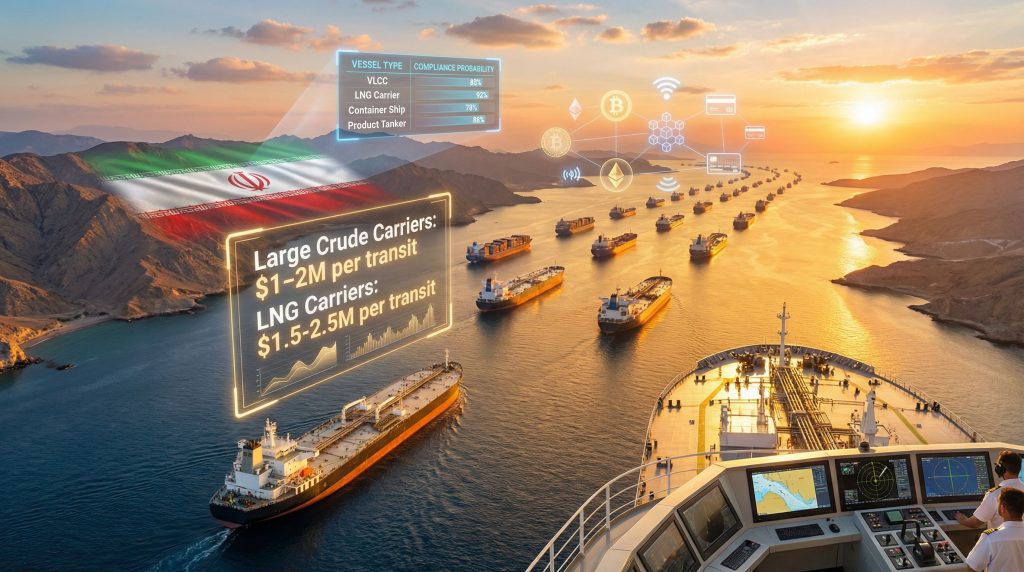
| Vessel Type | Estimated Toll Impact | Alternative Route Viability | Compliance Probability |
|---|---|---|---|
| Large Crude Carriers | $1-2M per transit | Limited (draft restrictions) | 85-90% |
| Product Tankers | $0.5-1M per transit | Moderate (shallow water routes) | 70-80% |
| LNG Carriers | $1.5-2.5M per transit | Very Limited | 90-95% |
| Container Ships | $0.8-1.5M per transit | Moderate | 75-85% |
Source: Scenario modelling based on industry analysis and operational constraints
The high-compliance scenario assumes that major shipping companies would treat toll payments as standard operational costs, similar to canal fees or port charges. This adaptation would likely accelerate integration of transit costs into long-term shipping contracts and insurance premium calculations.
Resistance Scenario: Market Fragmentation Outcomes
Alternative routing development represents the primary resistance mechanism for vessels seeking to avoid toll payments. Maritime operational analysis indicates that smaller vessels capable of navigating shallow waters could potentially circumvent Iranian territorial waters by utilising the southernmost passages near Omani territorial boundaries.
Routing Alternative Assessment:
- Omani Waters Transit: Technically feasible for vessels with appropriate draft characteristics
- Extended Indian Ocean Routes: Significant cost and time penalties but eliminates chokepoint dependence
- Regional Hub Restructuring: Potential development of alternative supply chain configurations reducing Hormuz dependency
- Pipeline Development: Accelerated investment in overland alternatives to maritime transport
Recent transit activity suggests mixed compliance patterns. According to MarineTraffic monitoring data referenced in industry reporting, several vessels have successfully transited the strait with some reportedly making fee payments to Iranian authorities, while others have faced operational challenges including delays and attack incidents.
Which Economic Multiplier Effects Would Transform Global Energy Markets?
Upstream Production Economics Under Transit Cost Pressure
The implementation of systematic tolling would fundamentally alter competitive dynamics between Gulf producers and alternative supply sources. Persian Gulf oil exports, which represent approximately 21% of global petroleum liquids production according to EIA data, would face cost disadvantages relative to Atlantic Basin crude sources, West African production, and Western Hemisphere suppliers. In addition, these market shifts connect to broader patterns of US-China trade war impacts on global supply chains.
Competitive Repositioning Implications:
- Gulf State Export Margins: Reduced competitiveness versus non-Hormuz producers in key Asian markets
- Investment Flow Redirection: Enhanced attractiveness of alternative supply source development
- Contract Renegotiation Triggers: Long-term supply agreements would require force majeure assessments
- Strategic Reserve Policies: Consuming nations would reassess inventory management strategies
Downstream Market Restructuring Implications
Refinery feedstock sourcing optimisation would accelerate under new cost structures imposed by toll implementation. Regional price differentials would likely expand as transportation cost advantages favour certain crude grades and supply routes over traditional Hormuz-dependent flows.
The downstream impact extends beyond simple cost pass-through mechanisms. According to maritime compliance analysis, operational inefficiencies including delays, documentation requirements, and coordination with military escorts would create additional friction costs beyond direct toll payments.
How Would Toll Systems Reshape Maritime Insurance and Risk Assessment?
Insurance Market Adaptation Strategies
Maritime insurance markets would require fundamental restructuring to accommodate toll-based transit systems. War risk premiums, which already incorporate geopolitical instability factors, would need to distinguish between compliant and non-compliant vessel categories when calculating coverage terms and pricing structures.
Coverage Framework Evolution:
- Toll Payment Verification Requirements: Insurance policies would mandate documented proof of fee payment before coverage activation
- Compliance-Based Premium Structures: Significant rate differentials between vessels following official toll protocols versus those attempting avoidance
- Specialised Transit Products: Development of insurance products specifically designed for chokepoint toll scenarios
- Claims Processing Modifications: New protocols for handling incidents related to toll disputes or enforcement actions
Risk Management Framework Evolution
The insurance industry's role as an unofficial enforcement mechanism represents a significant innovation in chokepoint control strategies. By requiring toll payment for coverage eligibility, insurers effectively externalise enforcement costs while maintaining compliance incentives through market mechanisms rather than military action.
Industry analysis suggests that this insurance-driven compliance model could prove more effective than traditional naval enforcement, particularly given current limitations in Iranian maritime capacity following recent military developments.
The next major ASX story will hit our subscribers first
What Precedent Analysis Reveals About Chokepoint Monetisation Success?
Historical Case Study Comparison Framework
Successful chokepoint monetisation requires careful analysis of existing precedents to understand critical success factors and potential failure modes. The most relevant comparisons involve established canal systems and regulated straits that have achieved sustained revenue generation through international recognition and operational efficiency. However, these developments must be considered within the context of an emerging multipolar global economy where traditional power structures are shifting.
Precedent Analysis Matrix:
| System | Legal Basis | Fee Structure | Annual Revenue | Key Success Factors |
|---|---|---|---|---|
| Suez Canal | Sovereign territory (1888 Constantinople Convention) | Tonnage/cargo-based | $7B+ | International treaty recognition |
| Panama Canal | Sovereign territory | Size/cargo classification | $4B+ | Universal acceptance, technical necessity |
| Turkish Straits | Montreux Convention (1936) | Service-based charges | $200M+ | Multilateral treaty framework |
| Danish Straits | Historical precedent (abolished 1857) | Tonnage-based | Historical reference | Eliminated due to international pressure |
Sources: Maritime treaty archives, canal authority financial statements, UN-OCEANS documentation
Success Factor Analysis for Sustainable Toll Implementation
Historical analysis reveals that sustainable chokepoint monetisation requires several critical elements that may be absent in current Hormuz scenarios. International recognition through multilateral treaties or established sovereignty provides legal legitimacy that voluntary compliance schemes cannot replicate.
Critical Success Requirements:
- Legal Foundation: Established through international treaties or undisputed territorial sovereignty
- Enforcement Capability: Naval and administrative capacity to maintain consistent collection
- Alternative Route Limitations: Geographic constraints that limit bypass options
- Service Provision: Actual services (navigation, security, maintenance) that justify fee collection
- International Acceptance: Diplomatic recognition from major shipping nations and maritime organisations
The Danish Sound Dues, abolished in 1857 following international pressure, demonstrate that even historically established toll systems can lose legitimacy without sustained international support and clear service provision justifications.
Which Technology Integration Models Enable Efficient Toll Collection?
Digital Payment Infrastructure Requirements
Modern toll collection systems require sophisticated technological frameworks to minimise transit delays while ensuring payment verification and compliance monitoring. Blockchain-based transaction processing offers transparency advantages while enabling real-time settlement across multiple currencies and banking systems.
Technical Infrastructure Components:
- Vessel Identification Systems: Integration with existing AIS (Automatic Identification System) networks for tracking and verification
- Cargo Documentation Platforms: Digital manifest systems enabling automated fee calculation based on vessel type, cargo value, or tonnage
- Multi-Currency Settlement: Payment processing infrastructure supporting various national currencies and digital assets
- Compliance Monitoring: Real-time tracking systems coordinated with port authorities and maritime traffic control
Operational Efficiency Optimisation Strategies
Successful toll implementation requires balancing revenue extraction with operational efficiency to avoid creating significant delays that might encourage alternative routing. Convoy scheduling systems could theoretically provide security services while optimising traffic flow, though this requires substantial naval coordination capacity.
The technological requirements for efficient toll collection may exceed current capabilities in conflict-affected regions, creating additional implementation challenges beyond legal and diplomatic obstacles.
What Long-Term Strategic Implications Emerge for Global Trade Architecture?
Geopolitical Power Dynamics Reshaping
The establishment of precedent for toll on Strait of Hormuz passage could fundamentally alter the balance of power in international maritime law and trade route control. Success in monetising critical chokepoints would likely inspire similar attempts at other strategic waterways, potentially fragmenting the principle of free maritime passage that has underpinned global trade since the post-World War II era. As detailed by SBS reporting on Iran toll fees, these developments represent unprecedented challenges to established maritime law.
Potential Replication Sites:
- Strait of Malacca: Critical for Asian trade flows, involving Malaysia, Singapore, and Indonesia
- Bab-el-Mandeb: Red Sea access point controlled by Yemen, Djibouti, and Eritrea
- Strait of Gibraltar: Mediterranean access involving Spain and Morocco
- Cape of Good Hope: Alternative routing option under South African jurisdiction
Supply Chain Resilience Transformation Patterns
Long-term strategic implications extend beyond immediate toll impacts to fundamental restructuring of global supply chain architecture. Companies would likely accelerate diversification strategies to reduce dependence on single chokepoint vulnerabilities, potentially driving investment in alternative transportation infrastructure including pipeline networks, overland rail connections, and alternative port facilities.
Infrastructure Development Acceleration:
- Pipeline Expansion: Enhanced investment in overland petroleum transport networks bypassing maritime chokepoints
- Regional Hub Development: Creation of alternative supply chain configurations reducing chokepoint dependency
- Strategic Reserve Enhancement: Expanded national and commercial inventory policies to buffer against supply disruptions
- Alternative Energy Transition: Accelerated adoption of local energy sources reducing import dependence
The precedent established by successful chokepoint monetisation would likely reshape international maritime law interpretation, potentially leading to more restrictive interpretations of innocent passage rights and expanded coastal state authority over strategic waterways. Consequently, this evolution could fundamentally alter the legal foundation supporting global free trade, creating new frameworks for economic leverage through geographic control.
Disclaimer: This analysis examines theoretical scenarios and strategic implications based on current maritime law frameworks and industry practices. Actual implementation outcomes would depend on complex legal, diplomatic, and operational factors that may differ significantly from projected scenarios. Readers should consult current maritime law resources and industry expert analysis for investment and operational decision-making.
Ready to Discover the Next Major Resource Investment Opportunity?
Discovery Alert's proprietary Discovery IQ model delivers instant notifications on significant ASX mineral discoveries, particularly relevant when global supply chains face uncertainty and investors seek alternative commodity opportunities. Begin your 14-day free trial today and position yourself ahead of market movements that could reshape resource investment landscapes.