August 22, 2026
Economic Pressures Shape Manufacturing Performance Across Sectors
Manufacturing sectors demonstrated varying resilience patterns during December 2025, with brazil's industrial output decline reflecting differentiated responses to monetary policy and global market conditions. Furthermore, the broad-based contraction affected multiple production categories, indicating systematic rather than isolated economic pressures affecting the region's manufacturing base.
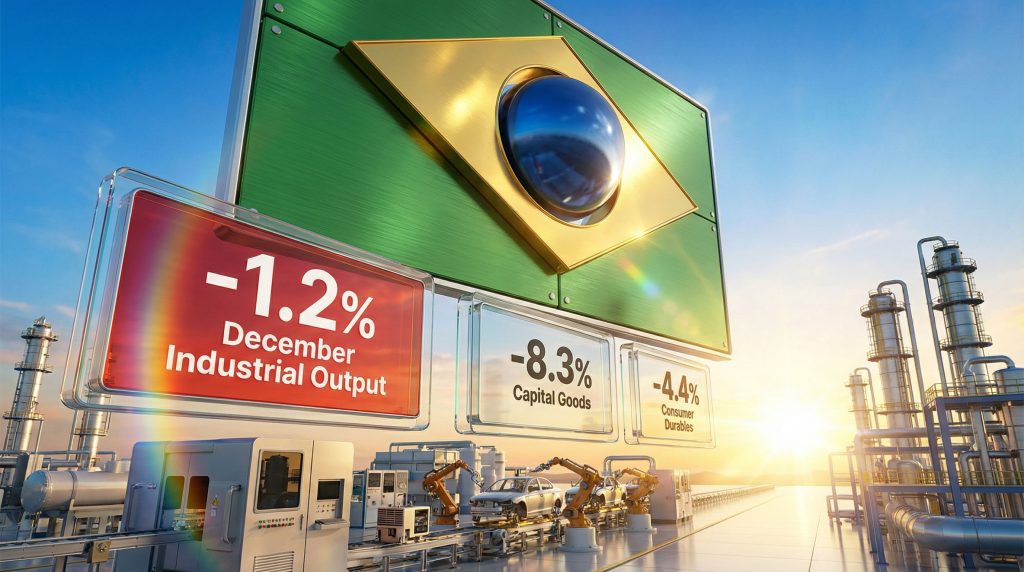
Capital goods production experienced the most severe disruption, falling 8.3% month-over-month according to IBGE data. This decline signals reduced business investment confidence as companies defer equipment purchases and facility upgrades in response to elevated financing costs. The manufacturing equipment and industrial machinery segments showed particular vulnerability, with producers reporting delayed orders and project cancellations throughout December.
Consumer durables faced significant headwinds with a 4.4% monthly decline, led by automotive sector weakness at 8.7% contraction. Brazilian households reduced major purchases as financing costs increased and economic uncertainty affected spending decisions. Electronics and appliance manufacturers experienced similar demand pressures, with production adjustments reflecting both domestic market softness and export competitiveness challenges.
Chemical industry performance revealed multiple pressure points, with production declining 6.2% month-over-month. Petrochemical derivatives faced pricing pressures from global commodity markets, while fertilizer production encountered additional stress from agricultural sector uncertainty. The industry's exposure to both domestic demand weakness and international competition became apparent through production adjustments across multiple chemical categories.
When big ASX news breaks, our subscribers know first
Monetary Policy Transmission Through Manufacturing Channels
Brazil's central bank maintained its benchmark rate at 15% throughout the second half of 2025, creating a challenging environment for manufacturing investment and operations. This elevated rate environment, implemented to control inflation running at 4.26% annually in December, transmitted through multiple channels affecting industrial production decisions. However, these inflation and tariffs dynamics create complex interactions with global trade policies.
High borrowing costs limited capital expenditure as manufacturers faced increased financing expenses for equipment upgrades and facility expansion. Working capital constraints affected inventory management and production planning, with companies reducing stock levels and adjusting output schedules to minimize financing requirements.
Currency dynamics added complexity as elevated Brazilian rates strengthened the real against trading partner currencies, reducing export competitiveness for manufactured goods. Import substitution patterns emerged as domestic producers faced increased competition from foreign suppliers benefiting from exchange rate advantages.
The transmission mechanisms from monetary policy to manufacturing operated through several channels:
- Direct credit effects: Higher policy rates increased commercial lending rates, reducing credit supply and raising borrowing costs for manufacturers
- Investment constraints: Capital expenditure decisions faced higher discount rates, delaying or cancelling expansion projects
- Working capital pressure: Inventory financing costs increased, leading to production adjustments and reduced stock levels
- Exchange rate impacts: Real appreciation reduced export competitiveness while potentially lowering import costs for industrial inputs
Sectoral Performance Patterns Reveal Structural Dynamics
| Manufacturing Sector | December 2025 (MoM) | Annual Performance | Key Drivers |
|---|---|---|---|
| Capital Goods | -8.3% | +2.5% (2025) | Investment cycle cooling, high financing costs |
| Consumer Durables | -4.4% | +1.5% (2025) | Household demand softening, credit constraints |
| Chemicals | -6.2% | +0.8% (2025) | Global pricing pressure, agricultural uncertainty |
| Automotive | -8.7% | Data pending | Financing costs, inventory adjustments |
| Oil Products/Biofuels | +5.4% | -5.3% (2025) | Energy transition volatility, seasonal factors |
The divergent performance patterns across sectors highlighted different sensitivity levels to monetary policy and global market conditions. Capital goods manufacturing's sharp decline reflected its role as a leading indicator of broader economic sentiment, while consumer durables weakness indicated household financial stress. In addition, tariffs impact investment decisions across multiple sectors.
Chemical production faced dual pressures from both domestic demand weakness and global commodity price volatility. Petrochemical derivatives encountered intensified competition from Asian producers, while fertilizer manufacturing dealt with agricultural sector uncertainty affecting farmer purchasing power and input demand.
Energy-related production showed mixed results, with oil products and biofuels gaining 5.4% monthly after previous declines. This recovery reflected seasonal demand patterns and inventory restocking following earlier production cuts, though the sector's 5.3% annual decline in 2025 demonstrated longer-term transition challenges.
Regional Manufacturing Disparities and Strategic Responses
Brazil's industrial decline displayed significant regional variations, reflecting the country's complex economic geography and manufacturing concentration patterns. The southeast manufacturing corridor, centered around São Paulo's industrial belt, experienced broad-based contractions across automotive and chemical production clusters.
The automotive concentration around the ABC region faced particular challenges as both domestic demand and export market access weakened simultaneously. Chemical complexes in Rio de Janeiro state showed mixed performance, with some facilities adjusting production schedules while others maintained output levels through export market focus.
Northeast Brazil demonstrated different dynamics through strategic industrial development initiatives. Steel billet production resumed in Ceará with 160,000 tonnes annual capacity, representing regional diversification efforts aimed at reducing freight cost disadvantages. The mini-mill strategy enables local market focus while offsetting broader manufacturing sector weakness.
Regional manufacturing strategies emphasized:
- Freight cost optimization: Mini-mill approaches reducing transportation expenses for steel products
- Local market development: Regional production serving nearby demand centres
- Import substitution: Domestic production replacing foreign suppliers in specific market segments
- Export diversification: Alternative market development for regions with established manufacturing bases
Global Commodity Cycles Impact Industrial Structure
Brazil's industrial performance reflected the ongoing tension between its roles as commodity exporter and manufacturing hub. December 2025 data revealed this structural dynamic through contrasting trends between extraction and manufacturing activities.
Extraction industries gained 1% monthly, supported by iron ore and petroleum production meeting international demand. Mining operations benefited from stable global commodity prices and operational efficiency improvements, contrasting sharply with manufacturing sector struggles. Consequently, iron ore price trends continue influencing Brazil's industrial composition.
Manufacturing sectors faced broad-based decline as global demand for Brazilian manufactured goods weakened. Value-added processing showed particular vulnerability to international competition, with chemical exports encountering pricing pressure from Asian producers and automotive manufacturing struggling with both domestic demand and export market access.
Steel production illustrated these challenges, with industry projections indicating 2026 output declining to 32.4 million tonnes as import competition intensifies. The sector's adjustment involves consolidation strategies and efficiency improvements to maintain market position amid challenging competitive conditions.
Resource extraction versus manufacturing balance created several implications:
- Export composition shifts: Commodity exports maintaining strength while manufactured goods face pressure
- Value-added processing challenges: Higher-margin production categories experiencing competitive stress
- Industrial policy considerations: Government responses to manufacturing competitiveness concerns
- Investment allocation patterns: Capital flowing toward extraction while manufacturing investment declines
Forward-Looking Manufacturing Competitiveness Factors
Brazil's manufacturing future depends on addressing multiple competitiveness challenges while capitalising on structural advantages. Productivity and technology adoption lag international peers, constraining competitiveness improvements across multiple sectors.
Consolidation efforts in key sectors like steel and automotive may improve operational efficiency through scale economies and technology integration. However, artificial intelligence and automation adoption requires significant investment commitments during a period of elevated financing costs. Furthermore, iron ore demand insights suggest shifting global patterns affecting industrial planning.
Energy costs and logistics infrastructure continue constraining manufacturing competitiveness relative to international competitors. Transportation bottlenecks and utility pricing affect production costs across multiple manufacturing categories, requiring infrastructure investment and regulatory attention. Additionally, oil price dynamics create additional complexity for energy-intensive manufacturers.
Policy response scenarios could significantly alter manufacturing dynamics through 2026. Potential interest rate adjustments may improve financing conditions for manufacturers while maintaining inflation control objectives. Industrial policy initiatives targeting strategic sectors could provide focused support for competitive positioning.
Trade policy responses to import competition pressures represent another variable affecting manufacturing prospects. Selective protection measures or trade agreement negotiations could influence competitive dynamics across different manufacturing segments.
The next major ASX story will hit our subscribers first
Investment Implications and Market Psychology Considerations
December's 1.2% monthly decline should be contextualised within Brazil's longer industrial trajectory, which showed three consecutive years of growth from 2023-2025. The 0.6% annual growth in 2025 indicates modest expansion despite monthly volatility, with pre-pandemic output levels achieved demonstrating recovery completion. For instance, recent analysis suggests this represents the lowest December output since mid-2024.
Sector rotation opportunities emerge from energy transition dynamics creating winners and losers within the industrial base. Infrastructure investment supports construction-related manufacturing while agricultural processing maintains relative stability through commodity sector strength.
Manufacturing sector performance will likely remain volatile as brazil's industrial output decline continues reflecting complex economic adjustments. Global trade dynamics continue reshaping competitive landscapes for Brazilian industrial production, requiring adaptive strategies from both companies and policymakers.
The brazil's industrial output decline reflects complex interactions between domestic monetary conditions, global commodity cycles, and structural economic transformation pressures. While monthly volatility creates headline concerns, underlying trends suggest an economy managing transition from post-pandemic recovery toward sustainable growth patterns.
Manufacturing competitiveness improvements through consolidation, technology adoption, and infrastructure development represent longer-term requirements for maintaining industrial sector strength. Near-term performance will depend significantly on monetary policy adjustments and global demand conditions affecting Brazilian manufactured goods, with brazil's industrial output decline serving as a key indicator of broader economic health.
Ready to Capitalise on Brazil's Industrial Market Shifts?
Discovery Alert's proprietary Discovery IQ model delivers real-time notifications on significant ASX mineral discoveries, helping investors identify actionable opportunities in commodity markets affected by global industrial trends like Brazil's current manufacturing adjustments. Begin your 14-day free trial today and position yourself ahead of market movements driven by shifting industrial demand patterns.