
May 16, 2026
Economic Transformation Reshapes Digital Commerce Landscape
The global economy faces unprecedented shifts as consumer behavior fundamentally transforms across multiple sectors simultaneously. Rising inflation pressures, evolving labor markets, and technological acceleration create complex interdependencies that reshape traditional business models. These US economic challenges intersect with tariff impacts on investments to create market volatility. Within this broader economic restructuring, food retail represents a particularly compelling case study of how digital transformation intersects with household budget optimization, supply chain innovation, and changing demographic preferences to create entirely new market dynamics that define online grocery shopping trends.
When big ASX news breaks, our subscribers know first
How Digital Infrastructure Investment Transforms Food Retail Economics
The economic foundation of grocery commerce undergoes radical restructuring as digital platforms challenge century-old retail paradigms. Traditional food retail operated on predictable cost structures centered around physical store networks, standardized inventory management, and location-based customer acquisition. These established models now compete against digitally-native approaches that optimize different economic variables entirely.
Investment capital flows reveal the magnitude of this transformation. Global venture funding in food technology and e-grocery platforms reached $3.1 billion in 2023, despite representing a 41% decline from the previous year's peak. This correction reflects market maturation rather than declining opportunity, as investors shift focus toward profitability metrics over pure growth acceleration.
Infrastructure requirements demonstrate stark economic differences between traditional and digital models. Conventional grocery stores require substantial real estate investments, typically $20-40 per square foot annually in prime retail locations. Digital fulfillment centers operate with significantly lower real estate costs of $5-15 per square foot for dark store facilities, though these savings often transfer to technology infrastructure and last-mile delivery capabilities.
The labor economics equation transforms completely in digital environments. Traditional retail labor costs range from $1.50-3.00 per transaction for checkout and customer service functions. Furthermore, online fulfillment substitutes these costs with picking labor at $0.80-2.50 per order, plus delivery expenses that typically add $4-12 per transaction. However, digital platforms achieve superior inventory control, reducing shrinkage rates from 2-4% in traditional retail to 1-2% in online operations.
Technology ROI Calculations Drive Competitive Positioning
Artificial intelligence integration creates measurable economic advantages for digitally-enabled retailers. Predictive analytics systems reduce inventory carrying costs by improving demand forecasting accuracy, with leading platforms achieving 15-25% reduction in stockouts while simultaneously decreasing excess inventory. These improvements translate directly to working capital optimization and margin enhancement.
Personalization algorithms demonstrate quantifiable impact on customer economics. Platforms utilizing advanced recommendation engines report average order value increases of 12-18% compared to static catalog presentations. For instance, voice commerce adoption remains nascent but early indicators suggest potential for further transaction cost reduction as natural language processing capabilities mature.
Mobile commerce infrastructure development requires substantial upfront investment but creates scalable economic advantages. According to IBISWorld, smartphone penetration correlation with market growth shows consistent patterns across developed economies, where smartphone adoption above 85% typically corresponds with e-grocery penetration exceeding 8-10% of total food retail spending.
What Market Penetration Metrics Indicate Economic Maturity
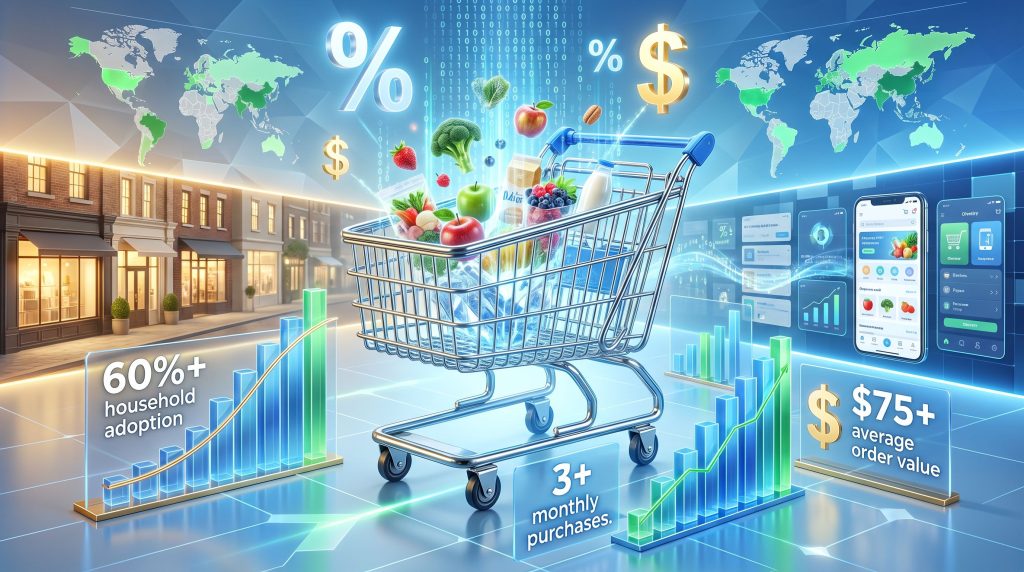
Economic indicators reveal distinct maturation phases for online grocery shopping trends across different regional markets. Household adoption rates provide the clearest signal of market development, with emerging markets showing penetration below 5%, growth markets achieving 15-40% household adoption, and mature markets exceeding 50% penetration rates.
| Economic Indicator | Emerging Markets | Growth Markets | Mature Markets |
|---|---|---|---|
| Household Penetration Rate | <5% | 15-40% | 50%+ |
| Monthly Purchase Frequency | <1 per month | 1-2 per month | 3+ per month |
| Average Order Value | $25-45 | $45-70 | $75-120+ |
| Repeat Customer Rate | <20% | 40-60% | 70%+ |
Purchase frequency metrics demonstrate behavioral entrenchment patterns that signal sustainable market development. Research indicates that the three monthly purchase threshold represents a critical psychological inflection point where online grocery transitions from discretionary convenience to habitual behavior. At this frequency level, annual churn rates decrease to below 15% compared to 40-50% churn for lower-frequency users.
Average order value economics reveal market sophistication levels. Sustainable delivery economics require minimum order values of $45-55 to cover last-mile delivery costs effectively. Consequently, markets achieving consistent order values above $75 demonstrate sufficient consumer willingness to pay convenience premiums that support profitable unit economics.
Regional variations in maturation indicators reflect economic development levels and infrastructure capabilities. The United Kingdom represents a mature market with 58-62% household penetration and average order values of £65-75. Germany demonstrates growth market characteristics with 31-35% penetration and €55-65 average orders. However, emerging markets like Brazil show 8-12% penetration concentrated in major urban centers with significantly lower $24-30 average order values.
Customer Lifetime Value Calculations Determine Investment Strategies
Customer acquisition cost analysis reveals significant variations across marketing channels and market maturity levels. Traditional media acquisition costs range from $25-45 per customer, while digital marketing achieves $15-35 per customer with faster scaling capabilities. In addition, referral and organic acquisition provide the most efficient $5-12 per customer costs but with limited volume potential.
Customer lifetime value calculations in mature markets show annual revenue per user of $150-250 for active customers. Gross margins typically range from 25-35% in competitive environments, with customer retention periods averaging 3-5 years for subscription-based models. These metrics generate calculated lifetime values between $112-438 depending on retention optimization success.
Investment capital flow patterns indicate market confidence levels. Warehouse automation spending specifically for grocery and retail applications reached $5.8 billion globally in 2023, with projections suggesting growth to $9.2 billion by 2027. This infrastructure investment demonstrates industry commitment to long-term digital transformation despite short-term profitability pressures.
Why Consumer Economic Behavior Shifts Toward Digital Channels
Demographic economic factors create distinct online grocery shopping trends across generational and income segments. High-income households earning $100,000+ annually demonstrate 3.5-4.2 times higher adoption rates for paid delivery services compared to middle-income segments earning $40-60,000. Lower-income households below $40,000 annually show minimal willingness to pay convenience premiums, limiting market penetration in these demographics.
Generational wealth distribution patterns influence platform selection and usage behavior. Baby boomer demographics prioritize security-focused purchasing patterns with emphasis on familiar brands and established retailers. Furthermore, millennial dual-income households optimize for time efficiency, driving adoption of subscription-based models and regular delivery scheduling. Generation Z consumers integrate price discovery tools and social commerce features into their grocery selection processes.
Income elasticity of convenience services exhibits non-linear patterns that affect market sizing calculations. Convenience service adoption accelerates rapidly above certain household income thresholds, creating concentrated market opportunities in affluent demographics while limiting mass market penetration potential in price-sensitive segments.
Economic pressure during inflationary periods creates paradoxical effects on digital adoption. While 34% of consumers report exploring online grocery platforms for price comparison capabilities during high inflation periods, the same economic pressures reduce willingness to pay delivery fees and service charges that make these platforms economically viable.
Geographic Economic Disparities Shape Market Development
Regional infrastructure investment requirements create uneven market development patterns. Dense urban environments support efficient last-mile delivery economics with delivery costs as low as $4-6 per order in optimal conditions. However, suburban and rural areas face delivery cost structures of $8-15+ per order, creating economic barriers to widespread adoption.
Currency fluctuation impacts affect international platform expansion strategies and local market economics. Platform operators expanding across currency zones face hedging costs and pricing challenges that complicate unit economics optimization. Consequently, local economic conditions, including purchasing power parity variations, require platform-specific adaptations that increase operational complexity.
Market entry capital requirements vary dramatically by geographic region and competitive intensity. Entering mature markets requires $10-50 million+ initial investment for technology infrastructure, inventory, and customer acquisition. In addition, emerging markets offer lower entry costs but face infrastructure limitations that increase long-term development expenses.
How Supply Chain Digitization Enables New Economic Models
Supply chain technology integration creates fundamental shifts in grocery retail economics through improved inventory management, demand forecasting, and distribution optimization. Real-time inventory visibility systems enable retailers to reduce safety stock requirements while maintaining service levels, directly improving working capital efficiency.
Warehouse automation investment demonstrates measurable returns on operational efficiency. Automated picking systems achieve productivity improvements of 2.5-4x compared to manual operations, though capital requirements typically range from $1-3 million per facility depending on sophistication levels. These investments become economically justified once order volumes exceed 500-1,000 orders per day.
Cold chain logistics optimization represents a critical technical challenge with significant economic implications. Temperature-controlled storage and transportation add 15-25% to fulfillment costs but enable expanded product category offerings that drive higher average order values. Furthermore, successful cold chain management often differentiates platforms in competitive markets.
Inventory management system upgrades enable sophisticated demand planning that reduces waste and improves margin performance. Advanced systems utilizing machine learning algorithms achieve 10-15% improvement in demand forecast accuracy, translating to reduced markdowns and better inventory turnover metrics.
Fulfillment Model Economics Determine Operational Strategy
Three primary fulfillment models have emerged with distinct economic characteristics that suit different market conditions and customer segments. Dark store and micro-fulfillment center models require $1-3 million capital investment per facility but achieve $0.40-0.85 picking costs per item. For instance, store-based fulfillment leverages existing retail infrastructure with lower $100,000-300,000 integration costs but higher operational complexity.
Hybrid fulfillment strategies combine multiple approaches to optimize economics across different order profiles and geographic areas. High-frequency, small-basket orders benefit from urban micro-fulfillment centers, while large weekly shopping orders achieve better economics through store-based picking and dedicated delivery routes.
Route optimization technology creates substantial efficiency improvements in last-mile delivery economics. Advanced routing algorithms achieve 20-30% reduction in delivery costs compared to basic scheduling systems by optimizing driver routes, consolidating orders, and predicting traffic patterns.
What Regulatory and Market Forces Shape Future Growth
Regulatory environment impacts create significant cost implications for digital grocery platforms. Food safety compliance requirements add operational complexity and expense, particularly for fresh product categories. However, data privacy regulations influence customer acquisition strategies and operational costs through required consent management and data protection infrastructure.
Labor regulation effects on gig economy fulfillment models create ongoing economic uncertainty. Classification changes for delivery workers potentially increase fulfillment costs by 25-40% if independent contractors require reclassification as employees with full benefit packages. These concerns mirror broader US–China trade impact challenges affecting global commerce.
Sustainability economics increasingly influence consumer preferences and operational requirements. Carbon footprint reduction initiatives require investment in electric delivery vehicles, renewable energy, and sustainable packaging. Furthermore, these investments may generate long-term cost savings and customer preference advantages.
Economic recession resilience of convenience-focused spending shows mixed historical patterns. While discretionary convenience services face pressure during economic downturns, time-saving services often maintain demand among employed demographics who value time over incremental cost savings. Statista's research indicates this trend varies by demographic segment.
Global Economic Uncertainty Factors Affect Investment Decisions
Currency volatility impacts international platform expansion economics through pricing complexity and hedging costs. Platforms operating across multiple currency zones face additional financial management requirements that increase operational overhead and complicate unit economics optimization.
Interest rate environment changes affect retail investment strategies and consumer behavior simultaneously. Higher borrowing costs reduce platform expansion capital availability while potentially increasing consumer focus on value and price comparison capabilities that favor online shopping. These dynamics align with broader concerns about the global recession outlook.
Inflation impact on delivery service demand demonstrates complex elasticity patterns. While price increases may reduce discretionary convenience spending, inflation simultaneously drives consumer desire for price comparison tools and bulk purchasing capabilities that online platforms provide effectively. Consequently, investors explore volatility hedging strategies to manage risk.
Market concentration trends indicate ongoing consolidation as smaller platforms struggle to achieve sustainable economics. Larger platforms benefit from scale economies in technology development, supplier negotiations, and delivery network optimization that create competitive advantages over specialized or regional players.
The next major ASX story will hit our subscribers first
How Platform Optimization Strategies Improve Financial Performance
Unit economics optimization requires systematic focus on customer acquisition cost reduction through retention-focused strategies. Platforms achieving 70%+ annual retention rates demonstrate significantly better lifetime value to acquisition cost ratios than those with 40-50% retention performance.
Average order value improvement through bundling strategies and personalized recommendations creates measurable impact on platform economics. Successful bundling programs achieve 12-18% AOV increases while improving inventory turnover for slower-moving products through cross-selling integration.
Operational efficiency gains via route optimization and demand forecasting directly impact profitability metrics. Platforms utilizing advanced logistics algorithms achieve 15-25% reduction in delivery costs while maintaining or improving delivery time performance.
Subscription model optimization creates predictable revenue streams that improve financial planning and customer lifetime value calculations. For instance, successful subscription programs achieve monthly churn rates below 5% while generating 20-40% higher annual revenue per user compared to transaction-based models.
Partnership Economics Versus Direct Investment Trade-offs
Market entry economic considerations require careful analysis of partnership versus direct investment strategies. Partnership models reduce capital requirements but typically involve revenue sharing of 15-30% that impacts long-term profitability. Furthermore, direct investment models require higher upfront capital but retain full economic upside potential.
Competitive positioning cost analysis reveals significant variations in customer acquisition difficulty across market entry timing. Early market entrants achieve lower acquisition costs but face market education expenses. However, late entrants face higher acquisition costs due to increased competition but benefit from established consumer behavior patterns.
Financial performance benchmarking across successful platforms reveals consistent patterns in key performance indicators. Profitable platforms typically achieve gross merchandise value per customer above $200 annually, gross margins exceeding 30%, and customer acquisition payback periods below 18 months.
Cash flow management in high-growth environments requires sophisticated working capital planning. Rapid growth platforms face inventory investment requirements that can exceed $2-5 million per month in working capital needs, requiring careful balance between growth acceleration and financial sustainability.
What Long-term Economic Projections Indicate for Digital Grocery Markets
Total addressable market expansion scenarios project continued growth across developed and emerging economies. Global online grocery shopping trends indicate markets are projected to reach $370.8 billion by 2030, representing a 13.5% compound annual growth rate from current levels of $172.35 billion.
Economic growth correlation with digital adoption rates shows consistent patterns where GDP per capita above $25,000 typically corresponds with e-grocery penetration exceeding 5% of total food retail spending. This correlation suggests significant growth potential in emerging markets as economic development continues.
Saturation point analysis for mature markets indicates potential ceiling effects as penetration rates approach 60-70% of households. However, frequency and order value growth may continue driving revenue expansion even after household penetration growth moderates.
Emerging economic models focus on subscription-based recurring revenue optimization and marketplace commission structure evolution. Subscription models demonstrate superior customer lifetime value characteristics but require careful balance between service value delivery and pricing to maintain retention rates.
Risk Factors and Economic Resilience Planning
Economic downturn impact on discretionary convenience spending creates cyclical risk factors for platform profitability. Historical patterns suggest convenience services face 20-35% demand reduction during recession periods. However, essential grocery categories demonstrate greater resilience than discretionary retail segments.
Technology disruption threats to current business models include automation advancement that may reduce labor cost advantages. Furthermore, autonomous delivery systems that could reshape last-mile economics, and artificial intelligence capabilities that may commoditize personalization advantages.
Competitive moat sustainability in digital environments requires continuous innovation investment and scale advantages that newer entrants cannot easily replicate. Network effects, data advantages, and supplier relationships provide the most sustainable competitive protection in digital grocery markets.
This analysis reflects market conditions and economic data available as of 2024. Investment decisions should consider additional factors including individual financial circumstances, risk tolerance, and professional financial advice. Market projections involve uncertainty and actual results may differ significantly from estimates presented.
Considering Investing in Small-Cap Food Technology Companies?
Discovery Alert provides instant notifications on significant ASX mineral discoveries, powered by its proprietary Discovery IQ model. Subscribers receive rapid insights into actionable trading and investment opportunities across diverse sectors, ensuring quick and informed decisions during market transformation periods like those affecting digital commerce markets.