May 10, 2026
Economic Transformation Through Integrated Mineral Processing
Africa's mineral wealth has historically flowed overseas as raw materials, generating minimal domestic economic value. Contemporary economic pressures and global supply chain vulnerabilities are fundamentally reshaping this paradigm, driving African nations toward comprehensive value chain development in African mining strategies that prioritise domestic processing and manufacturing capabilities.
The transformation represents more than simple beneficiation. Modern value chain approaches encompass entire economic ecosystems, integrating mining operations with processing facilities, manufacturing capabilities, and supporting infrastructure networks. Furthermore, this systematic approach aims to capture maximum economic value from mineral resources while building sustainable industrial foundations.
When big ASX news breaks, our subscribers know first
Redefining African Mining's Economic Architecture
Traditional mining models focused on rapid extraction and export, minimising capital investment in domestic processing infrastructure. This approach generated limited employment opportunities and constrained economic multiplier effects within African economies.
However, value chain development in African mining fundamentally restructures these economic relationships. Rather than exporting raw materials, nations develop integrated processing capabilities that transform mineral resources into higher-value products. This approach generates substantially greater economic returns while creating diverse employment opportunities across technical, manufacturing, and support sectors.
Key Economic Advantages:
- Processing activities generate 300-500% higher economic value than raw material exports
- Manufacturing operations create 15-25 jobs per dollar invested compared to extraction-only models
- Integrated value chains reduce vulnerability to international commodity price volatility
- Domestic processing capabilities attract technology transfer investments
The economic transformation extends beyond mining companies to encompass entire regional economies. Supporting industries, from specialised equipment manufacturing to technical services, develop around processing hubs, creating self-reinforcing industrial ecosystems.
Regional Leadership in Value Chain Implementation
Several African nations have emerged as pioneers in implementing comprehensive value chain strategies, demonstrating practical approaches to economic transformation through integrated mining development. In addition, these mining industry innovation initiatives showcase how regional cooperation accelerates development.
West African Gold Processing Innovation
Ghana's strategic partnership with South African technical expertise demonstrates how regional collaboration accelerates value chain development. The collaboration focuses on expanding domestic gold refining capacity while transferring specialised processing technologies.
The partnership targets annual domestic refining capacity exceeding 200 tonnes, representing a fundamental shift from traditional export-oriented approaches. Technical expertise from South African refining operations provides the foundation for sustainable processing capabilities.
This regional cooperation model addresses critical skill shortages while accelerating technology transfer. South African technical partnerships provide specialised knowledge in refining processes, equipment optimisation, and quality control systems essential for internationally competitive operations.
Southern African Lithium Processing Revolution
Zimbabwe's approach to lithium value chain development showcases how policy frameworks can drive industrial transformation. The country's planned 2027 prohibition on raw lithium concentrate exports compels international investors to establish domestic processing facilities.
Implementation Timeline:
- 2024-2026: International partnership establishment and facility planning
- 2027: Raw concentrate export restrictions implementation
- 2028-2030: Full domestic processing capacity achievement
This regulatory approach transforms Zimbabwe from a raw material supplier into a processed lithium producer, capturing significantly greater economic value while building domestic industrial capabilities. Moreover, the critical minerals energy transition creates substantial opportunities for processed battery materials.
Infrastructure Requirements for Successful Value Chain Development
Integrated value chains require sophisticated infrastructure systems that support both mining operations and downstream processing activities. Energy systems, transportation networks, and technical facilities must operate as coordinated ecosystems.
Energy Infrastructure Integration
Processing operations require substantially more energy than traditional extraction activities. Lithium processing facilities typically consume 45-65 MWh per tonne of refined product, compared to 15-25 MWh per tonne for primary extraction operations.
Advanced manufacturing processes demand even greater energy inputs, with finished battery component production requiring 80-120 MWh per tonne of final products. These requirements necessitate reliable, cost-effective energy systems capable of supporting industrial-scale operations.
Energy Infrastructure Development Priorities:
- Grid stability improvements to support consistent industrial operations
- Renewable energy integration to reduce operational costs
- Backup power systems ensuring processing continuity
- Energy storage capabilities managing peak demand periods
Transportation Network Optimisation
Value chain operations require sophisticated logistics capabilities handling diverse product types, from raw materials to finished goods. Transportation infrastructure must accommodate varying cargo requirements whilst maintaining cost efficiency.
Integrated processing facilities generate different transportation demands than traditional mining operations. Raw material inputs, intermediate products, and finished goods require specialised handling and storage capabilities throughout the logistics chain.
Financial Innovation Supporting Value Chain Development
Contemporary financing approaches recognise the extended timelines and diverse risk profiles associated with integrated value chain development. Financial institutions are adapting their strategies to support comprehensive ecosystem development rather than single-project financing.
Comprehensive Project Financing Evolution
| Financing Aspect | Traditional Mining | Value Chain Development |
|---|---|---|
| Project Duration | 5-10 years | 15-25 years |
| Capital Requirements | $500M-2B | $2B-8B |
| Risk Management | Commodity price hedging | Diversified revenue stream protection |
| Infrastructure Investment | Mine-specific only | Regional ecosystem development |
Long-term financing approaches acknowledge that value chain development in African mining requires patient capital willing to accept extended payback periods in exchange for more diversified and stable returns. Financial institutions increasingly recognise the superior risk-adjusted returns from integrated operations compared to single-commodity projects.
Furthermore, mining consolidation trends influence financing structures as companies seek strategic partnerships for value chain development.
Critical Minerals Reshaping Strategic Approaches
The global energy transition has elevated African critical minerals to strategic importance, creating unprecedented opportunities for value chain development across multiple commodity sectors. Battery metals, rare earth elements, and other transition-critical materials command premium valuations for processed products.
Battery Metals Processing Expansion
African nations controlling significant lithium, cobalt, and nickel reserves are positioning themselves as essential participants in global battery supply chains through integrated processing strategies. The recent battery recycling breakthrough developments enhance the strategic value of African processing capabilities.
Processing Capacity Expansion Targets:
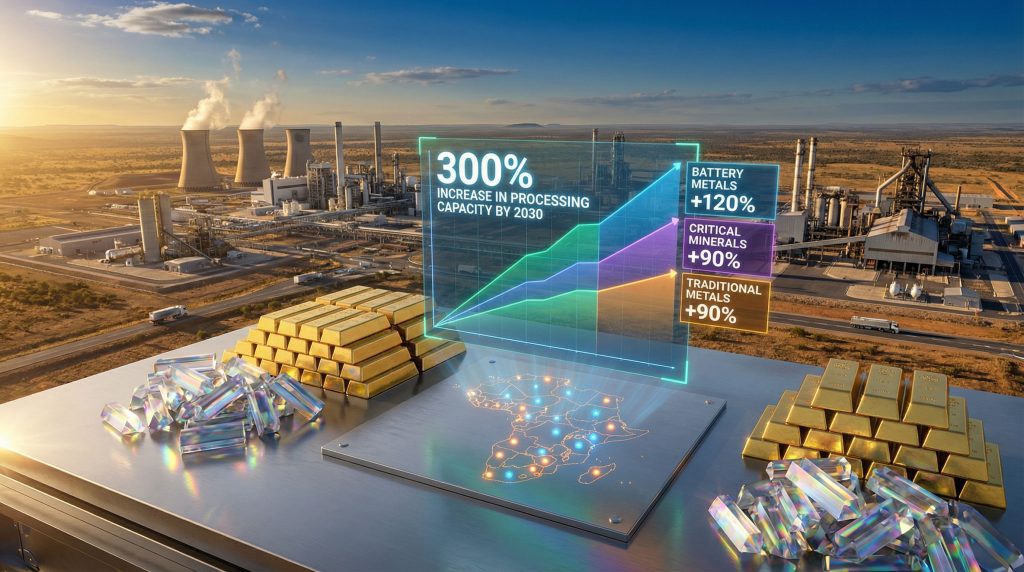
- Lithium processing: 300% capacity increase targeted by 2030
- Cobalt refining: 250% expansion in intermediate product manufacturing
- Nickel processing: 200% growth in battery-grade material production
These expansion targets reflect growing recognition that processed critical minerals command substantially higher prices than raw concentrates. Battery-grade lithium carbonate typically sells for 200-300% higher prices than raw lithium concentrates.
The next major ASX story will hit our subscribers first
Regulatory Framework Harmonisation
Successful cross-border value chain development requires coordinated regulatory approaches that facilitate investment and trade whilst maintaining environmental and social standards. The African Continental Free Trade Area provides the institutional framework for regulatory harmonisation.
Continental Trade Integration
The African Continental Free Trade Area creates opportunities for seamless value chain integration across national borders. Harmonised mining codes and regional cooperation reduce regulatory barriers whilst maintaining appropriate oversight.
Regulatory Harmonisation Priorities:
- Standardised mining and processing regulations across participating nations
- Coordinated environmental impact assessment procedures
- Streamlined cross-border investment approval processes
- Unified trade facilitation mechanisms for intermediate products
Implementation Challenges and Solutions
Despite significant opportunities, value chain development faces substantial implementation challenges that require systematic solutions and patient capital commitment. Additionally, AI in mining efficiency technologies are helping address operational challenges.
Technical Capacity Development
Many African nations lack the specialised technical expertise required for advanced mineral processing operations. Successful value chain development requires comprehensive capacity building programmes spanning multiple skill categories.
Critical Skill Development Areas:
- Advanced metallurgical processing techniques
- Quality control and assurance systems
- Environmental management for integrated operations
- Project management for complex multi-phase developments
Training programmes must combine theoretical knowledge with practical experience, often requiring international partnerships for technology transfer and skill development.
Infrastructure Coordination Challenges
Value chain development requires coordinated infrastructure investment across multiple sectors simultaneously. Energy, transportation, and processing facilities must develop in synchronised phases to ensure operational efficiency.
Poor infrastructure coordination can create bottlenecks that undermine entire value chain operations. Processing facilities without reliable energy supplies or transportation access cannot achieve competitive operational costs.
Global Demand Projections and Strategic Positioning
Projected increases in global mineral demand create exceptional opportunities for African value chain development, provided nations can align production growth with processing capacity expansion. Research indicates that African mining's supply chain integration is becoming increasingly critical to global markets.
Demand Growth Analysis
| Mineral Category | 2025 Baseline | 2030 Projection | 2050 Projection |
|---|---|---|---|
| Battery Metals | 100% baseline | 350% increase | 900% increase |
| Critical Minerals | 100% baseline | 280% increase | 650% increase |
| Traditional Metals | 100% baseline | 160% increase | 320% increase |
These demand projections reflect global energy transition requirements and emerging technology adoption. African nations with integrated processing capabilities are positioned to capture disproportionate value from this demand growth.
Investment Strategy Optimisation
Successful value chain development requires sophisticated investment approaches that balance immediate returns with long-term economic transformation objectives. Multi-phase investment strategies allow for progressive capability building whilst maintaining operational flexibility.
Phased Investment Implementation
Phase 1 (Years 1-3): Foundation Development
- Basic processing infrastructure establishment
- Core technical workforce development
- Primary energy and transportation infrastructure
- Initial processing capability demonstration
Phase 2 (Years 4-7): Capacity Expansion
- Intermediate manufacturing capabilities
- Advanced processing technology integration
- Regional supply chain development
- Quality certification achievement
Phase 3 (Years 8-12): Market Integration
- Advanced manufacturing and technology integration
- Global supply chain participation
- Research and development capabilities
- Innovation and optimisation systems
Phase 4 (Years 13-20): Leadership Consolidation
- Market leadership in specific product categories
- Technology export capabilities
- Regional hub development
- Sustainable competitive advantage establishment
This phased approach allows investors to validate assumptions and adjust strategies based on market developments whilst building comprehensive capabilities over time.
Consequently, value chain development in African mining represents Africa's most promising pathway to maximising economic returns from mineral wealth whilst building sustainable industrial foundations for long-term economic growth.
Looking to Capitalise on Africa's Mining Transformation?
Discovery Alert's proprietary Discovery IQ model identifies significant ASX mineral discoveries in real-time, helping investors spot opportunities in companies operating across Africa and other emerging mining regions. Begin your 14-day free trial today and gain the market edge needed to position yourself ahead of major value chain developments transforming the global mining landscape.