July 26, 2026

The Architecture of Economic Vulnerability in an Interconnected World
Modern economies have evolved into intricate networks where localised disruptions can trigger cascading effects across continents. The delicate balance between efficiency and resilience becomes most apparent during periods of geopolitical tension, when supply chain optimisation suddenly transforms into systemic vulnerability. The global economy inflation and growth amid Iran conflict presents a compelling case study of how regional tensions translate into worldwide economic pressures through interconnected transmission mechanisms.
The transmission mechanisms through which geopolitical events impact worldwide economic stability operate on multiple levels, from immediate commodity price fluctuations to longer-term structural adjustments in trade patterns and monetary policy frameworks.
When big ASX news breaks, our subscribers know first
Energy Markets as Economic Shock Absorbers
Energy price dynamics serve as the primary conduit through which geopolitical tensions translate into broader economic impacts. Recent analysis from Goldman Sachs reveals the mathematical relationship between oil price movements and macroeconomic outcomes, providing a framework for understanding economic vulnerability amid current tensions.
Under baseline conditions, oil prices are projected to average $76 per barrel in Q1 2026, moderating to $65 per barrel by Q4 2026. This trajectory represents a controlled adjustment that markets can absorb with minimal disruption.
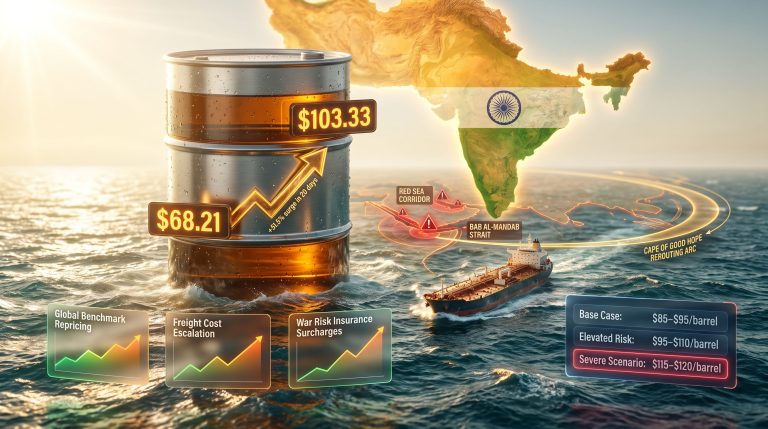
However, escalation scenarios present dramatically different outcomes. Should prices surge to approximately $100 per barrel, the economic mathematics change substantially, creating conditions ripe for an oil price rally:
- Global GDP Impact: 0.4 percentage point drag versus 0.1 percentage point under baseline conditions
- Inflation Acceleration: 0.7 percentage point rise compared to 0.2 percentage point baseline increase
- Consumer Spending Effects: Direct impact on real incomes through elevated transportation and energy costs
Secondary Transmission Channels
Furthermore, the energy price mechanism operates through multiple economic pathways beyond direct fuel costs. Manufacturing sectors experience cost pressures through increased input expenses, whilst service industries face elevated transportation and logistics costs. These secondary effects often prove more persistent than initial price shocks, as they embed themselves in longer-term cost structures.
Regional economies demonstrate varying sensitivity levels based on energy import dependencies. Export-oriented manufacturing regions face dual pressures from both input cost increases and potential demand reduction from trading partners experiencing similar pressures.
Central Banking in the Age of Supply Shocks
Modern monetary policy frameworks face unprecedented challenges when addressing supply-side inflation pressures. Goldman Sachs analysis indicates that central banks historically avoid direct responses to oil shocks, instead focusing on broader inflation trends and their persistence, particularly when considering the global economy inflation and growth amid Iran conflict.
The research reveals critical policy thresholds: "Central banks have historically not reacted directly to oil shocks, but tend to tighten policy modestly when inflation is elevated, or price shocks are large."
Policy Response Mechanisms
Under baseline scenarios where oil prices remain contained, monetary policy outlooks experience minimal adjustment. However, escalation to $100 per barrel levels triggers different policy considerations, directly impacting the US economy and inflation:
Emerging Market Vulnerabilities:
- Delayed rate cuts become likely policy responses
- Currency stability concerns intensify
- Capital flow reversals create additional pressure
Developed Economy Adjustments:
- Policy tightening bias increases with inflation persistence
- Consumer price pass-through rates become critical monitoring metrics
- International coordination requirements intensify
The analysis specifically notes that policy could turn more hawkish through rate cut delays in emerging markets if higher costs pass through to consumer prices at elevated rates, highlighting the asymmetric nature of global monetary policy responses.
Asymmetric Economic Impacts Across Regions
Geographic positioning creates dramatically different economic outcomes during energy price volatility periods. Goldman Sachs research identifies clear winners and losers based on trade relationships and resource endowments, particularly as the US‑China trade war adds additional complexity to global economic dynamics.
Beneficiary Economies:
Oil exporters including Canada and several Latin American economies stand to benefit from sustained higher prices, creating positive terms-of-trade effects that can offset broader global slowdown impacts.
Vulnerable Regions:
Energy-importing economies face the dual challenge of increased input costs and reduced consumer purchasing power, with manufacturing-heavy regions experiencing particularly acute pressure.
Consumer Behaviour Adaptation
Real income effects represent the most direct channel through which energy price increases impact economic activity. As Goldman Sachs notes, higher oil prices are expected to weigh on real incomes and consumer spending, creating demand-side headwinds that compound supply-side pressures.
This dynamic creates a feedback loop where initial supply disruptions trigger demand adjustments, potentially amplifying the overall economic impact beyond what pure supply-side analysis would suggest.
Financial Market Stress Testing
Energy price volatility serves as a comprehensive stress test for global financial systems, revealing vulnerabilities in interconnected markets and highlighting the importance of market volatility hedging frameworks adapted to supply-side shocks.
Credit Market Implications
Financial institutions face complex risk assessment challenges during energy price volatility periods. Sectors with high energy intensity experience deteriorating credit profiles, whilst energy producers may see improved fundamentals. This sectoral divergence requires sophisticated portfolio management approaches.
Currency markets experience particular volatility as energy-importing nations face balance-of-payments pressures whilst energy exporters benefit from improved current account positions.
Investment Flow Reconfiguration
Capital allocation patterns shift dramatically during periods of energy price uncertainty. Traditional risk-return relationships require reassessment as correlations between asset classes change under supply shock conditions.
Safe haven demand typically increases, supporting government bond markets in stable jurisdictions whilst pressuring emerging market assets. Commodity exposure becomes increasingly valuable as both an inflation hedge and a portfolio diversification tool.
Supply Chain Resilience Architecture
The vulnerability of globally integrated supply chains becomes most apparent during periods of energy price volatility. Organisations that prioritised efficiency over resilience face particular challenges adapting to new cost structures, especially when considering the global economy inflation and growth amid Iran conflict.
Inventory Strategy Evolution
Just-in-time inventory management, optimised for stable energy costs, requires fundamental reassessment during price volatility periods. Buffer stock strategies gain importance as insurance against both supply disruptions and cost fluctuations.
Transportation route diversification becomes critical as traditional efficiency calculations no longer apply. Alternative routing options, previously considered uneconomical, may become necessary risk management tools.
Long-term Structural Adaptations
Energy price volatility accelerates existing trends toward supply chain regionalisation and strategic autonomy development. Organisations begin factoring geopolitical stability into long-term sourcing decisions, potentially reducing efficiency but enhancing resilience.
The next major ASX story will hit our subscribers first
Economic Forecasting Under Uncertainty
Traditional economic modelling frameworks require enhancement to capture the non-linear relationships between energy prices and broader economic outcomes. The Goldman Sachs analysis demonstrates the importance of scenario-based forecasting approaches when assessing the global economy inflation and growth amid Iran conflict.
Threshold Effects and Tipping Points
The research reveals critical price thresholds where economic relationships change qualitatively rather than quantitatively. The difference between $76 per barrel baseline impacts and $100 per barrel stress scenarios represents more than simple proportional scaling.
Economic Impact Scaling:
| Price Level | GDP Impact | Inflation Impact | Policy Response |
|---|---|---|---|
| $65/bbl (Q4 baseline) | Minimal drag | Contained pressure | Status quo |
| $76/bbl (Q1 baseline) | -0.1 percentage point | +0.2 percentage point | Limited adjustment |
| $100/bbl (stress) | -0.4 percentage point | +0.7 percentage point | Policy tightening |
This non-linear relationship suggests that risk management frameworks must account for threshold effects rather than assuming smooth adjustments across price ranges.
Building Adaptive Economic Capacity
The current environment demonstrates the importance of economic systems designed for adaptability rather than optimisation around specific conditions. Successful navigation requires recognition that efficiency and resilience often represent competing objectives.
Institutional Framework Evolution
Central banking institutions require enhanced tools for addressing supply-side shocks that operate outside traditional demand-management frameworks. Coordination mechanisms between monetary authorities become increasingly important as policy spillover effects intensify.
Fiscal policy frameworks need updating to address the distributional impacts of energy price volatility, particularly the disproportionate effects on lower-income households and energy-intensive industries.
Private Sector Risk Management
Corporate financial strategies must evolve beyond traditional interest rate and currency risk management to incorporate commodity price volatility and supply chain disruption scenarios. Cash management becomes more critical as operational flexibility requirements increase.
Strategic planning horizons require extension to account for longer adjustment periods and the potential for sustained periods of elevated volatility rather than quick returns to previous equilibrium conditions.
The Path Forward: Balancing Efficiency and Resilience
The current period of energy price volatility and geopolitical tension represents a critical juncture for global economic architecture. The Goldman Sachs analysis provides quantitative frameworks for understanding impact magnitudes, but the broader challenge lies in building systems capable of withstanding future shocks.
Success requires recognition that the globalised economy optimised for efficiency under stable conditions needs fundamental adaptations to maintain functionality under stress. This evolution demands coordinated responses across monetary policy, fiscal frameworks, and private sector risk management practices.
The mathematical relationships revealed through current stress testing provide valuable guidance for building more resilient economic systems. However, true adaptability requires going beyond reactive responses to create proactive frameworks capable of absorbing and adjusting to future uncertainties.
Disclaimer: This analysis incorporates economic forecasting and scenario planning that involves inherent uncertainties. Readers should consider multiple perspectives and consult appropriate financial professionals when making investment or business decisions. Economic outcomes may differ materially from projected scenarios based on evolving geopolitical conditions and market dynamics.
Looking to Position Ahead of Economic Volatility?
Discovery Alert's proprietary Discovery IQ model delivers real-time alerts on significant ASX mineral discoveries, instantly empowering subscribers to identify actionable opportunities during periods of global economic uncertainty and market volatility. Begin your 14-day free trial today and secure your market-leading advantage when traditional assets face headwinds from geopolitical tensions.