June 11, 2026
When Energy Dependency Becomes a Strategic Tool: India's Evolving Role in Gulf Oil Architecture
For most of the past four decades, the conventional wisdom in Asian energy markets held that large crude importers were inherently price-takers, structurally exposed to the decisions of producers and perpetually vulnerable to the chokepoints through which their supply flowed. That logic is now being challenged at its core, not by a shift in global supply dynamics, but by the deliberate architectural choices of one of the world's largest consuming nations.
India's approach to the India UAE strategic oil reserves deal represents something qualitatively different from previous bilateral energy arrangements. It is not simply about securing more barrels. It is about redesigning the institutional and logistical framework through which those barrels are accessed, stored, traded, and leveraged, transforming a chronic vulnerability into an instrument of geopolitical influence.
When big ASX news breaks, our subscribers know first
India's Structural Import Exposure: The Problem That Demanded a New Architecture
Understanding what the current agreement actually achieves requires first appreciating the depth of India's historical exposure. According to the International Energy Agency's India 2020: Energy Policy Review, crude oil and condensate imports met approximately 84 percent of India's oil demand as of 2018, with the Petroleum Planning and Analysis Cell (PPAC) reporting that this share has since remained consistently in the range of 85 to 88 percent across subsequent years.
This is not a marginal dependency. More than four in every five barrels consumed in India must be sourced from abroad, the majority transiting the Strait of Hormuz, through which roughly 20 percent of global oil supply passes. Any disruption to that chokepoint, whether from naval conflict, drone strikes on Gulf export infrastructure, or maritime blockade, lands directly on Indian refineries with limited domestic buffer to absorb the shock.
India's existing Strategic Petroleum Reserve (SPR) infrastructure, developed under Indian Strategic Petroleum Reserves Limited (ISPRL), consists of three underground rock caverns located at:
- Visakhapatnam, Andhra Pradesh
- Mangaluru, Karnataka
- Padur, Karnataka
Combined, these facilities store approximately 5.33 million tonnes, equivalent to roughly 38 to 39 million barrels of crude oil depending on the grade and conversion factor applied. This volume corresponds to only around 9 to 10 days of net crude import cover at current consumption rates, well below the 90-day benchmark that the IEA recommends for member and associated countries.
That gap between import exposure and reserve coverage has historically constrained India's negotiating posture with Gulf producers, furthermore forcing a reactive, price-sensitive buyer stance rather than a confident, long-horizon partnership approach. Understanding crude oil price trends helps contextualise why this structural gap has proved so costly for India over time.
What the India UAE Strategic Oil Reserves Deal Actually Changes
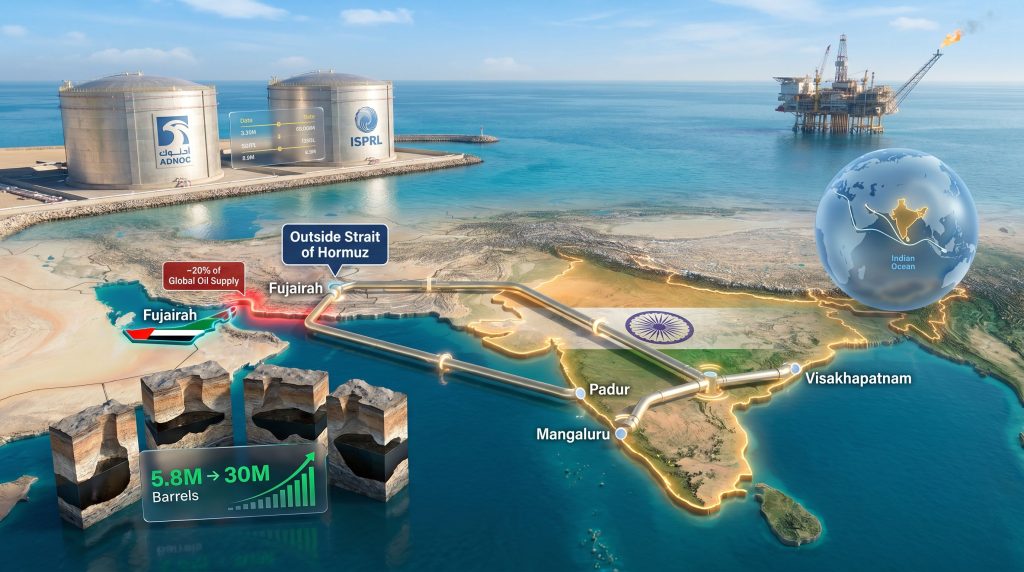
The Strategic Collaboration Agreement between ISPRL and Abu Dhabi National Oil Company (ADNOC) addresses that structural gap head-on. Under the arrangement, ADNOC-linked crude storage on Indian soil will expand from approximately 5.8 million barrels to 30 million barrels, representing a near-fivefold increase in Gulf-partnered reserve capacity.
This builds on a 2018 precedent in which the UAE became the first foreign nation to participate in India's SPR programme, with an initial allocation at the Mangaluru facility. That arrangement was relatively modest, a storage lease covering roughly 5 million barrels with limited commercial dimensions. The 2026 agreement, however, transforms that precedent into something architecturally distinct.
The following table illustrates how substantially the two agreements differ across every meaningful dimension:
| Dimension | 2018 Arrangement | 2026 Strategic Collaboration Agreement |
|---|---|---|
| Storage volume | ~5 million barrels (Mangaluru) | Up to 30 million barrels |
| Agreement type | Storage lease / bilateral MOU | Strategic Collaboration Agreement (ISPRL-ADNOC) |
| Commercial dimension | Limited | Explicit dual-use: strategic + commercial/re-export |
| Gas component | Absent | LPG and LNG strategic reserve framework included |
| Fujairah access | Not included | Under active discussion |
| Upstream equity linkage | Separate | Integrated into broader energy package |
| Bilateral investment context | Standalone energy deal | Part of USD $5 billion UAE investment commitment |
The 2018 arrangement proved the concept of foreign-nation SPR participation. The 2026 agreement proves the concept can scale, commercialise, and generate geopolitical returns simultaneously.
The Dual-Use Reserve Model: A Structural Departure From Conventional SPR Doctrine
Perhaps the most significant and least widely understood feature of the new framework is its explicit dual-use design. Conventional SPR doctrine, as practised by IEA member states, treats stored reserves as static emergency cushions, barrels held in readiness for supply disruption and not deployed for commercial purposes. India's new arrangement deliberately departs from that model.
India's ambassador to the UAE, Deepak Mittal, confirmed in an interview with ET EnergyWorld on 11 June 2026 that the reserve framework is designed to serve more than one function, with portions of stored crude capable of operating within a commercial dimension that includes the potential for sale to third-party buyers or re-export to other markets.
This is a materially different proposition. Rather than parking capital in inert stockpiles, India can generate economic returns from reserve infrastructure while simultaneously maintaining strategic depth. The stored crude remains available as an emergency buffer, but in non-emergency periods it functions as a tradeable asset within regional oil logistics, consequently producing revenue streams that partly offset the cost of holding large inventories.
The Fujairah Dimension: Distributing Risk Beyond the Hormuz Chokepoint
The geographic logic of the India UAE strategic oil reserves deal extends beyond domestic cavern capacity. India's potential access to storage at Fujairah, the UAE's primary eastern oil export hub, introduces a second layer of supply resilience that is architecturally distinct from anything India has previously constructed.
Fujairah sits on the Gulf of Oman, positioned entirely outside the Strait of Hormuz. Securing storage access there would make India one of the first major Asian crude importers to hold distributed strategic reserves across both domestic underground sites and a Gulf waypoint. This enables crude movement to Indian refinery complexes even during scenarios where the Strait itself is disrupted.
This geographic distribution matters enormously in risk modelling terms. A supply chain with reserves concentrated only at the demand end remains vulnerable to upstream disruption. Reserves distributed across a Gulf waypoint and domestic caverns create multiple independent access pathways, meaning that any given disruption scenario is unlikely to block all pathways simultaneously.
The commercial case for Fujairah access is reinforced by ADNOC's infrastructure investments. The company is advancing a second West-East pipeline with a target to double export capacity by 2027, bypassing the Strait of Hormuz entirely for a portion of UAE crude exports. As that bypass capacity matures, the combination of Fujairah waypoint storage and expanded pipeline access creates a two-layer Hormuz hedge for Indian supply chains. In this respect, the broader Gulf resource strategy being pursued across the region is reshaping how Asian importers think about energy security architecture.
The Gas Security Gap: India's Most Underdeveloped Energy Vulnerability
Crude oil dominates the public discussion of Indian energy security, but the India-UAE collaboration's gas component addresses what is arguably India's more acute structural weakness. Gas storage and distribution infrastructure in India remains comparatively underdeveloped relative to the crude system, with LPG cavern storage covering only a fraction of daily national demand.
LNG supply, furthermore, remains almost entirely dependent on regasification terminal throughput, with minimal strategic buffer capacity in place. The social stakes of gas supply disruption are significant. LPG is the primary cooking fuel for hundreds of millions of Indian households, meaning that supply shocks in this segment carry immediate social and economic consequences that crude supply disruptions do not replicate as directly.
The emerging framework addresses this through two channels:
- Existing infrastructure leverage: LPG cavern facilities already in place will be adapted to provide a strategic buffer layer beyond their current commercial function.
- New dedicated LNG storage: Plans are underway to develop purpose-built LNG storage facilities to create meaningful strategic buffer capacity independent of regasification terminal constraints.
The supply-side foundation for this framework is Indian Oil Corporation's 14-year supply agreement for 1.2 million tonnes of LNG per annum from UAE's Das Island facility. For additional detail on India's LPG and strategic oil agreements with the UAE, reporting from specialist energy media offers useful context on the commercial dimensions of these arrangements.
| Reserve Category | Current Status | Target Development |
|---|---|---|
| Crude oil SPR | ~39 million barrels (3 cavern sites) | Expanding with ADNOC to ~30M barrels additional UAE-linked capacity |
| LPG storage | Limited cavern capacity | Leveraging existing infrastructure for strategic buffer |
| LNG storage | Regasification-dependent; minimal buffer | New dedicated LNG storage under planning |
| Upstream equity (gas) | Limited | Das Island LNG supply agreement as anchor |
Upstream Equity, Vertical Integration, and the Multi-Layer Supply Architecture
India's ownership stake in ADNOC's Lower Zakum offshore oil field adds a further dimension that the storage agreements alone cannot provide. Equity oil, barrels produced from fields in which India holds a direct ownership interest, provides preferential access to physical volumes at cost-of-production pricing rather than spot market rates. This partially insulates a portion of India's supply from the price volatility that dominates spot procurement.
The combination of equity production, strategic storage, and long-term supply contracts creates what can be described as a vertically coherent energy security architecture. Each layer operates independently:
- Equity barrels provide cost-based access to upstream production volumes.
- Long-term contracts provide price and volume certainty for a defined horizon.
- Strategic reserves provide buffer capacity against short-term disruption at any layer.
- Dual-use commercial optionality provides revenue generation from reserve infrastructure between disruption events.
In any given supply shock scenario, India can consequently draw on whichever pathway is least affected, reducing the systemic vulnerability that comes from dependence on any single procurement mechanism.
The next major ASX story will hit our subscribers first
Geopolitical Recalibration: Competing With China for Gulf Partnership Primacy
The India UAE strategic oil reserves deal must also be read against the backdrop of China's extensive and long-established energy infrastructure integration across Gulf producer nations. China has pursued upstream equity stakes, storage arrangements, and long-term supply agreements aggressively, and China's regional infrastructure push across Asia further illustrates the scale of its strategic ambitions in this domain.
India's deepening integration with the UAE, combining storage hosting, equity participation, downstream access, and logistics partnership, positions it as a credible alternative anchor partner for Gulf producers. For producers like ADNOC, having a second large, reliable, integrated Asian partner reduces exposure to any single buyer relationship and creates competitive tension that can be leveraged in commercial negotiations.
The ISPRL-ADNOC framework also establishes a replicable template that India could extend to other Gulf producers. Saudi Aramco, Kuwait Petroleum Corporation, and Iraq's SOMO all represent potential participants in a multi-producer SPR model. Understanding OPEC's market influence is essential here, as any expansion of India's reserve partnerships will inevitably intersect with the production and pricing decisions of the broader OPEC grouping.
If India successfully extends the framework across multiple Gulf producers, it progressively deepens its integration into the Gulf energy system while diversifying its own reserve base. This could potentially consolidate a regional energy logistics hub role that is currently fragmented across Singapore, South Korea, and Japan.
India is not a full IEA member, participating as an Association Country with partial access to collective emergency response mechanisms. Expanding domestic SPR capacity toward the IEA's 90-day import coverage benchmark would strengthen India's credibility within that framework. It would simultaneously build informal energy security architecture that operates independently of Western-led multilateral institutions, consistent with India's broader multi-alignment foreign policy posture. The evolution of global oil benchmarks will, however, remain a central variable in how effectively India can leverage its growing reserve architecture across different price environments.
Disclaimer: This article incorporates forward-looking statements and analytical projections based on publicly available information and reported plans as of mid-2026. Reserve expansion timelines, infrastructure development schedules, and commercial outcomes are subject to change. Nothing in this article constitutes investment advice. Readers should conduct independent research before making financial or policy-related decisions.
Want to Track the Resource Discoveries Reshaping Global Energy Markets?
Discovery Alert's proprietary Discovery IQ model delivers real-time alerts on significant ASX mineral discoveries, instantly translating complex resource data into actionable investment insights — explore Discovery Alert's discoveries page to understand how historic finds have generated substantial returns, and begin your 14-day free trial to position yourself ahead of the broader market.