
June 11, 2026
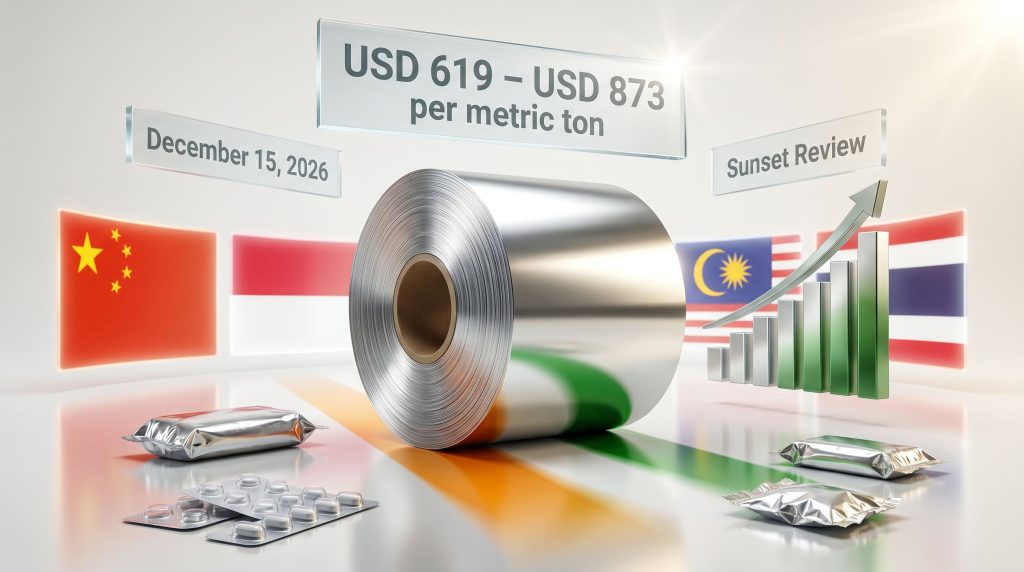
The Global Trade Defence Playbook: Why Aluminium Foil Has Become a Flashpoint
Across manufacturing economies, the downstream aluminium sector has emerged as one of the most contested arenas in global trade policy. Thin-gauge aluminium foil sits at a peculiar intersection: it is simultaneously a commodity product, a precision-engineered material, and a critical input for industries ranging from pharmaceutical blister packaging to flexible food packaging and industrial insulation. When export-oriented Asian producers with structural cost advantages flood foreign markets with foil priced below fair value, the consequences for domestic manufacturers extend far beyond lost revenue.
Capacity utilisation collapses, capital investment stalls, and the long-term industrial base erodes. India anti-dumping duty on aluminium foil imports represents one of the clearest examples of how trade remedy architecture functions in practice, and why it matters for downstream supply chains, investors, and industrial policymakers alike.
When big ASX news breaks, our subscribers know first
Why India's Domestic Aluminium Foil Sector Remains Structurally Exposed
The Downstream Significance of Thin-Gauge Foil
Aluminium foil at or below 80 microns in thickness is not a niche product. It underpins packaging formats across the pharmaceutical, food processing, dairy, and flexible packaging industries. India's domestic foil manufacturing base services these sectors, but it operates at a structural disadvantage relative to large-scale Asian producers who benefit from lower energy costs, integrated supply chains, and government-supported industrial expansion.
The vulnerability is asymmetric. Indian producers cannot easily absorb prolonged periods of import price pressure because their cost structures, particularly for energy and raw material inputs, do not compress in proportion to the prices set by export-oriented competitors. Furthermore, when import volumes surge at prices that undercut domestic benchmarks, the injury to local producers manifests across multiple dimensions simultaneously: market share erosion, price suppression, declining capacity utilisation, and profitability compression.
What Makes Aluminium Foil a Prime Target for Dumping?
Dumping, in the context of WTO trade remedy law, occurs when a foreign exporter sells goods in an overseas market at prices below their normal value, which is typically defined as either the price in the exporter's home market or the cost of production. When this pricing behaviour causes material injury to the importing country's domestic industry, the WTO framework under Article VI of the General Agreement on Tariffs and Trade (GATT) permits the imposition of anti-dumping duties as a corrective measure.
Aluminium foil is particularly susceptible to dumping dynamics for several structural reasons:
- Significant overcapacity in Chinese aluminium foil production creates persistent pressure to export surplus volumes at below-cost prices to maintain capacity utilisation
- The product is highly standardised, meaning price is the primary competitive variable in procurement decisions
- Energy-intensive production gives jurisdictions with subsidised electricity a structural cost advantage that cannot be replicated by market-price energy consumers
- Thin profit margins in domestic markets incentivise exporters to price aggressively in foreign markets to capture volume
China, Indonesia, Malaysia, and Thailand have each emerged as sources of concern for Indian trade regulators, with Chinese producers facing the most significant scrutiny given China's dominant position in global aluminium foil manufacturing capacity. These trade wars and tariff dynamics are reshaping supply chain decisions across the region.
Key Concept: Dumping does not require intent. An exporter need not deliberately target a foreign market with below-cost pricing. The WTO anti-dumping framework focuses on the effect of the pricing behaviour on the domestic industry of the importing country, not the motive behind it.
The Legal Architecture Behind India's Anti-Dumping Duty on Aluminium Foil Imports
Statutory Framework and WTO Alignment
India's legal authority to impose anti-dumping measures derives from Section 9A of the Customs Tariff Act, 1975, which provides the primary legislative basis for initiating investigations and collecting duties. The procedural mechanics are operationalised through the Customs Tariff (Identification, Assessment and Collection of Anti-Dumping Duty on Dumped Articles and for Determination of Injury) Rules, 1995, which govern how investigations are conducted, how injury is assessed, and how duties are calculated and applied.
This framework is explicitly aligned with India's obligations under the WTO Anti-Dumping Agreement, ensuring that measures imposed are consistent with multilateral trade rules. India's compliance with WTO disciplines is important not only for legal integrity but also for insulating duty decisions from challenge by affected exporting countries at the WTO dispute settlement level.
The Role of the DGTR in India's Trade Defence System
The Directorate General of Trade Remedies (DGTR), operating under the Ministry of Commerce and Industry, serves as India's primary trade remedy investigating authority. Its mandate spans the full lifecycle of a trade defence measure:
- Initiation of investigations based on petitions from domestic industry or suo motu action
- Evidence gathering through questionnaire responses from exporters, importers, and domestic producers
- Oral hearings to allow stakeholder submissions and cross-examination of evidence
- Injury assessment using quantitative indicators including price undercutting, import volume growth, market share shifts, and profitability data
- Final findings recommending duty rates to the Ministry of Finance for formal imposition
The DGTR also conducts Sunset Reviews, which are mandatory re-examinations of existing duties before their standard five-year expiry to determine whether withdrawal would likely result in a resumption of dumping and injury.
Notification No. 51/2021-Customs (ADD) and the 2026 Amendment
The original anti-dumping investigation covering aluminium foil imports from China, Indonesia, Malaysia, and Thailand was formally established on September 16, 2021, through Notification No. 51/2021-Customs (ADD) issued by the Ministry of Finance. This notification imposed definitive duties covering aluminium foil of 80 microns thickness and below, with rates varying by exporter and country of origin.
Through an amended notification, the Ministry of Finance has confirmed that the anti-dumping duty remains applicable through December 15, 2026, irrespective of the original five-year timeline, to maintain protection during the ongoing Sunset Review investigation.
How the Sunset Review Process Works in Practice
Triggering a Review and the Procedural Timeline
Under Indian trade remedy law, anti-dumping duties automatically expire after five years unless the domestic industry petitions for continuation and the DGTR initiates a Sunset Review. The review must determine whether the removal of duties would likely cause dumping to resume and injury to domestic producers to recur.
The current Sunset Review timeline for aluminium foil unfolds as follows:
| Milestone | Date |
|---|---|
| Original duty established | September 16, 2021 |
| Sunset Review initiated by DGTR | September 29, 2025 |
| DGTR oral hearing conducted | April 28, 2026 |
| Interim duty extension confirmed | June 2026 |
| Extended duty coverage deadline | December 15, 2026 |
The Mechanics of Interim Protection
The interim extension confirmed through June 2026 serves a critical procedural function: it prevents a protection vacuum from forming while the DGTR's investigation reaches its final determination. Without this interim measure, the original five-year duty could technically lapse before a conclusion is reached, exposing domestic producers to a sudden influx of competitively priced imports during the review period itself.
Policy Insight: Interim extensions are a standard procedural safeguard in global trade remedy practice. They are not indicators of the final outcome of a review but rather mechanisms designed to preserve the status quo while due process runs its course.
The April 28 oral hearing was a significant procedural milestone, allowing domestic producers, importers, and exporting country representatives to present evidence and arguments directly to the DGTR. The outcome of the hearing feeds into the authority's final assessment of whether continued protection is warranted beyond December 2026.
Duty Rates, Product Scope, and Exporter-Specific Calculations
Defining the Product Under Investigation
The subject product is aluminium foil with a thickness at or below 80 microns, encompassing a wide range of applications including flexible packaging, pharmaceutical blister packs, food service foils, and industrial laminate substrates. Certain specialised categories, including ultra-thin foil used in capacitor applications, are excluded from the duty's scope. Importers should verify applicable Harmonised System (HS) tariff codes and specific exclusion criteria with Indian customs authorities when assessing duty liability.
Duty Structure Across Measure Types
| Duty Type | Period | Rate Range | Applicable Origins |
|---|---|---|---|
| Provisional duty | From March 2025 (6-month period) | USD 619 to USD 873 per metric ton | China (primary) |
| Definitive duty | Five-year term (2021 onwards) | Varies by individual exporter | China, Indonesia, Malaysia, Thailand |
| Extended interim duty | Through December 15, 2026 | Continuation of existing rates | China, Indonesia, Malaysia, Thailand |
The wide range in provisional duty rates reflects the DGTR's methodology of calculating individual dumping margins for each cooperating exporter based on a comparison of their export prices to India against their normal value. Non-cooperating exporters, those who do not respond to DGTR questionnaires, typically face a higher residual rate calculated on the basis of best available evidence, creating a financial incentive for exporters to engage with the investigation process.
The Domestic Industry Coalition Driving India's Trade Protection Case
Key Stakeholders and Their Market Positions
Four major domestic producers have been central to the trade protection petitioning process, each with significant exposure to the competitive dynamics created by below-cost imports:
- Hindalco Industries Limited: India's largest integrated aluminium producer, with substantial downstream foil rolling capacity and extensive exposure to packaging sector demand
- SRF Altech: A significant domestic aluminium foil manufacturer serving industrial and packaging end markets
- Vedanta Limited: A diversified metals and mining group with aluminium production operations that extend into downstream foil manufacturing
- Bharat Aluminium Company Limited (BALCO): An aluminium producer with downstream manufacturing interests and a consistent advocate for trade protection continuation
These producers collectively argued before the DGTR that without continued duty protection, the resumption of dumped imports would cause material injury to the domestic industry, consistent with the evidentiary standard required under Indian and WTO trade remedy law.
How Injury Is Demonstrated in Anti-Dumping Investigations
Establishing material injury in an anti-dumping investigation requires presenting quantitative evidence across multiple indicators. The DGTR's assessment framework typically examines:
- Price undercutting: Whether import prices are consistently below domestic selling prices for comparable product specifications
- Volume suppression: Whether import surges are correlated with declines in domestic production volumes
- Market share erosion: The extent to which domestic producers have lost share to imported product over the investigation period
- Profitability decline: Whether return on sales or return on capital in the domestic foil sector has deteriorated in correlation with import price pressure
- Capacity utilisation rates: A reduction in the percentage of installed capacity being used is a key indicator of dumping-related injury
The next major ASX story will hit our subscribers first
The Broader Context: India's Expanding Aluminium Trade Defence Posture
Parallel Anti-Subsidy Investigation Into Malaysian Wire Rod
The aluminium foil duty extension does not stand in isolation. Following the DGTR oral hearing in April 2026, the Government of India through the DGTR launched a parallel anti-subsidy investigation covering aluminium wire rod imports from Malaysia. This signals a broadening of India's trade defence posture across multiple aluminium product categories, extending from primary downstream products like foil into further processed forms such as wire rod. Consequently, the wire rod and casthouse investment landscape is being reshaped by these converging regulatory and trade pressures.
Anti-subsidy investigations, also known as countervailing duty (CVD) investigations, target government financial contributions to foreign producers that distort competitive conditions rather than pricing behaviour alone. The concurrent use of both anti-dumping and anti-subsidy instruments reflects a more sophisticated and layered approach to trade defence across India's aluminium value chain.
How India's Approach Compares Globally
India's trade defence actions on aluminium foil are not isolated. Multiple jurisdictions have independently reached similar conclusions about the need to defend their domestic foil sectors. According to reporting on India's five-year anti-dumping duties, domestic producers have been pushing for market resilience amid sustained import pressure.
| Country Imposing Duty | Targeted Origins | Duration | Status |
|---|---|---|---|
| India | China, Indonesia, Malaysia, Thailand | Extended to December 2026 | Active, under Sunset Review |
| Turkey | China | Five-year extension confirmed | Active from 2025 to 2026 |
| European Union | China | Various ongoing measures | Active |
Turkey's decision to extend its own anti-dumping levy on Chinese aluminium foil for a further five years, confirmed in close proximity to India's extension announcement, illustrates how overcapacity in Chinese foil manufacturing continues to generate trade friction across geographically diverse markets. The convergence of independent trade remedy decisions across India, Turkey, and the EU reflects a shared set of underlying market conditions rather than coordinated policy action.
Scenario Analysis: If the DGTR's Sunset Review concludes that dumping is unlikely to recur following duty withdrawal, the measures could expire after December 2026. However, given the persistent scale of Chinese aluminium foil production capacity relative to global demand, and the documented injury patterns presented by Indian producers, trade remedy practitioners broadly consider the probability of duty continuation to be elevated.
Market Implications: Pricing, Supply Chains, and Investment Signals
How Continued Protection Reshapes Domestic Market Dynamics
Sustained anti-dumping duties on aluminium foil imports recalibrate the competitive environment for Indian producers, but they are not without trade-offs. For domestic manufacturers, continued protection provides a more predictable pricing floor that supports capacity utilisation and investment planning. For downstream industries, including pharmaceutical packagers and food processors, the duty structure can contribute to elevated input costs compared to a fully liberalised import environment.
The critical question for India's industrial economy is whether the protected period has enabled domestic foil producers to invest in competitive capacity upgrades that would allow them to sustain market positions even in a post-protection environment. Trade remedy protection is most economically valuable when it provides a temporary adjustment period rather than a permanent shield against structural competitive disadvantage.
Investment Environment for Indian Foil Producers
For producers like Hindalco and SRF Altech, the continuation of trade protection through at least December 2026 provides a defined investment horizon within which capacity expansion decisions can be evaluated with greater certainty. The alignment between trade protection timelines and capital investment cycles is a recognised mechanism through which trade remedy law can support industrial development objectives. This is particularly evident in capital-intensive manufacturing sectors where commodity prices impact the return on investment and require extended payback periods.
India's broader industrial policy framework, including the Production Linked Incentive (PLI) scheme for downstream manufacturing and the Make in India initiative, operates in parallel with trade remedy protection as a complementary policy lever, though these are distinct government programmes rather than project-specific support measures for individual companies.
The Risk Scenario: What Duty Withdrawal Would Mean
If the Sunset Review were to conclude that dumping is not likely to recur, and duties were allowed to expire after December 2026, the domestic foil market would face a materially different competitive environment. Historical patterns from markets where anti-dumping protection has lapsed without adequate domestic capacity development suggest that import volumes can recover rapidly, compressing domestic producer margins and potentially triggering renewed capacity rationalisation.
The current investigation trajectory, including the breadth of domestic industry participation and the DGTR's documented oral hearing process, suggests the procedural foundations for duty continuation are well established. However, the final determination remains subject to the evidentiary record developed through the review. Furthermore, broader challenges facing Indian steel and aluminium sectors in 2025 underscore the systemic pressures these industries continue to navigate.
Frequently Asked Questions: India Anti-Dumping Duty on Aluminium Foil
What is India's anti-dumping duty on aluminium foil imports?
India anti-dumping duty on aluminium foil imports applies to foil of 80 microns thickness and below originating from China, Indonesia, Malaysia, and Thailand. Originally established in September 2021 under Notification No. 51/2021-Customs (ADD), the measure has been extended through December 15, 2026 via an amended notification while the DGTR conducts its Sunset Review investigation.
Which countries are targeted by India's aluminium foil anti-dumping duty?
The four countries currently subject to the India anti-dumping duty on aluminium foil imports are China, Indonesia, Malaysia, and Thailand.
What duty rates apply to aluminium foil imports into India?
Provisional duty rates announced in March 2025 ranged from USD 619 to USD 873 per metric ton, varying by exporter and country of origin. Definitive five-year rates vary by individual exporting producer, with higher residual rates applying to non-cooperating exporters.
What is a Sunset Review and why does it matter?
A Sunset Review is a mandatory re-examination of an anti-dumping duty before its five-year expiry. The DGTR must determine whether withdrawal of the duty would likely result in the continuation or recurrence of dumping and injury. If the evidence supports continued risk, the duty is renewed. The current Sunset Review was initiated on September 29, 2025.
Which Indian companies are the primary beneficiaries of the aluminium foil duty?
The domestic producers that petitioned for duty continuation include Hindalco Industries Limited, SRF Altech, Vedanta Limited, and Bharat Aluminium Company Limited (BALCO).
Are any aluminium foil products excluded from the duty?
Yes. Certain ultra-thin foil categories used in capacitor and specific technical applications are excluded from the scope of the anti-dumping duty. Importers are advised to verify applicable HS codes and exclusion criteria directly with Indian customs authorities.
Key Takeaways
- India's anti-dumping duty on aluminium foil imports from China, Indonesia, Malaysia, and Thailand remains active through December 15, 2026, formalised via an amended Customs (ADD) notification
- The DGTR Sunset Review, initiated September 29, 2025, is the central procedural mechanism determining whether protection continues beyond 2026
- Provisional duty rates ranged from USD 619 to USD 873 per metric ton; definitive rates vary by individual exporter
- Hindalco, SRF Altech, Vedanta, and BALCO represent the domestic industry coalition driving the trade protection case
- India is broadening its aluminium trade defence posture with a parallel anti-subsidy investigation into Malaysian wire rod imports
- Turkey's concurrent decision to extend anti-dumping levies on Chinese aluminium foil for five years reflects converging global conclusions about persistent overcapacity in Chinese foil production
- In addition, the US aluminium tariff impact in 2025 has contributed to a broader global recalibration of trade flows across the aluminium supply chain
- The outcome of the Sunset Review carries significant implications for both domestic foil producers and downstream industrial consumers across India's packaging, pharmaceutical, and food processing sectors
This article is intended for informational purposes only and does not constitute financial, legal, or investment advice. Readers with specific import compliance or trade remedy questions should seek guidance from qualified trade law professionals or Indian customs authorities. Forward-looking statements and scenario analysis contained herein involve uncertainty and should not be interpreted as predictions of regulatory outcomes.
Want to Stay Ahead of Commodity and Resource Sector Shifts Like These?
Trade defence actions, supply chain disruptions, and commodity market recalibrations create real investment opportunities for those positioned ahead of the curve — and Discovery Alert's proprietary Discovery IQ model delivers real-time alerts on significant ASX mineral discoveries, turning complex resource data into actionable insights the moment they hit the market. Explore how historic mineral discoveries have generated substantial returns and begin your 14-day free trial today to ensure you're never on the wrong side of a major market move.