May 10, 2026
The Hidden Architecture of Industrial Vertical Integration in Gulf Manufacturing
Most analyses of aluminium competitiveness focus on smelting efficiency, energy costs, and bauxite access. Far less attention is paid to the logistics infrastructure underpinning production continuity. Yet for a producer moving 14 million tonnes of raw materials and finished metal annually across more than 50 countries, freight reliability and supply chain architecture are not peripheral concerns. They are the structural foundation upon which margin and market access depend.
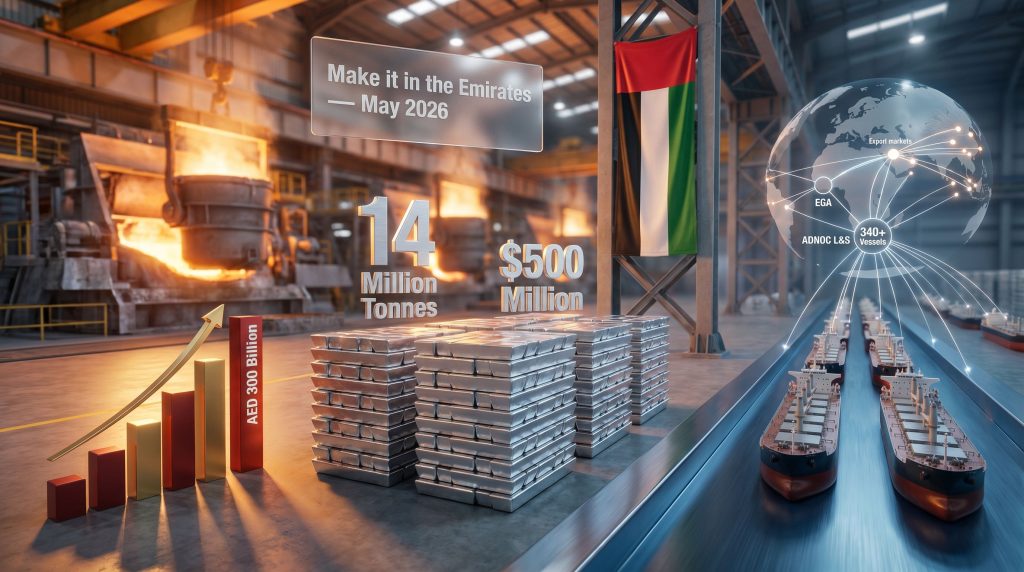
The EGA and ADNOC aluminium supply chain partnership, formalised at the Make it in the Emirates forum in May 2026, brings this reality into sharp focus. Rather than examining this agreement in isolation, it is more instructive to analyse it as the latest layer in a multi-year, deliberately constructed integration architecture — one that is reshaping the competitive fundamentals of UAE-based aluminium production.
When big ASX news breaks, our subscribers know first
Why Logistics Has Become the New Frontier of Aluminium Competitiveness
Primary aluminium production is among the most logistics-intensive industrial activities in the world. Unlike steel, which can be produced from relatively local inputs in many regions, aluminium smelting requires a continuous, uninterrupted flow of calcined petroleum coke for anode production, alumina as feedstock, and reliable outbound freight for finished metal distribution.
Each of these flows is exposed to distinct risk categories:
- Price volatility risk: calcined petcoke trades as a global commodity, with prices fluctuating in correlation with crude oil refining margins
- Shipping disruption risk: global freight bottlenecks, port congestion, and geopolitical events affect route reliability
- Specification risk: anode-grade petcoke requires precise chemical parameters that not all suppliers can consistently meet
- Lead time risk: deep-sea shipping cycles mean supply disruptions can take weeks to resolve, compressing production buffers
For EGA, which functions at the scale of a mid-sized maritime freight operator — a characterisation its own CEO has publicly endorsed — addressing these risks through bilateral, long-term partnership rather than spot market procurement represents a fundamentally different strategic posture.
EGA's leadership has described the company not merely as a metal producer, but as a global logistics company, given the scale of its worldwide shipping operations. This self-classification is operationally significant: it signals that supply chain capability has been internalised as a core competitive variable, not outsourced as a support function.
EGA's Position in the Global Production Hierarchy
Understanding the strategic weight of the EGA and ADNOC aluminium supply chain partnership requires contextualising EGA's industrial scale. The company ranks among the top aluminium companies worldwide and is the UAE's largest non-energy industrial enterprise.
| Metric | Detail |
|---|---|
| Annual logistics throughput | ~14 million tonnes (raw materials and finished products) |
| Export markets served | 50+ countries |
| Annual domestic procurement | AED 8 billion+ |
| Local sourcing share of total procurement | 40%+ |
| Aluminium customers | North America, Europe, Asia-Pacific, Australia |
This scale means that EGA's supply chain decisions carry consequences that extend well beyond individual contract negotiations. Freight route choices, supplier selections, and logistics partnerships shape employment, port throughput, and industrial capability across the UAE's broader economy.
What the May 2026 Agreement Actually Establishes
The agreement signed at the Make it in the Emirates forum is best understood as a framework arrangement rather than a fully executed operational contract. It establishes the commercial intent and cooperative framework between EGA and ADNOC Logistics and Services, with three defined focus areas:
- Transportation infrastructure covering inbound raw material flows and outbound finished metal distribution
- Fleet management optimisation across EGA's global shipping requirements, leveraging ADNOC L&S's maritime capacity
- Integrated supply chain solutions encompassing end-to-end logistics coordination
The agreement also explicitly contemplates the potential formation of an aluminium joint venture focused on logistics assets and transportation services. As of May 2026, no formal JV has been confirmed, but the framework positions this as an active pathway under exploration.
ADNOC Logistics and Services brings substantial operational capacity to this arrangement. The company operates more than 340 owned vessels and charters approximately 600 additional vessels annually, making it one of the world's largest maritime logistics operators. Critically, its CEO has articulated a corporate mandate to extend logistics services beyond energy commodities into broader industrial sectors, with the EGA arrangement serving as a flagship example of this diversification strategy.
For EGA, access to this fleet on a preferential or co-ownership basis would represent a structural cost advantage that market-only logistics buyers cannot replicate. Third-party freight procurement exposes industrial operators to rate volatility during periods of shipping scarcity. Integrated access to owned fleet capacity eliminates this exposure. Furthermore, as reported by Mining Technology, this partnership signals a broader shift in how Gulf industrial producers are approaching supply chain resilience.
Calcined Petcoke: The Critical Input That Most Analysts Overlook
To fully appreciate the EGA and ADNOC aluminium supply chain partnership, it is necessary to understand the technical role of calcined petroleum coke in aluminium production. This is a detail that rarely surfaces in mainstream industrial analysis, yet it represents the foundational input security layer of the entire partnership architecture.
Primary aluminium is produced via the Hall-Héroult electrolytic process. In this process, aluminium oxide (alumina) is dissolved in molten cryolite and reduced by electrical current passing through carbon anodes. These anodes are consumed during the reaction at approximately 0.4 to 0.5 tonnes per tonne of aluminium produced. There is no viable substitute for carbon anodes in primary smelting at commercial scale.
Calcined petroleum coke is the primary material from which these anodes are manufactured. Its quality parameters are non-negotiable:
- Sulfur content: ideally below 2%, as high-sulfur anodes generate sulfur dioxide emissions during smelting and degrade anode performance
- Vanadium and nickel impurities: must be tightly controlled to prevent contamination of finished metal
- Real density: higher density improves anode electrical conductivity and mechanical integrity
- Volatile matter content: must be minimised through calcination to ensure dimensional stability of formed anodes
ADNOC Refining's facility at Ruwais operates a Carbon Black and Delayed Coker unit capable of producing petroleum coke that can be calcined to meet these specifications. This proximity advantage, combined with direct logistics connectivity between Ruwais and EGA's smelter sites, translates into measurable supply chain efficiencies that internationally sourced petcoke cannot match.
The shift from international commodity procurement to domestic strategic sourcing for a non-substitutable input is not merely a cost optimisation exercise. It represents a structural change in supply risk profile, converting price-exposed market procurement into a managed, relationship-defined supply arrangement with clear volume and quality commitments.
A Decade of Deliberate Integration: The Timeline of EGA-ADNOC Agreements
The 2026 logistics agreement is the most visible recent milestone, but the EGA and ADNOC aluminium supply chain partnership is the product of nearly a decade of phased commercial integration. Viewing the full timeline reveals a deliberate, layered strategy that has progressively reduced EGA's exposure to external supply chain risks.
| Year | Agreement | Key Parameters |
|---|---|---|
| 2019 | Long-term calcined petcoke supply deal | Covered up to 40% of EGA's total petcoke requirements; reduced logistics costs |
| 2025 | Petcoke supply commitment | $500M (AED 1.84B) value; up to 1.5M tonnes over five years; minimum 30% of total requirements |
| May 2026 | Lubricants supply agreement (ADNOC Distribution) | Locally blended, smelter-specific lubricants; 96% In-Country Value score |
| May 2026 | Logistics and supply chain MOU (ADNOC L&S) | Transportation, fleet management, potential JV formation |
Each agreement targets a distinct category of operational dependency. The 2019 petcoke deal addressed raw material price and availability risk. The 2025 commitment formalised and extended volume security. The lubricants agreement addressed operational consumables sourcing. The 2026 logistics MOU addresses freight infrastructure and transportation cost exposure.
The cumulative effect is a supply chain architecture in which EGA's most critical input and operational categories are progressively anchored to domestic, relationship-defined supply arrangements rather than global spot markets. In addition, details of the lubricants supply agreement highlight how even consumables procurement is being systematically localised within this broader integration strategy.
The scale of the 2025 petcoke commitment alone contextualises the industrial weight of this relationship. At 1.5 million tonnes of calcined petcoke over five years, this volume supports the production of approximately 3.75 million tonnes of primary aluminium — a figure roughly equivalent to Germany's annual primary aluminium consumption, and a meaningful share of EGA's total output capacity.
The next major ASX story will hit our subscribers first
In-Country Value as an Industrial Policy Instrument
The Make it in the Emirates forum, at which multiple EGA-ADNOC agreements have been signed, reflects a structured policy mechanism for advancing industrial localisation under the UAE's Operation 300bn initiative. This strategy targets doubling the industrial sector's contribution to GDP to AED 300 billion by 2031, using anchor industrial players as vectors for supply chain localisation.
A key measurement tool within this framework is the In-Country Value (ICV) score, which quantifies the proportion of economic value generated domestically within a supplied product or service. ADNOC Distribution's lubricants division carries a 96% ICV score, meaning near-total domestic value creation across the production and supply chain of those products.
EGA's own procurement profile demonstrates comparable commitment to the ICV framework. With annual domestic procurement exceeding AED 8 billion and a local sourcing rate above 40% of total procurement, EGA functions as one of the UAE manufacturing sector's most significant contributors to in-country industrial value creation.
What is often overlooked in analyses of ICV requirements is their systemic function. By embedding measurable domestic value creation metrics into procurement decisions and industrial agreements, the framework creates self-reinforcing incentives for supply chain localisation without requiring direct mandates. Each agreement meeting high ICV thresholds creates demand for domestic suppliers, which in turn builds the capacity base that makes future localisation more commercially viable.
Benchmarking Against Global Aluminium Integration Models
The EGA and ADNOC aluminium supply chain partnership occupies a distinctive position within global aluminium industry structures. Most vertically integrated aluminium majors have pursued integration across the upstream production chain (bauxite mining, alumina refining, smelting), but logistics integration at this scale and with this degree of state-owned entity coordination is less common in non-Chinese markets. Considerations around global bauxite supply further underscore why upstream input security remains central to any comprehensive aluminium strategy.
Comparable structural models include:
- China's state-owned aluminium sector: where production, logistics, energy supply, and raw material procurement are coordinated across interconnected state entities under centralised industrial policy, creating cost structures that private-sector competitors struggle to match
- Rio Tinto's integrated bauxite-to-aluminium chain: spanning operations in Australia, Canada, and Guinea, with dedicated logistics networks for bauxite and alumina transport, though without equivalent sovereign maritime logistics backing
- Rusal's integrated Russian aluminium model: combining Siberian hydropower access with bauxite sourcing from multiple continents, though exposed to significant geopolitical freight risk
The EGA-ADNOC model introduces a dimension that distinguishes it from most Western counterparts: access to a state-owned maritime logistics entity with over 340 owned vessels, without requiring EGA to carry the capital burden of fleet ownership on its own balance sheet. This creates a structural cost advantage that commercially financed aluminium producers cannot easily replicate. Consequently, understanding the broader aluminium operations strategy employed by global peers helps contextualise just how distinctive the EGA-ADNOC approach has become.
The Virtuous Circle Framework and Its Compounding Logic
EGA's leadership has articulated an industrial growth framework in which domestic procurement, supply chain investment, and export competitiveness reinforce one another in a compounding cycle. Each layer of the EGA-ADNOC partnership adds a new dimension to this dynamic:
- Domestic petcoke supply reduces input costs and price volatility exposure, improving production economics and output stability
- Locally sourced lubricants with high ICV scores reduce operational costs while supporting the domestic industrial supplier base
- Integrated maritime logistics reduce freight cost exposure and improve delivery reliability to export customers
The cumulative effect is a competitive positioning improvement that operates across the full production and distribution value chain simultaneously. For export markets, this translates into greater pricing competitiveness and supply reliability, which are increasingly important differentiators as aluminium buyers globally seek to reduce supply chain risk in their own procurement. However, external pressures such as aluminium tariff impacts continue to influence the broader market environment within which these partnerships operate.
A less commonly discussed implication concerns the feedback loop this creates for ADNOC L&S itself. By expanding beyond energy logistics into industrial commodity services, ADNOC L&S diversifies its revenue base and builds operational capability in a growing segment. Success in the EGA partnership potentially creates a replicable model for similar arrangements with other large UAE industrial manufacturers, compounding the strategic value of the initial agreement.
What the EGA-ADNOC Partnership Signals for the Future of Gulf Industrial Strategy
The progression of agreements between EGA and ADNOC over nearly a decade reveals something more significant than the sum of individual commercial transactions. It illustrates a coherent, phased strategy for converting hydrocarbon sector expertise and infrastructure into industrial manufacturing competitiveness.
For investors and industry analysts, five structural conclusions emerge from this analysis:
- Logistics ownership is becoming as strategically important as production capacity in determining long-term aluminium competitiveness at scale
- The potential JV between EGA and ADNOC L&S, if formalised, would create a logistics vehicle without direct parallel among non-Chinese aluminium producers
- ICV frameworks represent an increasingly powerful supply chain policy tool that is reshaping procurement architecture across Gulf industrial sectors without requiring direct mandates
- Multi-agreement architecture signals long-term strategic intent that is insulated from short-term commodity price cycles, providing a more durable competitive foundation
- UAE aluminium is positioning itself as a globally cost-resilient export platform, not merely a domestic manufacturing activity, with logistics integration as a key enabler of that ambition
Disclaimer: This article is intended for informational and analytical purposes only and does not constitute financial or investment advice. Forecasts, projections, and strategic assessments referenced herein involve assumptions and uncertainties. Readers should conduct independent due diligence before making any investment decisions. Joint venture formation and other forward-looking elements described in this article are under exploration as of May 2026 and have not been formally confirmed.
Want To Identify The Next Major Mineral Discovery Before The Market Does?
Discovery Alert's proprietary Discovery IQ model scans ASX announcements in real time, instantly transforming complex mineral data into actionable investment insights across more than 30 commodities — giving both traders and long-term investors a critical edge the moment a significant discovery is announced. Explore historic discoveries and their returns to understand the opportunity, then begin your 14-day free trial at Discovery Alert to position yourself ahead of the broader market.